

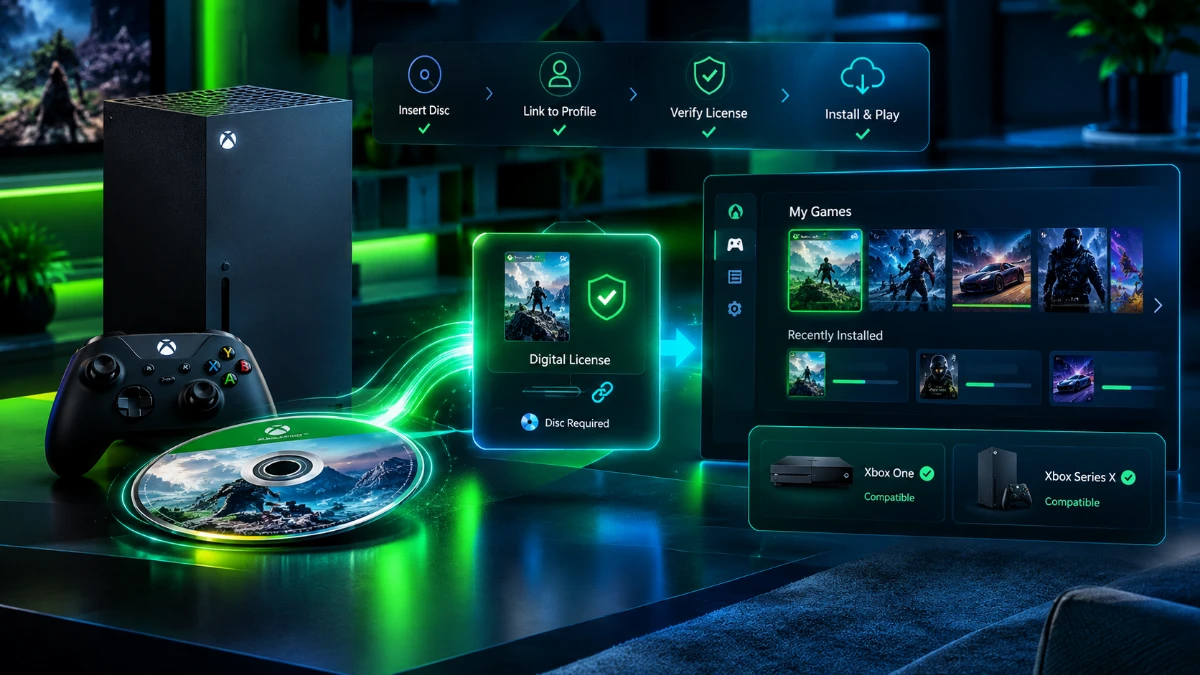
Xbox Disc to Digital lets players convert eligible Xbox One and Xbox Series X physical discs into profile-linked digital licenses, allowing games to launch without the disc inserted. Most discs qualify, but not all, and eligibility can change. Players must keep the qualifying disc to retain the license. The feature improves convenience but is not a preservation solution, and important details about verification, revocation, and coverage remain unclear.
Microsoft has opened its Disc to Digital feature to every Xbox player. The company announced the rollout on X on September 29, 2026. In practical terms, the feature turns eligible physical discs into digital licenses tied to an Xbox profile. Afterward, players can launch those games without inserting the disc.
Coverage is broad but not complete. Most Xbox Series X and Xbox One discs qualify. However, Microsoft does not promise that every title will work, and it says eligibility can change over time.
This launch follows a staged test. Xbox began experimenting with the feature in early July 2026. Then, in late August, it released the feature to Xbox Insiders. Now the general player base can use it.
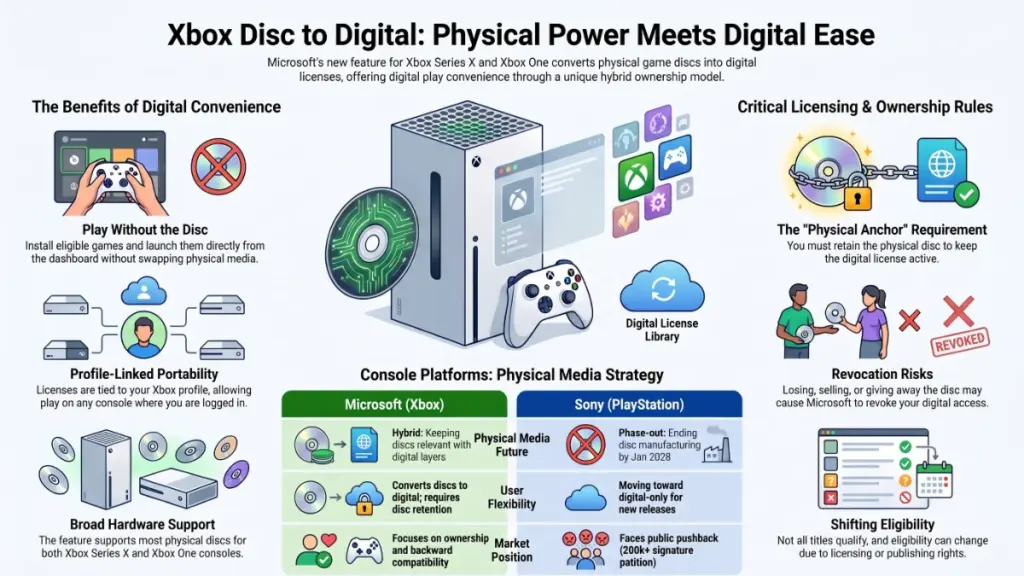
For anyone with a large disc collection, the impact is immediate. Eligible games install and play on any Xbox console where the owner is logged in. As a result, players no longer need to swap discs or hunt for a specific case.
One condition sets this feature apart from a standard digital purchase, though. Players must keep access to the qualifying disc to retain the license. If a player loses, sells, or gives away the disc, Microsoft may limit or revoke the license. In other words, the disc remains the anchor for the digital copy.
The report also stresses what the feature is not. Tom’s Hardware describes it as a quality-of-life tool. It does not function as a game preservation program.
Timing adds context. Sony has announced that it will stop manufacturing physical media for new releases by January 2028. Microsoft, meanwhile, keeps discs relevant while adding digital convenience on top.
This article explains how the feature works, who benefits, and where the limits sit. It also compares Microsoft’s approach with Sony’s direction. Finally, it flags every question the source leaves unanswered.
Strategic Context & Why It Matters
Who benefits
Three groups gain the most from this rollout.
Players with large physical libraries. Before this feature, each game required a disc in the drive. Now an eligible disc works as a one-time key to a digital license. After that, the player installs the game and plays without the disc inserted.
Households with shared consoles. Families often scatter discs across several rooms. A license linked to a profile reduces the hassle of finding the right case. Furthermore, any console where the player logs in can use the license.
Players who value ownership. Some gamers prefer discs to online licenses because a disc feels tangible. Disc to Digital lets them keep that physical anchor. At the same time, they gain digital convenience without paying again.
One forum commenter on the Tom’s Hardware story captured the ownership sentiment. According to the commenter, the disc requirement is how licensing should have worked all along. Of course, that is one reader’s opinion rather than a Microsoft position. Even so, it shows how some players view the trade-off.
Which workflows change
The feature changes several everyday habits.
First, installation changes. A covered game no longer needs the disc in the tray to launch. Instead, the license lives with the profile.
Second, library management changes. Disc games can appear alongside digital purchases, so players get one place to browse and launch.
Third, the decision to sell used games gets harder. Selling a disc that holds a Disc to Digital license may limit or revoke the license. Consequently, anyone who sells discs to fund new purchases must weigh that loss.
Fourth, the resale market may feel pressure. If buyers value discs partly for the license they unlock, secondhand demand could shift. This is analysis, not a reported fact, because the source says nothing about resale prices.
The competitive backdrop
The feature lands during a heated debate over physical media. Sony announced that it will end disc manufacturing for new releases by January 2028. Critics responded sharply. Within a week, a Change.org petition against the plan passed 200,000 signatures. Despite that, Sony has doubled down and says it will move forward cautiously.
Microsoft’s approach contrasts with Sony’s. According to the report, Xbox is choosing a hybrid path. Players keep their physical games, and they also gain a digital copy in their library without a second purchase.
The report adds a piece of history. A couple of years ago, former Xbox CEO Phil Spencer said the company would not abandon physical media, despite Game Pass’s success. Spencer has since retired. Still, the report treats Disc to Digital as evidence that Xbox is keeping that promise.
Deep-Dive Technical Specifications
The source describes the feature at a functional level. It does not publish a technical architecture. Therefore, this section sticks to what the report states, and it separates reasonable inference from confirmed fact.
What the report confirms
Supported hardware. The feature works on Xbox Series X and Xbox One consoles. The announcement says “most” physical discs qualify. Unfortunately, the report does not list excluded titles.
License type. Players secure a digital license tied to the physical media. Microsoft associates that license with the player’s Xbox profile.
Play behavior. Once licensed, a game plays without the disc in the console. Players can install and play the title on any Xbox console where they are logged in.
Eligibility rules. Not every Xbox One and Xbox Series X title qualifies, according to Microsoft. Moreover, the company says eligibility may change over time.
Reasons for ineligibility. Microsoft names several factors, including technical factors, licensing, publishing rights, and manufacturing. A change in any of these areas can affect eligibility.
Retention rule. Players must keep access to the qualifying disc. If they lose, sell, or give away the title, the license may be limited or revoked.
Rollout timeline. Experiments began in early July 2026, and Insiders received the feature in late August. Finally, the September 29 announcement opened it to everyone.
What the report does not confirm
Several technical details remain unpublished in the source.
For example, the report does not explain how the console verifies disc ownership. It also leaves open whether players must insert the disc once during activation. How often the system rechecks the disc is unclear as well. Likewise, the report does not describe how Microsoft detects a sold or traded disc.
Coverage numbers are missing too. The report gives no count or percentage of qualifying titles. In addition, it does not say whether older titles are supported or whether regional differences apply.
Why the missing details matter
These gaps affect real decisions. A player who wants to sell a disc needs to know how revocation works. Similarly, a collector needs to know whether licenses persist if a disc becomes damaged. Meanwhile, a family with multiple profiles needs to know whether sharing rules apply.
Until Microsoft publishes documentation, readers should treat any claim about these mechanics as unverified. The announcement on X links to Microsoft’s official page. That page is the best place to check current terms.
A note on scope
A typical technical blueprint covers context windows and model parameters. Those terms do not apply to a licensing feature. Instead, the relevant specifications are eligibility rules, supported consoles, license binding, and revocation conditions. This section covers each one above.
Performance, Benchmarks & Evidence
No benchmarks exist
No benchmark data accompanies this feature. The source contains no performance tests, install-speed measurements, or comparative scores. Presenting such numbers would mean inventing them.
That absence is a finding in itself. Disc to Digital is a licensing program, not a performance upgrade. Players should therefore not expect faster load times or better graphics. The feature changes how the console verifies ownership, but it does not change how the game runs.
The evidence that does exist
The report offers four categories of evidence.
1. Staged rollout as a maturity signal. Microsoft moved from experiments in July to Insiders in August to all players in late September. This progression suggests the company tested the system before opening it widely. Keep in mind, however, that this is an inference, since the report does not describe test results.
2. Official confirmation. Xbox announced the rollout on its own X account. According to the post, all players can enjoy the benefits with most Xbox Series X and Xbox One discs. This statement comes directly from the platform holder.
3. Stated limitations. Microsoft openly lists the conditions that can restrict eligibility. Companies that disclose limits up front usually reduce the risk of customer disputes. Again, that point is analysis rather than a reported claim.
4. Reader reaction. At the time of the report, the story had drawn one comment. That sample is far too small to measure public sentiment. Although the comment favored the disc-retention rule, one voice proves nothing.
Comparative metrics
The report supplies a few figures about Sony’s side of the debate.
- Sony plans to stop manufacturing physical media for new releases by January 2028.
- A Change.org petition against the plan passed 200,000 signatures within a week.
- Despite the pushback, Sony confirmed it will continue and act cautiously.
These numbers describe public resistance to Sony’s plan. They do not measure Disc to Digital’s success. In fact, no adoption data exists yet. Microsoft has not said how many players have used the feature or how many titles it has licensed.
How to evaluate the feature yourself
Players can run a simple test on their own libraries. First, check which discs the feature accepts. Next, note any titles that fail. Then confirm that each license appears in your library after activation. Finally, review Microsoft’s terms before you sell or trade any disc.
Anyone building a purchasing strategy should wait for more data. Early adoption numbers and user reports will reveal edge cases. Those cases will matter most to heavy collectors.
Pricing, Licensing & Availability
Pricing
The source report does not mention a fee for Disc to Digital. It describes the feature as available to players and frames it as a licensing program for owned discs. No price appears anywhere in the text.
Even so, readers should not assume the feature is free in every case. Microsoft’s official page holds the current terms, and the announcement links to it.
Licensing terms
The licensing rules carry the real cost. In this case, players pay with flexibility rather than money.
The license depends on the disc. Microsoft ties the digital license to the physical media. Players must therefore keep access to that disc.
Revocation risk is explicit. Selling, losing, or giving away the title may limit or revoke the license. As a result, anyone who trades in discs must treat each trade as a potential loss of the digital copy.
Eligibility can change. Technical, licensing, publishing, and manufacturing factors may alter which titles qualify, says Microsoft. A game that qualifies today might not qualify later. Unfortunately, the report does not say whether Microsoft would revoke licenses already granted in such cases.
Profile-bound access. The license attaches to the player’s Xbox profile. Consequently, it works on any Xbox console where the player logs in.
Availability
Consoles. Xbox Series X and Xbox One players can use the feature.
Players. Microsoft opened the rollout to all players, not only Insiders.
Games. Most, but not all, Xbox Series X and Xbox One physical discs qualify.
Regions. The report describes no regional restrictions. Still, players outside the United States should check local terms.
API or open-weight access. These categories do not apply here. Disc to Digital is a consumer licensing program, not a developer platform or a model release.
Context: broader Xbox costs
Related headlines on the same site point to wider cost pressure. One reports that Microsoft raised European Xbox prices by up to £200, citing component shortages. That story concerns console hardware, not Disc to Digital. Nevertheless, rising hardware prices make software conveniences more valuable to players who already own discs.
⚡ Limited Time Free Access
Unleash Your Digital Empire: Get 4 Premium Gifts in 1 Pack!
Grab this exclusive, high-value digital asset package tailored for creators, marketers, and builders. Enter your best email to claim instant access.
What’s Inside Your Ultimate All-In-One Package:
01. 50 AI Digital Product Ideas: A curated list of profitable, AI-driven digital product ideas engineered for fast execution and high margins.
02. Digital Sales Mastery: The strategic architecture behind high-converting sales funnels, persuasive copywriting, and online revenue growth.
03. Mastering Email List: Advanced frameworks for building an engaged audience, maximizing open rates, and generating automated income.
04. THE ULTIMATE FACELESS PLAYBOOK: Complete blueprint to building a powerful, monetizable brand on social media without showing your face.
Included Bonus:
[BONUS] Premium Canva Marketing Vault: High-converting templates to scale your organic traffic.
💥 $197 VALUE — FREE FOR READERS
Industry Implications & Competitive Analysis
Microsoft versus Sony
The two platform holders now point in opposite directions.
Sony says it will end physical manufacturing for new releases by January 2028. Public backlash followed, including a petition with more than 200,000 signatures. Even so, the company has not reversed course.
Microsoft, in contrast, keeps physical media alive and adds a digital layer. Players keep the disc and gain a license. This approach tries to satisfy two camps at once: collectors and convenience seekers.
Strategic readings of the move
Analysts can read Microsoft’s decision in several ways. Because the source report endorses none of them, treat these as interpretations.
Brand positioning. Microsoft can present Xbox as the platform that respects ownership. Sony’s disc phase-out gives Xbox an easy contrast.
Library lock-in. A digital library that includes old discs deepens ties to the Xbox ecosystem. Consequently, players with many licensed titles may think twice before switching platforms.
Reduced friction. Disc swapping annoys many players. Removing it improves the day-to-day experience at little visible cost.
Retail relationships. Physical retailers still depend on disc sales, so keeping discs relevant protects those partners. A related headline says GameStop’s CEO called Sony’s decision “totally irrelevant.” That headline concerns Sony, however, not Xbox.
Related Xbox developments
Other headlines on the same site add context. One says Microsoft wants its next-generation Xbox, called Helix, to play every Xbox game ever made. It also reports that Microsoft urges publishers to opt in. Separately, another headline describes Xbox backward compatibility arriving on PC. Together, these stories suggest a broader strategy around library continuity.
The same site also covers a 16-hour Xbox outage. One headline says the outage stopped even physical games from working. Microsoft, on the other hand, says physical discs should not have stopped working. The Disc to Digital report does not connect these stories. Still, they raise a fair question about how much a disc-based game depends on online verification. Readers should watch for Microsoft’s answer.
Effects on publishers
Publishers hold the key to eligibility. The report lists licensing and publishing rights among the factors that determine which titles qualify. In effect, publishers influence how much of the catalog benefits.
Several concerns could shape their positions. Some may worry about used-game sales, while others may want to protect digital storefront revenue. Alternatively, publishers might welcome a feature that keeps players engaged with older titles. Regardless, the report states no publisher’s position.
Effects on players who prefer digital
Players who buy only digital games see no change. The feature targets disc owners. Nevertheless, a stronger physical ecosystem might keep game prices and retail options competitive. That claim is speculative.
Effects on game preservation
The report states plainly that Disc to Digital is not a preservation strategy. After all, a license that depends on a disc and can be revoked does not guarantee long-term access. Preservation advocates will likely keep pushing for stronger measures. In short, the feature helps convenience rather than archival goals.
Limitations, Caveats & Skepticism
Confirmed limits
Partial coverage. Microsoft says only most discs qualify, so some owners will find their games excluded.
Shifting eligibility. Eligibility may change, according to the company. For that reason, players cannot treat a qualifying title as permanently covered.
Disc dependency. Continued access to the disc is a requirement. Losing or selling it can limit or revoke the license.
Not for preservation. Tom’s Hardware describes the feature as a quality-of-life tool only.
Unverified questions
Several important questions lack answers in the source.
- How does the console confirm that a player still holds the disc?
- Does the system need periodic disc checks?
- What happens if a disc scratches or breaks?
- How does revocation work in practice?
- Do family sharing rules apply?
- How many titles qualify?
- Does the feature differ by region?
- What happens to licenses if a publisher withdraws rights?
Until Microsoft answers these, players should avoid assumptions. Each gap represents a possible surprise.
Production risks
Heavy collectors face the biggest exposure. For instance, a player who digitizes hundreds of discs and then sells half of them may lose access to those games. Keeping a careful record of which titles carry licenses is therefore wise.
Account dependence adds another risk. Digital licenses tie to a profile, so account problems could affect access. Unfortunately, the report does not discuss account recovery.
The outage question
The related reports about the 16-hour Xbox outage deserve attention. One headline says physical games stopped working. Microsoft maintains that discs should not have been affected. Because the reports do not explain the discrepancy, this article does not resolve it either. Players who value offline reliability should watch for clarification. After all, a feature that adds a license check may add another point of failure.
A fair reading
Disc to Digital offers real convenience. At the same time, it restricts the freedom that physical ownership usually provides. Players cannot sell a game and keep its digital twin. Some will accept that trade-off, whereas others will find it frustrating.
Skeptics should keep two facts in mind. First, Microsoft discloses the limits openly. Second, the details that matter most to heavy users remain unpublished. Judge the feature after reading the official terms, not only the announcement.
Future Outlook & Conclusion
What to watch next
- Eligibility lists: A clear public catalog of qualifying titles would settle many questions.
- Policy clarifications: Detailed documentation on revocation, disc verification, and offline behavior would help heavy users most.
- Adoption data: Statistics on players and titles would show whether the feature gains traction.
- Sony’s response: Public pressure may or may not change the January 2028 plan, and Sony might offer its own digital-license bridge.
- Helix and backward compatibility: Microsoft wants its next-generation Xbox to play every Xbox game ever made, so observers should track how Disc to Digital fits that plan.
- Outage follow-up: An official explanation tying physical-game behavior to online services would clear up the current confusion.
Conclusion
Xbox Disc to Digital gives players a practical way to modernize a disc library. It removes disc swapping, adds profile-based access, and keeps physical media relevant. On the other hand, it imposes a firm rule: keep the disc, or risk losing the license.
This feature is not a preservation tool, and it does not promise permanent access. Eligibility can change, and Microsoft reserves that right.
For players with large collections, the feature is worth exploring. Start with the games you play most. Then check eligibility, confirm the license appears, and read the terms before selling anything. Players who care about preservation or resale freedom, however, will weigh the limits more heavily than the convenience.
Microsoft has chosen a hybrid path while its main rival moves toward a disc-free future. The coming months will show whether players reward that choice. Ultimately, clear documentation and reliable performance will decide the outcome.