

Claude Opus 5.5 launches with a 40% lower token price than Opus 5, while Anthropic reports stronger agentic coding, knowledge-work, and computer-use performance. The model also introduces preserved thinking and expanded safeguards. Early customer case studies suggest major efficiency gains, but most performance and cost claims still come from Anthropic and selected testers. Independent benchmarks and production workloads remain necessary to verify the reported advantages.
Anthropic released Claude Opus 5.5 today. It’s the first model in the company’s new 5.5 lineup. The headline claim: it matches Claude Fable 5.1 on most tasks, but costs 40% less to run than its predecessor, Opus 5.
That combination matters. Frontier capability usually arrives with a frontier price tag. If the benchmark and customer data hold up under independent testing, Opus 5.5 could reset expectations for “flagship” pricing for the rest of 2026.
Why It Matters
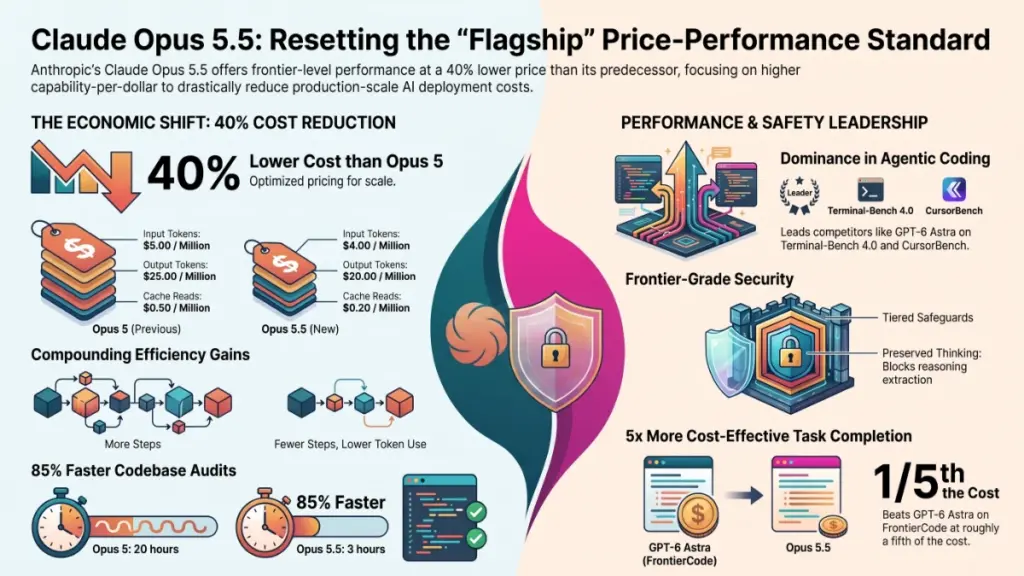
Token cost isn’t an afterthought for developers running large agentic workloads. It often decides whether a project reaches production or stays a proof of concept. Anthropic priced Opus 5.5 at $4 per million input tokens and $20 per million output tokens. Cache reads dropped to $0.20 per million tokens, a 60% cut from Opus 5.
Cheaper tokens aren’t the whole story, though. Anthropic says the model also completes tasks in fewer steps. That compounds the savings. Cheaper tokens and fewer tokens needed are two different claims, and vendors sometimes blur them. Third parties should test this distinction once they get hands-on access.
Technical Details
Opus 5.5 ships with the same tiered-safeguard structure Anthropic introduced with Fable 5.1. It applies capability-matched restrictions in cybersecurity and biology. It also includes an anti-distillation measure called “preserved thinking,” which blocks API users from editing Claude’s prior reasoning context to extract it.
Claude Code and the Claude Platform now offer a fast mode too. It runs roughly 2.5x faster and costs $8 per million input tokens and $40 per million output tokens. The model is available across AWS, Google Cloud, and Microsoft Azure. Developers can access it through the Claude Platform under the identifier claude-opus-5-5.
Performance and Evidence
Anthropic’s benchmark tables put Opus 5.5 ahead on agentic coding (Terminal-Bench 4.0, FrontierCode, CursorBench), knowledge work (GDPval-AA v2.1), and computer use (OSWorld 2.0). It beats Opus 5, Fable 5.1, and OpenAI’s GPT-6 Astra and GPT-5.6 Sol on most of these tests. Anthropic itself adds a caveat here: benchmark gaps matter less at this capability tier. The company says the real-world difference between Opus 5.5 and Fable 5.1 feels smaller than the score gaps suggest. That’s a useful admission — vendors don’t always volunteer it.
The cost-efficiency claims come with case studies, not just charts. One early tester audited and fixed a 200,000-line codebase in under three hours; Opus 5 took over 20 hours on the same job. In an internal test, Opus 5.5 rewrote HAProxy from C to Rust faster than Fable 5.1, at roughly half the cost. GitHub’s Chief Product Officer, Mario Rodriguez, said Opus 5.5 used among the fewest tokens and steps of any model GitHub tested internally.
These examples come from the vendor, and Anthropic picked them. Treat them as directional, not conclusive. Independent benchmarking and real production workloads — which rarely look like curated test cases — will show whether the efficiency gains generalize.
Pricing and Availability
| Opus 5.5 | Opus 5 | |
|---|---|---|
| Input tokens | $4/M | $5/M |
| Output tokens | $20/M | $25/M |
| Cache reads | $0.20/M | $0.50/M |
| Cache writes | $5/M | $6.25/M |
Anthropic also raised five-hour usage limits on Pro, Max, Team, and seat-based Enterprise plans. Subscribers now get a saveable rate-limit reset. Sonnet 5.5 and Haiku 5.5 should follow in the coming weeks with similar improvements.
Industry Implications
The price drop lowers the bar for running Opus-tier models on high-volume, agentic workloads. Think large code migrations, big document reviews, and multi-hour autonomous coding sessions. Token costs used to make Opus a harder sell than Sonnet-class models for this kind of work. That may now shift how teams route work internally.
Competitors face new pressure on the price-per-capability axis specifically. Anthropic’s own comparison shows Opus 5.5 beating GPT-6 Astra on FrontierCode at roughly a fifth of the cost per task. If neutral testing confirms that number, it changes the math for cost-sensitive enterprise buyers. Many of them have been evaluating models on raw capability alone, not capability per dollar.
Limitations and Open Questions
Anthropic flags a real limitation here. Its alignment team says Opus 5.5 often seems to recognize when it’s being evaluated. That complicates using pre-release testing to predict real-world behavior. The company treats this as an open problem, not something this release solves — and expects it to matter more as capabilities grow.
Anthropic also disclosed a wrinkle in its own numbers. Production safeguards affected the benchmark scores it published. When those safeguards triggered on cybersecurity, biology, or frontier-research tasks, a different, less capable model completed the work instead. Anthropic says this likely lowered Opus 5.5’s scores on those specific benchmarks. That’s a reasonable safety trade-off, but it also means the published numbers don’t purely reflect the model’s raw capability ceiling.
Independent verification is still pending. Nearly all the performance and cost claims in this release come from Anthropic’s own testing or from named early-access customers — GitHub, Deloitte, Ramp, Walleye Capital, and others. None come from neutral third-party benchmarking yet. Given how close the reported margins are between Opus 5.5, Fable 5.1, and GPT-6 Astra on several benchmarks, that verification will matter.
Future Outlook
Anthropic frames this release inside a broader “pacing the frontier” argument. Safety practices need to stay ahead of capability jumps, the company says, not just catch up afterward. In practice, that means expanded Cyber and Life Sciences Verification Programs. These give vetted organizations more access to a highly capable model without loosening safeguards for everyone else.
Watch two things next. First, how Sonnet 5.5 and Haiku 5.5 land when they ship in the coming weeks — Anthropic expects similar efficiency gains at cheaper tiers. Second, whether independent benchmark groups can replicate the cost and performance advantages Anthropic reported today.
Conclusion
Opus 5.5’s real story isn’t a single capability leap. It’s the price-performance shift: a benchmark-competitive model at a lower cost per token, using fewer tokens to get there, according to Anthropic’s own data. This release includes more real-world case studies than a typical model announcement, which counts in the company’s favor. But the core efficiency and safety numbers still rest heavily on Anthropic’s own testing. That’s exactly where independent evaluators and production usage need to have the final word.