


Disclosure: This article may contain affiliate links. If you buy through one of them, I may earn a commission at no extra cost to you. However, that doesn’t change my assessment, and I’ve listed the weaknesses alongside the strengths.
One to Ten by OneDigitalNetwork is a six-module email list-building course priced at $9. It covers funnel setup, lead magnets, email engagement, traffic generation, and subscriber retention. Beginners may appreciate its structured approach and two bonuses, but lesson depth, refund terms, and support remain unverified. It’s a budget-friendly option for new list builders, provided they understand that results aren’t guaranteed.
Most email lists don’t fail loudly. Instead, they just go quiet. Open rates drift down, replies dry up, and the person who built the list starts wondering whether email still works at all.
That’s the problem One to Ten says it was built to address. Specifically, it’s a six-module email list-building course from OneDigitalNetwork, sold at a one-time price of $9 (listed against a regular price of $49.95), with two small bonuses attached.
I spent time going through the official sales page, the module descriptions and the bonus listings to work out what this product actually covers, who it fits, and where the gaps are. Because a $9 price makes it an easy impulse buy, it deserves a careful look before you click.
Build your email list, improve engagement, and grow your audience.
One thing up front, because it matters for trust: I’m reviewing this from the sales page and the information published about the course. Since I haven’t been given the lesson content itself, I won’t invent lesson-level observations or results. Wherever something can’t be confirmed from what’s published, I’ll say so plainly.
Quick Verdict
One to Ten is a low-cost, strategy-focused introduction to building and keeping a responsive email list. Based on what’s published, it covers the right topics in a sensible order: funnel basics, positioning, lead magnets, email content, traffic and retention.
It looks best suited to beginners and early-stage list builders who want a structured framework without spending much. However, it’s probably not the right pick if you want software walkthroughs, advanced deliverability training or guaranteed results, since the sales page says the course leans toward strategy rather than technical hand-holding and offers no income or growth guarantees.
My take: At $9, the risk is small and the topic list is solid. Still, lesson depth, format and refund terms are unknowns, because the sales page doesn’t spell any of them out.
Best for: Beginners, solo creators, affiliate marketers and small business owners starting or restarting a list.
Product Overview
| Detail | Information |
|---|---|
| Product Name | One to Ten |
| Category | Email marketing / list-building training course |
| Creator | OneDigitalNetwork (individual author not named on the page) |
| Launch Date | Not stated on the sales page |
| Price | $9 one-time payment (regular price listed as $49.95) |
| Refund Policy | Not stated on the sales page |
| Retailer | JVZoo |
| Format | Digital product with instant access after purchase |
| Website | Official One to Ten sales page (OneDigitalNetwork) |
| Best For | Beginners and small-list owners who want a clear framework |
| Rating | 7/10 (based on sales page evaluation, not lesson-level testing) |
What Is One to Ten?
One to Ten is a six-module course about building an email list that people actually read. As the name suggests, it follows the journey from your first subscribers to a larger, more engaged audience.
The sales page frames the central question well: why do some lists feel alive while others go quiet? According to the page, there’s rarely one magic trick. Instead, a healthy list depends on how your funnel, lead magnet, messaging, traffic and follow-up emails fit together.
That framing is worth noting, because a lot of cheap email courses sell a single tactic. In contrast, this course is positioned as a system.
What problem does it solve?
If you’ve ever built a landing page, collected a handful of subscribers and then watched the list stall, you’ve met the problem this course targets. Typical symptoms include:
- A lead magnet that nobody seems excited about
- Low opt-in rates on your lead page
- Emails that get ignored
- Traffic that’s inconsistent or too expensive
- Subscribers who unsubscribe before you’ve earned their trust
To address each of these, One to Ten works through them in sequence rather than treating them as separate problems.

Who is it written for?
The page doesn’t name a single audience. Even so, the content points to beginners and early-stage marketers: bloggers, affiliate marketers, coaches, course creators and small online businesses. Module 5’s focus on a first-1,000-subscribers strategy makes that fairly clear.
Main Features: The Six Modules Explained
Here’s what each module covers, according to the official description, and how I’d expect it to apply in practice.
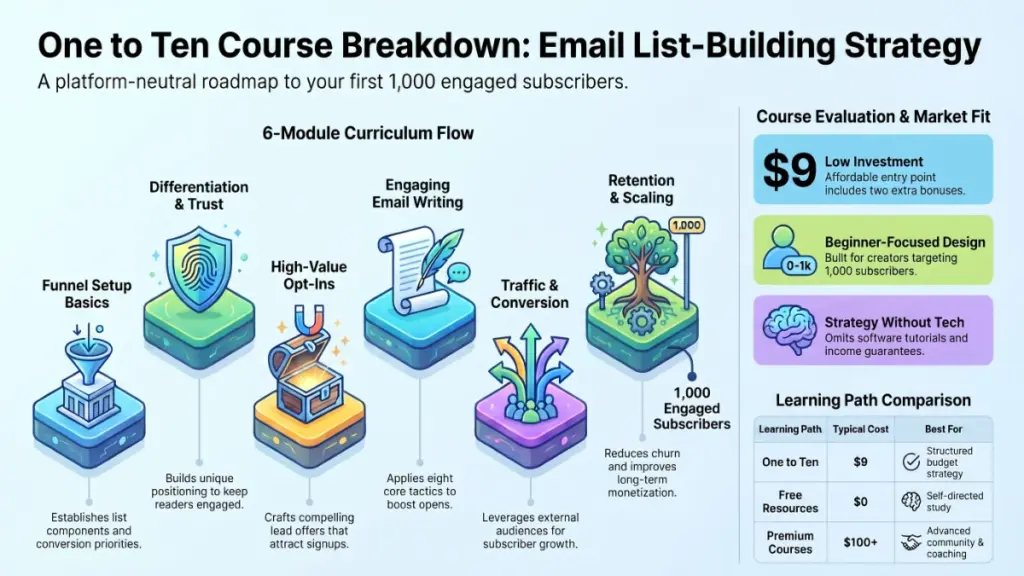
Module 1: The Science-Based Model for Building Responsive Lists
This opening module introduces four funnel components and covers lead page and list setup priorities, plus what to plan for as the list grows.
The phrase “science-based” is a marketing term, and the page doesn’t cite studies. Therefore, I’d read it as “structured and systematic” rather than “backed by research.” Still, starting with the funnel’s moving parts is the right call, because most beginners jump straight to writing emails before they’ve set up a page that converts.
Build your email list, improve engagement, and grow your audience.
Module 2: Build Subscriber Loyalty & Stand Apart
Module 2 deals with positioning and relationships. According to the description, it helps you differentiate yourself in your niche, build trust, and give people reasons to keep paying attention.
I’d be most curious about this module in practice. After all, positioning is where many email lists quietly fail. If your emails sound like everyone else’s in your niche, subscribers have no reason to open the next one.
Module 3: Create Better Lead Magnets & Lead Pages
Here you’ll find four important lead-magnet characteristics, plus guidance on finding out what prospects actually want and writing stronger lead-page messaging.
A lead magnet is the free resource you offer in exchange for an email address. Since getting this right is arguably the most influential piece of the whole funnel, devoting a full module to it makes sense.
Module 4: Create Emails People Want To Read
Next, the focus shifts to engagement: improving opens, reads and clicks, writing more engaging content, and using eight engagement ideas.
If the lessons deliver on the title, this is the module that helps with the “quiet list” problem. Besides, good email content is one of the few things you fully control.
Module 5: Generate Traffic & Improve Conversions
Module 5 covers conversion optimization, using other people’s audiences and resources to reach subscribers, and a strategy for the first 1,000 subscribers.
Traffic and conversion are linked, so I like that they’re taught together. After all, sending more visitors to a weak page just wastes the traffic.
Module 6: Ramping Up Your Email Strategy
The final module looks past acquisition. It addresses reducing churn, improving monetization across lists of different sizes, and expanding traffic as your system improves.
Retention and monetization are usually the last things beginners think about. For that reason, it’s encouraging to see them included rather than ignored.
The Two Bonuses
One-to-Ten Checklist: A condensed action list that pulls the core process into one reference page. For people who learn better by doing than by watching, this kind of checklist can become the most-used part of a course.
101 Ways To Grow Your List Without Ads: A collection of traffic ideas that don’t rely on paid advertising. Its usefulness depends on how detailed each idea is. For instance, a one-line idea list works as a brainstorming aid, while a set of explained tactics is a genuine resource. Unfortunately, the sales page doesn’t say which this is.
Benefits: What You Could Realistically Get Out of It
Features only matter if they change what you do. With that in mind, here’s how I’d map the modules to outcomes.
- A clearer funnel structure. Instead of guessing which piece is broken, you’d have a framework to diagnose it.
- A stronger opt-in offer. Because Module 3 targets lead magnets, it should help you build one people actually want, which can improve sign-up rates.
- Better email habits. Module 4’s engagement ideas can help you write messages that earn opens and replies.
- More options for free traffic. When you don’t have an ad budget, Module 5 and the 101-ideas bonus give you places to look.
- A plan beyond the first sign-ups. Finally, Module 6 helps you think about keeping subscribers, not only collecting them.
- Confidence on a tight budget. At $9, you get a framework without a big financial commitment.
To be clear, these are the outcomes the course is designed to support. In fact, the sales page itself states that results vary and that there’s no guarantee of subscriber growth, conversion rates or revenue. So I’d treat any course as a set of ideas that you still have to implement.
My Hands-On Assessment: What I Could and Couldn’t Verify
I want to be straightforward here, because this section is where many reviews quietly invent things.
What I reviewed: the complete sales page, all six module descriptions, both bonus descriptions, the pricing, and the disclaimers.
What I did not have access to: the actual lesson videos, text or slides. As a result, I can’t tell you how long the lessons run, how polished the production is, or whether the examples are strong.
What stood out from the sales page
- The structure is logical. The progression runs from funnel setup to positioning, lead magnets, email content, traffic and finally retention, which is the order I’d teach it in.
- Expectations are honest. Because the page says the course leans toward strategy over technical hand-holding, you know it isn’t a tutorial for a specific email platform.
- The disclaimers are clear. Notably, the page states there’s no income guarantee and that individual results vary, which is more restrained than many offers in this price range.
- The price is low enough to test. Nine dollars is closer to a coffee-and-snack order than a business investment.
What I’d want to know before buying
- How the lessons are delivered (video, audio, PDF or a mix)
- Total length and depth of each module
- Whether the “four funnel components” and “eight engagement ideas” come with examples and templates
- What the refund policy is, if any
- Who the author is and what their own list-building background looks like
Once you’ve gone through the lessons yourself, ask one question instead of judging by production polish: did you take a concrete action after each module? That’s a better test than how impressive the videos feel.
Ease of Use
Since it’s a course rather than software, “ease of use” mostly comes down to how digestible it is.
Learning curve
The six-module layout and the plain-language descriptions suggest a gentle learning curve. Nothing in the module list requires technical skills like coding, API work or deliverability configuration. However, you’d need a basic understanding of what an email list and an autoresponder are.
Interface and delivery
Access is instant after purchase, according to the page. On the other hand, it doesn’t describe the member area or the player, so I can’t comment on navigation, mobile access or download options.
Documentation and support
No support channel, community or Q&A access is mentioned. Therefore, treat this as a self-study product.
Beginner friendliness
This is where the course looks strongest on paper. Because the topics start from fundamentals, and the first-1,000-subscribers angle speaks directly to people who are starting out, newcomers should feel at home. Advanced marketers, however, will likely find much of it familiar.
Performance
For a course, performance means one thing: does it help you get results?
I can’t measure that from the sales page, and nobody honestly can until they’ve applied the lessons to their own list. Still, I can say how the content is built to support results:
- Coverage: The six modules cover the full cycle, from acquisition to retention.
- Actionability: Since the course includes a checklist bonus, the author seems to expect readers to implement, not just read.
- Scope limits: Because it skips platform-specific instructions, you’ll need to translate the ideas into whichever email tool you use.
- Reliability of claims: The page makes no inflated promises, which is a point in its favor.
Results will depend heavily on your niche, your consistency and the quality of your offer. A course can speed up the learning, but it can’t do the publishing for you.
Pricing
Current price
One to Ten is listed at $9 as a one-time payment, against a regular price of $49.95. In addition, no subscription is mentioned.
A note on “regular price” claims
Discount comparisons like this are common on digital product pages, but a “regular price” isn’t always one that buyers have actually paid. For that reason, I wouldn’t use the $49.95 figure to judge value. Instead, judge the $9 on what you get.
Upsells and upgrades
The sales page doesn’t list any upsells. However, products sold through JVZoo often include one or more offers after checkout, and I can’t confirm whether this one does. If you see extra offers, decide on them separately from the $9 course.
Build your email list, improve engagement, and grow your audience.
Refund policy
The sales page I reviewed doesn’t state a refund policy. So check the checkout page or the retailer’s terms before paying, since that’s the one piece of risk protection worth confirming.
Is it good value?
For nine dollars, yes, if the lessons contain concrete, usable guidance. Even a single improvement to your lead page or welcome email could justify the cost. On the other hand, if the content turns out to be thin, you’ve lost very little, but I’d still want the refund terms in writing.
Pros
- Very low price. The $9 entry point makes it easy to try without second-guessing the purchase.
- A full-cycle framework. It covers funnel setup, positioning, lead magnets, email writing, traffic and retention, not just one slice.
- Beginner-friendly topics. Since the course aims at the first 1,000 subscribers, it suits people starting out.
- Practical bonuses. Besides the checklist, the 101 traffic ideas give you places to start without a paid ad budget.
- Honest disclaimers. Unlike many offers in this niche, the page doesn’t promise income.
- Platform-neutral. Because it focuses on strategy, it should apply to whichever email service you already use.
- Retention is included. Many entry-level courses stop at “get subscribers,” but this one also addresses churn and monetization.
Cons
- Little detail about the lessons. I couldn’t confirm format, length, examples or templates from the sales page.
- No refund policy stated. This is a real gap, even at a low price.
- Author background not shown. OneDigitalNetwork is credited, but no named expert or track record appears on the page.
- Light on technical help. Because the course favors strategy, complete beginners may still need separate tutorials for their email platform.
- “Science-based” isn’t backed up. In fact, the label appears without cited research.
- No support or community mentioned. After purchase, you’re on your own.
- The 101 ideas may be shallow. After all, a list of ideas is only as useful as the explanation behind each one.
- Possible upsells. I can’t rule them out for a JVZoo-sold product.
Comparison With Competitors
I can’t compare lesson content head to head, since I haven’t gone through the course. However, I can compare One to Ten against the main alternatives a buyer would realistically consider.
| Option | Typical Cost | Depth | Best For |
|---|---|---|---|
| One to Ten | $9 | Strategy overview across six modules | Beginners wanting a framework on a budget |
| Free blogs, YouTube and newsletters | Free | Varies widely, often scattered | Self-directed learners with time to sort through content |
| Email platform academies and help centers | Usually free | Strong on the tool, lighter on strategy | People who want to learn a specific platform |
| Mid-priced and premium list-building courses | Usually higher, from around the low hundreds and up | Often more depth, community and coaching | Serious marketers who want guidance and support |
| Books on email marketing | Low to moderate | Deep on theory, slower to apply | Readers who prefer long-form learning |
How I’d think about it
- Versus free content: Free material is abundant, but it’s scattered. A course like this offers one ordered path. If you’re disciplined, you might assemble something similar yourself, although it takes time.
- Versus higher-priced courses: Premium programs usually offer more: community, feedback, advanced tactics. One to Ten doesn’t claim to compete at that level, so at $9 it shouldn’t be expected to.
- Versus platform tutorials: These teach you where to click, while One to Ten, by its own description, teaches what to do strategically. In short, the two complement each other.
If you want a quick structured primer, One to Ten is a reasonable pick. On the other hand, if you want mentoring, accountability or advanced tactics, look higher up the price ladder.
Who Should Buy It?
One to Ten looks like a good fit if you are:
- Starting with a blank list or only a few subscribers
- An affiliate marketer or blogger who knows email matters but hasn’t built a system yet
- Running a small business and wanting a plain-language roadmap
- Watching your list go quiet and trying to diagnose why
- Working with a tight budget but still wanting structure
- Someone who learns well from checklists and likes a quick-reference tool nearby
Who Should Skip It?
You may want to pass if you are:
- An experienced email marketer who already runs segmented, automated funnels, since much of this will likely feel familiar
- Looking for platform tutorials, such as step-by-step setup for a particular email service
- Expecting guaranteed growth or income, because the page explicitly says it doesn’t promise either
- After community support or coaching, which isn’t mentioned
- Wanting advanced deliverability, compliance or technical training
Frequently Asked Questions
What is One to Ten?
One to Ten is a six-module digital course about building and maintaining a responsive email list. It covers funnel setup, positioning, lead magnets, email content, traffic, conversion and retention. In addition, it includes a checklist and a list of 101 ways to grow a list without ads.
How much does One to Ten cost?
The sales page lists a one-time price of $9, with a regular price of $49.95. However, pricing can change, so check the official page before buying.
Is One to Ten good for beginners?
Based on the module topics, yes. Because it starts with fundamentals and focuses on reaching your first 1,000 subscribers, it suits newcomers. Still, total beginners may need separate tutorials for the technical side of their email platform.
Does One to Ten guarantee results?
No. Instead, the sales page states that individual results vary and that the training doesn’t guarantee subscriber growth, conversion rates, revenue or other business results.
Is there a refund policy?
The sales page I reviewed doesn’t mention one. Therefore, look at the checkout page or the retailer’s terms before you pay.
What bonuses are included?
Two bonuses come with the course. First, the One-to-Ten Checklist, a condensed action list. Second, 101 Ways To Grow Your List Without Ads, a collection of traffic ideas that don’t rely on paid advertising.
Do I need an email marketing tool to use it?
Yes, you’ll need one to put the ideas into practice. However, the course appears to be platform-neutral, since it focuses on strategy rather than the controls of a specific service.
Is One to Ten worth it for $9?
If the lessons contain actionable guidance, the price is low enough that one useful improvement could cover it. Still, lesson depth and the refund terms are unknown, so I’d confirm both before buying.
Who created One to Ten?
The page credits OneDigitalNetwork and doesn’t name an individual author. Additionally, it notes that JVZoo acts as the retailer.
🎁 Free Gift Waiting for You!
Before you leave, there’s a free gift waiting for you.
As a thank-you for reading, you can claim my Ultimate All-In-One Digital Marketing Package completely FREE.
🎉 What’s Inside Your Ultimate All-In-One Package
01. 50 AI Digital Product Ideas
A curated collection of highly profitable AI-powered digital product ideas designed for quick implementation and strong profit potential.
02. Digital Sales Mastery
Discover the proven framework behind high-converting sales funnels, persuasive copywriting, and sustainable online revenue growth.
03. Mastering Email List
Advanced strategies for building an engaged email audience, increasing open rates, improving click-through rates, and generating automated income.
04. The Ultimate Faceless Playbook
A complete blueprint for building a profitable online brand and growing on social media without ever showing your face.
🎁 BONUS: Premium Canva Marketing Vault
A premium library of high-converting Canva templates to help you create professional marketing assets, generate more organic traffic, and boost conversions.
💥 Total Package Value: $197
✅ Yours Today: FREE
Claim your complimentary bundle and get instant access to premium resources that can help you create, market, and grow your online business more effectively.
Final Verdict
One to Ten does what a $9 course should do: it gives you a clear, ordered way to think about email list building without burying you in jargon or promising miracles.
Who benefits most: beginners, solo creators and small business owners who want a framework for building a list and keeping it engaged. In particular, the retention and monetization module is a nice touch for something at this price.
Is it worth the price? Based on the published module list and bonuses, I think it’s a reasonable low-risk purchase. However, I reviewed the sales page, not the lessons, so I can’t vouch for depth or production quality. Also, I couldn’t confirm a refund policy, so look for one at checkout.
Would I recommend it? Yes, with conditions. I’d recommend it to a beginner who wants structure and a checklist to work from. On the other hand, I wouldn’t recommend it to an experienced marketer looking for advanced tactics, or to anyone expecting guaranteed growth.
The best way to get value from any course is to pick one module, take one action and measure what changes. If One to Ten helps you do that for $9, it has earned its place.
Ready to look closer? Check the official One to Ten sales page here for the current price, the refund terms and any checkout offers before you decide.
Build your email list, improve engagement, and grow your audience.