

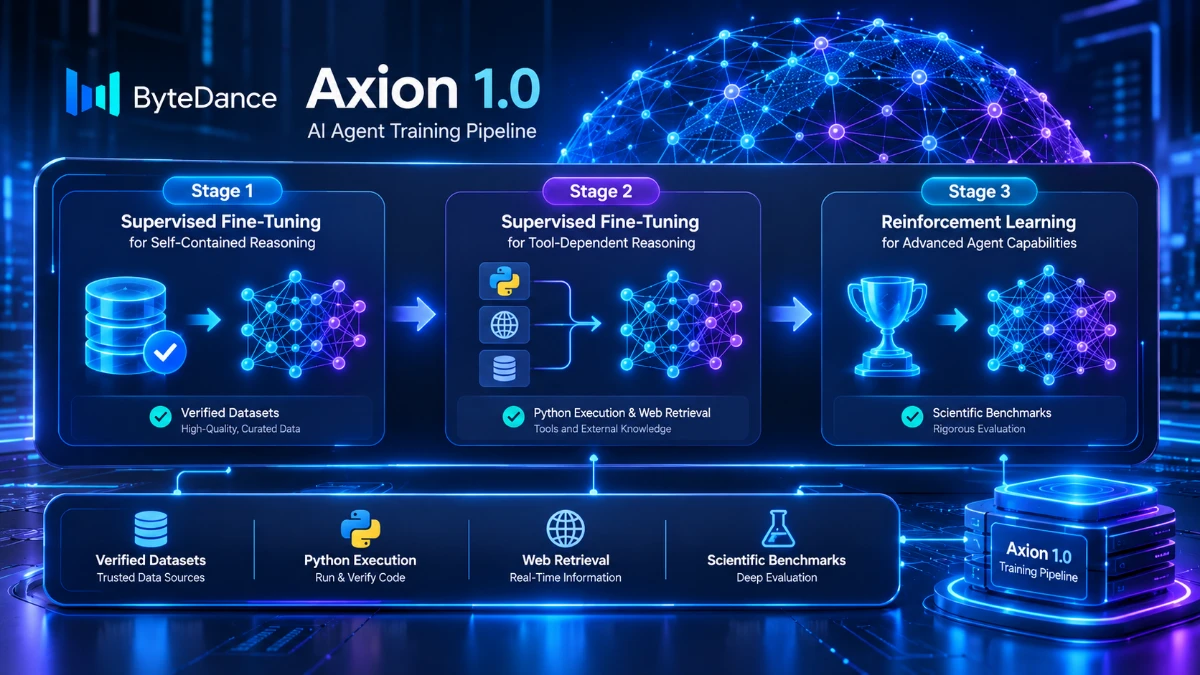
ByteDance’s Axion 1.0 is an open agent foundation model trained using two supervised fine-tuning stages followed by reinforcement learning. Its 35B and 122B variants deliver competitive results on several scientific reasoning and information-seeking benchmarks. The project releases detailed training tools and methods, helping researchers reproduce and study its approach. However, benchmark limitations, uneven performance, compute requirements, and unresolved licensing details mean independent verification remains essential.
Lead: What Axion 1.0 Is and Why It Matters
The release at a glance
A team led by ByteDance researchers has released Axion 1.0, an open agent foundation model. The paper appeared on arXiv on 3 November 2026 (arXiv:2611.03233v2). Authors from Duke University, the University of Maryland, and the University at Buffalo also contributed. Yunjie Tian leads the project.
The headline claim is simplicity. Many modern agent models rely on mid-training, several supervised stages, preference optimization, and on-policy distillation. Axion 1.0 uses none of those. Instead, it trains in three stages: two supervised fine-tuning (SFT) stages, then reinforcement learning (RL).
The team also makes a strong openness claim. Many “open” models release only weights. By contrast, Axion 1.0 releases the full recipe, including data construction, generation, filtering, verification, prompts, and training code. The code lives on GitHub under bytedance/axion1_0.
Two configurations carry the results. Axion 1.0-35B uses a mixture-of-experts design with about 3B active parameters. Meanwhile, the 122B version activates about 10B parameters per token. The team also trained 4B and 9B variants with SFT only.
The numbers behind the claim
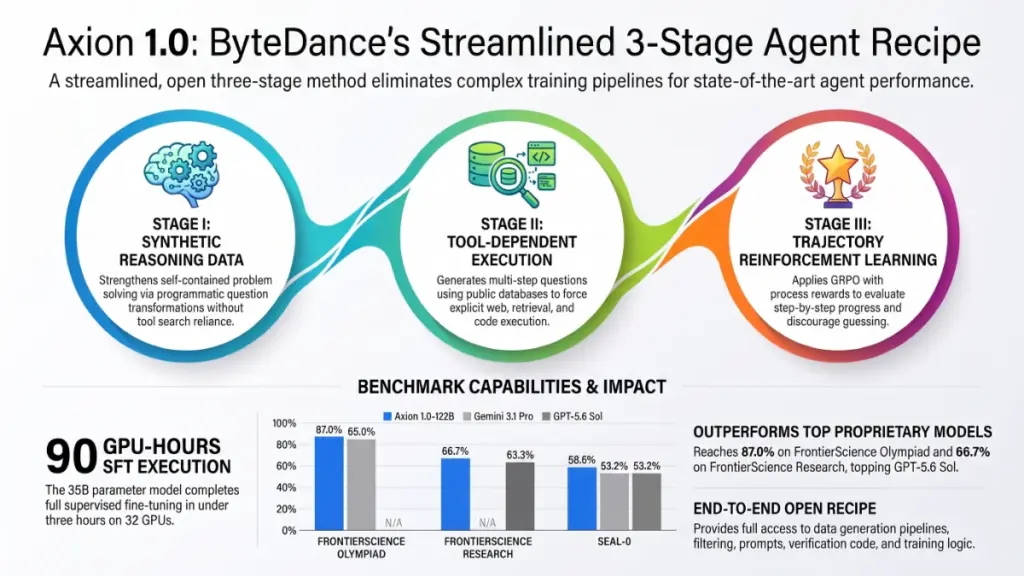
The numbers deserve a careful read. On full Humanity’s Last Exam (HLE), the 35B model scores 52.2%, and the 122B model scores 59.0%. Those runs block access to sites such as Hugging Face. Without that restriction, the scores rise to 59.1% and 64.8%.
FrontierScience Research shows the biggest edge. There, the 122B model scores 66.7%, while GPT-5.6 Sol scores 63.3% in the same table. Likewise, the 122B model reaches 87.0% on FrontierScience Olympiad.
However, the model does not win everywhere. Claude Opus 5 and Claude Fable 5 post HLE scores of 63.6% and 63.8%, above the restricted-site 59.0%. Three proprietary models also beat the 122B model on BioMysteryBench. Therefore, this article separates the strong results from the caveats.
Immediate impact
The immediate impact is practical. First, researchers can now reproduce a competitive agent pipeline end to end. Second, teams with modest GPU budgets can study which ingredients matter. According to the paper, the 35B model’s full SFT run took about 90 GPU-hours.
Strategic Context: Who Benefits and Which Workflows Change
Why the field needs a simpler recipe
The paper starts from a real industry trend. Language models now act as agents. They plan, search the web, run code, read pages, and revise their answers over long trajectories. For example, commercial systems such as ChatGPT and Claude already work this way.
Training pipelines have grown more elaborate in step. The authors list continued pre-training, multiple SFT stages, capability-specific data mixtures, preference optimization, RL, and extra post-training. Each piece may help individually. Together, however, they make it hard to tell which pieces matter.
Axion 1.0 asks a blunt question: how much of this complexity is necessary? According to the authors, the answer is less than the field assumes. In their view, careful data construction can replace extra training stages.
Who benefits
Several groups stand to benefit.
Academic labs. Universities rarely afford large multi-stage pipelines. A three-stage recipe with published data tooling therefore lowers the barrier. In fact, a lab can reproduce the 35B run on 32 GPUs in under three hours.
Open-model builders. Teams that start from open bases can adopt the data pipelines directly. Moreover, the paper shows the recipe works on two different Qwen bases. That suggests the method transfers.
Applied research teams. Scientific reasoning and information seeking sit at the center of the benchmarks. For this reason, groups building research assistants for biology, chemistry, or physics get a ready reference design.
Evaluation researchers. The released verification code lets outsiders inspect how the team checks answers. That level of transparency is rare.
Which workflows change
Several workflows change as a result. Data teams shift effort from stacking stages toward building harder, verifiable tasks. Similarly, training teams can skip DPO and distillation infrastructure. Evaluation teams, in turn, gain a template for checking intermediate reasoning steps, not just final answers.
Marketers and content teams feel the effect indirectly. Open agent models make cheaper research tooling possible. Because a competitive open model can run inside a company’s own environment, teams with data-privacy limits benefit most.
Finally, the authors make a methodological point. Simplifying the pipeline does not simplify the learning problem. Instead, they invest the saved effort in data quality. That framing shapes everything that follows.
Deep-Dive Technical Specifications
Base models and sizes
The 35B model starts from Qwen3.6-35B-A3B. In contrast, the 122B model starts from Qwen3.5-122B-A10B. Both are mixture-of-experts models. In addition, the team trains 4B and 9B variants with the two SFT stages only.
The agents run in a ReAct environment. There, they use web search, webpage visits, scholarly retrieval, and Python execution. However, benchmark-specific rules restrict some tools.
Stage I: self-contained reasoning data
The first dataset teaches the model to solve hard problems from the question alone. To build it, the team collects seed question–answer pairs from course materials, competitions, and reasoning datasets. The subjects include mathematics, physics, chemistry, biology, and computer science.
Next, a generator model turns each seed into a harder question. It finds a quantity from the seed’s solution. Then it builds a new question that needs that quantity as an intermediate result. Finally, the new question must have a checkable answer.
The base model then attempts each problem with Python but without search. If the base model fails, the problem enters the question bank. If it succeeds, however, the pipeline strengthens the problem. The pipeline applies one of four random operations:
- Composition adds a dependent reasoning step.
- Parameterization swaps a fixed value for a symbol, so the answer becomes a general expression.
- Range shift widens a parameter so shortcuts break.
- Case analysis adds conditions where the answer changes by case.
Verification is strict. First, GPT-5.5 solves each new problem three times. The team keeps the reference answer only when all three solutions agree and pass correctness checks. In addition, the pipeline re-verifies after every rewrite.
Finally, a separate model solves the questions. The team keeps only correct, complete trajectories with valid tool calls.
Stage II: tool-dependent reasoning data
The second dataset targets facts missing from the question. For this, the team assembles structured public databases. The domains include biology, chemistry, mathematics, geography, and aviation.
Deterministic programs build each question in four steps: filter, select, compute, and verbalize. First, a program filters records and picks one entity by an extreme value. Next, it computes a derived quantity. Lastly, an LLM rewrites the result as a natural question.
The paper gives an example. Filter for planets with rings, select the one with the smallest mass, and ask for its mean density. As a result, the solver must identify Uranus, find its mass and radius, and compute roughly 1.27 g/cm³.
The team enforces tool dependence in two ways. For one, it blocks direct access to the construction databases during solving. For another, it removes questions that models answer correctly without any retrieval tools.
Supervised fine-tuning settings
Both SFT stages share the same settings. The learning rate is 3×10⁻⁶ and constant. Training runs in BF16 for three epochs per stage. Moreover, the maximum sequence length is 128K tokens, and the global batch size is 8.
The loss covers assistant tokens only. That includes reasoning, tool calls, and final answers. By contrast, tool observations and user messages provide context without contributing to the loss.
Reinforcement learning settings
RL uses group-relative policy optimization (GRPO) through the verl framework. Each question gets eight rollouts at temperature 1.0. In addition, the learning rate is 2×10⁻⁶.
The reward has two parts. A correct final answer earns 1. Otherwise, the model earns partial credit of max(0, 0.3P − 0.1(1 − A)). Here P measures verified intermediate progress, and A flags whether the model submitted an answer.
Progress checks run in dependency order. Consequently, a later step earns credit only when all earlier steps pass. This design rewards real progress and discourages guessing.
Task selection also filters the pool. The team samples four trajectories per question. It keeps a question only if at least one trajectory is correct and the rewards vary.
Infrastructure
SFT integrates NVIDIA Megatron-FSDP into the ms-swift framework. It uses expert parallelism of 8 and tensor parallelism of 1. Additionally, context parallelism of 4 handles 128K-token sequences. Ring Attention covers full-attention layers, while a Ulysses-style all-to-all covers gated-delta-net layers.
Likewise, RL separates rollout, training, and service work onto different GPU pools. The 122B run uses ten rollout engines on 40 GPUs and a 16-GPU trainer. Besides, a service node hosts two Qwen3.8-27B judges and six Qwen3.5-9B helpers.
Two consistency techniques stand out. First, Token-In-Token-Out (TITO) passes token IDs directly, so re-tokenization cannot create mismatches. Second, Rollout Routing Replay (R3) records expert choices during rollout and replays them in training. R3 needs about 20 MB per sample.
Performance, Benchmarks, and Evidence
The paper evaluates six settings. They are Humanity’s Last Exam, BioMysteryBench (human-difficult subset), SEAL-0, HiPhO, FrontierScience Olympiad, and FrontierScience Research. Notably, the authors test both scientific reasoning and information seeking.
Main results
| Benchmark | Axion 1.0-35B | Axion 1.0-122B |
|---|---|---|
| HLE (restricted sites) | 52.2% | 59.0% |
| BioMysteryBench | 35.3% | 41.7% |
| SEAL-0 | 62.2% | 58.6% |
| HiPhO | 45.7% | 46.2% |
| FrontierScience Olympiad | 86.0% | 87.0% |
| FrontierScience Research | 56.7% | 66.7% |
Against similar-sized open models, the 35B model does well. It beats Agents-A1 on three benchmarks. For example, on HLE it scores 52.2% against 47.6%. Likewise, SEAL-0 shows 62.2% against 56.4%. Finally, FrontierScience Olympiad shows 86.0% against 79.0%.
However, Agents-A1 keeps one edge. Its HiPhO score of 46.4% tops both Axion models.
Against proprietary models
Axion also competes with closed systems. On SEAL-0, its 62.2% tops GPT-5.6 Sol and Gemini 3.1 Pro, which both score 53.2%. In addition, the 122B model’s 87.0% on FrontierScience Olympiad tops Gemini 3.1 Pro’s 85.0%. HiPhO tells a similar story, since both Axion models beat the proprietary entries listed.
The picture reverses on HLE and BioMysteryBench. Claude Fable 5 scores 63.8% on HLE, and Claude Opus 5 scores 63.6%. Meanwhile, Claude Opus 5 scores 49.4% on BioMysteryBench, and GPT-5.6 Sol scores 47.1%. Claude Fable 5 scores 46.1%. As a result, the 122B model’s 41.7% trails all three.
What each training stage adds
The stage tables use a separate 130-question text-only HLE subset. Therefore, the authors warn against comparing those scores with full HLE.
For the 35B model, HLE-130 climbs from 47.7% at the base to 59.2% after Stage I. Then it reaches 66.2% after Stage II and 70.0% after RL. For the 122B model, the path runs 40.8%, 68.5%, 68.5%, and 74.6%.
Stage I helps multi-step scientific reasoning most. For instance, FrontierScience Olympiad for the 35B model rises from 71.0% to 83.0%. Stage II, on the other hand, helps data-heavy tasks. BioMysteryBench for the 35B model jumps from 17.6% to 35.3%.
RL adds gains on agentic tasks. SEAL-0 for the 35B model rises from 53.2% to 62.2%. However, RL effects on science benchmarks vary by model size.
Smaller models
The 9B model beats the 4B model on all six benchmarks. For example, HLE-130 rises from 53.1% to 63.1%. Likewise, BioMysteryBench doubles from 11.8% to 23.5%. Because these models skip RL, the data alone drives the results.
Case studies
The appendix shows concrete behavior changes. In a cube-geometry task, the Stage I model tested its numerical solver against a known distance. Consequently, it spotted the error, switched to analytical unfolding, and answered 73%. The base model, by contrast, answered 100% without checking.
In a philosophy question, the Stage II model retrieved a passage naming Izydora Dąmbska. The Stage I model, however, guessed Kazimierz Twardowski from loosely related material. Still, the authors stress that these are selected trajectories, not proof of causation.
Pricing, Licensing, and Availability
Pricing and release
The paper does not list a price. Axion 1.0 is a research release, not a hosted product. Indeed, no API pricing appears in the document.
Availability centers on two links. The project page sits at axion1-0.github.io, while the code sits at github.com/bytedance/axion1_0. According to the authors, the release covers data construction, generation, filtering, verification, prompts, and training code.
Licensing questions
The paper itself carries a CC BY-NC-ND 4.0 license. That license covers the paper text, but it does not settle the license for model weights or code. Therefore, check the repository for the terms that govern commercial use.
Because the models build on Qwen bases, upstream license terms may also apply. Teams should read both sets of terms before commercial deployment.
Compute costs
The real cost is compute, and the paper reports it in detail. For the 35B model, Stage I took 1 hour 2 minutes, and Stage II took 1 hour 46 minutes on 32 GPUs. In total, the run took 2 hours 48 minutes, or about 90 GPU-hours. Peak memory reached 101 GiB per GPU.
The 122B model costs more. Stage I took 3 hours 32 minutes, and Stage II took 3 hours 58 minutes. Altogether, that reaches 7 hours 30 minutes, or 240 GPU-hours, with 113 GiB peak memory per GPU.
Those figures cover SFT only. RL, in contrast, adds substantial infrastructure. The 122B RL setup uses 40 rollout GPUs plus a 16-GPU trainer and a service node. Still, the paper does not give total RL GPU-hours.
⚡ Limited Time Free Access
Unleash Your Digital Empire: Get 4 Premium Gifts in 1 Pack!
Grab this exclusive, high-value digital asset package tailored for creators, marketers, and builders. Enter your best email to claim instant access.
What’s Inside Your Ultimate All-In-One Package:
01. 50 AI Digital Product Ideas: A curated list of profitable, AI-driven digital product ideas engineered for fast execution and high margins.
02. Digital Sales Mastery: The strategic architecture behind high-converting sales funnels, persuasive copywriting, and online revenue growth.
03. Mastering Email List: Advanced frameworks for building an engaged audience, maximizing open rates, and generating automated income.
04. THE ULTIMATE FACELESS PLAYBOOK: Complete blueprint to building a powerful, monetizable brand on social media without showing your face.
Included Bonus:
[BONUS] Premium Canva Marketing Vault: High-converting templates to scale your organic traffic.
💥 $197 VALUE — FREE FOR READERS
🛡️ Secure Processing • Your privacy is 100% protected.
Industry Implications and Competitive Analysis
Axion 1.0 lands in a crowded field of agent models. The paper compares it with open-weight and proprietary systems. Each group offers a different lesson.
Versus open-weight peers
Agents-A1 is the closest rival at a similar size. Its recipe uses long-horizon supervision and domain-routed on-policy distillation. Even so, Axion 1.0-35B beats it on HLE, SEAL-0, FrontierScience Olympiad, and FrontierScience Research. Agents-A1 wins HiPhO by 0.7 points against the 35B model.
Kimi-K2.6 scores 54.0% on HLE, and DeepSeek-V4-Pro Preview scores 48.2%. Axion’s 122B model beats both when the restricted-site setting applies. Furthermore, both rivals score far lower on FrontierScience Research, at 17.9% and 13.3%. Note that the paper marks those numbers as third-party evaluations.
Apodex 1.1 uses executable environments and agent coordination. Its Agent Team configuration scores 56.1% on HLE and 63.3% on FrontierScience Research. The 122B Axion model tops it on both, though the setups differ.
Versus proprietary models
The frontier systems still lead on the hardest general benchmark. Claude Fable 5 and Claude Opus 5 post HLE scores above Axion’s restricted-site 59.0%. Muse-Spark-1.0 (58.0%) and GPT-6 Astra (57.2%) land just below the 122B model. Axion’s unrestricted 64.8% is higher still, but the setups differ.
On science-heavy and search tasks, however, Axion competes well. It leads the listed proprietary scores on HiPhO, FrontierScience Olympiad, and SEAL-0. Thus, a compact open model can match or beat closed systems on specific tasks.
What the recipe signals
The broader signal concerns method. For instance, MiroThinker-1.7 combines agentic mid-training, SFT, preference optimization, and RL, and Agents-A1 adds distillation. Axion 1.0 reaches competitive results without those pieces. Therefore, it pushes back on the assumption that more stages always help.
The data design also matters. Model-aware strengthening targets problems the base model already solves. Meanwhile, deterministic construction guarantees verifiable answers. In addition, process rewards turn partial progress into a training signal. Other labs can adopt each idea separately.
The infrastructure choices carry weight too. TITO removes tokenization drift, and R3 aligns expert routing between inference and training engines. Both address problems that plague long-horizon agentic RL. Consequently, teams building their own pipelines can borrow them regardless of model choice.
For businesses, the implication is cost and control. Open recipes let companies tune models on private data. They also reduce dependence on a single vendor. Nevertheless, buyers should still weigh the gaps on tasks such as biological data analysis, where closed models lead.
Limitations, Caveats, and Skepticism
Several caveats limit how far readers should push these results.
Evaluation caveats
Best-run reporting. For models the team evaluated itself, it ran three attempts per benchmark and five on BioMysteryBench. However, it reports the best single run, not an average. That choice inflates scores relative to mean performance.
Mixed baselines. Baseline numbers come from official reports, third-party studies, and the authors’ own runs. The paper says cross-source comparisons are indicative rather than strictly controlled. In addition, tool access and execution settings may differ.
Self-evaluation. The authors evaluated Axion themselves. Independent replication would therefore strengthen the claims.
Restricted versus open web access. The headline HLE scores block sites such as Hugging Face. By comparison, the unrestricted scores run about 6 to 7 points higher. Readers should pick the right figure when comparing.
Small subsets. The stage and size comparisons use a 130-question HLE subset. Because small test sets produce noisy scores, the authors tell readers not to compare those scores with full HLE.
Training and scaling caveats
Uneven gains. Stage I lowered the 35B model’s BioMysteryBench score from 23.5% to 17.6%. Similarly, RL reduced FrontierScience Research for the 35B model from 58.3% to 56.7%. Scale did not help everywhere either: the 35B model beats the 122B model on SEAL-0, at 62.2% against 58.6%.
Not a controlled scaling study. The 35B and 122B models use different bases, and both undergo RL. For that reason, the authors warn against reading the gap as a pure size effect.
Instability remains. R3 improved average training consistency. Yet the largest gradient spike rose from 21.1 to 26.8, and reward standard deviation rose 15%. The authors state that occasional instability persists. They also say asynchronous staleness limits causal attribution of R3’s benchmark gains.
Case studies are selective. The appendix examples show chosen trajectories. Accordingly, the authors say these do not prove a behavior is absent elsewhere.
Production and reproduction risks
Production gaps. The benchmarks test scientific reasoning and information seeking. They do not measure latency, cost per query, safety behavior, or reliability in business workflows. Teams should therefore run their own evaluations before deployment.
Dependence on proprietary tools. The data pipeline uses GPT-5.5 to verify reference answers. As a result, reproducers need access to a strong verifier model or a substitute. That detail tempers the “fully open” framing.
Future Outlook and Conclusion
What the evidence supports
Axion 1.0 makes a clear argument. Careful data construction, a logical progression from reasoning to tool use, and reinforcement learning over agent trajectories can produce capable agents. Notably, the recipe skips mid-training, DPO, and distillation.
The evidence supports a moderate reading. The 122B model competes with leading models on several science and search benchmarks. Yet it trails the top Claude models on HLE and BioMysteryBench. Overall, the checkpoint tables show most gains arrive during the two SFT stages, with RL adding targeted improvements.
What to watch next
Several milestones deserve attention. First, watch for independent replications of the recipe on other base models. The paper shows transfer between two Qwen bases, but outside groups should confirm it. Second, watch the repository for license terms and released datasets. Third, watch for evaluations that average multiple runs rather than reporting the best one.
Developers should also track three technical questions. Does the recipe scale beyond 122B parameters? Do process rewards help in domains without database-grounded tasks? Can teams replace the proprietary verifier with open models without losing quality?
Practical takeaways
For practitioners, the takeaway is simple. Read the data-construction sections first, since they hold the most reusable ideas. Then test the released code on a small model such as the 4B or 9B variant before committing larger budgets. Above all, treat the benchmark table as a starting point, not a purchase decision.
The field keeps moving quickly. Still, a simple, open, reproducible recipe gives researchers a baseline to improve on. That alone makes Axion 1.0 worth studying.