

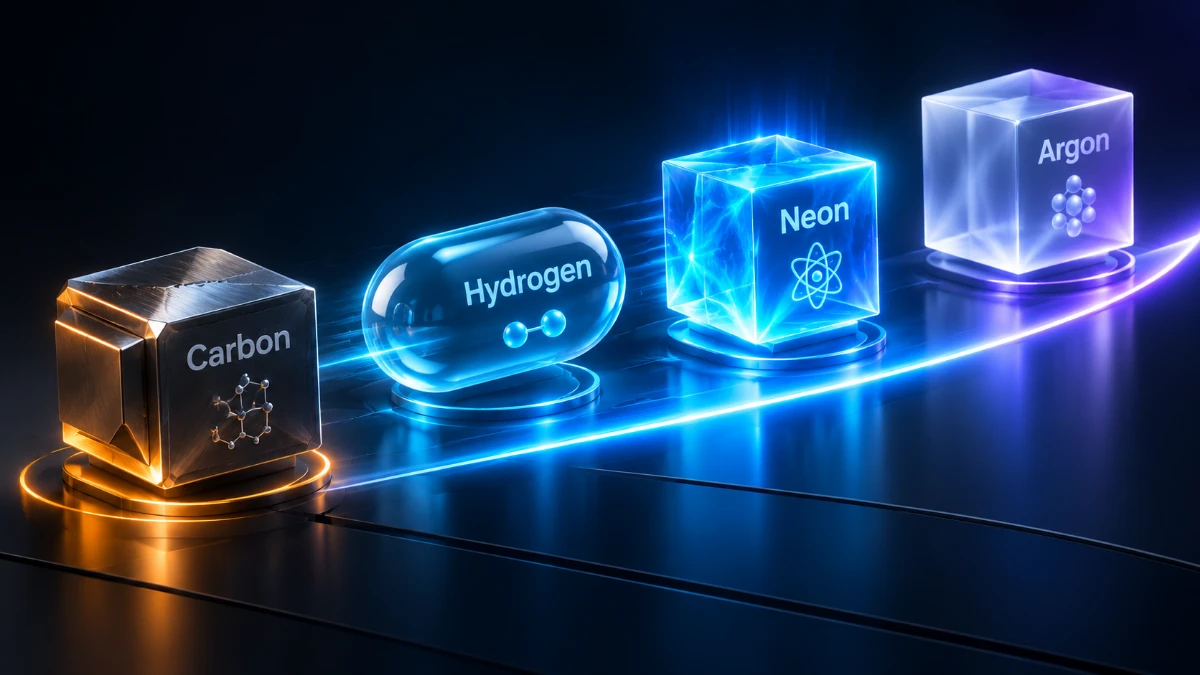
Google released four Gemini 4 models—Argon, Carbon, Hydrogen, and Neon—named after elements rather than sizes. Instead of a simple tier ladder, each maps to a tradeoff curve of quality, speed, and cost. Neon leads in structured, rules-heavy domains like finance and legal work while claiming lower costs than Carbon, whereas Hydrogen targets high-volume, latency-sensitive tasks and Claude Opus 5.5 still leads coding.
What Google Released and Why It Matters
Google has released four Gemini 4 models within weeks of each other. It named them Argon, Carbon, Hydrogen, and Neon, after chemical elements instead of version numbers.
The Naming Problem
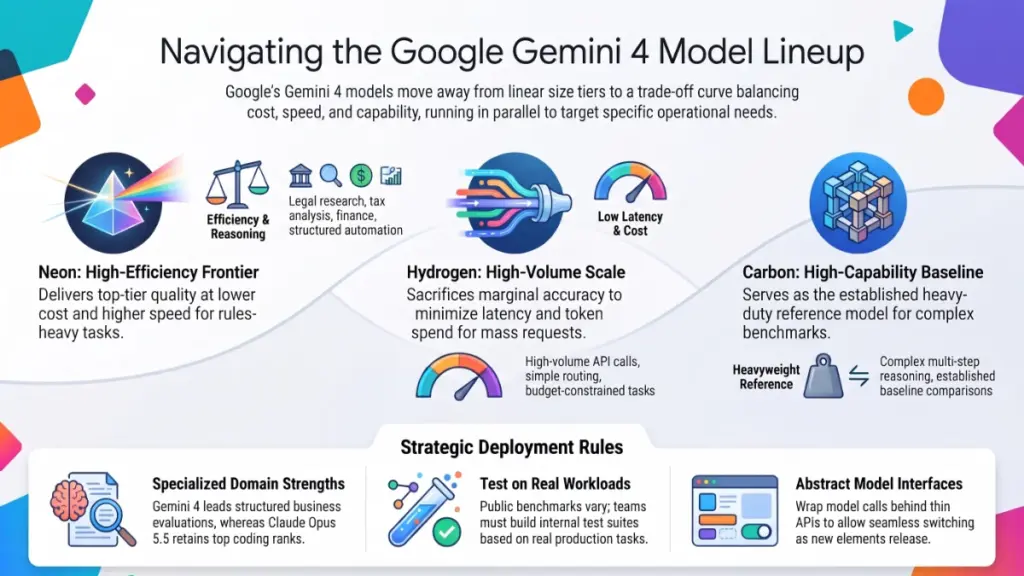
The names confuse many readers. They do not form a ranking, and they do not nest by size the way Anthropic’s Haiku, Sonnet, and Opus tiers do. Instead, each name marks a different point on a tradeoff curve between capability, speed, and cost.
Neon Takes the Headline
Neon is the newest release. Google positions it as better than Carbon on quality, while also cheaper and faster. That combination is unusual, because labs normally ship a cheaper tier by cutting capability.
What the Early Results Show
Reported results support the claim in several areas. Neon reportedly ranks around third on the Artificial Analysis Intelligence Index. It also ranks second on that group’s Pareto Frontier chart, which plots capability against cost and latency. In addition, Gemini 4 models reportedly lead several specialized evaluations in legal research, tax work, finance, spreadsheet modeling, and simulated business operations.
Where Coding Stands
Coding tells a different story. Anthropic’s Claude Opus 5.5 remains the model most coding benchmarks name as the leader. Google cites one benchmark where Neon edges ahead. However, independent hands-on testing has not confirmed that result.
The Immediate Impact for Builders
For builders, the impact is practical. You can no longer assume the newest name is the best choice. Instead, you must match the model to your workload. This article explains how to do that, what the evidence shows, and where the claims need caution.
Strategic Context and Why It Matters
Google is optimizing a curve rather than chasing a single title. Earlier generations followed a simple pattern in which each release replaced the last. Developers upgraded and moved on.
A Break From the Old Pattern
The element scheme breaks that pattern. Google appears to run all four models in parallel and has not retired older releases each time a new one ships. As a result, each model occupies a separate position on the cost-capability curve.
Who Benefits Most
This strategy benefits several groups.
High-volume application teams benefit first. They care about cost per request and response time. A cheaper, faster model with strong quality lets them serve more users at lower cost, and Hydrogen targets this group directly.
Teams building agents for structured domains come next. Neon’s reported strengths concentrate in finance, legal research, tax analysis, spreadsheet work, and automation. These domains follow rules and punish errors. Therefore, a model that follows constraints well has real value there.
Procurement and platform teams gain flexibility. They can assign different models to different tiers of work. For example, a routing layer can send simple requests to a cheap model and hard requests to a stronger one.
How Workflows Change
Workflows change in three ways.
First, model selection becomes an ongoing task. Releases arrive every few weeks, and each one can reset which model sits where on the curve. Teams that pick a model once and never revisit it will overpay or underperform.
Second, evaluation moves in-house. Public leaderboards disagree with one another, so your own tasks decide the winner. Teams need a small, repeatable test suite built from real work.
Third, naming no longer carries information. A developer cannot read “Neon” and infer its size. Consequently, teams must document which element handles which job. Otherwise, new engineers will guess wrong.
The Cost of Confusion
The confusion has a price. Even people who follow AI daily have asked Google’s developer relations team what the names mean. One common guess says Neon is small and fast while Hydrogen is mid-tier. That guess is wrong, because the elements do not sort neatly by size.
Google has not published an official explanation for the naming scheme in the material reviewed here. Still, the pattern is functional. Each name signals a distinct release with its own tradeoffs.
Deep-Dive Technical Specifications
The available source material contains no hard architecture data. It lists no context window sizes, no parameter counts, and no supported modalities for each model. Therefore, this section describes positioning and flags the gaps.
How Each Model Is Positioned
Carbon serves as the heavier, higher-capability model. Other releases get compared against it. Before Neon arrived, it was the flagship of the lineup.
Hydrogen sits at a lower cost and latency point. It gives up some quality relative to Carbon and Neon. In return, it runs cheaper and faster. Independent evaluations still describe it as a strong performer in absolute terms.
Neon is the newest entrant. It claims higher quality than Carbon at lower cost and higher speed. Google also used its highest reasoning setting for at least one benchmark claim.
Argon completes the current set of four. However, little detail exists on how it differs from the others. Treat any claim about Argon’s role as unconfirmed until Google documents it.
What the Reasoning Setting Implies
The reference to Neon’s “highest reasoning setting” matters. It suggests that Neon exposes adjustable reasoning effort. Higher settings usually raise accuracy on hard tasks. At the same time, they raise latency and token usage.
This affects fair comparison. A benchmark run at maximum reasoning does not reflect default behavior, and it does not reflect typical production cost. Therefore, check which setting produced a Neon score before you trust it.
Specifications to Verify
Before you commit to a model, confirm these items in Google’s official documentation:
- Maximum context window for each model
- Maximum output length
- Supported input types, such as text, images, audio, and video
- Tool use and function calling support
- Structured output support
- Reasoning effort options and their cost impact
- Rate limits at each access tier
- Knowledge cutoff dates
- Deprecation and retirement policy
The last item deserves special attention. Google appears to ship new elements often, so you need to know how long each one stays supported. After all, a model that disappears in six months can break a production pipeline.
An Architecture-Neutral Way to Compare
You do not need architecture details to choose well. Three measurable properties decide most selections.
Quality means accuracy on your tasks. Measure it with your own test set.
Latency means time to first token and time to complete response. Measure it under your real load.
Cost means total spend per completed task, not price per token alone. A model that needs fewer retries can cost less overall, even at a higher token price.
Run all three measurements on each candidate, and then plot the results. The Pareto frontier logic Google references applies to your own data too.
Performance, Benchmarks and Evidence
Reported results span general and specialized evaluations. This section separates what the sources claim from what independent testing has confirmed.
General Intelligence Rankings
Neon reportedly ranks around third on the Artificial Analysis Intelligence Index. That index aggregates results across many tasks into one score. A third-place finish indicates strong general capability, but it does not indicate the top spot.
Neon also reportedly ranks second on the Pareto Frontier chart from the same group. A high position here means Neon delivers strong results for its price and speed. For that reason, this result supports the efficiency claim better than the raw index rank does.
Specialized and Agentic Benchmarks
Gemini 4 models, plural, reportedly lead several evaluations:
- Vals index: a broad, applied-task evaluation
- Legal research benchmark: tests research accuracy on legal questions
- Tax agent benchmark: tests agentic work on tax problems
- Surge AI evaluations: cover finance, accounting, spreadsheet modeling, and complex constraint-following
- Zapier automation benchmark: tests workflow automation
- Vending Bench 2: a simulated business from Andon Labs that tests how well an agent runs a simple commercial operation over time
Note the wording here. Several of these results apply to Gemini 4 models as a group rather than to Neon alone. Therefore, check the original leaderboard to see which specific model earned each result.
Sources also describe Neon as best in class on terminal-based benchmarks, science reasoning benchmarks, and HLE Diamond. HLE Diamond is a harder subset of the Humanity’s Last Exam set.
The Coding Picture
Coding results look less favorable. Claude Opus 5.5 remains the reference point on most public coding benchmarks. Google points to at least one benchmark where Neon, on its highest reasoning setting, narrowly beats Opus 5.5 and other competitors.
Two cautions apply. The margin is narrow, and independent hands-on coding tests have not verified the result. Consequently, do not switch a coding workflow on this claim alone.
An Informal Signal From Bot Arenas
One informal test deserves mention. It used bot-versus-bot arenas, where models write scripts that compete in a game-like environment. The models adapt and improve across multiple rounds.
Neon reportedly improved faster than other models in that test, including some from competing labs. Notably, it did so without the shared learnings that other bots had accumulated.
Even so, this is a small and early signal rather than a rigorous benchmark. It suggests strong self-improvement in iterative, agentic settings. Treat it as a reason to run your own tests, not as proof.
How to Read These Numbers
Benchmarks measure narrow slices of behavior, and a model can lead one while trailing another. Three habits help.
First, match the benchmark to your task. A legal research score tells you little about code generation.
Second, check who ran the test. Third-party evaluators carry more weight than vendor claims.
Finally, look for agreement across sources. A result confirmed by two independent evaluators deserves more trust than one reported once.
Pricing, Licensing and Availability
The source material does not state prices for any Gemini 4 model. It also does not say whether Google offers open-weight access or list API availability by region. I will not guess at any of these.
What the Sources Do Say
The sources do offer relative comparisons. Neon costs less than Carbon. Based on its positioning as the lower-cost option, Hydrogen likely costs less than both. Still, Google has not confirmed exact price differences in the reviewed material.
What to Confirm Before Budgeting
Check Google’s pricing page for these details:
- Input and output price per million tokens, per model
- Separate pricing for the highest reasoning setting
- Whether reasoning tokens bill as output tokens
- Discounts for caching or batch processing
- Free tier limits
- Enterprise agreements and committed-use terms
- Licensing terms, including any open-weight availability
- Regional availability and data residency options
Estimating Real Cost
Price per token misleads, because total task cost matters more. Use this simple method.
- Select 50 to 100 representative tasks from your workload.
- Run each candidate model on every task.
- Record total tokens used, including reasoning tokens.
- Record how many tasks needed a retry or human correction.
- Multiply tokens by price, then add the cost of corrections.
A cheaper model that fails often can cost more than a pricier one that succeeds. Therefore, Neon’s efficiency claim only matters if it holds on your tasks.
⚡ Limited Time Free Access
Unleash Your Digital Empire: Get 4 Premium Gifts in 1 Pack!
Grab this exclusive, high-value digital asset package tailored for creators, marketers, and builders. Enter your best email to claim instant access.
🎁 Claim Your $197 Free Digital Empire Bundle 🚀What’s Inside Your Ultimate All-In-One Package:
01. 50 AI Digital Product Ideas: A curated list of profitable, AI-driven digital product ideas engineered for fast execution and high margins.
02. Digital Sales Mastery: The strategic architecture behind high-converting sales funnels, persuasive copywriting, and online revenue growth.
03. Mastering Email List: Advanced frameworks for building an engaged audience, maximizing open rates, and generating automated income.
04. THE ULTIMATE FACELESS PLAYBOOK: Complete blueprint to building a powerful, monetizable brand on social media without showing your face.
Included Bonus:
[BONUS] Premium Canva Marketing Vault: High-converting templates to scale your organic traffic.
💥 $197 VALUE — FREE FOR READERS
🎁 Claim Your $197 Free Digital Empire Bundle 🚀🛡️ Secure Processing • Your privacy is 100% protected.
Industry Implications and Competitive Analysis
Google’s strategy shifts the competitive frame. The contest is no longer about the single largest model. Instead, it centers on the best result per dollar and per millisecond.
Google Versus Anthropic
Anthropic uses a tiered naming system. Haiku, Sonnet, and Opus signal small, mid, and large, so buyers can infer capability and cost from the name. This clarity helps procurement.
Google’s element names carry no such signal, which costs buyers some clarity. In return, Google keeps the freedom to ship models that do not fit a clean ladder. Neon shows the benefit, since it combines gains that a tier system would force into separate models.
On capability, the picture splits by task. Claude Opus 5.5 leads on most public coding benchmarks. Meanwhile, Gemini 4 models lead on a range of finance, legal, tax, and automation evaluations. Neither side wins everywhere.
Building a Multi-Model Strategy
Teams should expect to use more than one model. A sensible split might look like this:
- Coding and software engineering: test Opus 5.5 against Carbon and Neon on your codebase
- Finance, legal, tax, and spreadsheet agents: evaluate Neon first
- High-volume, latency-sensitive tasks: evaluate Hydrogen first
- General agentic workflows: compare Neon against current alternatives
Treat this split as a starting hypothesis rather than a verdict. Your data should confirm or overturn it.
Pressure on Competitors
Rapid releases raise the pace for everyone. When one lab pushes the efficiency frontier, others respond. Buyers benefit from falling prices and rising quality, while vendors face pressure on margins.
Rapid releases also create a different kind of switching cost. Teams that hard-code one model’s quirks into prompts will struggle to move. Prompt portability therefore becomes a real engineering concern. To prepare, abstract model calls behind a thin interface and keep evaluation suites ready to rerun when a new model ships.
The Platform Angle
Several platforms now let teams route between models. This lowers the risk of betting on one vendor and makes comparison easier. Whichever tooling you choose, check that it supports the new Gemini 4 models quickly, because support lag can delay adoption by weeks.
Likely Winners and Losers
Teams with strong evaluation habits will likely win, since they can adopt improvements fast. Teams building in finance, legal, and tax gain the most from Neon’s reported strengths.
On the other side, teams that treat model choice as a one-time decision will lose ground. Their costs will drift upward as cheaper options appear. Likewise, teams that rely on naming conventions to guide choices will struggle.
Limitations, Caveats and Skepticism
Several claims need scrutiny. Hold them loosely until independent testing confirms them.
Claims That Lack Verification
The core efficiency claim is unverified in your context. Google says Neon beats Carbon on quality while costing less and running faster. Benchmarks support parts of this. Even so, “better” depends on the benchmark, and Neon’s strengths concentrate in agentic and domain-specific tasks.
Coding claims lack independent confirmation. Google cites one benchmark where Neon narrowly beats Opus 5.5. The sources describe this result as unverified through hands-on coding tests. A narrow margin on one benchmark can vanish on real codebases.
Group results blur individual models. Many reported wins apply to “Gemini 4 models” collectively. A buyer cannot assume Neon earned each one, so verify the specific model behind each score.
Gaps in Testing and Documentation
Settings affect results. Top scores may use the highest reasoning setting. That setting raises cost and latency, and production use may not match benchmark conditions.
Informal tests prove little. The bot-arena result is early and informal. It hints at strong iterative improvement but does not measure production reliability.
Documentation gaps remain. The reviewed material lacks specifications, pricing, and an official naming rationale. Argon’s role is especially unclear. Any plan built on missing data carries risk.
Operational and Benchmark Risks
Rapid release cadence adds operational risk. Frequent releases can mean frequent changes, and behavior may shift between versions. Deprecation timelines may also be short. Teams should pin model versions and monitor for changes.
Benchmark gaming is a general risk. Labs optimize for public benchmarks, so scores can overstate real-world ability. Private evaluations on your own tasks resist this problem.
Production Risks to Plan For
- Run regression tests whenever a model version changes.
- Keep a fallback model ready for outages or degradation.
- Log inputs and outputs so you can audit failures.
- Set cost alerts, especially with high reasoning settings.
- Have qualified humans review outputs from legal, tax, and finance agents. A benchmark lead does not replace professional review.
Future Outlook and Conclusion
Expect the lineup to keep shifting. Google has released new elements every few weeks, and each release has reset which model sits where on the cost-capability curve. Argon, Carbon, Hydrogen, and Neon will probably not be the last names.
What to Watch Next
Developers should watch five things:
- Official specifications. Context windows, modalities, and limits will clarify real use cases.
- Published pricing. Exact numbers will confirm or weaken the efficiency claim.
- Independent coding tests. Hands-on results will settle the Opus 5.5 comparison.
- Argon’s role. Documentation should explain where it fits.
- Deprecation policy. Support timelines will determine how safely you can build on each model.
The Practical Takeaway
The advice is simple. Do not pick a model by name. Define your task first, and then measure quality, latency, and total cost on real examples. Finally, match the element to the job.
Overall, Neon looks like the strongest option in the family for structured, rules-heavy agentic work. Hydrogen deserves first evaluation for high-volume, cost-sensitive use. For coding, test Opus 5.5 against Google’s models on your own code. After that, decide with your own data.