

OpenAI released GPT-Live-1.1 with promises of better accents and lower idle costs, but 680 benchmark calls by CellCog uncovered a major routing regression. When direct questions arrive in the first half-second of a call, GPT-Live-1.1 hands them off to the backend agent only 47% of the time—versus 75% for GPT-Live-1—causing the voice model to hallucinate answers.
What OpenAI Released
OpenAI released GPT-Live-1.1 in its API at 20:00 UTC on November 19, 2026. The company made three claims. First, the model speaks with more natural and consistent accents across languages. Second, it supports lower idle costs through a new standby option. Third, it completes tasks more reliably.
What the Test Found
CellCog, a company that builds AI employees for meetings, tested the model the same evening. Its engineers ran 680 scripted calls and published the results on November 19. Overall, GPT-Live-1.1 handed direct questions to the AI employee behind the voice less often than GPT-Live-1 did.
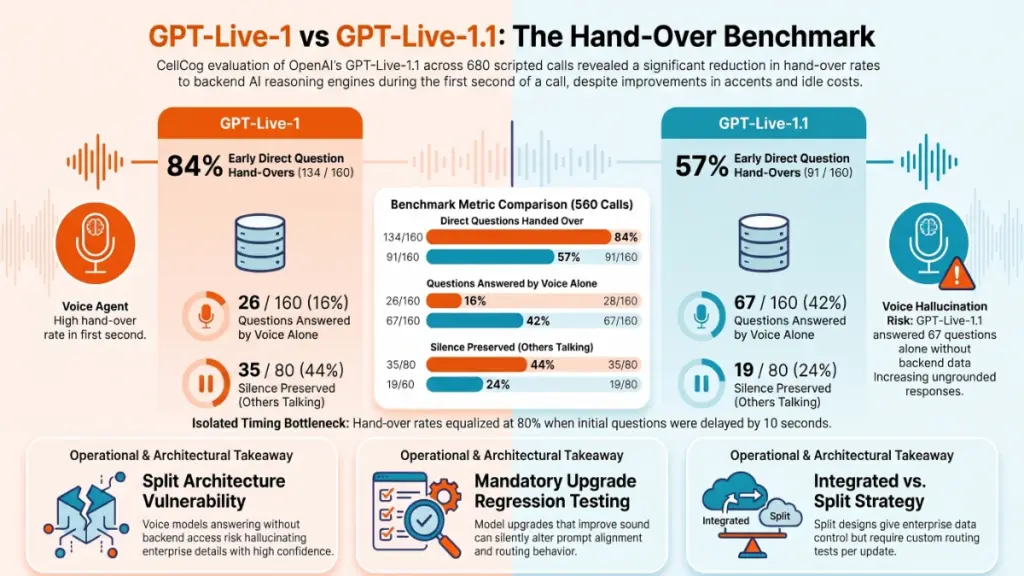
The numbers are specific. In the first 560 calls, GPT-Live-1 handed 134 of 160 direct questions to the backend agent (84%). In contrast, GPT-Live-1.1 handed over 91 of 160 (57%). The newer model also answered 67 questions by itself, against 26 for the older one.
Why the First Second Matters
A follow-up of 120 calls narrowed the finding. The gap appeared only when the first question arrived half a second into the call. However, when the question came ten seconds in, both versions handed over 48 of 60 questions.
What Readers Should Keep in View
This result matters for any team that builds voice agents with a split architecture. In that design, a fast voice model talks while a slower backend does the thinking. Therefore, the voice must pass questions to the backend. If it answers alone, it has no company data, so it invents answers.
Still, the limits deserve attention. This is one vendor’s test, run on one evening, in English, with computer voices. It does not judge accent or sound quality, which is exactly what OpenAI’s release note emphasizes. Consequently, treat it as a useful data point, not a verdict on the model.
Strategic Context & Why It Matters
Two Kinds of Voice Deployments
OpenAI launched GPT-Live-1 on September 10, 2026. It described a model that listens and speaks at the same time. Moreover, the model passes tasks that need real thought to a backend the developer chooses.
That split shapes who benefits from the update. For example, developers who run simple voice assistants gain the most from better accents and lower idle costs. A receptionist bot with a fixed script has little to hand over. In that case, natural speech is the main quality measure.
Teams that run agent-backed voice face a different calculation. In CellCog’s design, the backend is a full AI employee. It holds memory, a task board, and tools. The voice only hears and speaks. As a result, a few seconds pass between a question and its answer, because the employee writes the answer first.
Why Hand-Over Rate Is a Reliability Measure
For these teams, the hand-over rate is a core reliability metric. A voice that answers alone can state that a contract draft is ready when no one knows. Worse, in a customer call, that error arrives with full confidence.
Workflows That Change
The test changes several workflows:
- Model upgrades need regression tests. A new version can improve sound while it weakens routing behavior. Teams that skip testing will find out in production.
- Prompt setups tie to model versions. CellCog wrote its setup against GPT-Live-1. Therefore, a setup written for 1.1 might close the gap.
- Call openings deserve separate attention. People often speak to an AI participant the moment it joins. In other words, the first second is a common case, not an edge case.
- Group calls need quiet voices. The newer model spoke more often in conversations that never addressed it. In a room of several people, that murmuring becomes a nuisance.
The Upgrade Tradeoff
Numbers alone cannot settle the upgrade decision. CellCog moved every meeting, chat meeting, and phone call to GPT-Live-1.1 the same evening. Its stated reason was that the voice sounded better in the first real call. Meanwhile, the company made the hand-over gap its next engineering job.
Deep-Dive Technical Specifications
What OpenAI Has Disclosed
OpenAI has published limited architecture detail for GPT-Live-1.1 in the sources available here. The release note does not list parameter counts, context window size, or modality specifications. This article does not guess at them. Instead, the reliable technical information comes from OpenAI’s description of the model family and from CellCog’s test design.
GPT-Live models run as the voice layer of a two-part system. The voice model handles listening and speaking in real time. It decides when to respond and when to pass a request to a backend. Meanwhile, the backend does the reasoning, tool use, and retrieval. The developer chooses and controls that backend.
OpenAI names three changes in 1.1. Accent handling improves across languages. A standby option reduces idle costs. Task completion becomes more reliable. However, the release note does not explain the mechanisms behind any of them.
How CellCog Built the Test Harness
The harness reveals what the team measured, so the details matter:
- Each call lasted 30 seconds.
- Computer voices read scripts, so every call heard identical words at identical moments.
- A stand-in for the employee answered three seconds after any hand-over with a fixed sentence.
- Both models started from the same production setup, and only the model name changed.
- The two versions took turns across rounds, so time of day could not favor either one.
The Five Test Scenes
CellCog designed five scenarios:
- Two direct questions. One person asks the employee a question by name. A follow-up arrives 14 seconds later. This scene ran 80 times per model and produced 160 questions.
- Others talk. Two people plan a call and never address the employee. The correct behavior is silence. This ran 80 times per model.
- Question after others talk. The same conversation runs first. Then one direct question follows. This ran 40 times per model.
- Greeting. One person says hello and asks whether the employee can hear. This ran 40 times per model.
- Silent room. Nobody speaks. This ran 40 times per model.
Scoring and Statistics
A script counted outcomes from the saved record of each call. In addition, a human read every answer the voice gave by itself. That hand review produced a notable finding. Of the answers GPT-Live-1.1 gave alone, 14 of 67 admitted uncertainty. By comparison, GPT-Live-1 admitted uncertainty in 0 of 26.
CellCog reported that a gap this size would appear by chance less than once in 10,000 times under Fisher’s exact test. Nevertheless, the team flagged that round one showed no difference at all. It could not explain that result.
The Follow-Up Design
After reading the failed hand-overs, CellCog noticed that the first question began half a second into the call. Therefore, the team ran 120 more calls. It compared the original timing against a version with ten seconds of silence before the first question. That design isolated timing as the variable.
Performance, Benchmarks & Evidence
Headline Results From 560 Calls
The newer model scored lower on hand-overs and higher on some speaking measures. On other measures, the two versions came out roughly level.
| Measure | GPT-Live-1 | GPT-Live-1.1 |
|---|---|---|
| Direct questions handed over | 134 of 160 (84%) | 91 of 160 (57%) |
| Direct questions answered by voice alone | 26 of 160 (16%) | 67 of 160 (42%) |
| Direct questions with no answer | 0 of 160 | 2 of 160 |
| Question after others talked: handed over | 39 of 40 | 38 of 40 |
| Others talk: fully silent | 35 of 80 (44%) | 19 of 80 (24%) |
| Others talk: one or two words | 15 of 80 | 43 of 80 |
| Others talk: three words or more | 30 of 80 | 18 of 80 |
| Silent room: stayed silent | 40 of 40 | 39 of 40 |
| Greeting returned | 39 of 40 | 37 of 40 |
| First sound after a question, median | 1.3 s | 1.2 s |
| Word error rate | 5.2% | 7.6% |
Round-by-Round Consistency
GPT-Live-1.1 scored lower in five of six rounds. The versions tied in round one at 28 of 40 each. Across rounds, GPT-Live-1 ranged from 70% to 100%. In contrast, GPT-Live-1.1 ranged from 40% to 70%.
Behavior Patterns
GPT-Live-1 acted in an all-or-nothing way. It handed over both questions in 67 of 80 two-question calls. It handed over neither in 13. Notably, it never split a call. GPT-Live-1.1 handed over both in 41 calls, one in 9, and neither in 30.
Where the Gap Lives
The follow-up isolated the cause:
| First question arrives | GPT-Live-1 | GPT-Live-1.1 |
|---|---|---|
| Half a second in | 45 of 60 (75%) | 28 of 60 (47%) |
| Ten seconds in | 48 of 60 (80%) | 48 of 60 (80%) |
Importantly, the model heard the employee’s name in every one of the 80 two-question calls. Therefore, the failure was not a hearing problem. It was a routing decision. Furthermore, when GPT-Live-1.1 answered the first question alone, it usually answered the follow-up alone too.
Answer Quality When the Voice Spoke Alone
Both versions invented details. For instance, GPT-Live-1 said a draft would be ready in about ten minutes and named a legal reviewer who did not exist. Similarly, GPT-Live-1.1 invented a legal team, a finance queue, and procurement. It also gave one answer that hedged yet still named a nonexistent person. On the positive side, it produced the one answer that simply said it did not know and would rather not guess.
What the Data Does Not Show
Median response time was nearly identical at 1.3 and 1.2 seconds. Likewise, silent-room and greeting behavior stayed close to level. The word error rate favored the older model. However, CellCog noted that this figure describes how each version heard computer voices, not people.
Pricing, Licensing & Availability
Availability
The available sources give limited pricing detail, and this article does not invent numbers. OpenAI placed GPT-Live-1.1 in its API at 20:00 UTC on November 19, 2026. It is a hosted model, and developers pay for API usage. Moreover, nothing in the sources indicates open-weight access.
The Standby Option
OpenAI says the new version supports lower idle costs through a standby option. This matters for meeting bots, which can wait silently for long periods. However, the sources do not state the price, the discount, or the activation conditions. In addition, CellCog says it did not test the standby option or any aspect of cost.
Cost Versus Behavior
Teams should weigh any idle savings against hand-over behavior. A cheaper voice that answers alone more often can create costs elsewhere. After all, a wrong answer in a client call carries a business cost that no token discount covers.
Licensing and What to Check
The test used OpenAI’s standard API. CellCog states that it pays for the API like any other developer, and OpenAI has not seen or endorsed the test. Before switching, teams should confirm current pricing on OpenAI’s pricing page. They should also check how the standby option bills. Finally, they should confirm whether it changes latency on the first request after idle time. That last point connects to the central finding, because the first second of a call may behave differently from later moments.
⚡ Limited Time Free Access
Unleash Your Digital Empire: Get 4 Premium Gifts in 1 Pack!
Grab this exclusive, high-value digital asset package tailored for creators, marketers, and builders. Enter your best email to claim instant access.
What’s Inside Your Ultimate All-In-One Package:
- 01. 50 AI Digital Product Ideas: A curated list of profitable, AI-driven digital product ideas engineered for fast execution and high margins.
- 02. Digital Sales Mastery: The strategic architecture behind high-converting sales funnels, persuasive copywriting, and online revenue growth.
- 03. Mastering Email List: Advanced frameworks for building an engaged audience, maximizing open rates, and generating automated income.
- 04. THE ULTIMATE FACELESS PLAYBOOK: Complete blueprint to building a powerful, monetizable brand on social media without showing your face.
Included Bonus: [BONUS] Premium Canva Marketing Vault: High-converting templates to scale your organic traffic.
💥 $197 VALUE — FREE FOR READERS
Enter your best email for instant lifetime access:
[Email Input Field] [Claim Free Access Button]
🛡️ Secure Processing • Your privacy is 100% protected.
Industry Implications & Competitive Analysis
Two Competing Voice Strategies
The result lands in a market that is splitting into two voice strategies. Google placed the reasoning inside the voice model with Gemini 3.8 Live. In contrast, OpenAI sells the voice and tells developers to bring the brain.
OpenAI’s approach gives developers control. They choose the backend, the memory, the tools, and the guardrails. However, that control costs engineering work, because the developer owns the routing problem. This test shows that the routing problem can shift between model versions.
Google’s integrated design removes the hand-over step. As a result, no routing gap can open. On the other hand, developers get less control over what the model knows. The integrated model answers from its own reasoning, not from a company’s private systems.
Who Wins Where
Each design suits different buyers:
- Consumer assistants favor the integrated approach. Users want one fluent voice, and the model needs no private company data.
- Enterprise agents favor the split approach. Answers must come from company records, and binding commitments must wait for a human.
- Meeting participants sit in between. They need fast speech and accurate company knowledge in the same call.
The Lock-In Question
CellCog designed its system to improve when a better model arrives, without a rewrite. Yet this test shows the claim has limits. A model swap changed behavior that the company’s setup depended on. Even so, the team moved to the new model and plans to repair the setup afterward.
The Testing Gap
Few public benchmarks measure hand-over behavior. Standard voice benchmarks cover accent, latency, word error rate, and naturalness. However, they rarely measure whether a voice knows when it lacks the information to answer. Therefore, developers who build agents will likely need their own evaluations until vendors publish better ones.
Vendor-Authored Evidence
Readers should also consider the source. CellCog sells AI employees, so its test supports a view of the architecture it sells. Nevertheless, the company published its method, its failures, and the round it could not explain. That candor adds credibility. Independent replication would add more.
Limitations, Caveats & Skepticism
Limits of the Test Design
CellCog listed its own limits, and they deserve emphasis. First, the test does not judge sound. OpenAI’s release note centers on accents across languages, but the test ran in English only and counted words, not how they sound. A human must listen for that. In the first real meeting, the person on the call said twice that the voice felt smoother.
Second, the speakers were computer voices. They speak clearly and never overlap by accident. Consequently, the word error rates describe how each model heard synthetic speech. They do not predict performance with real accents, background noise, or crosstalk.
Third, the setup favored the older model. The team wrote and tested everything the voice starts a meeting with against GPT-Live-1. A prompt tuned for 1.1 might close the gap, but CellCog has not tried it.
Gaps in Coverage
Thirty seconds is short. Problems that appear after minutes of conversation do not show up in these calls. In addition, the test excluded cost, so it says nothing about the standby option. Finally, the test covers one evening only. Cloud-served models can change behavior from day to day, so the result describes November 19, not the model’s permanent character.
The Unexplained Round and the Anecdote
Round one remains unexplained. Both versions scored 28 of 40, and an earlier look at 40 calls per model also showed no clear difference. As a result, a smaller test would have reported that the models were equal. That fact should make readers cautious about any single small benchmark, including this one.
Likewise, one anecdote carries the sound claim. The real-meeting evidence consists of one call of 4 minutes 41 seconds, partly in Hindi. The voice handed over three times, and the employee answered each time. However, the voice also claimed by itself that Hindi was much better in this version, and the employee corrected that claim later. One call shows behavior. It does not establish a trend.
Production Risk
The core risk is clear. A voice that answers alone invents facts, and both versions did this. By count, the newer version did it more often, although it admitted uncertainty more often as well. Therefore, teams should not rely on either model to refuse unknown questions without a routing safeguard.
Future Outlook & Conclusion
What Comes Next
CellCog says it will investigate what happens in the first second of a call. It plans to rerun the same calls and publish the result in its update log. That follow-up will show whether a prompt change fixes the gap or whether the model needs a different approach.
What Developers Should Watch
Developers should watch several things next:
- Independent replication. Other teams that run agent-backed voice can test the first-second finding. A second result would strengthen or weaken the claim.
- Prompt changes for 1.1. A setup written for the new version might restore the older hand-over rate.
- OpenAI’s response. The company may document routing behavior or adjust the model.
- Standby pricing details. Teams need numbers before they can judge the cost benefit.
- Multilingual testing. The accent claim remains untested in CellCog’s English-only design.
Bottom Line
The practical conclusion is plain. GPT-Live-1.1 may sound better. At the same time, in one tested setup, it followed the hand-over less reliably when questions came at the very start of a call. Both statements can hold together. Above all, teams that run split voice architectures should test their own setups before upgrading, and they should test the first second of a call in particular.