


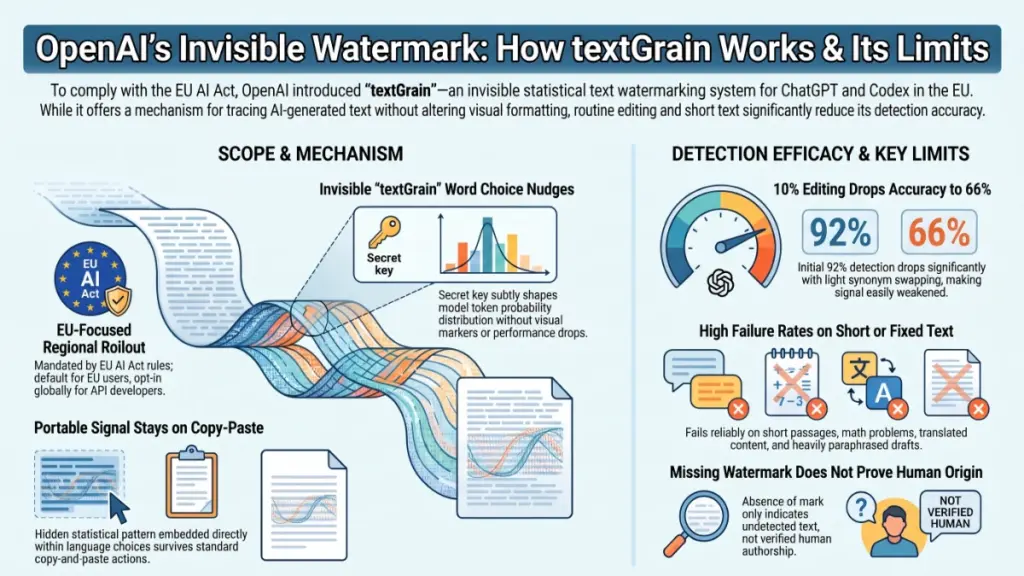
OpenAI is rolling out invisible text watermarking for ChatGPT and Codex in the EU to support EU AI Act transparency rules. The textGrain system subtly alters word choices so approved detectors can identify AI-generated content. However, editing, short passages, translations, and math can weaken detection, and a missing watermark does not prove human authorship. For content teams, the key takeaway is to maintain human review and avoid treating watermark detection as definitive proof.
What OpenAI Announced
OpenAI will start adding an invisible watermark to text from ChatGPT and Codex in the European Union. The company announced the change on Monday, October 5, 2026. According to OpenAI, the move complies with the EU AI Act. The Act’s transparency rules took effect on August 2. As a result, AI companies must now mark AI-generated content so other systems can identify it.
Who Gets the Watermark
First, the rollout reaches eligible ChatGPT and Codex users on all plans over the coming weeks. However, it applies only in the EU. Second, developers who use OpenAI’s API anywhere in the world can switch the feature on for select models starting now. Even so, the setting stays off by default. In addition, OpenAI says it is not making text watermarking a global default at launch.
How the Watermark Works for Readers
The watermark is not a visible symbol. Instead, it subtly shapes the model’s word choices. Readers see nothing unusual, but a detector can pick up the pattern. Because the signal lives in the words themselves, it travels with the text when someone copies and pastes it.
Why This Announcement Matters
This change matters to three groups. First, marketers and publishers who draft with ChatGPT will now produce text that carries a hidden signature. Second, developers can test the feature in their own products. Third, regulators get a working example of how a major lab meets the transparency rules.
Still, the announcement raises hard questions. For one, OpenAI admits that light editing weakens the signal. Moreover, the company limits detector access to approved researchers and expert organizations. Finally, a missing watermark proves nothing about who wrote a passage. This article covers each point. It also separates what OpenAI has confirmed from what remains unknown, and it explains what content teams should do next.
Strategic Context and Why It Matters
The Regulatory Push
The EU AI Act sets transparency duties for providers of generative AI systems. Those duties took effect on August 2. The core requirement is simple: AI-generated content must carry a mark that other systems can read. However, text is the hardest medium to mark. Images and audio hold signals in pixels and waveforms. Text, by contrast, offers far less room.
OpenAI’s answer is a statistical watermark built into word choice. Therefore, the approach meets the rule’s intent without adding visible clutter to the output.
A Market Shift Already Under Way
TechCrunch reports that OpenAI’s move follows Anthropic’s. Two months earlier, Anthropic said it would watermark text generated by Claude. Notably, Anthropic applies that policy worldwide, while OpenAI limits its default rollout to the EU.
Anthropic’s decision drew backlash from some Claude users. They argued that they had supplied “the instructions, context, decisions” while Claude was only “the tool.” This reaction shows a real tension. Many professionals see AI as a power tool, not an author. Yet a watermark treats the output as machine-made, no matter how much human direction shaped it.
OpenAI faced a version of this dilemma before. The Wall Street Journal reported in 2024 that OpenAI had built a text watermark but held it back. One reason was concern that users would move to rivals that did not watermark. Now, however, the EU rules change that calculation. When the law requires marking, no major provider gains an edge by skipping it inside the EU.
Who Benefits
Regulators benefit first, since they gain a technical path to enforce transparency. Researchers benefit next, because they get early detector access and a published method to study. Later, platforms and publishers may benefit too, but only if detector access widens and proves reliable.
Whose Workflows Change
Content teams feel the change most directly. For example, a marketing agency that drafts blog posts with ChatGPT in the EU will now produce marked text. Consequently, the agency may need a policy for disclosure, editing, and client communication. Developers who build on the API also gain a new option. They can enable watermarking for select models and decide how to expose that choice to their own users.
Education and publishing workflows shift as well. Editors and teachers often want to know whether AI wrote a passage. At first glance, the watermark seems to offer an answer. In fact, OpenAI works hard to say it does not. I cover that limit below.
My Read on the Strategy
This section is analysis, not reporting. OpenAI chose a narrow launch that targets the legal requirement and nothing more. As a result, the company limits user backlash outside the EU. In addition, it gathers real-world data before any global decision. Meanwhile, it can point to Anthropic’s earlier move if pressure to expand grows. Expect competitors and users to watch the EU rollout closely.
Technical Specifications and Method
What the Source Confirms
OpenAI published a technical report on its method, called textGrain. Researchers from the University of Pennsylvania and Yale co-wrote it. For engineering detail, the report is the best source. In contrast, TechCrunch’s summary does not include model sizes, context windows, or modality specifications. Therefore, this article does not guess at them.
How the Watermark Works
Language models generate text one token at a time. At each step, the model produces a probability distribution over possible next words. A watermark nudges that choice without breaking fluency.
According to TechCrunch’s description of the report, the method uses a secret key to sort the model’s next-word predictions. The report then walks through an example of finishing a sentence this way. One nudge means little. However, hundreds of nudges add up to a statistical pattern. A detector that holds the key can test a passage for that pattern, and it needs only the text and the key.
Three properties follow from this design:
- The signal is invisible. Readers cannot see it.
- The signal is portable. Because it lives in word choice, copying and pasting keeps it.
- Detection depends on the key. Without the secret key, an outsider cannot run the test.
Privacy and Quality Claims
OpenAI says the watermark does not identify the user. In other words, the pattern marks the text as machine-generated, but it does not tie that text to an account. This distinction matters for privacy and for regulators.
OpenAI also says it saw no meaningful change in model performance with the watermark switched on. Still, treat this as a company claim until independent teams test it. The technical report likely includes the supporting data, so researchers will want to check it.
Where the Watermark Runs
The watermark covers text from ChatGPT and Codex in the EU. Separately, the API option covers select models. Unfortunately, the source does not list which models qualify. For that reason, developers should check OpenAI’s documentation before they plan around the feature.
What the Source Leaves Out
The TechCrunch article does not include the following details. Verify them before you rely on them:
- Which API models support watermarking
- The minimum text length for reliable detection
- How the detector handles mixed human and AI text
- Whether code output carries the same signal strength as prose
- The false-positive rate on human-written text
The last item matters most. After all, a detector that flags human writing as AI-made causes real harm, especially in schools and hiring.
Performance, Benchmarks, and Evidence
The Numbers OpenAI Published
The source gives one headline robustness figure. In one test, OpenAI replaced 10% of words in a watermarked passage with synonyms. As a result, detection fell from about 92% to 66%.
This result deserves a careful reading:
- 92% is not perfect. Even before any editing, the detector misses roughly one in twelve watermarked passages in that test.
- A 10% synonym swap is light editing. Indeed, a human editor polishing a draft can change more than that without effort.
- 66% is a weak signal. At that level, no one should treat a detection result as proof.
Known Weak Spots
OpenAI says three kinds of text are harder to detect:
- Short passages
- Math answers
- Translated text
Each limit has a clear cause. First, short passages hold too few word choices to build a statistical pattern. Second, math answers leave little freedom, because correct answers are fixed. Third, translation replaces the original words, so it can erase the pattern.
What the Numbers Do Not Show
The source does not report false-positive rates. Likewise, it does not say how detection varies by language or topic. It also does not describe attacks beyond synonym replacement. For example, a determined user could paraphrase with another model, which would likely weaken the signal further. Overall, OpenAI’s tests suggest the watermark is a useful signal, not a lock.
OpenAI’s Own Caution
The company says a missing watermark “does not prove human authorship.” Several situations can explain a missing mark. The text may be too short. Alternatively, it may be too heavily edited. It may also come from another company’s AI, or a human may have written it.
OpenAI frames the watermark narrowly as well. It says a watermark can indicate that an OpenAI system generated or processed part of a passage. However, it cannot show how much human judgment, editing, or creativity went into the final text. This framing speaks directly to the user complaints about Anthropic’s policy. In short, the signal says “a model touched this.” It does not say “a model wrote all of this.”
Independent Verification
No independent evaluation appears in the source. Instead, OpenAI restricts initial detector access to approved researchers and expert organizations. The company says this restriction follows from the limitations above, and it wants those groups to help evaluate reliability and responsible uses. Until they report, the 92% and 66% figures rest on OpenAI’s own testing.
Pricing, Licensing, and Availability
Cost
The source mentions no extra charge for the watermark. Furthermore, it does not say whether API pricing changes when a developer turns the feature on. Therefore, check OpenAI’s pricing page before you assume it is free.
Who Gets It, and When
- ChatGPT and Codex users in the EU: The rollout reaches eligible users on all plans over the coming weeks. Consequently, the watermark will not appear everywhere on the same day.
- API developers worldwide: Developers can enable watermarking for select models starting now. The setting stays off by default.
- Everyone else: Consumer ChatGPT and Codex users outside the EU do not get the watermark at launch. OpenAI says it is not making text watermarking a global default.
Detector Access
Detector access is the tightest restriction. For now, OpenAI offers it only to approved researchers and expert organizations. Meanwhile, the source gives no timeline for wider access. Thus, a typical publisher, school, or agency cannot run its own checks today.
Licensing and Open-Weight Terms
The source does not discuss open-weight access. However, the detector depends on a secret key, which suggests OpenAI will control verification for now. The technical report documents the method. Whether others can implement it freely is a question for the report and OpenAI’s terms.
⚡ Limited Time Free Access
Unleash Your Digital Empire: Get 4 Premium Gifts in 1 Pack!
Grab this exclusive digital asset package for creators, marketers, and builders. Enter your best email to claim instant access.
What’s inside your all-in-one package:
01. 50 AI Digital Product Ideas: A curated list of AI-driven digital product ideas built for fast execution and high margins.
02. Digital Sales Mastery: The strategy behind high-converting sales funnels, persuasive copywriting, and online revenue growth.
03. Mastering Email List: Frameworks for building an engaged audience, improving open rates, and generating automated income.
04. THE ULTIMATE FACELESS PLAYBOOK: A blueprint for building a monetizable social media brand without showing your face.
Included bonus:
[BONUS] Premium Canva Marketing Vault: Templates to help you grow organic traffic.
💥 $197 VALUE — FREE FOR READERS.
Industry Implications and Competitive Analysis
Anthropic: Global and Earlier
According to TechCrunch, Anthropic moved first, by about two months. It also moved wider, since Anthropic applies its Claude text watermark worldwide. OpenAI, on the other hand, limits its default rollout to the EU.
The two approaches reflect different bets. Anthropic accepts user pushback in exchange for a single global policy. OpenAI, in contrast, accepts a patchwork in exchange for fewer disruptions outside Europe. A global policy is simpler to explain and to audit. Yet a regional policy limits risk if the technology underperforms.
Google, Meta, and Microsoft
The source says Anthropic, Google, Meta, Microsoft, and OpenAI have all committed to the EU’s code of practice on AI-generated content. This commitment suggests more announcements will follow. However, the source does not describe Google, Meta, or Microsoft’s text-watermarking plans, so I make no claims about them. Instead, watch for similar posts from each company.
Interoperability
The biggest open question is whether detectors will work across vendors. OpenAI notes that a missing watermark could mean the text came from another company’s AI. That statement hints at the problem. Each lab can detect its own signal, but no single check covers every model. Therefore, a publisher who wants to screen submissions would need access to several detectors, and each lab currently controls its own.
Effects on the Tool Market
The watermark changes the market in a few predictable ways. This section is my analysis.
- Paraphrasing and “humanizer” tools may gain demand. If watermarks matter, some users will try to remove them. OpenAI’s own synonym test shows why. Expect vendors to advertise this use, and expect labs to respond with stronger methods.
- Detector services may grow. Third parties will want access. Consequently, the lab-controlled model may not last if demand rises.
- Enterprise buyers will ask new questions. For instance, procurement teams will want to know whether a tool marks its output and where.
- Policy debates will intensify. Users who see themselves as authors will keep pushing back on labeling that treats them as bystanders.
What This Means for Marketers and Publishers
Marketing teams should treat watermarking as a compliance fact, not a ranking factor. The source says nothing about search engines reading these marks. Accordingly, do not assume search platforms will penalize or reward watermarked text. No evidence in the source supports either claim.
A sensible policy has four parts:
- Document which tools your team uses and where.
- Decide how you will disclose AI assistance to clients and readers.
- Keep human editing and review in every workflow.
- Never promise clients that content is “undetectable,” because the method makes that promise unreliable.
Limitations, Caveats, and Skepticism
Weak Against Editing
OpenAI’s own test shows the core weakness. A 10% synonym swap cut detection from about 92% to 66%. In practice, real editing often goes further. Therefore, a watermark that fades under routine revision cannot serve as strong proof of origin.
Weak on Short Text
Short passages carry few signals. For example, social posts, product titles, headlines, and short replies may fall below the useful threshold. Math answers and translations also resist detection. Unfortunately, many real marketing and support tasks fall into these categories.
Proof of Absence Is Impossible
A missing watermark proves nothing, and OpenAI says so directly. For that reason, schools, employers, and publishers must not treat “no watermark found” as “a human wrote this.” The reverse also needs caution. A detection result shows model involvement, but it does not show how much.
Limited Detector Access
At first, only approved researchers and expert organizations get the detector. On the one hand, that limit protects against misuse. On the other hand, it means the public cannot verify claims. As a result, independent testing will take time.
Self-Reported Performance
OpenAI says it saw no meaningful change in model performance with the watermark on. Yet no outside team has confirmed that. The technical report offers the details, so independent reviewers should examine them.
Authorship and Fairness
The Claude backlash points to a deeper issue. Many users supply the ideas, structure, and judgment. A statistical mark, however, cannot capture that contribution. OpenAI’s own statement concedes that a watermark cannot measure human judgment, editing, or creativity. For this reason, policymakers and platforms should keep that limit in mind before they build rules on top of detection scores.
Unknowns to Track
- False-positive rates on human writing
- Resistance to paraphrasing by another model
- Performance across languages
- Which API models support the feature
- Whether pricing or latency changes
Future Outlook and Conclusion
OpenAI’s rollout marks a turning point. Anthropic and OpenAI now both watermark text. One does so globally, while the other does so in the EU, with an API option elsewhere. In short, the EU’s transparency rules created the deadline, and the technology followed.
Several milestones will shape what comes next. First, watch the rollout across ChatGPT and Codex plans over the coming weeks. Second, watch for outside evaluations from the researchers who receive detector access. Their findings will test OpenAI’s 92% figure and its claim of no performance cost. Third, watch whether OpenAI expands watermarking beyond the EU. The company says it is not doing so at launch, which leaves the door open. Finally, watch Google, Meta, and Microsoft, which share the same code of practice commitment.
Developers should do three things now. First, read the textGrain technical report. Next, test the API option on the supported models. Lastly, build products that do not treat watermark detection as proof of anything.
Content teams have a simpler task. Keep humans in the loop and disclose AI use honestly. Also, assume that editing will blur any technical signal. Overall, the watermark is a useful signal, but it is not a verdict.