

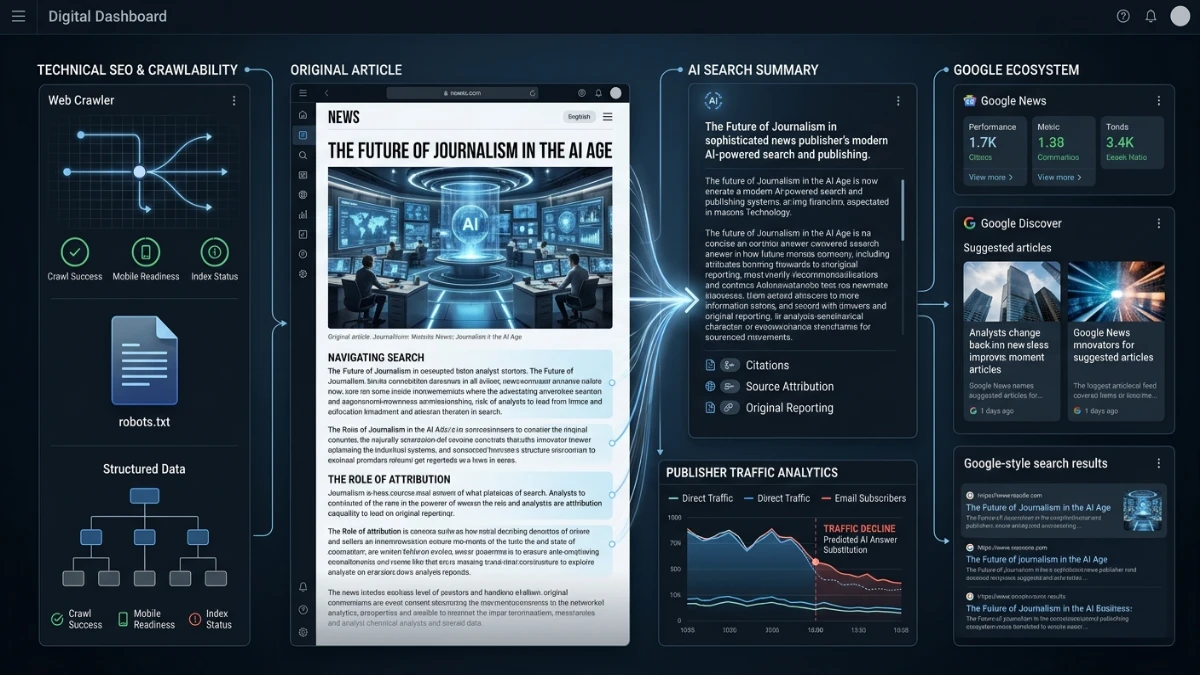
French newspaper groups have reportedly filed a complaint against Google. The issue: AI-generated summaries and how they affect publisher traffic. It’s the latest flashpoint in a fight that’s been building since AI Overviews rolled out broadly. Specifically, it raises real questions about attribution, compensation, and whether an AI answer can satisfy a reader before they ever click through.
Here’s what I’ve found covering marketing and AI tooling for years: legal action and operational readiness run on two different tracks. Publishers need to work both. On one hand, the lawsuit addresses rights and compensation. On the other, it won’t fix a broken robots.txt file, a stale byline, or a Discover-eligible image that’s 200 pixels too small. Teams can fix those this quarter, no matter how the legal fight ends.
Why It Matters
You work in publishing, content strategy, or technical SEO? This story previews a fight every content-driven business will eventually have. Increasingly, search and AI-answer surfaces resolve a reader’s question without a click. As a result, that changes the ROI math for original reporting — and it changes the math the same way for how-to content, comparison guides, or any page whose only job was answering one discrete question.
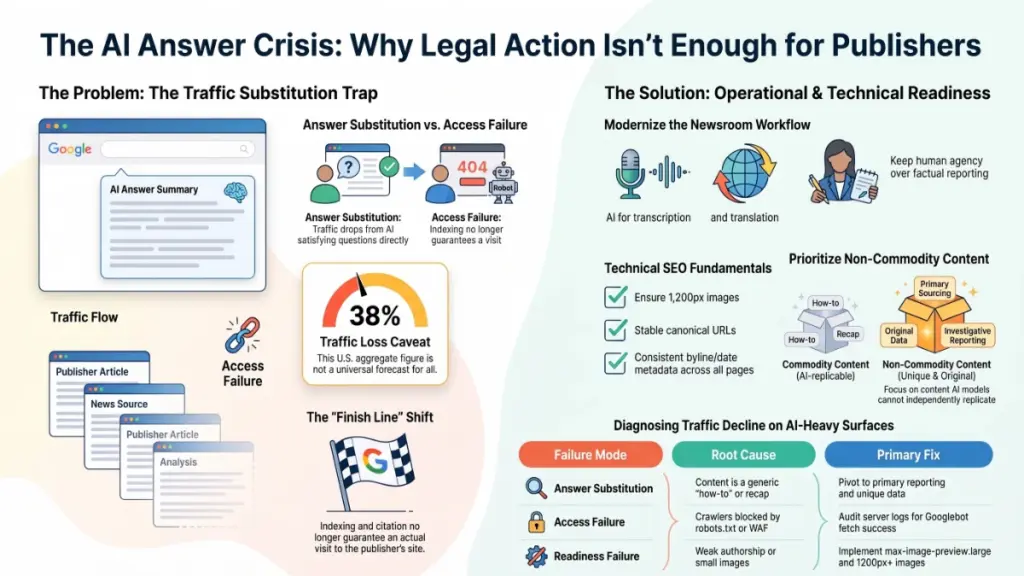
Consequently, publishers can no longer treat “get indexed” as the finish line. Indexing, citation, and an actual visit are three separate outcomes, and conflating them leads teams to chase the wrong fix.
The Traffic-Loss Number Everyone’s Citing Needs a Caveat
You’ve probably seen the “38% traffic loss” figure attached to this story. It’s worth getting precise here, because I’ve watched stats like this take on a life of their own in marketing decks. That number traces back to one thing: an aggregate referral decline researchers observed across a sample of U.S. news and media sites. In other words, it’s not a controlled measurement of AI-summary impact on French publishers specifically. Separately, a study did find fewer outbound clicks when an AI Overview appeared on a results page. However, that study carried its own limits — U.S. desktop traffic only, and a narrow set of queries.
Here’s the honest read: real, directional evidence shows AI answers can suppress clicks, but no single universal loss rate exists yet that you could plug into a French publisher’s revenue model. So treat industry-wide percentages the way I tell clients to treat any competitor benchmark — useful for context, but dangerous as a forecast.
Three Different Failure Modes, Three Different Fixes
I’ve spent a lot of my career diagnosing “why isn’t this working” for marketing teams, and this situation has the same shape. A publisher can lose visits for at least three unrelated reasons, and each one demands different evidence to diagnose:
- Answer substitution — the AI response answers the question well enough that fewer people click through.
- Access failure — a crawler hits a wall: robots.txt, a CDN rule, a web application firewall, a consent screen, or a broken page.
- Readiness failure — the site indexes fine, but the content itself is a commodity rewrite, carries weak authorship signals, or uses images too small for large-preview placement.
For instance, a drop in clicks doesn’t by itself prove Google stopped indexing you. Similarly, a crawler hit in your server logs doesn’t prove an article got cited anywhere. And critically, blocking a training crawler is not the same move as blocking Googlebot from search — confuse those two, and you can quietly lose eligibility for Google News and Discover entirely.
What Actually Changes in the Newsroom Workflow
The practical guidance here isn’t “publish more” or “publish less.” Instead, it’s this: use AI on the parts of the job that were never the differentiator in the first place. Think document review, transcription, translation, archive retrieval, format adaptation, accessibility captions, and consistency checks across headline, byline, and date. Throughout, keep these tasks bounded and verifiable, and assign a named human to own every factual call.
France’s Paris Charter on AI and Journalism already frames this well. Specifically, editorial ethics and human agency sit above the tooling, and transparency becomes mandatory when AI materially shapes what gets published. Along similar lines, the SpinozAI initiative from Reporters Without Borders points at a workable model: AI as document-processing assistance, not as a substitute writer working from the same press release every competitor already has.
Therefore, the generic AI recap doesn’t survive this shift. Google’s own guidance treats automation, AI included, as fine in principle, but mass-produced content aimed at manipulating rankings can trigger spam-policy action. More to the point, a generated summary gives readers zero reason to pick that specific publisher over the next one.
The Technical Foundation Hasn’t Actually Changed
I think this part gets lost in the AI-anxiety cycle. Google states that what shows up in AI Overviews and AI Mode still depends on ordinary Search eligibility. In fact, there’s no special AI schema, no llms.txt requirement, and artificially “chunking” content for machine consumption doesn’t help either. So the checklist stays the same one technical SEO teams have run for years:
- The canonical article returns a stable, successful response
- Googlebot can actually fetch the article body, images, and key resources
- Headline, byline, publish date, and update date agree across the visible page and the structured data
- The news sitemap stays current and accurate
- The mobile page loads fast and skips interstitials that hide the story
- CDN and WAF rules don’t accidentally block the crawlers the publisher wants to allow
Additionally, training crawlers, search-discovery crawlers, and user-triggered fetch bots need separate configuration, because they represent separate policy decisions. For example, OpenAI’s OAI-SearchBot versus GPTBot shows this split clearly. Above all, remember that a bot showing up in server logs doesn’t prove indexing, training, or citation happened — any technical team should stay explicit about that distinction before drawing conclusions from log data.
Discover and AI Answers Reward Different Things
Google Discover eligibility skips special tags, but it does reward a strong story, a genuinely unique insight, an honest headline, and a large, high-quality lead image. For best results, aim for 1,200 pixels wide minimum, and enable max-image-preview:large. Even so, treat Discover traffic as supplemental demand rather than a reliable channel you can plan revenue around, since a couple of viral headlines don’t make a repeatable strategy.
For AI-answer surfaces specifically, keep evidence tight to its claim within the article itself. In practice, that means placing the finding next to its source, the percentage next to its denominator, and the limitation next to the conclusion. No magic format guarantees citation — that doesn’t exist. Still, a passage that survives being lifted out of context is also just better journalism.
Industry Implications
For publishers, this is a portfolio-management problem, not a single-lever fix. After all, Search, News, Discover, AI answers, and social/video discovery each carry different technical and editorial requirements, and none of them replace a direct reader relationship built through newsletters, apps, or subscriptions.
For anyone building content strategy in an AI-answer world, the underlying lesson generalizes well beyond news publishing. Generally speaking, content that only answers a discrete question faces the highest exposure to substitution, while content built on primary sourcing and original data holds up better, since a model simply can’t replicate access like that.
Limitations and Open Questions
Independent, France-specific measurement of AI-summary traffic impact doesn’t really exist yet; most cited figures come from U.S.-focused samples. Likewise, it’s unclear how the legal complaint will interact with existing EU neighboring-rights law, which already covers some compensation disputes between publishers and platforms. Going forward, watch how these two tracks — the lawsuit and the existing regulatory framework — end up relating to each other.
What Comes Next
Expect more complaints like this one from other national publisher groups as the traffic-substitution question keeps playing out across markets. Likewise, expect Google to keep pointing back to standard Search eligibility rather than offering AI-specific compliance mechanisms. Ultimately, the publishers who come out ahead probably won’t be the ones waiting on the lawsuit — they’ll be the ones running technical audits and rebuilding original-reporting workflows right now, in parallel.
Bottom line: the legal fight over compensation and the operational fight over crawl access, content differentiation, and multi-surface measurement both matter. Even so, only one of them is something a newsroom can fix this quarter.