


Solo.io shipped version 1.3.0 of agentgateway on July 8. Buried in the release notes is a feature that solves a headache I’ve watched dozens of teams stumble into: they hardcode a specific provider model name into every application, then scramble when that model gets deprecated or the pricing changes overnight. Solo.io calls the new feature Virtual Models, and it’s a genuinely useful piece of infrastructure for anyone managing LLM spend across multiple providers.
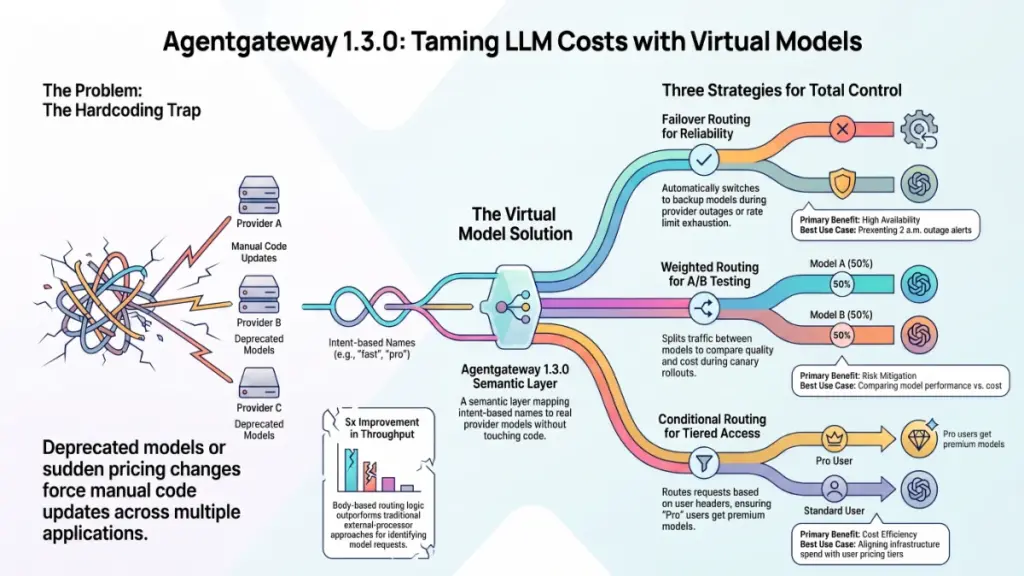
Here’s what I found after digging into the docs and the underlying design. Virtual Models let you define an abstract, intent-based name — something like “fast” or “reasoning” — that maps to one or more actual provider models behind the scenes. Your application code calls “fast.” Agentgateway decides which real model handles that request. Later, you can change that mapping without touching a single line of application code.
Why It Matters
If you’ve built anything on top of GPT-4o, Claude, or Gemini, you already know the pain. Provider model names are not stable. They get renamed, deprecated, or replaced with a “better” successor that carries different pricing and different latency. Every time that happens, someone has to grep the codebase for a hardcoded model string and update it in a dozen places.
Virtual Models remove that coupling entirely. Teams get a semantic layer between what the app asks for and what actually processes the request. That means platform teams can change routing decisions — cost, quality, failover — centrally instead of at the application layer. For a team responsible for AI spend across an organization, that’s the difference between a five-minute config change and a multi-team migration project.
Three Routing Strategies, Each Solving a Different Problem
Agentgateway 1.3.0 ships three routing strategies for Virtual Models. It’s worth understanding what each one actually does, rather than treating them as interchangeable options.
Weighted routing splits traffic across models by percentage. The obvious use case is A/B testing. Send half your traffic to a full-size model and half to a cheaper, faster variant, then compare quality and cost side by side. It’s also a sane way to canary a new model: start it at 10% of traffic, watch it, then dial the weight up as confidence builds. You never flip every user over at once.
Failover routing defines priority-ordered backup models. These kick in when the primary model goes down or hits a rate limit. Most production teams will likely reach for this strategy first, because provider outages and quota exhaustion are the failure modes that actually wake people up at 2 a.m. Order your fallbacks by descending cost, and you degrade gracefully to a cheaper model instead of taking a full outage.
Conditional routing is the most flexible of the three. It routes requests based on attributes like a header. In the documented example, “pro” tier users get a stronger model, while “free” tier users get routed to a cheaper one, based on an x-tier header. This ties infrastructure cost directly to your actual pricing tiers. You stop giving every user access to your most expensive model by default.
Technical Details Worth Knowing
Configuration happens through a YAML-based structure with two main sections: llm.models and llm.virtualModels. Each underlying model definition specifies a provider, the actual model name, and an API key reference. Each virtual model then points at one or more of those underlying models, with a routing strategy attached. You can mark models public or internal for visibility. That matters if you expose some model names directly to external callers while reserving others for internal routing logic only.
This feature builds on agentgateway’s existing body-based routing work. There, a custom pre-routing expression parses the model name out of the request body and exposes it as a header for downstream routing decisions. Solo.io says this mechanism delivers a 4x to 5x improvement in throughput and latency over the traditional external-processor approach. Virtual Models adds the next layer on top: once you can cheaply identify which model a request wants, you can just as cheaply redirect it somewhere else.
Industry Impact
The broader trend here isn’t new. API gateways have been evolving to handle AI-specific routing logic for a while, and agentgateway isn’t the only project in this space. What stands out is how directly this release targets cost management, rather than treating it as a side effect of routing infrastructure built for other reasons.
Engineering teams running production LLM workloads across multiple providers gain a real lever here. This kind of abstraction layer reduces vendor lock-in risk. It turns cost optimization into an operational task instead of a spreadsheet exercise. It’s also a sign that “multi-model, multi-provider” is becoming the default assumption for serious AI infrastructure, not just a niche concern for teams big enough to negotiate multiple vendor contracts.
Limitations and Open Questions
Solo.io’s blog post naturally reflects the vendor’s own perspective. It doesn’t include independent benchmarking of routing overhead or real-world cost savings, and I haven’t seen third-party numbers yet either. The weighted and conditional strategies also assume your team already knows which models map to which use cases. That clarity doesn’t always exist in practice, and the tooling won’t decide it for you.
The strategy list may not be final, either. Solo.io frames weighted, failover, and conditional as the current set “with perhaps more to come.” That phrasing suggests this feature is still evolving, not settled.
What Comes Next
Solo.io plans to keep building on Virtual Models in future agentgateway releases. If you already run multi-provider LLM infrastructure and fight the hardcoded-model-name problem, check the configuration docs. See whether the current routing strategies match how your teams actually consume models. For everyone else, this feature signals where AI gateway tooling is headed. Expect less “proxy that forwards requests” and more “policy layer that actively manages cost and reliability.” If you’ve ever had a client ask why last month’s OpenAI bill tripled, you know exactly why that shift matters.