

SpaceX’s AI division has released Grok 4.5, the first model co-built with coding startup Cursor since the two companies’ $60 billion tie-up — a direct challenge to the coding-assistant dominance of Anthropic and OpenAI.
Elon Musk’s SpaceXAI pushed Grok 4.5 into public availability this week, folding it directly into the Cursor IDE and into Grok Build, SpaceXAI’s own developer platform. The release caps a months-long courtship between the two companies that started with a data-center rental deal and ended with SpaceX absorbing Cursor outright.
For anyone who tests, buys, or builds on AI coding tools for a living, this is the moment the “who owns the model versus who owns the workflow” debate stopped being theoretical.
What Actually Happened
SpaceX confirmed it exercised its option to fully acquire Cursor in an all-stock deal, finalizing an arrangement first floated back in April. That original agreement had given SpaceX until year-end to decide, but the company moved early — a signal of how urgently it wants a foothold in the developer-tools market.
Key facts investors and developers should know:
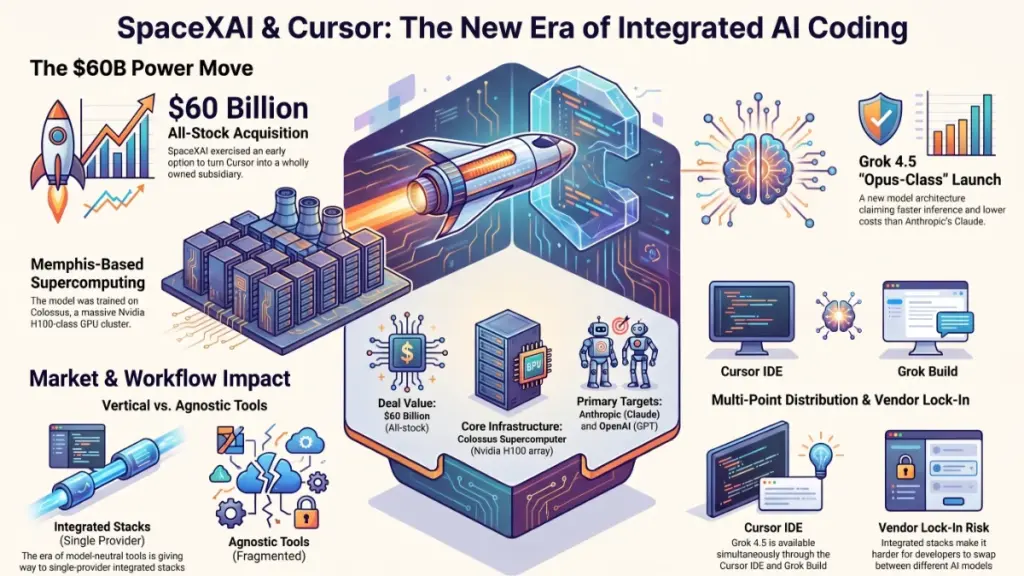
- Deal structure: All-stock transaction valuing Cursor at roughly $60 billion, with Cursor becoming a wholly owned subsidiary.
- Model name: Grok 4.5, described internally as an entirely new architecture rather than a fine-tuned version of prior Grok releases.
- Training infrastructure: Built on SpaceX’s Colossus supercomputer cluster, a massive Nvidia GPU array housed in Memphis, Tennessee.
- Distribution: Available simultaneously inside the Cursor editor and through Grok Build, giving SpaceXAI two entry points into the developer market at once.
- Positioning: Musk has described the model as “Opus-class” — a direct comparison to Anthropic’s Claude Opus line — while claiming faster inference and lower per-token cost.
Why SpaceX Wanted Cursor
SpaceXAI (formerly xAI) had no shortage of raw compute, but it lacked something Cursor had in abundance: a loyal base of paying developers already living inside its editor every day. Cursor, meanwhile, had users and revenue but relied on outside labs — including Anthropic — for its underlying models.
Buying Cursor collapses that dependency in one move. Rather than spending years building a coding-assistant audience from scratch, SpaceXAI inherited one, along with the product surface developers already trust.
It’s worth noting the acquisition wasn’t purely opportunistic. Cursor had reportedly been close to a competing funding round backed by major venture and chip-industry investors before SpaceX intervened with its buyout option — turning a rental partnership into a full takeover almost overnight.
The Compute Behind the Model
Grok 4.5’s training run leaned on one of the largest dedicated AI compute clusters in existence, combining a large fleet of Nvidia H100-class GPUs. That scale reflects Musk’s long-standing argument that raw compute density — not just algorithmic tricks — is what separates frontier labs from everyone else chasing them.
SpaceX has paired that ambition with equally aggressive infrastructure plans, including data-center buildouts intended to push AI compute beyond Earth’s surface in the coming years. Whether or not that orbital vision materializes on schedule, it underscores how much capital SpaceX is willing to commit to owning its AI stack end to end — chips, training, and now the coding tool developers actually open every morning.
Why It Matters for Developers and Digital Marketers
This isn’t just a corporate finance story — it changes real workflows for the people who use these tools daily.
- Coding assistant competition intensifies. Cursor previously offered developers a choice of underlying models. A first-party Grok option inside the same editor means more competition on price and latency, which is generally good news for teams watching AI tooling budgets.
- Vendor lock-in risk rises. Once a coding platform is owned by a single model provider, “model neutrality” — the ability to swap in whichever LLM performs best for a given task — becomes harder to guarantee long term.
- Marketing and automation teams should watch pricing shifts. SpaceXAI has framed Grok 4.5 as cheaper per token than comparable Opus-class models. If that holds up under independent benchmarking, it could pressure pricing across the broader SaaS AI-tooling market, including tools built on Anthropic and OpenAI APIs.
- Enterprise buyers need to verify claims independently. Reports on Grok 4.5’s performance are still largely self-reported by SpaceXAI. Teams evaluating a switch should wait for third-party coding benchmarks, published rate limits, and real pricing tiers before committing production workflows.
The Bigger Picture
Grok 4.5 arrives during a turbulent stretch for SpaceX. The company’s blockbuster IPO briefly pushed its market cap above $2 trillion, but shares have since pulled back sharply, and Musk’s personal net worth has swung by tens of billions of dollars in single trading sessions. That volatility is a reminder that even well-funded AI bets carry real financial risk for the parent company footing the bill.
For the AI coding-assistant market, the message is clearer: the era of neutral, model-agnostic developer tools is giving way to vertically integrated stacks, where the company that owns the editor increasingly also owns the model running inside it. Whether that serves developers better than the multi-model status quo — or simply narrows their choices — is the question worth watching over the next few quarters.
As always, AppReviewLab will publish hands-on benchmarks of Grok 4.5 against Claude and GPT-based coding assistants once broader access and pricing details are confirmed.