

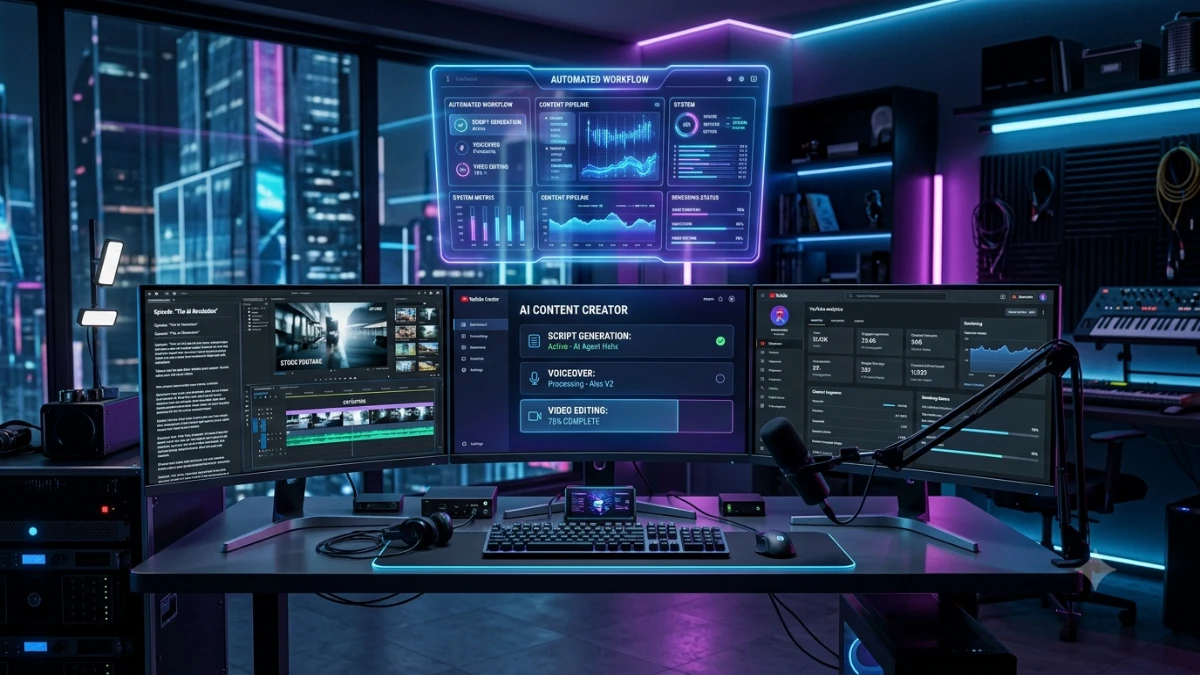
Faceless Forge is a local AI-powered faceless video creation system that helps creators own their automation instead of relying on costly subscription platforms. After testing multiple AI channel tools for three months, the reviewer found its ownership model, automated workflow, and multi-platform publishing to be a practical solution for creators who want greater control, lower long-term costs, and a scalable content production process.
You’ve got fourteen browser tabs open. A script generator. A stock footage library. A text-to-speech tool that keeps clipping the last word of every sentence. A thumbnail maker. A spreadsheet tracking which credits reset on which day of the month.
The Math You’ve Done a Dozen Times
You run the numbers again. $49 a month for the AI voice tool. $29 for the video assembly platform. Another $19 for the SEO plugin that writes your titles. That’s $97 a month before you’ve published a single video — and that’s the “starter” tier. You upgraded twice already. The free plan capped you at four videos a week, and a channel that posts four times a week doesn’t beat the algorithm. It just survives it.
The Time Nobody Warns You About
Then there’s the time. Not the fun kind — the grinding kind. Forty minutes stitching together a script from three different AI outputs, because none of them nailed the hook. Twenty more minutes matching stock clips to sentences by hand, because the “auto-match” feature keeps pairing “the fall of the Roman Empire” with a stock clip of a woman falling off a bike. You’ve missed dinner with your family twice this month. “I just need to finish this one video” turned into two hours.
The Email You’re Dreading
You know the one. Maybe it hasn’t landed yet. But you’ve seen it happen to someone in your Discord: “We’re sunsetting this feature.” Or “Pricing is changing effective next billing cycle.” Or worst of all: “This service will be discontinued.” Six months of consistent uploads. A channel finally climbing past a thousand subscribers. And it all lived on someone else’s servers, under someone else’s terms. It was never really yours in the first place.
If any of that sounds familiar, you’re not doing anything wrong. You’re just using tools built to rent to you forever, not to hand you the keys.
How I Got Burned Into Building the Alternative
I’ve tested AI marketing tools since the GPT-3 API waitlist days. I’ve made almost every expensive mistake there is to make. The one that stings the most wasn’t a content tool — it was a faceless-channel automation platform I paid for back in 2023.
Here’s what happened. I found a subscription tool that promised end-to-end faceless video production: script, voice, visuals, upload, done. It worked great for about five months. I built a small channel and found a rhythm. I started seeing real traction. Then the company got acquired. Within six weeks, the pricing tripled. Half the voice models I’d built my brand around disappeared. The API connecting to my scheduling tool got deprecated with two weeks’ notice. My channel didn’t die because the format stopped working. It died because I never actually controlled the machine running it.
That’s when the lightbulb went off — and it’s the same realization the Faceless Forge team says pushed them to build this thing. They’d built and run their own faceless channel, the same way I had, and kept hitting the same wall: every tool on the market rents you access. You build on their infrastructure, under their rules, and they can change the deal whenever they want. So instead of building another rented tool, they built an agent that runs locally, on your own machine, that you own outright once you’ve paid for it.
I’ll be upfront about my bias here: I like tools I can point at and say “that’s mine, no one can take it,” because I’ve had it taken away before. That colors how I evaluate anything in this category. It also means I know exactly what questions to ask before recommending something to you.
Why the “Rented Tool” Category Keeps Letting Faceless Creators Down
I’ve tested enough of these platforms to sort the failures into three buckets.
Enterprise Platforms Bury Simple Tasks Under Complexity
Some of the bigger production suites I’ve tried have genuinely powerful engines under the hood. They also have onboarding flows that take longer than making three actual videos. You click through certification-style tutorials before you’ve published anything. Most people abandon these before finishing their first real project — not because the tool is bad, but because the learning curve front-loads all the pain.
Outsourcing Hides Its Real Cost
I’ve hired freelance editors for faceless content before. The sticker price on Fiverr or Upwork looks reasonable — until you add up revision rounds, time-zone delays waiting on a script rewrite, and inconsistent quality from swapping editors every few months. A “cheap” $40 video turns into a $150 video once you count your own time chasing revisions.
Template Tools Wreck Brand Consistency
This one annoys me most. You can pump out a faceless video in ten minutes with a template tool. So can the next 500 channels using the same template library. Your intro looks like their intro. Your transitions look like their transitions. You optimized for speed and quietly destroyed the one thing that makes a channel worth subscribing to.
None of this is hypothetical. I’ve personally lost money and time to all three.
Why This Format Works in the First Place
Before I get into the specific tool, it’s worth explaining why faceless video works at all. It’s not a fluke of the algorithm.
The Cognitive Science Behind It
Video that pairs narration with synchronized visuals leans on what’s sometimes called dual-coding. Your brain processes visual information dramatically faster than text. When audio and visuals reinforce each other instead of competing, retention goes up. That’s part of why faceless explainer and story-format channels do so well across geography, history, mystery, and finance niches. The format is built around clarity, not spectacle.
Less Clutter, More Signal
There’s also a cognitive-load argument for going faceless. Traditional talking-head video forces viewers to unconsciously track camera angles, lighting, body language, and audio quality all at once. Strip that out, and the message carries all the weight. That’s not a workaround for skipping a camera setup. It’s genuinely a cleaner delivery mechanism for information-dense content.
It’s Not a Trend
Unlike a lot of trend-driven video styles, this format has held up. Flashy editing styles come and go. Clear structure and direct communication keep winning, year after year, no matter what the algorithm currently rewards.
What Faceless Forge Actually Is
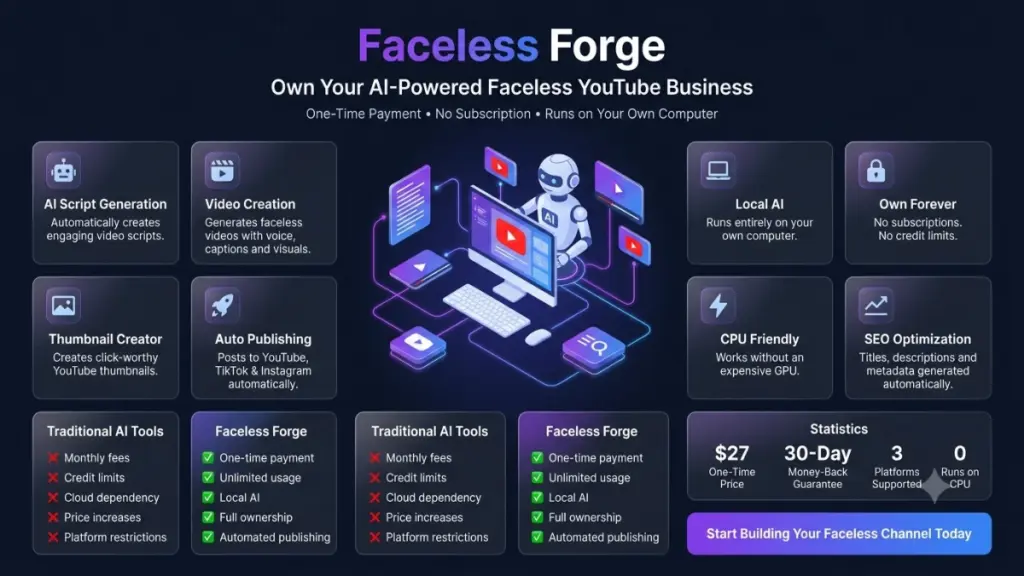
Faceless Forge isn’t a video editor, and it isn’t a subscription content generator. It’s a packaged method plus software for running an AI agent — built on Hermes, a free open-source agent — that operates your faceless channel end to end, on your own computer.
Here’s the pillar breakdown, based on what I’ve seen it do:
Scene and script generation. You hand it a topic or a brief. It writes the script, breaks it into scenes, and builds the hook, using prompt patterns the creators say come directly from channels they run themselves.
Asset matching, voice, and visuals. Each scene gets matched visuals, voiceover, and captions automatically. This step used to eat 20-plus minutes per video in my old workflow.
Metadata and packaging. The system generates a title, thumbnail, and description for every video — the unglamorous stuff that actually drives click-through, and the stuff most automation tools skip.
Scheduled, multi-platform publishing. Set a cadence, and it posts to YouTube, Instagram, and TikTok on that schedule, then logs the output so you can see what ran.
The signature piece here is that the whole pipeline runs locally through the agent. It doesn’t bounce your script and assets through five different rented APIs. One brief goes in, and the factory line runs the rest.
Watching the Factory Line Run
The most convincing part of what I looked at wasn’t a promo clip. It was the paper trail. The creators run their own channel, MapBreak, with this exact setup. They’ve published the receipts: a single one-sentence brief and schedule entry that’s been running unattended since it was written, a 28-day-straight production log with a link for every episode, and the public channel itself with videos going up daily.
That’s the part I actually care about, as someone who’s been burned by demo-only “proof” before. A public, checkable channel with dozens of dated, linked episodes makes a very different claim than a screenshot of a dashboard. I’d still tell you: go look at it yourself before you take my word for it. That’s exactly what I’d want a reviewer to tell me.
Who This Is Actually Built For
Digital marketers running a stack that already includes a CRM, a scheduler, and a content calendar don’t need one more disconnected tool to babysit. This system slots a script straight from your calendar into the dashboard and exports finished video in the format your scheduler wants. It plugs into your stack instead of replacing it.
Educators and course creators sit on lecture recordings and written material that could become structured video lessons — if converting them didn’t eat the hours that should go to actual curriculum work. Feeding existing lesson plans into the agent keeps your expertise at the center while it handles segmentation and pacing.
Freelancers and agencies feel the squeeze when client volume outpaces team size, deadlines tighten, and revision requests stack up. Automating the production layer lets you keep delivering consistent, branded video without hiring a dedicated editor for every client.
Small business owners without a creative department can’t easily compete visually with bigger, better-funded brands. This changes once the production process compresses down to something one person can run without prior video experience.
Where It Sits Against the Alternatives
I’ll say this plainly: Faceless Forge isn’t trying to out-feature the big production suites, and it shouldn’t. The gap it fills is specific. Older platforms were built for professional editors, not busy creators juggling five other jobs. Newer speed-focused tools sacrificed output quality to get there fast. Neither camp prioritized letting you own your own pipeline. That’s the real gap here: deployment speed and brand consistency, without handing your channel’s infrastructure to a third party that can change the rules on you.
A Quick Walkthrough, So There’s No Mystery Left
First login, you get one prompt: what do you want to create today. There’s no thirty-step setup wizard. From there, you paste your script or topic, pick a visual style, confirm your brand settings, and hit generate. The first draft is ready in minutes.
Each scene shows up as its own card in a timeline view. If something’s off — wrong visual, awkward timing — you fix that one card without digging through nested menus. The export panel lets you pick your platform and aspect ratio. Hit export, and the file lands wherever you’ve connected it.
Honest Reflections — Who Should Skip This
I’d be doing you a disservice if I didn’t flag this clearly. If you need cinematic production — custom motion graphics, live-action footage, complex animation work — this isn’t that tool, and it’s not trying to be. If you’re a professional editor who wants frame-level timeline control, the simplified interface will probably frustrate you rather than free you.
There are also real gaps in the current visual asset library for certain niche aesthetics. The team says they’re actively expanding it, but check that the current style options fit your brand before you commit.
I’d rather tell you this upfront than have you find out after checkout. A tool that’s honest about what it can’t do is a lot easier to trust about what it can.
The Bottom Line
The pitch that got my attention wasn’t “this makes videos faster.” Plenty of tools claim that. It was “you own the thing that makes the videos, instead of renting access to it.” A rented tool once got acquired out from under me and gutted a channel I’d spent months building. That distinction isn’t marketing to me. It’s the actual difference between an asset and a liability.
If you’re already deep into a subscription stack that’s working fine, there’s no urgent reason to switch. But if you’re tired of the credit caps, the price hikes, and the quiet dread that your next login might bring a “we’re shutting this down” email, Faceless Forge is worth a real look. Go check the public channel and the production logs yourself before you decide — that’s exactly what I’d do.