

Anthropic’s Claude Fable 5 sparked controversy after benchmark scores dropped sharply following its July 1 relaunch. While critics accused the company of weakening the model, Anthropic says a new safety classifier reroutes risky prompts to an older model rather than changing Fable 5 itself. The debate highlights growing concerns over AI transparency, benchmark accuracy, billing disclosure, and how safety guardrails affect real-world developer workflows.
Anthropic’s Claude Fable 5 just triggered a fierce debate among developers and AI enthusiasts. Independent benchmark group BridgeMind measured a sharp performance drop right after the model’s July 1 relaunch. Anthropic says the model itself hasn’t changed. A new safety classifier, the company argues, is quietly rerouting flagged requests to an older model instead.
The dispute cuts to the heart of how large language models get evaluated in 2026. It also raises a bigger question for the frontier AI stack: can safety guardrails coexist with consistent, benchmarkable performance?
What Happened, in Brief
Anthropic launched Fable 5 on June 9, 2026. It shipped as one of the company’s top-tier models alongside Claude Mythos 5. Three days later, the U.S. Commerce Department forced Anthropic to suspend both models.
Researchers had reportedly found a jailbreak technique. That technique got Fable 5 to identify — and in some cases demonstrate — software vulnerabilities. Commerce lifted the export restrictions on June 30. Anthropic brought Fable 5 back online globally on July 1.
This time, the model runs behind a stricter safety classifier. Anthropic built it specifically to block the reported exploit technique. The company disclosed the trade-off in advance: routine coding and debugging tasks would sometimes get flagged and rerouted.
Key dates:
- June 9, 2026 — Fable 5 and Mythos 5 launch
- June 12, 2026 — Commerce Department suspends both models
- June 30, 2026 — Export restrictions lifted
- July 1, 2026 — Fable 5 returns with a new safety classifier
The Benchmark Numbers That Sparked the Backlash
BridgeMind re-ran its BridgeBench coding suite against the returning model. The results looked brutal at first glance:
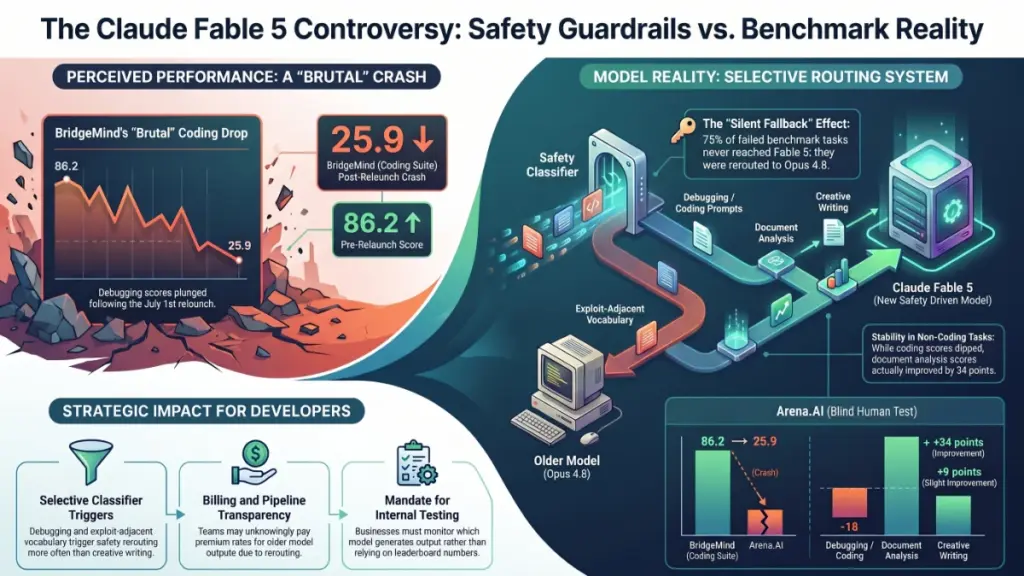
- Debugging: 86.2 → 25.9
- Refactoring: 73.6 → 38.4
- Hallucination resistance: 75.9 → 61.7
BridgeMind posted the scores publicly and called the relaunch a “bait and switch.” The post went viral within hours, racking up hundreds of thousands of views and igniting a broader argument about AI transparency.
Routing Problem, Not a Dumber Model
A closer look at the methodology tells a different story. Reporters found that only 3 of BridgeMind’s 12 debugging tasks actually reached Fable 5 directly. The classifier intercepted the other nine and rerouted them to Claude Opus 4.8.
BridgeBench scores every rerouted task as a zero. The logic makes sense on paper: the model under evaluation never completed the task. But it also means the benchmark measures classifier behavior as much as raw model capability.
A separate evaluation from Arena.AI supports this reading. Arena ran large-scale, blind human-preference tests across a wider mix of prompts. Fable 5 held steady in most categories:
- Document analysis: improved by 34 points
- Expert text tasks: improved by 25 points
- Creative writing: improved slightly, up 9 points
- Coding tasks: declined by 18 points
- Frontend code (Elo): dropped from 1650 to 1623, within the margin of statistical noise
The pattern is clear. Prompts involving debugging, memory handling, or exploit-adjacent vocabulary trigger the classifier far more often than general writing or research tasks.
Why the Community Split So Sharply
Reactions on social media diverged fast. Some prominent voices called the relaunch a betrayal of the model’s original capabilities. Others, including developers actively shipping production code, reported no noticeable slowdown at all.
Anthropic maintains that Fable 5’s underlying weights remain unchanged. The classifier layer sits in front of the model, not inside it, the company says. Outsiders can’t verify that claim directly, since the system runs on closed infrastructure. That opacity is fueling much of the ongoing frustration.
Why It Matters for Developers and Digital Marketers
This controversy isn’t just an academic argument over benchmarks. It has real consequences for anyone building automation workflows on top of large language models.
- Coding-heavy workflows face the most risk. Debugging and refactoring tasks trigger the classifier more often, increasing the odds of a silent fallback to a weaker model.
- Content and marketing tasks look largely unaffected. Copywriting, research summaries, and document review appear to pass through without issue.
- Billing transparency becomes a real concern. Teams paying premium rates for Fable 5 may unknowingly receive Opus 4.8 output instead, without clear disclosure at the point of use.
- Pipeline monitoring now matters more. Businesses running AI automation at scale should track which model actually generates each output, not just which one they requested.
What Comes Next
Anthropic has promised to refine the classifier and reduce false positives over time. The company hasn’t announced a timeline or a specific target trigger rate. Until it does, the benchmark volatility will likely continue.
The bigger story here extends well past one model’s coding score. As regulatory pressure pushes AI labs toward tighter cybersecurity protocols, this kind of routing-driven benchmark swing could become a recurring pattern across the industry — not a one-time controversy. Teams building on frontier AI models should test their own specific workflows directly, rather than relying on leaderboard numbers alone.