


GLM-5.2, a new AI model from China’s Z.ai, is emerging as a serious competitor to leading US models by offering strong coding and reasoning performance at a much lower cost. Its affordability, open-weight deployment, and growing developer adoption make it an important option for businesses looking to reduce AI expenses while diversifying beyond a single AI provider.
The Hook: A Cheap Chinese Model Is Closing the Gap
A Beijing-based startup called Z.ai has released an AI model that’s forcing Silicon Valley to pay attention. The model, GLM-5.2, launched last month and has already climbed above several Anthropic models on developer platforms like OpenRouter — while reportedly costing a fraction of what US frontier labs charge. For an industry that has spent years assuming American labs held an uncontested lead, that’s a genuinely big deal.
Analysts are calling it a “mini DeepSeek moment,” a nod to the market shock that Chinese lab DeepSeek triggered when it debuted a low-cost, high-performing model early last year.

What Makes GLM-5.2 Different
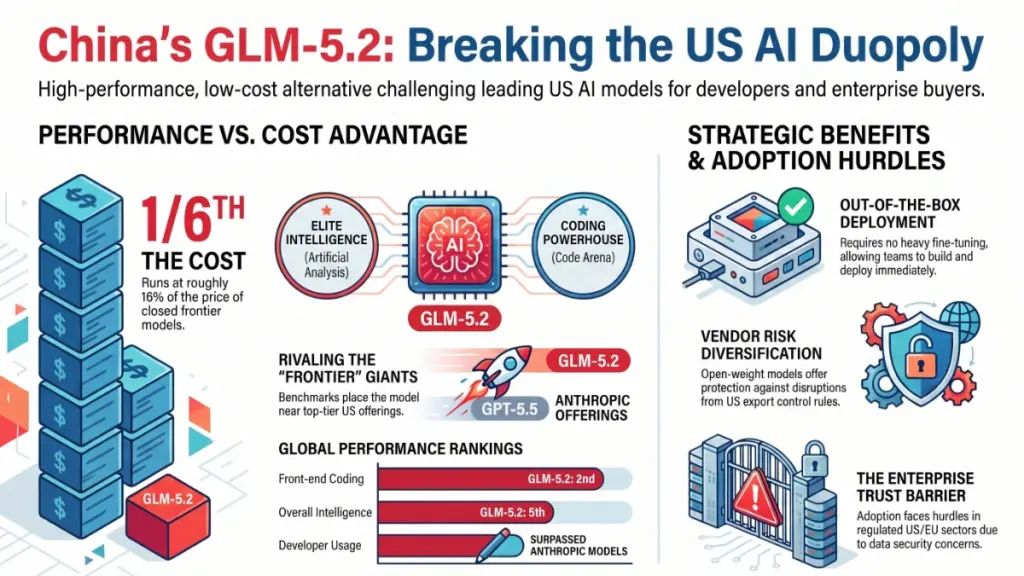
Unlike previous Chinese models that lagged behind on real-world usability, GLM-5.2 is being praised for something more practical: it works out of the box. Former Hugging Face APAC lead Tiezhen Wang noted that the model doesn’t require heavy fine-tuning to become useful — you can essentially deploy it and start building immediately, which lowers the barrier for teams that don’t have deep ML infrastructure.
That matters for developers and automation specialists (like the readers of AppReviewLab) because ease of deployment is often a bigger adoption blocker than raw benchmark scores.
Where GLM-5.2 Stands on the Leaderboards
- Ranked fifth on Artificial Analysis’ overall LLM intelligence leaderboard, which scores models across reasoning and coding benchmarks
- Second place on Code Arena’s front-end coding rankings, which measure how well a model builds websites and UI
- Estimated to run at roughly one-sixth the cost of closed frontier models from Anthropic and OpenAI
- Surpassed several Anthropic models in usage rankings on the OpenRouter developer platform
Even prominent US voices have taken notice. David Sacks, who previously served as the White House’s AI policy lead, remarked on the All-In podcast that the model sits just below Anthropic’s Opus 4.8 and roughly matches OpenAI’s GPT-5.5 tier — a striking admission from a former US AI official.
Why the Timing Matters
Part of GLM-5.2’s momentum comes from circumstance rather than pure technical superiority. Washington briefly restricted access to Anthropic’s Fable and Mythos models under export control rules before lifting the curbs, and OpenAI has been slow to broadly roll out its newest GPT-5.6 model. That created a window where developers went looking for alternatives — and found one.
Brian Tse, founder of the Beijing-based AI safety consultancy Concordia AI, framed it as a wake-up call: the developer community is increasingly wary of leaning entirely on proprietary, US-hosted API models when policy shifts can disrupt access overnight.
There’s also a cost-control angle. As agentic AI tools consume more tokens to complete complex tasks, unpredictable billing from closed-source providers is pushing more businesses to evaluate cheaper, open-weight alternatives.
Why It Matters for Developers, Marketers, and Remote Teams
For the AppReviewLab audience — marketers, automation builders, and SaaS buyers — this shift has immediate, practical implications:
- Lower operating costs: Running agentic workflows on a model priced at a fraction of Claude or GPT rates could meaningfully cut monthly AI spend for content generation, coding assistants, and automation pipelines.
- Deployment flexibility: Open-weight models like GLM-5.2 can be self-hosted, giving technical teams more control over latency, customization, and data routing.
- Vendor risk diversification: Regulatory disruptions to any single provider (as seen with Anthropic’s temporary export restrictions) are a reminder that single-vendor AI stacks carry real business risk.
- Not a free pass on data security: Enterprise buyers in regulated sectors like banking still need to weigh where model inference actually runs, and under what data-handling terms.
The Adoption Hurdle: Trust, Not Talent
Performance isn’t the only variable in enterprise AI purchasing decisions. Wei Sun, principal AI analyst at Counterpoint Research, pointed out that some clients and regulated industries in the US and EU may simply be unwilling to bring Chinese-developed models into their AI stack, independent of how well the model actually performs.
That resistance is real, but it isn’t universal. Analysts who track China’s tech sector note that developers and smaller companies tend to prioritize functionality, price, and reliability over the country of origin — meaning adoption may creep in through smaller teams and side projects well before large enterprises officially sign off.
Research from the nonprofit RAND, examining web traffic across 135 countries, found that Chinese large language models saw their combined global market share roughly quadruple in the months following DeepSeek’s initial breakout release. That growth was concentrated mainly in developing markets and countries with closer economic ties to Beijing — a pattern that could repeat itself with GLM-5.2, though Western enterprise uptake will likely remain slower and more cautious.
What This Means Going Forward
Don’t expect wholesale replacement of Claude or GPT-series tools inside major US enterprises anytime soon — migration cycles for enterprise AI systems typically take months, and compliance teams move carefully. What’s more likely, according to China tech analyst Poe Zhao, is partial routing: teams quietly running specific workloads on cheaper Chinese models while keeping sensitive or regulated tasks on established US providers.
Still, the signal here is clear. The gap between US frontier labs and Chinese open-weight alternatives is narrowing faster than many expected, and price-conscious teams now have a credible reason to at least test the alternative. For anyone managing AI tooling budgets, GLM-5.2 is worth watching — not necessarily replacing your current stack, but definitely benchmarking against it.