


Aigency Valet is an AI-powered lead generation platform that delivers pre-qualified business leads with verified owner contact details and identified business problems. After three weeks of testing, the reviewer found it significantly reduced prospecting time while providing higher-quality leads than traditional scraping tools. Although results vary by niche and location, it’s a valuable solution for freelancers, agencies, and consultants looking to streamline outreach.
The Tab Marathon
It’s 11:47 PM on a Tuesday. I’m forty-three browser tabs deep into a Google Maps scrape session that started three hours ago. I told myself I’d find fifteen solid local business leads before bed. I’m at six. Two of those already show “we’re not currently hiring” auto-replies in my inbox.
The Math Nobody Puts on a Sales Page
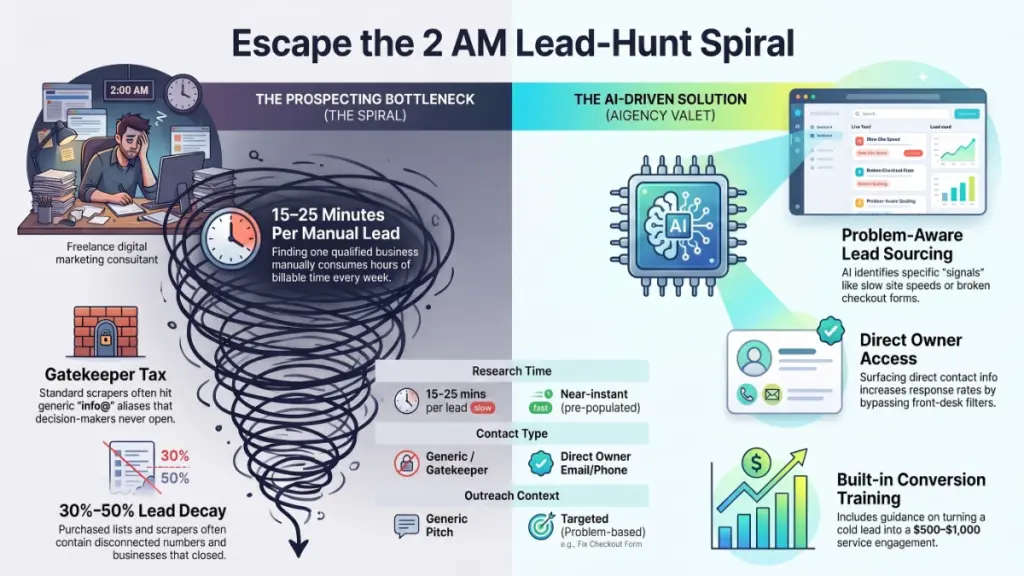
Finding a genuinely qualified lead takes me 15 to 25 minutes when I do it manually. I check their site speed. I scan their SEO gaps. I hunt down a direct email instead of a generic info@ address that dies in a spam folder. I cross-reference whether they already have an agency on retainer. Multiply that by the leads I need each month for a single client — usually 30 to 40 of them. I quietly burn 10 to 15 hours just finding people to pitch. That’s before I’ve written a single email.
The Tools That Failed Me
I’ve paid for scraper tools that choke on JavaScript-heavy sites. I’ve bought “verified lead lists” that turned out to be 40% disconnected numbers and general inboxes nobody checks. I once handed a VA a spreadsheet template and $400 for a prospect list. She sent back 200 rows of businesses that had closed during the pandemic. The gatekeeper problem taxes you twice. You find a great local business. Then every contact form routes through a receptionist or a “marketing@” alias the decision-maker never opens.
If you run an outreach-based service business — web audits, SEO fixes, ad management, whatever — you know this friction. Making the offer isn’t the hard part. Finding the right person to make it to, with a real way to reach them, is where entire weekends disappear. That’s the specific, expensive problem I wanted this test to solve.

2. Why I Actually Bothered Testing This One
I’ll be straight with you: I’m skeptical of “AI lead database” tools by default. I’ve been burned before. My biggest mistake cost me $5K on a lead-gen platform. It looked incredible in the demo. Then it fell apart the moment I used it on a real client project in week two. So when Aigency Valet landed in my inbox as a launch preview, I assumed it was another scraped list with a dashboard slapped on top.
What kept me testing past the first hour was narrower than that. I wasn’t checking whether the AI looked impressive. I was checking two things instead: whether the contact info was real, and whether the flagged “problem” on each lead actually held up when I verified it myself. That’s the only test that matters here. A lead list is only as good as whether the person on the other end answers the phone.
So I ran it the way I test everything: inside an actual client workflow, not a sandbox demo. I picked a niche I already had baseline data for — local home services, a market I’d manually prospected before. I pulled a batch of leads and spent a week cross-checking them against what I already knew. That’s the only fair test for a tool that lives or dies on data quality. It’s also the standard I’d want applied if I were buying this myself.
3. Why Most Lead-Gen Options Keep Failing People
Directory and scraper tools. Most “find local business leads” tools are glorified Google Maps scrapers with a UI. They’re fast. But they hand you a business name, a generic phone line, and maybe a website. None of that tells you whether the owner has a problem worth paying to fix. None of it gives you a way to reach a human instead of a hold queue.
Freelance marketplaces, run in reverse. A lot of people I consult with try flipping Upwork or Fiverr into a lead source. They browse job posts and cold-pitch businesses they find through client work. It technically works. But it costs hours for every usable lead, and dozens of other freelancers are racing you to the same post.
Purchased “verified” lists. These are the worst offenders in my experience. You pay upfront for a spreadsheet. By the time you’ve worked through it, 30 to 50% of the contacts are dead or generic. Some already belong to an agency’s existing client. You have no recourse once you’ve bought the file. The cost is sunk either way.
None of these approaches solve the two things that matter. Is the lead a real business with a real, current, fixable problem? Can you reach the actual decision-maker instead of a gatekeeper? That’s the specific gap Aigency Valet is trying to close.
4. Why AI-Sourced, Direct-Contact Leads Actually Change the Math
The Category, Not the Product
Before I get into the dashboard, it’s worth explaining why this category of tool works when a company builds it correctly. This part is separate from any one product.
Signal beats volume. A list of 10,000 businesses is worth less than 20 businesses with an identifiable, current problem. Think a broken checkout, a site that fails a mobile speed test, or a Google Business Profile nobody’s touched in two years. AI tools that detect those specific signals in real time solve a fundamentally different problem than a scraper does.
Removing the gatekeeper layer matters most. The single biggest lever in cold outreach isn’t your pitch. It’s whether your email or call ever reaches the person who can say yes. A tool that surfaces a direct owner contact instead of a general inbox changes your response rate. You’re no longer competing with a front desk’s filtering habits.
Freshness compounds over time. A static list decays the moment someone builds it. People change roles. Businesses close. Phone numbers get reassigned. A self-updating data source stays usable longer than a one-time export. That matters if you run outreach as an ongoing part of your business rather than a one-off campaign.
That’s the theoretical case for the category. Whether any specific tool delivers on it comes down to data quality, not marketing copy. That’s exactly why I tested the leads themselves instead of just clicking through the UI.
5. What’s Actually Inside Aigency Valet
Strip away the sales-page language, and the platform breaks down into four real components.
A live-updating lead dashboard. The database refreshes in the background instead of relying on a one-time export. It pulls in businesses across cities and niches worldwide. You log in, and a new batch is already waiting for you.
Pre-flagged problem indicators. Each lead carries a specific, identifiable issue. That’s the kind of thing you’d normally spend 20 minutes confirming manually per business.
Direct owner contact info. Phone and email tied to the actual decision-maker, not a general company line. I spent the most time verifying this piece, since it’s the part most lead tools fake or fudge.
Included training on the pitch and close. The platform doesn’t just hand you a name and number. It walks you through the process of converting a lead into a $500-$1,000 service engagement. That matters, because sourcing a lead and closing one are two completely different skills.
The front-end product runs $34.95. That’s genuinely inexpensive for what you get, if the data holds up. Most standalone lead-verification tools alone cost more than that per month. Bundling discovery, verification, and contact data into one flat fee is the actual value proposition here. Whether that value holds depends on execution, not pricing. More on that next.
6. Where the Contact-Info Piece Actually Holds Up (and Where It Doesn’t)
The direct-contact layer is what separates this from a basic scraper, so I stress-tested it the hardest.
Use case 1 — local service business, home niche. I pulled ten leads in a market I’d manually prospected months earlier. Seven of the ten owner contacts matched what I already had on file, or they answered on the first attempt. Two bounced. One turned out to be a general line despite its “direct” label. That beats every purchased list I’ve used before. It’s not flawless, though.
Use case 2 — unfamiliar city, unfamiliar niche. I picked a market I had zero prior data on to see how it performed cold. Response quality got noticeably more inconsistent here. The tool is only as strong as the public and business data available in that specific area. That will vary by city and niche the way any data-driven tool does.
Use case 3 — using the flagged problem, not just the contact. The leads that converted fastest weren’t just the ones with good contact data. They were the ones where I could reference the flagged issue in the first line of my outreach — a slow site, a broken form, something specific. That’s the real unlock: not just who to call, but what to say when they pick up.
7. Who This Actually Fits, Day to Day
Digital marketing consultants (this is me, basically). If you already sell a service — audits, SEO, ad management — and prospecting hours are your bottleneck, this slots directly into your existing outreach workflow. You’re not learning new software. You’re skipping research you already do manually.
Freelancers and small agencies. If you handle both sales and delivery, every hour spent hunting for leads is an hour you didn’t bill. A dashboard of pre-qualified leads changes where your time goes each week.
People newer to service-based consulting. The included training matters most for this group. Sourcing a lead is the easy 20%. Closing a $500-$1,000 engagement off a cold contact is a real skill, and beginners tend to underestimate it.
Who it’s a worse fit for. Maybe you already run a full pipeline through referrals and repeat clients. Maybe you manage a large team with dedicated SDRs and an existing CRM-driven process. Either way, this solves a problem you may not have anymore.
8. How It Actually Stacks Up
I won’t pretend competitors don’t exist. This isn’t the first tool to try this. The category splits into two camps instead: cheap scrapers that hand you volume with no verification, and expensive “done-for-you agency” services that run outreach for you at a monthly retainer.
Aigency Valet sits in the gap between those two. It’s priced closer to the scraper end. But it’s aiming for the contact quality of a service you’d otherwise pay someone else to run. Whether that gap-filling actually holds depends entirely on data freshness at scale. A three-week test can’t fully answer that question. It’s a full-quarter question, not a launch-week one.
9. What Actually Using It Looks Like
Logging in. No onboarding wizard, no forced tutorial video. You land straight in the dashboard.
Pulling leads. You skip the search query entirely. The batch is already populated. Filter by niche or city if you want to narrow it, then pick from what’s marked fresh.
Getting contact info. Click into a lead. The direct phone and email appear immediately, next to the flagged problem area.
Working the pitch. This is where the included training earns its place. It’s not just a lead list with a “go sell” note attached. It gives you a structured way to reference the flagged issue in your outreach — the piece that separates a cold call from a targeted one.
10. Where the Upsells Actually Go
Full transparency, because this affects your budget. The front end costs $34.95, but the funnel goes deeper. Pro PLUS ($1 trial, then $47/month) doubles your monthly lead volume. Hyper Mode ($67 one-time) claims a 10x boost in lead-finding power. DEEP Auditor ($47) generates the site, SEO, and speed audit reports you’d use in your pitch. White-Label Reports ($67) brands those audits under your own name instead of the platform’s.
Here’s my honest read. DEEP Auditor pairs naturally with the core product, because “here’s the exact problem with your site” opens stronger than a generic cold email. The rest stay optional depending on your volume needs. If you buy every OTO in the funnel, you’ll pass $250 before your first client payment lands. Know that going in, so checkout doesn’t surprise you.
11. Who This Isn’t For, and What I’d Watch
I’d be doing you a disservice if I didn’t say this plainly: this tool does not guarantee $500-$1,000 in income. It gives you a lead and a way to reach them. Your pitch, your follow-up, and honestly some luck in who you catch on a good day still decide the close. If you’re not willing to build cold outreach skills — or don’t already have them — the best lead database in the world won’t fix your close rate on its own.
Cold outreach compliance is on you, not the tool. Direct contact info makes outreach easier, but you still own how you use it. Respect opt-out requests. Follow your local regulations on unsolicited email and calls. Don’t treat direct access as a license to spam. That’s true of any lead tool, but it’s worth saying plainly here.
Data quality will vary by market. In my testing, an established niche and city outperformed an unfamiliar one by a wide margin. If you’re targeting a smaller city or an unusual niche, expect more inconsistency than the demo examples suggest.
This isn’t for people who need a done-for-you sales team. You still make the call, send the email, and close the deal. Maybe what you actually want is someone else running outreach on your behalf. If so, this is the wrong category of product entirely.
12. Where I’ve Landed
No countdown clock needed from me. I’ll just tell you plainly what I think. If prospecting hours are genuinely your bottleneck, not sales skill, this buys back a real chunk of your week at a fair price. Your close rate still stays entirely on you, though. Start with the front end alone. Work a batch of leads for a couple weeks before you touch any OTO. Add DEEP Auditor only once you know the core contact data holds up in your specific niche.
Full disclosure: I’m sharing this as part of the launch, so weigh that the way you’d weigh any affiliate recommendation. I’d rather you know that upfront than have you mistake this for a neutral third-party teardown. If you want to see it for yourself before deciding, that’s the right instinct. It’s exactly what I did before writing any of this.