

A developer had fully integrated Claude Code into his daily workflow. Then he dropped it for seven days and ran OpenAI’s Codex instead. The goal wasn’t a benchmark showdown. It was a real-world test.
Could Codex take over the jobs Claude Code had already earned trust doing? That meant debugging, small feature work, documentation, and digging through unfamiliar codebases.
The result wasn’t a clean win for either tool. Instead, it mapped out where each tool actually excels. That map matters more right now than any leaderboard score. Most teams choosing between agentic coding tools face a narrower question: which tool fits my workflow, not which one wins in the abstract.
Why It Matters
Agentic coding assistants have moved past the novelty phase. Developers no longer ask whether to use one. They ask which one, for which task, and increasingly, whether to run more than one at a time.
That shift changes what a comparison like this is worth. Vendor benchmarks show how a model scores on a fixed test set. A week of daily-driver use shows how a tool behaves in messier conditions. Tasks get half-specified. Bugs hide three layers deep in a codebase nobody’s touched in months.
For engineering teams and technical leads building out their toolchains, that second kind of evidence is harder to find. It’s also more useful.
Where Codex Pulled Ahead
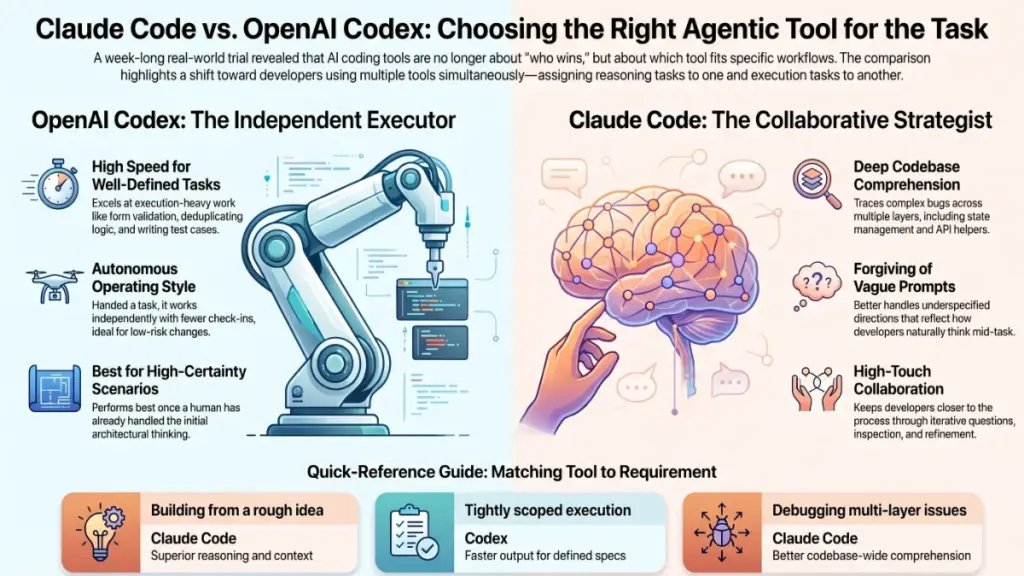
Codex’s speed advantage wasn’t consistent, the developer found. It depended entirely on how well-defined the task was. He asked Codex to build a multi-section website from scratch. Codex produced a fast first draft, but the draft still needed considerable manual cleanup. Spacing looked off. Some sections felt generic. The mobile layout needed rework.
The picture changed on narrower, well-scoped work. Form validation went faster. So did layout bug fixes, deduplicating logic, and writing test cases. This pattern points to a tool that performs best once a human has already done the thinking. Codex just needs to execute.
Codex’s operating style also leaned more autonomous. Handed a task, it tended to work independently rather than checking in. That approach helps on small, low-risk changes — a developer can review the diff and move on. But it creates friction on changes sensitive enough to warrant closer oversight.
Where Claude Code Held Its Ground
Claude Code performed better on tasks that required deep codebase comprehension rather than isolated edits. In one example, the developer used it to trace a dashboard bug. A settings panel had stopped saving changes. The obvious fix seemed to live in the UI component. But Claude Code traced the real issue through the state management layer and the API helper instead.
The gap showed up in prompt handling too. Claude Code proved more forgiving of vague, underspecified prompts – the kind that reflect how developers actually think mid-task, not a clean spec written in advance. Codex, by contrast, needed more precise direction to hit the intended result.
There’s a control dimension here too. Claude Code kept the developer closer to the process. He could ask questions, inspect answers, push back, and refine his approach step by step. Codex created more distance between the developer and the change itself. That cut both ways, depending on how much oversight the task warranted.
Independent Testing Still Matters
It’s worth being direct about what this comparison is and isn’t. One developer ran a one-week trial on his own projects. This isn’t a controlled benchmark, and it shouldn’t count as a definitive ranking. Task selection, project structure, and individual prompting habits all shape outcomes like these. Another developer’s week could look completely different.
That’s not a reason to dismiss it, though. Real-world usage patterns capture exactly what vendor benchmarks tend to miss. Still, the sensible move treats this as one useful data point, not a verdict. Production workloads, team size, and codebase complexity will all shift the calculus.
The Bigger Picture
The broader trend here isn’t “which tool wins.” Developers increasingly run multiple agentic coding tools side by side. They assign different jobs to different tools rather than standardizing on one. This pattern already shapes how teams structure their review pipelines: one model plans, another executes, and a third audits the result before it ships.
Will this multi-tool pattern hold as these products mature? Or will one vendor close the gap enough to make switching not worth it? That question remains open.
For now, developers evaluating their own stack should take a narrower, more practical lesson: match the tool to the task. Reach for something like Claude Code when the work requires reasoning through unfamiliar code or building from a rough idea. Lean on something like Codex when the task is scoped tightly enough that execution speed matters more than back-and-forth.