

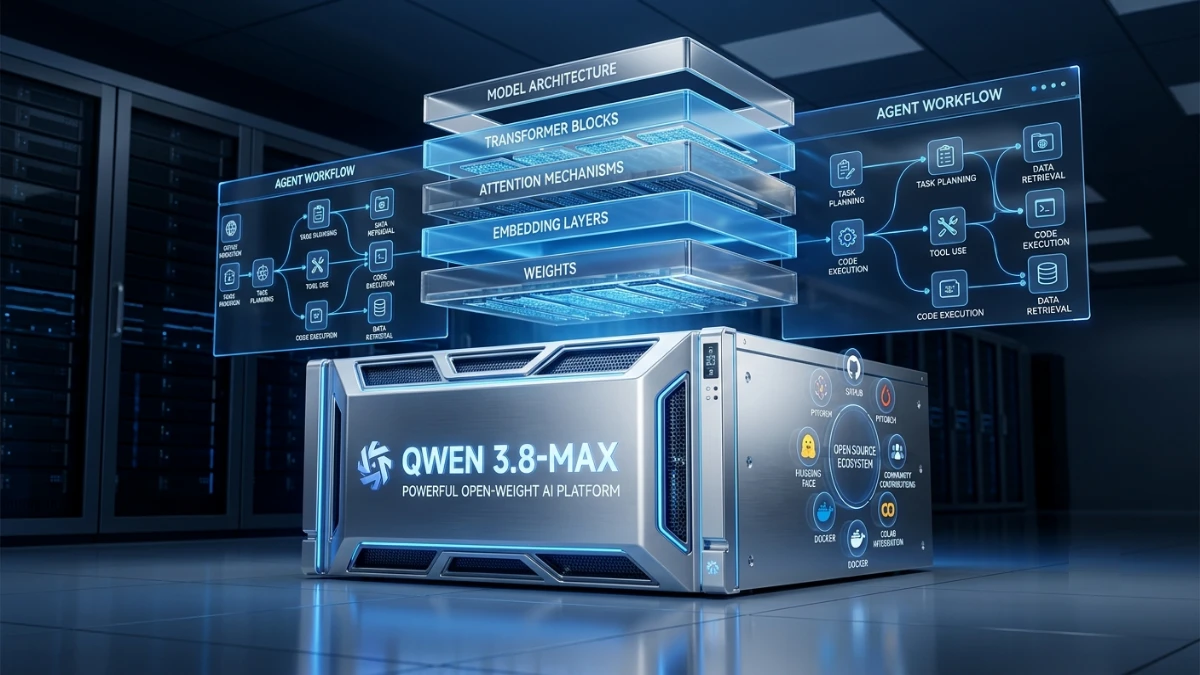
Alibaba’s Qwen team released Qwen3.8-Max today. The headline isn’t another benchmark table. It’s the promise of open weights for a Max-class Qwen model, coming next week. That’s a meaningful shift for any team currently locked into proprietary APIs for their highest-capability workloads.
Why It Matters
Frontier-model decisions usually come down to a trade-off. Proprietary models tend to lead on raw capability. Open-weight models offer control, cost predictability, and the ability to run inference on your own infrastructure. Qwen3.8-Max aims to blur that line. If the open-weight release next week matches the hosted API’s performance, teams evaluating self-hosted inference will finally have a genuinely frontier-tier option, not a second-tier fallback.
This matters most for organizations with data residency requirements. It also matters for teams facing unpredictable usage spikes that make per-token pricing painful. And it matters for engineering teams that want to fine-tune a base model for internal workflows without waiting on a vendor’s roadmap.
Technical Details Worth Knowing
Qwen3.8-Max builds on the Qwen 3.5 architecture. It scales to 2.4 trillion total parameters, with 95 billion active at inference. This mixture-of-experts design keeps per-query compute manageable despite the model’s overall size. The API also supports a configurable reasoning_effort parameter — low, medium, or the default xhigh — so developers can trade latency and cost against reasoning depth on a per-request basis. Qwen enables preserve_thinking by default.
That reasoning-effort control isn’t a marketing detail; it’s a practical one. Teams can dial the model down for high-volume, low-stakes calls. They can dial it up for the kind of long-horizon agentic work this release emphasizes.
Where the Model Was Pushed Hardest
The Qwen team didn’t rely solely on static benchmarks. They ran the model through several multi-day autonomous tasks instead. In one case, the model worked on a coding project for more than ten days straight. It managed its own issue tracking, testing, and pull-request cycle with no human intervention. In another test, researchers handed it a recent AI-training paper with no starter code and asked it to reproduce the experiments, then improve on them. That run took roughly five days and reportedly produced a modest gain over the original paper’s method on a competitive math benchmark. A third test entered the model into a live, time-boxed data-science competition against hundreds of human teams. It placed ahead of the majority of the field.
These evaluations are self-reported and vendor-run. Readers should treat them as demonstrations of what the model can attempt, not as independently verified capability claims. Still, a clear pattern emerges: sustained, self-directed iteration over many hours, rather than a single-shot response. That pattern matches where the broader agentic-coding market has been heading.
Benchmark Comparisons
On the published tables, Qwen3.8-Max lands in the same tier as Claude Opus 4.8 and Claude Fable 5 across several coding and agentic-work suites. It trails GPT-5.6 Sol on a handful of terminal and instruction-following benchmarks. Compared with its predecessor, Qwen3.7-Max, it shows a substantial jump in nearly every category the company reports, including multimodal reasoning and document intelligence.
Independent benchmarks are still needed here, as with any vendor-published numbers. Analysts can’t yet draw firm conclusions about where the model sits relative to Opus, Fable, or GPT-5.6 Sol in production use. Benchmark methodology varies significantly between labs. Different harnesses, timeouts, and prompt formats can shift scores meaningfully. Real-world workloads rarely map cleanly onto any single leaderboard.
Pricing and Availability
QwenCloud offers Qwen3.8-Max now through an OpenAI-compatible chat completions API and an Anthropic-compatible interface. Developers can point Claude Code directly at the model by swapping the base URL and auth token. The model also integrates with Codex, Qoder CLI, Qwen Code, and OpenClaw. Qwen expects to publish the open weights on Hugging Face and ModelScope next week, which should open the door to self-hosted and fine-tuned deployments. The announcement didn’t fully break out pricing details for the hosted API.
Limitations and Open Questions
The long-horizon case studies look impressive on paper. But the model’s own creator designed and reported them, which means the tasks, success criteria, and stopping points were all defined internally. It remains to be seen how the model performs on unscripted, real-world agentic work where the goalposts aren’t predefined. The open-weight release next week will offer the real test: can third-party evaluators reproduce these results independently?
What Comes Next
The bigger story here goes beyond any single benchmark. It’s about a trend line: labs increasingly release frontier-capable models with open weights attached, not months later as a downgraded afterthought. If that pattern holds with Qwen3.8-Max, it pressures other labs to justify keeping their top-tier models closed. Developers evaluating agentic coding and long-horizon automation tools should watch for the open-weight drop next week. They should also watch for independent benchmark runs in the weeks that follow. Vendor demos mark a starting point, not a verdict.