


Kimi K3 marks a major shift for open-weight AI models by combining trillion-scale architecture, agentic workflows, native multimodal abilities, and enterprise adoption. With lower reported costs and strong benchmark results, it challenges the idea that open models are only budget alternatives. While independent testing is still needed, Kimi K3 signals that open AI systems are becoming serious competitors for business and developer workloads.
Moonshot AI released Kimi K3 this month. It’s a 2.8 trillion-parameter open-weight model, and it’s already showing up inside U.S. production stacks. That adoption pattern is why this release matters, not just the parameter count.
Why It Matters
People have long treated open-weight models as a cheaper, weaker alternative to closed frontier systems. Kimi K3 complicates that narrative. It pairs a large-scale architecture with agentic and multimodal features that used to belong only to closed APIs. And it does this at a fraction of the cost per completed task.
Engineering leaders now face a different calculus. Open models used to be the budget option. They’re becoming a legitimate default for a growing share of tasks.
Parallel Agents Replace Sequential Tool Calls
Kimi K3 builds on the “Agent Swarm” framework from Kimi K2.5. This framework fixes a real bottleneck: most agent systems run tool calls one after another. That slows down complex, multi-step workloads as their scope grows.
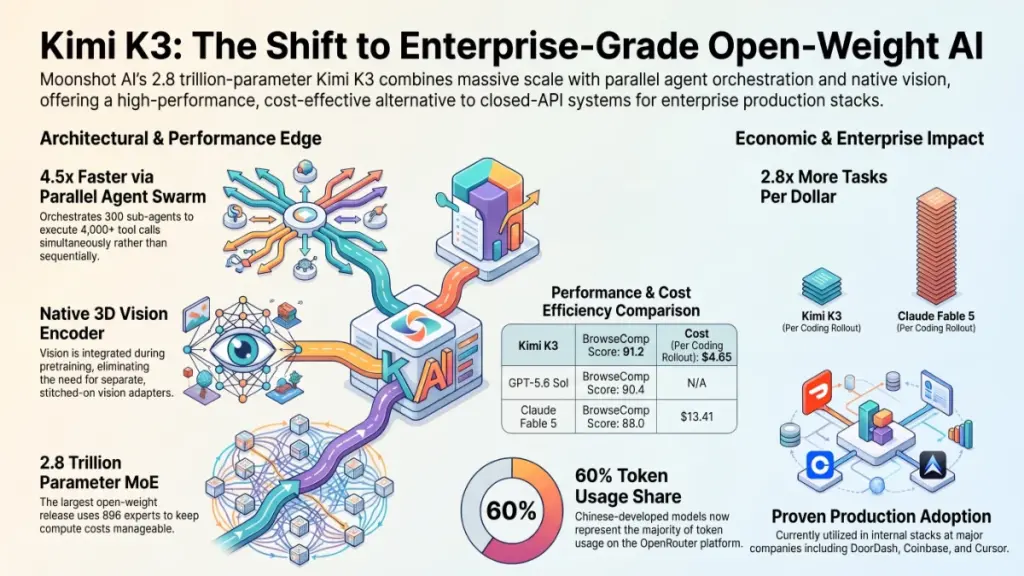
Agent Swarm changes this. An orchestrator spins up sub-agents and delegates work in parallel instead of in sequence. Kimi K3 pushes this further. It scales to roughly 300 sub-agents and handles over 4,000 tool calls in a single task. In wide-search scenarios, it runs about 4.5 times faster than sequential execution.
The practical effect is simple. Task completion time now depends on parallel compute, not the number of sequential steps. Teams running research, data-gathering, or multi-tool automation pipelines should see a real latency drop, not a marginal one.
Vision Is Built In, Not Bolted On
Kimi K3 carries over the vision stack from K2.5. That stack includes a native-resolution 3D vision encoder paired with the underlying Mixture-of-Experts language model. Moonshot trained this vision component in from the start of pretraining. It didn’t bolt it on afterward as an adapter.
This distinction matters for teams building tools that read screenshots or visual layouts and turn them into code. DeepSeek’s open releases remain largely text-only. Kimi K3’s native multimodal support removes a common workaround: stitching a separate vision model onto a text-only base.
Enterprise Adoption Is Already Happening
Adoption may matter more than architecture here. DoorDash reportedly uses Kimi for lower-tier internal tasks and keeps Anthropic’s Fable for higher-stakes work. Coinbase has confirmed internal Kimi use. Cursor, the coding startup SpaceX now owns, built its product on a Kimi model foundation.
Marketplace data backs up these individual cases. On OpenRouter, Chinese-developed models now account for roughly 60% of token usage among U.S. companies on the platform. Nvidia CEO Jensen Huang has publicly backed this practice. He told Axios that U.S. firms should be free to use Chinese models. That’s a notable stance, given that Nvidia supplies most of the hardware those models run on.
This doesn’t mean enterprises are abandoning closed models. It does mean procurement teams are mixing vendors by task tier instead of defaulting to one provider. That shift is worth tracking, regardless of where you stand on any single model’s capabilities.
Benchmark and Cost Comparisons
Kimi K3 scored 91.2 on the BrowseComp benchmark, which tests real-world research and browsing tasks. Claude Fable 5 scored 88.0, and GPT-5.6 Sol scored 90.4. Independent verification of these figures is still limited. Treat them as vendor-published results until broader third-party testing confirms them.
The cost gap sharpens Kimi K3’s position further. Moonshot cites $4.65 per coding-benchmark rollout for Kimi K3, versus $13.41 for Claude Fable 5. Across a 452-rollout sweep, that’s roughly $2,103 versus $6,010. By this measure, Kimi K3 delivers about 2.8 times more solved tasks per dollar spent.
These cost-per-task figures depend heavily on how the benchmark is run. Treat them as directional, not definitive, until independent labs replicate them under comparable conditions.
Technical Specs Worth Knowing
- Parameters: 2.8 trillion — the largest open-weight release to date.
- Architecture: Mixture-of-Experts with 896 experts. Only 16 activate per inference, which keeps compute costs down.
- Attention mechanism: Kimi Delta Attention (KDA), a hybrid linear attention design. Moonshot says it delivers a 6.3x decoding speedup on million-token contexts.
- Agent orchestration: up to 300 parallel sub-agents, 4,000+ tool calls per task.
Teams evaluating self-hosting should watch the MoE design closely. It’s the detail that makes a 2.8 trillion-parameter model computationally viable, since only a fraction of experts activate per token.
Limitations and Open Questions
Several things remain unverified. Moonshot’s own reporting is still the primary source for most benchmark scores and cost figures. Nobody has published independent, apples-to-apples testing against Claude Fable 5 and GPT-5.6 Sol yet. Real-world production workloads carry messier data and less controlled conditions than benchmark suites, so they may not match the same cost or performance ratios.
Open questions remain about the cost advantage, too. Will it hold at scale? And will enterprises expand Kimi’s role beyond “lower-tier” tasks, or keep it capped by design?
The Bigger Picture
This story isn’t really about Kimi K3 beating a closed model on a specific benchmark. It’s about a broader pattern. Agentic and multimodal capabilities once required closed APIs. Now they’re showing up in open weights, too. That narrows the case for defaulting to closed systems down to specific needs: top-end reasoning, vendor support, or regulatory comfort.
Whether this pattern holds depends on a few things. Independent benchmarking needs to catch up. Other open-weight labs, in China and elsewhere, need to match this feature set. And closed-model providers need to respond on pricing and capability in their next release cycle. Developers should treat this release as a prompt to re-test their own workloads against Kimi K3, rather than take any vendor’s benchmark numbers at face value.