


OpenAI quietly released Codex Security CLI as open-source under Apache-2.0, but the hosted security scanning service remains limited to approved users. The tool integrates AI-powered vulnerability detection, fix verification, and CI workflows into developer environments. While it challenges established security scanners like Snyk and Semgrep, pricing, benchmarking, and broader availability remain unknown, making this an early strategic move rather than a fully accessible product.
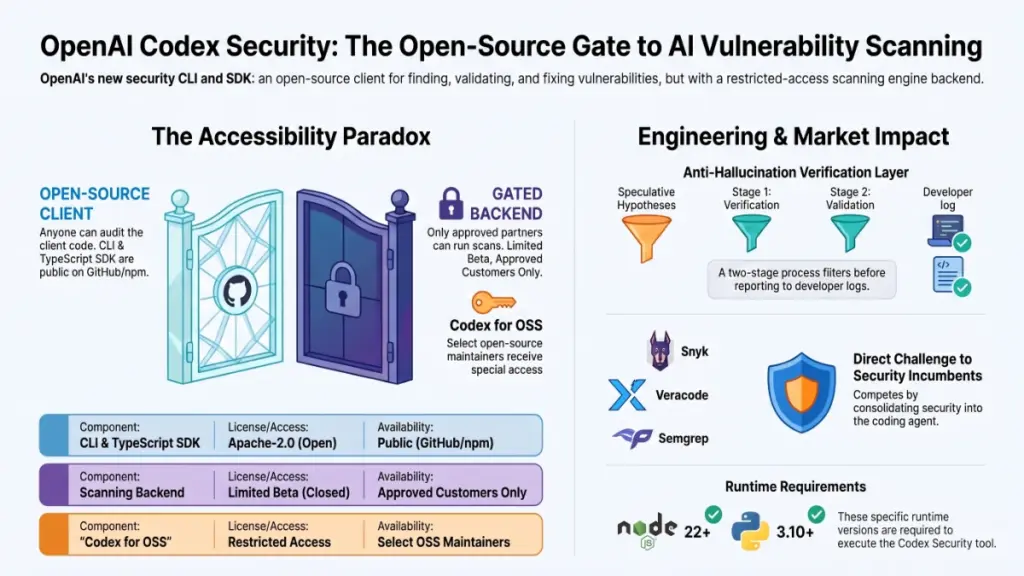
OpenAI has released Codex Security, a command-line tool and TypeScript SDK for finding, validating, and fixing code vulnerabilities. The code sits on GitHub under an Apache-2.0 license. But the scanning backend that actually powers the tool remains in limited beta. Only approved customers and partners can use it. The open-source code is the front door. The product itself stays locked.
Why It Matters
For teams already writing code with Codex, this closes a loop. Previously, they needed a separate vendor for security scanning. Now a single OpenAI credential can cover both jobs: generating code and gating a merge on a vulnerability finding. Developers never have to leave the terminal.
That’s a meaningful shift for engineering leads weighing tool consolidation. It’s also a direct challenge to established players like Snyk, Veracode, and Semgrep. They now face a competitor that controls the model, the coding agent, and the CI hook — all under one login.
How It Shipped
OpenAI skipped the usual launch playbook. No press briefing, no announcement post — just a fresh Apache-2.0 repository and an npm publish. Hacker News found the repo first. OpenAI’s own account on X confirmed the release only after the fact, framing it as an early build still gathering feedback rather than a finished product.
That sequencing matters. A stealth drop followed by a reactive acknowledgment sends a different signal than a coordinated launch. It suggests OpenAI aimed this release at developer mindshare, not at a formal go-to-market moment.
Technical Details
Installation runs through npm: @openai/codex-security. Developers authenticate with a ChatGPT account or an OPENAI_API_KEY. The core command, codex-security scan ., scans a repository, reviews changes, tracks findings across runs, verifies fixes, and can slot into CI as a security check. A lightweight TypeScript SDK supports programmatic use. The runtime requires Node.js 22+ and Python 3.10+.
One design choice stands out in independent reviews of the code. The tool separates a speculative discovery phase from a stricter candidate-accounting ledger. Discovery can surface loosely-formed hypotheses about vulnerabilities. But nothing graduates to a reported finding without passing the stricter verification layer. This filters out model hallucinations before they reach a developer’s CI log — a real, if narrow, technical edge over scanners that report raw model output directly.
Access and Availability
Here’s where the open-source framing breaks down. OpenAI’s own documentation states plainly: the CLI and SDK remain in limited beta, available only to approved customers and partners. That directly contradicts the assumption most people bring to an open-source release — that anyone can use it. OpenAI also runs a “Codex for OSS” program. It gives select open-source maintainers access to Codex Security specifically, layering a tiered community strategy on top of the commercial gate.
In practice, anyone can read the code, audit the prompt design, or fork the client. Almost no one can run a scan against the hosted backend without OpenAI’s approval. Apache-2.0 lowers friction for trust-building. It doesn’t open the product.
Limitations and Open Questions
OpenAI hasn’t published pricing. It hasn’t defined the scope of “Codex Security access.” And no independent benchmark yet compares the tool against incumbent SAST scanners. Hacker News discussion has already pointed to Strix, a 45,000-star open-source rival, as the natural comparison point. Key questions also remain open: what data leaves a repository during a scan, and whether findings persist server-side across runs. The release itself doesn’t answer either question. Readers should treat these gaps as unresolved, not as evidence for or against the tool.
Industry Impact
Teams already inside the OpenAI ecosystem have a low-risk move available. Point the CLI at a non-critical repository. Wire it into a CI job behind an API key. See whether the fix-verification loop holds up under real commits, not just a demo. That’s a cheap way to form an opinion before OpenAI decides whether to widen access.
The bigger question sits with the incumbents. Snyk, Veracode, and Semgrep built businesses on sitting next to the coding tool as a separate security layer. OpenAI is testing whether it can fold that layer into the coding tool itself. Independent benchmarking — not GitHub star counts — will determine whether Codex Security is a credible scanner or a well-packaged wrapper around a beta API. Until that data exists, treat this as an early move in a longer positioning fight, not a finished verdict on the product.