

Moonshot AI has temporarily paused new Kimi K3 subscriptions after overwhelming demand exhausted available compute resources. The move highlights both the popularity of its 2.8-trillion-parameter AI model and the infrastructure challenges of scaling frontier AI. As Moonshot prepares for a Hong Kong IPO and fundraising, developers and investors will closely watch how quickly it expands capacity and validates Kimi K3’s real-world performance.
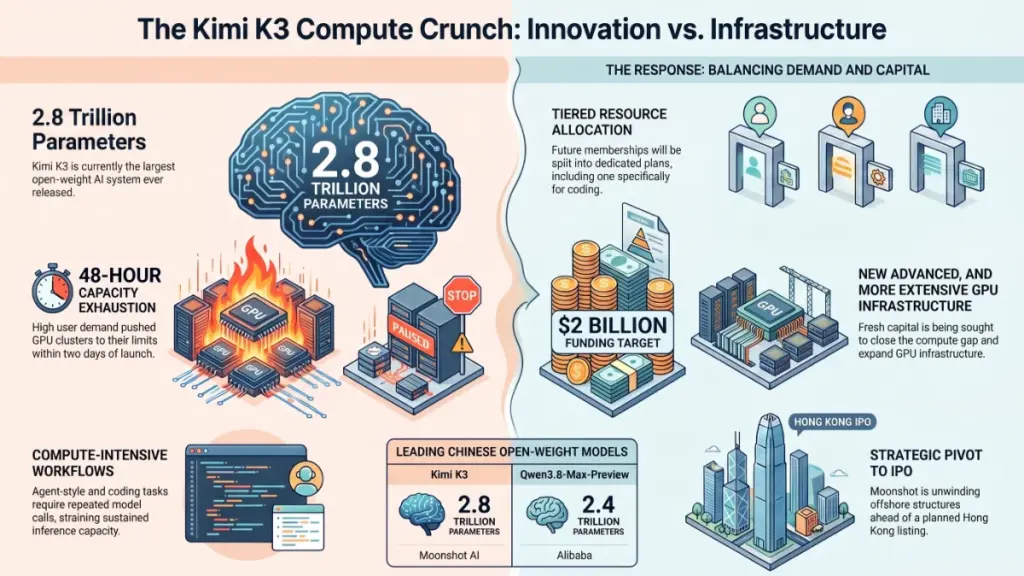
Chinese AI startup Moonshot AI has halted new subscriptions for its Kimi K3 model. The pause comes just days after launch. User demand pushed Moonshot’s GPU clusters toward their limits.
The timing matters. Moonshot is running a live fundraising round and planning a Hong Kong IPO. A technical bottleneck like this becomes a signal that investors and developers will watch closely.
For a company trying to prove it can scale a frontier open-weight model, running out of capacity within 48 hours sends a mixed message. It proves strong demand. It also proves the infrastructure hasn’t caught up yet.
Why It Matters
A subscription pause this early tells developers something concrete. It shows the real-world cost of serving very large models, not just their benchmark scores. Kimi K3’s architecture leans on coding and agent-style workflows. These workflows typically require repeated model calls and sustained inference capacity, not single-shot queries.
That distinction matters for anyone evaluating the model for production use. A model can perform well in isolated tests and still be impractical to deploy at scale if the provider itself runs short on compute. It also matters for the open-weight ecosystem broadly. Moonshot’s struggles show that “open-weight” doesn’t mean “easy to self-host” once a model reaches trillions of parameters.
Technical Details
Moonshot describes Kimi K3 as a 2.8-trillion-parameter model. The company says this makes it the largest open-weight AI system released to date. Size alone doesn’t determine usefulness. But at this scale, it does explain the compute crunch: serving a model this large to a large user base multiplies GPU load quickly, especially for coding and agentic tasks that call the model repeatedly within a single session.
In response, Moonshot will split future memberships into two separate plans. One plan will focus specifically on coding use cases. This is a resource-allocation move as much as a product decision. It lets the company match compute supply to the workloads that consume the most of it, instead of treating all users the same.
Performance & Evidence
Moonshot says Kimi K3 performs competitively with leading U.S. models on select technical tasks. The company also points to independent evaluations that have shown strong results. These claims deserve attention given the scale of interest the launch generated. But they still fall short of sustained, independent benchmarking. Only that kind of testing can show whether a model holds up under real production workloads rather than curated test sets.
Pricing & Availability
New subscriptions are paused as of this weekend. Moonshot says existing paid users won’t feel the shortage. The company plans to reopen new subscription slots in batches as it adds compute. It hasn’t given a firm timeline.
Industry Implications
Moonshot is reportedly unwinding its offshore corporate structure ahead of a planned Hong Kong listing. Sources familiar with the matter say the company has engaged financial advisers to explore that process. Moonshot is also reportedly seeking up to $2 billion in fresh capital. A May fundraising round reportedly pushed its valuation to roughly $30 billion.
A compute shortage days after a major model launch cuts both ways with investors. It demonstrates product-market pull. It also highlights the capital intensity of competing in frontier AI. Moonshot isn’t alone here. Competitors including DeepSeek have also sought outside capital recently to expand compute capacity, as Chinese AI labs work to close the gap with U.S. rivals.
The launch also arrives alongside a broader wave of releases from Chinese developers. Alibaba says its Qwen3.8-Max-Preview model, at 2.4 trillion parameters, has gone live on its platforms ahead of a planned open-weight release. Other firms, including Z.ai and MiniMax, have shipped more capable models at lower cost. Together, these releases challenge the assumption that Chinese model developers trail U.S. labs by a significant margin.
Limitations & Open Questions
Several things remain unverified. Independent, broad benchmarking hasn’t yet confirmed Moonshot’s performance claims for Kimi K3. It’s also unclear how long the subscription pause will last or how quickly new compute will come online. The IPO timeline remains fluid too. Neither Moonshot nor its advisers have confirmed further details publicly.
A structural constraint also hangs over the entire sector. U.S. export controls on advanced Nvidia chips continue to limit how much compute Chinese AI companies can access, regardless of how much capital they raise.
Future Outlook
What happens next will say more about Moonshot’s trajectory than the initial launch did. Suppose the company restores open subscriptions quickly and backs up its performance claims with independent testing. In that case, Kimi K3 could strengthen the case that open-weight Chinese models are closing the gap with proprietary U.S. systems. If the compute constraints persist instead, they’ll teach a different lesson: model size and benchmark performance mean little without the infrastructure to serve them reliably.
For now, Kimi K3’s parameter count isn’t the most useful signal to watch. The real question is whether Moonshot can turn a surge of demand into a durable service, while it also tries to convince IPO investors that its compute strategy holds up.