


Anthropic’s threat-intelligence report exposes how an AI-powered content operation produced 8,913 articles across 70 fake news sites, using rigid production rules, fabricated accounts, and mandatory internal-link quotas. The key lesson for marketers isn’t to fear AI-generated content, but to recognize manipulation patterns. Sustainable AI publishing still depends on authentic authorship, useful internal linking, original insight, trustworthy sourcing, and genuine value for readers.
Here’s the thing about “AI-generated spam” that most marketers get wrong. The AI part was never the tell. I’ve been saying this for years to clients who panic about whether their content “reads too AI.” The real signal was never in the prose. It’s in the operational footprint behind it.
Anthropic’s latest threat-intelligence report just handed the industry a textbook case. It shows exactly what that footprint looks like. Honestly, it’s worth every marketer’s attention.
What Actually Happened
Anthropic disrupted a commercial operation that had produced at least 8,913 articles. These were spread across roughly 70 fake news sites, in about 20 languages. The network also ran 70 matching social accounts and over 250 fake commenter accounts.
That’s a big number. But in my experience testing content workflows at scale, raw output volume alone tells you almost nothing. Legitimate publishers hit big numbers too. What made this operation identifiable wasn’t the count. It was the pattern underneath it.
The Production Contract Was the Giveaway
The sites were all registered within a tight ten-week window. They ran on one shared technical setup. Every article had to conform to a rigid production contract: fixed JSON output, specific HTML formatting, and exact character limits.
Here’s the part that should catch every SEO person’s attention. Each article required three to four internal links, every time, no exceptions.
Why the Link Quota Matters More Than the Word Count
Look, I’ll be straight with you. I’ve built AI content pipelines for clients that also use structured JSON output and character constraints. That’s not inherently sketchy. It’s just how you keep a content system consistent at scale.
The difference here is what the structure was for. A repeated internal-link quota baked directly into the generation spec isn’t an editorial choice. It’s a manipulation instruction. When your production contract requires a fixed number of internal links regardless of whether the article needs them, you’re not writing for readers anymore. You’re writing for a ranking algorithm.
That distinction is honestly the cleanest litmus test I’ve seen articulated in a while. I’ll be reusing it with clients: content designed to serve a reader’s problem versus content designed to hit a link quota.
Volume Without Trust Still Fails
Here’s what surprised me most reading the report. Despite all that production volume, Anthropic found little evidence of authentic engagement. There was no sign the network broke out beyond its own manufactured activity.
In other words, this operation solved the production problem. It cranked out volume across dozens of fake outlets. But it never solved the trust problem. Nobody was actually reading, sharing, or citing this stuff in any meaningful way.
That tracks with something I’ve watched play out with real clients. I’ve seen teams dump 40-plus AI-written articles a month onto a site and see flat traffic. Meanwhile a competitor publishing a third as much – but with real sourcing, named experts, and updates over time — pulls ahead in both rankings and reader trust. Volume is an input metric. It was never the outcome that mattered.
What Google’s Policy Does – and Doesn’t – Prove Here
It’s worth being precise about what this report actually proves. Anthropic documented the network’s infrastructure and apparent intent. The internal-link quotas point clearly toward an attempt to build search authority artificially.
What the report does not include is any evidence that Google actually ranked these pages. There’s no proof Google indexed them widely or took enforcement action. Google’s scaled-content-abuse policy targets content made primarily to manipulate rankings rather than help users, regardless of the tool used. That gives you the rule the network appears to have violated. It doesn’t confirm Google caught it, or that the tactic worked before getting caught.
That’s a distinction I see marketers blur constantly, usually in one of two unhelpful directions. Either “AI content never works,” or “if it’s not banned yet, it’s fine.” Neither is true. The policy is about purpose and value delivered to the reader, not the tool used to produce the draft.
A Quick Checklist for Your Own Content Operation
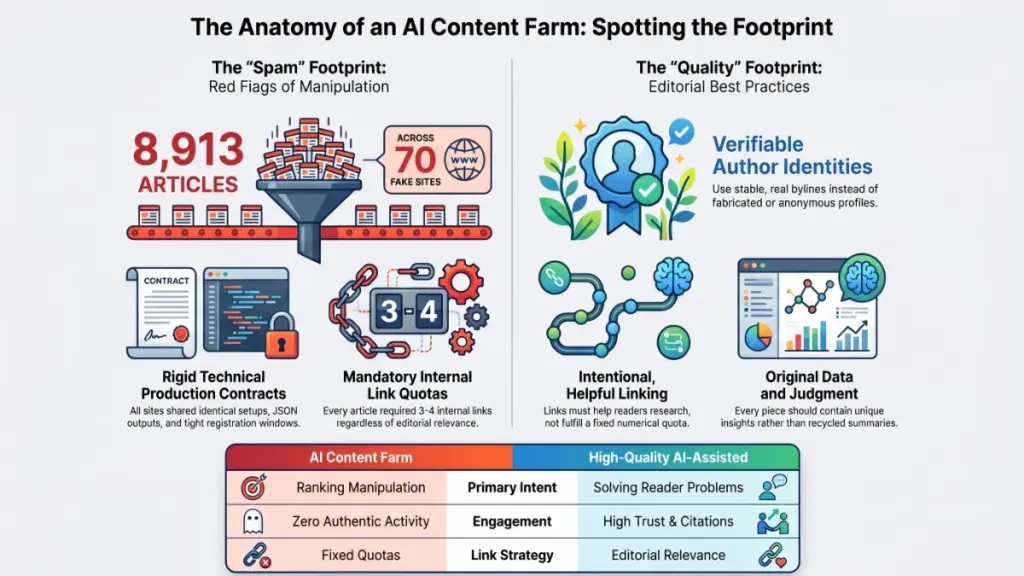
If you’re running AI-assisted content production, this report doubles as a useful checklist. At this point, most serious content operations use AI in some form. Here’s what should look nothing like the network above:
- Stable, verifiable author identities, not fabricated bylines
- Internal links chosen because they help the reader continue their research, not to hit a fixed quota
- Original examples, data, or judgment in every piece, not just recycled summary
- A visible correction and update history
- Publishing volume your editorial team can actually stand behind reviewing
None of that is exotic. It’s basically what good editorial practice has always looked like. AI just makes it faster to fake if you’re not careful, and faster to do right if you are.
The Bigger Picture
I don’t read this as an indictment of AI-assisted publishing. I use AI tools daily, and I’m not walking that back. What it actually shows is how easily automation can industrialize bad publishing practices. That happens when deception and manipulation get built into the production system on purpose.
The tell was never “does this sound like AI.” It was registration timing, shared infrastructure, fabricated identities, and link quotas baked into the spec. That’s the checklist worth remembering next time someone asks whether a site “looks AI-generated.”