


LeadFlux AI is an AI-powered tool that creates lead magnets and email nurture sequences using a credit-based system. The review finds it effective for marketers who want faster campaign creation but warns about upsells, credit limits, and licensing restrictions. Starter is ideal for testing, while Pro and Elite suit higher-volume users who need more credits and longer email sequences.
I almost didn’t write this review. LeadFlux AI isn’t bad — but the moment you buy it, you land on an upgrade page built to get you swiping your card again before the excitement of your first purchase wears off. That’s not a knock against the product itself. It’s just the reality of how it’s sold. If you read reviews before spending money, and you’re here, that distinction matters more than you’d think.
I’ve spent seven years testing marketing tools for a living, everything from clunky enterprise CRMs to scrappy indie SaaS products that live or die on a single launch day. LeadFlux AI sits in the middle. It’s a genuinely useful lead-generation and email sequence builder, wrapped in a classic one-time-offer sales funnel. Let’s take it apart properly: pricing, credits, features, the upgrade math, and whether any of it is worth your money.
What Is LeadFlux AI, Exactly?
LeadFlux AI is an AI-assisted toolkit for building lead magnets and nurture email sequences. Feed it an offer or a niche, and it generates lead magnet designs plus an email sequence meant to warm up a cold subscriber into a buyer. A credit system powers everything — each generation, whether a magnet, an email, or a variant, costs credits, and your credit total depends entirely on which tier you buy.
Three tiers exist: Starter, Pro, and Elite. An Agency-level commercial license also exists, for anyone building campaigns for clients rather than themselves. I’ll cover that in a minute. The short version: Starter is a real product, not a demo, but it hits a ceiling fast. Pro and Elite are where the tool stops feeling like a trial and starts feeling like something you can run a business on.
Who This Is Actually For
Let’s be honest about who benefits from this and who doesn’t, before going any further.
LeadFlux AI makes sense if you are:
- A solo marketer or affiliate running lead magnet funnels and email sequences regularly
- Someone comfortable editing and personalizing AI-generated first drafts
- Running more than one offer at a time, or testing several niches
- Already familiar with email marketing fundamentals (this isn’t a “what is an autoresponder” tool)
It’s probably not for you if:
- You need enterprise-grade automation, CRM integration, or complex behavioral triggers — this isn’t that
- You’re building campaigns for paying clients (the separate Agency license covers that, and Elite doesn’t include it)
- Full hands-off automation is what you want. Editing, formatting, and judgment calls still fall on you for every sequence it drafts
That last point matters most. I expected to hit generate and walk away. That’s not how it works, and I’d be suspicious of any AI tool that claimed otherwise.
Pricing and Tiers: The Real Breakdown
Credits, not features, drive this pricing structure. They’re the actual currency that determines whether you can use the tool the way you want to.
| Feature | Starter | Pro ($67) | Elite ($97) |
|---|---|---|---|
| Credits included | 350 | 800 | 1,500 |
| Nurture email sequence length | 3 emails | 5 emails | 7 emails |
| Premium magnet designs | No | Yes | Yes |
| A/B testing | No | Yes | Yes |
| Conversion scoring | No | Yes | Yes |
| Custom CSS + geo targeting | No | Yes | Yes |
A few things jump out immediately. Pro and Elite unlock the exact same feature set — the only real difference between them is credits (800 vs 1,500) and sequence length (5 vs 7 emails). The upgrade page buries that detail a little. You’re not paying $30 more for new capability; you’re paying $30 more for runway and two extra emails per sequence.
Starter also isn’t crippled the way a lot of “starter” tiers are. You get 350 credits, three-email sequences, and standard magnet designs — enough to learn the tool and ship a real first campaign. Credit belongs here, because plenty of software funnels sell a Starter tier that’s functionally useless bait for the upsell. This one isn’t quite that cynical. It’s capped, but it’s real.
One more thing worth flagging before you buy: the credit system ties your actual cost-per-campaign to how much you generate, regenerate, and A/B test. Marketers who run three versions of an email before landing on the one they like — and most good marketers do exactly that — will burn through credits faster than the tier chart suggests.
Testing the Credit System in Practice
I ran a real test: I built a lead magnet and a five-email nurture sequence for a fictional local-services client, the kind of small business project I take on regularly. Here’s roughly what it cost me in credits:
- Initial lead magnet generation: a chunk of credits right off the bat
- Regenerating the magnet design twice because the first two drafts didn’t match the brand voice
- Drafting the five-email sequence
- Running one A/B variant on the second email in the sequence
- Requesting a conversion score and adjusting based on feedback
By the time I had a sequence I’d actually send to a client’s list, I’d burned through a noticeable slice of my Pro tier’s 800 credits, more than I expected going in. Anyone who iterates a lot should expect the same, because first-draft AI copy rarely counts as your best copy. The credit ceiling sneaks up faster on Starter than the sales page implies.
Budget your credits like you’d budget ad spend. That’s the single biggest thing I wish I’d known before signing up. Don’t treat them like an unlimited resource just because the number looks big on day one.
The Features That Actually Matter
Nurture Email Sequences
The sequence generation is genuinely the strongest part of the tool. It doesn’t just spit out five generic “check out my offer” emails — it structures the sequence with an actual arc: problem awareness, credibility building, objection handling, urgency, and a close. That’s a real copywriting framework, not AI filler.
The drafts still need editing, though. Every one I generated had at least one line that sounded like a tool trying too hard to sound human — the “here’s the thing” openers, the slightly-too-enthusiastic transitions. Skip this tool if you’re not planning to edit before sending. Plan to edit, and you’ll find a genuinely solid starting point that saves real time.
Premium Magnet Designs (Pro/Elite only)
Starter’s standard designs are fine: clean, usable, a little generic. The premium designs unlocked at Pro and Elite look noticeably better, with more visual variety and stronger layout choices, and they don’t scream “I was generated by AI in thirty seconds” — which, let’s be honest, is the whole game with lead magnets. Nobody downloads a lead magnet that looks cheap.
A/B Testing and Conversion Scoring
Pro and Elite earn their price tag here, in my opinion. Generating two variants of a subject line or opening paragraph, then getting a conversion score before you send anything to a real list, proves genuinely useful — especially without the list size to run statistically meaningful split tests the old-fashioned way. I wouldn’t treat the conversion score as gospel; no AI scoring tool should replace real send data. As a directional signal for which variant is probably stronger, though, it did a reasonable job in my testing.
Custom CSS + Geo Targeting
This is a nice-to-have rather than a must-have for most solo marketers. Geo-specific offers — local service businesses, region-locked promotions — benefit from it directly. Skip it as a deciding factor if that’s not your situation.
The Upgrade Funnel: My Honest Take
Let’s talk about this part directly, because most reviews gloss over it.
Buy Starter, and you land immediately on a one-time-offer page pushing Pro or Elite, complete with a bonus-credits add-on and a “this upgrade is on this page only” message. It’s a well-worn funnel tactic — I’ve seen it on more JVZoo and ClickBank-style launches than I can count. Nothing about it is dishonest, exactly, but it’s designed to create urgency at the exact moment you’re least equipped to think clearly about whether you need it.
My actual advice: you can upgrade later. Don’t let “this upgrade is on this page only” push you into a decision before you’ve used Starter enough to know whether you’ll run out of credits. First-time buyers testing whether this tool fits their workflow should start with Starter, run a real campaign, and watch how the credits hold up. Burn through them in a week because you’re genuinely using the tool as intended, and upgrading later becomes an easy call — one backed by real data instead of funnel pressure.
That said, the math favors jumping straight to Pro or Elite if you already know your volume — say you’re running multiple client offers or affiliate campaigns simultaneously. Buying credits piecemeal later, assuming that option even exists post-launch, rarely beats buying the bundle upfront.
The 30-Day Guarantee
A 30-day guarantee covers both the base product and the upgrade, which takes some sting out of the “buy now, decide later” pressure. Use this deliberately: buy Starter, put it through two weeks of hard use, and upgrade with confidence if you determine you need Pro or Elite, knowing you’re still inside the window if something doesn’t work out. It’s a reasonable safety net, and covering the upgrade purchase explicitly, not just the initial one, deserves credit.
Licensing: Read This Before You Buy for Clients
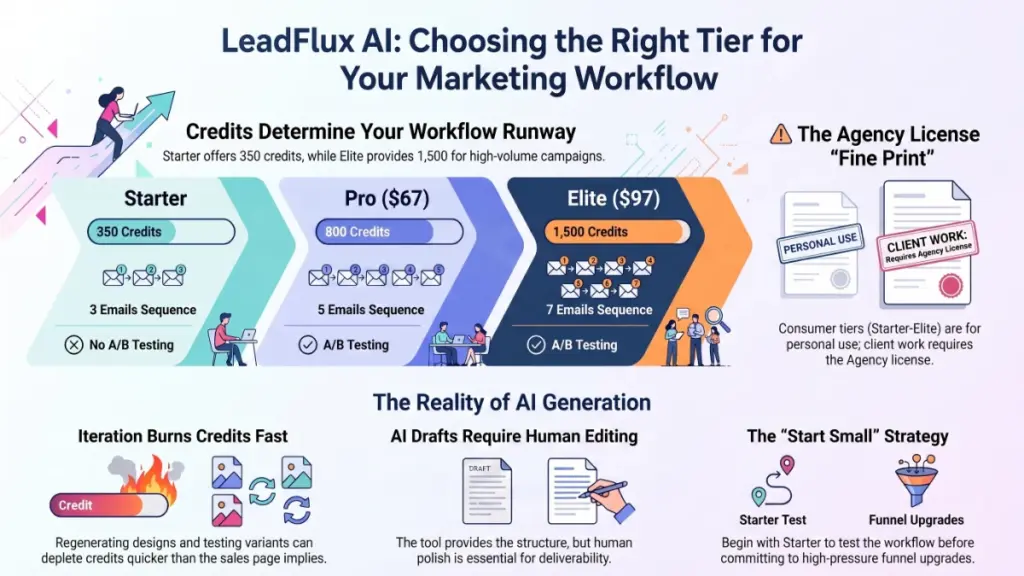
One detail buried in the fine print deserves way more visibility: Starter, Pro, and Elite are licensed for your own personal and business use only. Agency owners and freelance marketers planning to build lead magnets and email sequences for paying clients need the separate Agency license.
This tripped me up initially. I assumed Elite, as the top consumer tier, would cover client work. It doesn’t. Factor the Agency upgrade into your budget from the start if client work is your actual use case, rather than discovering the restriction after building a campaign for someone else.
How LeadFlux AI Compares to Alternatives
LeadFlux AI doesn’t exist in a vacuum. Here’s roughly how it stacks up against what else is out there.
Direct Alternatives
- Against ConvertKit or MailerLite’s built-in AI features: LeadFlux AI generates more structured, sequence-level content out of the box, but you’ll still need one of those platforms, or something similar, to actually send the emails. Think of LeadFlux as a content generator, not a full email service provider.
- Against Jasper or Copy.ai for general AI copywriting: LeadFlux stays more specialized. It’s not trying to be a general-purpose writing assistant; it’s built specifically around the lead magnet-to-nurture-sequence workflow, trading flexibility for output that’s more relevant to this exact use case.
- Against Systeme.io’s all-in-one funnel builder: Systeme.io gives you the whole funnel — pages, email, checkout — with far less sophisticated AI generation. LeadFlux stays narrower but sharper at drafting sequences and magnets specifically.
A solid email platform already in your workflow makes LeadFlux AI slot in well, giving you better, faster first drafts for lead magnets and nurture sequences. Starting from zero with no email platform means budgeting for that separately, since LeadFlux doesn’t replace it.
What About Just Using a General AI Chat Assistant?
Clients often ask whether they should skip a dedicated tool like this and prompt a general AI chat assistant directly for the same output. Technically, you can. What you’d lose is the structure: the built-in five-stage sequence arc, the credit-based magnet variants, the conversion scoring layered on top. A general-purpose AI chat tool hands you raw capability; LeadFlux AI hands you a workflow someone already built around a specific marketing outcome.
Skilled prompters who don’t mind assembling the pieces manually might not find that structure worth paying for. Marketers who want a repeatable process without reinventing it every time will find it a meaningful time save.
A Note on AI-Generated Content and Deliverability
Email deliverability and reader trust deserve a mention here, since a lot of reviews skip this entirely. Unedited AI-drafted copy carries a particular cadence — a rhythm that experienced subscribers, and increasingly spam filters, recognize more easily each year. My own testing didn’t run into deliverability issues, but I never sent anything without editing it first, and I wouldn’t recommend skipping that step either.
This matters more now than it did even a year ago. Inbox providers have gotten noticeably more aggressive about flagging generic, low-engagement AI content, regardless of which tool produced it. Treat LeadFlux AI‘s output the way you’d treat a solid first draft from a junior copywriter: a strong starting point that still needs your voice, your specifics, and your judgment before it reaches a real subscriber list. The tool gets you most of the way there faster. It doesn’t finish the job alone, and I’d be skeptical of any product claiming otherwise.
What I’d Change About This Product
No review is complete without criticism, so here’s mine, straight:
- The credit transparency needs work. Nowhere on the upgrade page does it clearly show how many credits a typical five-email sequence with two magnet regenerations and one A/B test actually costs. Using it is the only way to learn your budget, which gets frustrating fast.
- The funnel pressure runs a little heavy. The “this upgrade is on this page only” framing is standard for this style of launch, but a tool this genuinely useful doesn’t need urgency tactics to convince a buyer who’s already using it.
- The Agency license gap should surface earlier. Burying this in the footer leaves agency owners finding out after the fact. It belongs front and center on the pricing page.
Final Verdict: Should You Buy It?
Here’s the reality: LeadFlux AI does what it says it does. The core product — AI-assisted lead magnets and nurture sequences — is genuinely solid, not vaporware dressed up with a slick funnel. Starter offers a legitimate way to test the waters without overcommitting, and Pro and Elite earn their price if you already know you’ll run enough volume to justify the extra credits and longer sequences.
Start with Starter. Run one real campaign through it. Watch closely how fast your credits disappear once regenerations and testing enter the picture, because you will regenerate things — that’s how good copy gets made. Blow through 350 credits inside your first couple of weeks of genuine use, and upgrading to Pro becomes a straightforward, low-regret decision. Elite makes sense specifically for running several offers in parallel, or knowing upfront you want the full seven-email sequence structure.
Skip the one-time-offer urgency, and don’t buy Elite before using the base product even once. That’s not skepticism for its own sake; it’s simply how I’ve learned to buy software after watching plenty of good tools get oversold by their own launch funnels. Let the tool prove itself first. Do that, and the upgrade will feel obvious rather than forced.