

Nous Research just closed a new funding round. The deal values the maker of the open-source Hermes agent at $1.5 billion. Sources familiar with the deal say the company raised at least $75 million in fresh capital.
Nous Research has stayed quiet. The company declined to comment on the round. Reported backers USV and Robot Ventures haven’t confirmed the details either. Still, the numbers tell a clear story. Investor money is flowing into autonomous AI agents that skip the need for a single chatbot provider.
From Scrappy Startup to Billion-Dollar Player
Nous Research isn’t a brand-new name. The company launched in 2023. It had already raised roughly $70 million before this latest round. Over the past few years, the team built a reputation for open-source language models tuned for coding and math tasks.
Hermes changed the company’s trajectory. The agent framework arrived shortly after OpenClaw sparked a wave of enthusiasm for locally run AI assistants.
Key funding facts:
- New valuation: approximately $1.5 billion
- Capital raised in this round: at least $75 million
- Prior total funding: roughly $70 million
- Company founded: 2023
- Reported investors: USV, Robot Ventures (unconfirmed by either firm)
Why Hermes Is Pulling Ahead
OpenClaw runs entirely on a user’s own machine and handles tasks locally. Hermes took a different path. It ships with built-in capabilities from day one, including web search, coding assistance, and image recognition.
Hermes also expands its own skill set over time. The agent picks up new abilities through use. It doesn’t need someone to manually program each new function. Developers seem to prefer this self-directed approach over OpenClaw’s more hands-on, local-only model.
A broader pattern is emerging here. Pre-built skill sets are winning out over do-it-yourself local agents. Tightly integrated agent ecosystems are also gaining ground over the Model Context Protocol (MCP). MCP once looked poised to become the industry standard for connecting AI tools to outside data and services. That momentum has clearly slowed.
A Model-Agnostic Approach
Hermes offers one major advantage: flexibility. Anthropic’s Claude Code and OpenAI’s Codex both lock users into their own company’s models. Hermes doesn’t. It works with a wide range of large language models instead of tying users to a single provider’s frontier AI stack.
Users interact with Hermes agents much like they would with OpenClaw. They can chat directly, automate workflows, or receive updates through messaging platforms like Telegram and Discord. These agents run remotely and continuously. That makes them popular for background automation, a trend I see fueling demand across the marketing automation and productivity software space.
Massive Open-Source Traction
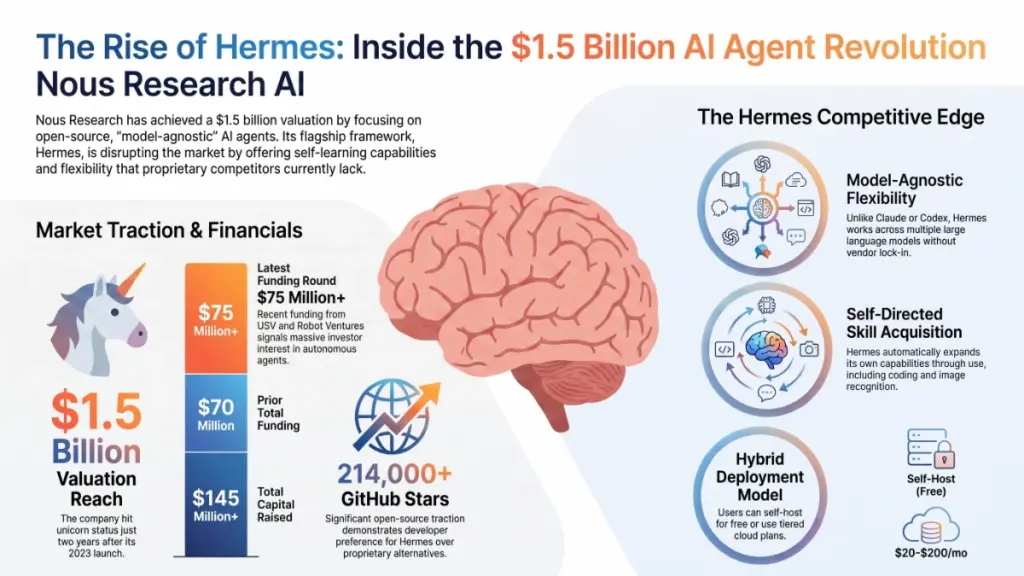
Hermes’s popularity shows up clearly on GitHub. The project has built one of the strongest followings in the AI agent category.
GitHub metrics for Hermes:
- Approximately 214,000 stars
- Nearly 40,000 forks
- Deployable on a personal desktop or a virtual private server (VPS)
- Optional cloud-hosted plans ranging from $20 to $200 per month
This setup mirrors a proven SaaS playbook. A free, self-hostable core product gives developers a low-friction entry point. Tiered cloud plans then create a clear path to revenue for Nous Research.
Why It Matters
This funding round matters beyond industry trivia. Developers, remote workers, and digital marketers evaluating AI automation tools should take note.
- Vendor lock-in risk drops. Hermes works with multiple LLMs. Teams don’t have to commit to a single provider for long-term automation workflows.
- Skills-based agents are becoming the standard. Self-learning agents keep outperforming purely local tools. Expect competitors and enterprise platforms to copy this architecture soon.
- MCP’s dominance isn’t guaranteed anymore. Marketers and developers who built integrations around MCP should watch this space closely. Tightly coupled agent ecosystems now appear to have the edge.
- Budget planning gets easier. Hermes offers transparent, tiered pricing between $20 and $200 per month. That gives teams a clearer ROI picture than many opaque enterprise AI contracts provide.
Looking Ahead
A two-year-old, open-source-first company just hit a $1.5 billion valuation. That fact alone shows how fast capital is consolidating around agentic AI. These tools don’t just answer questions anymore. They complete tasks, learn new skills, and operate independently of any single foundation model.
Nous Research still needs to convert this funding into lasting developer adoption and enterprise deals. If it succeeds, Hermes could become a reference point for the next generation of AI agents: open, model-agnostic, and increasingly able to teach itself new tricks. Anyone tracking the AI automation and SaaS landscape should keep this name on their watchlist for the rest of 2026.