


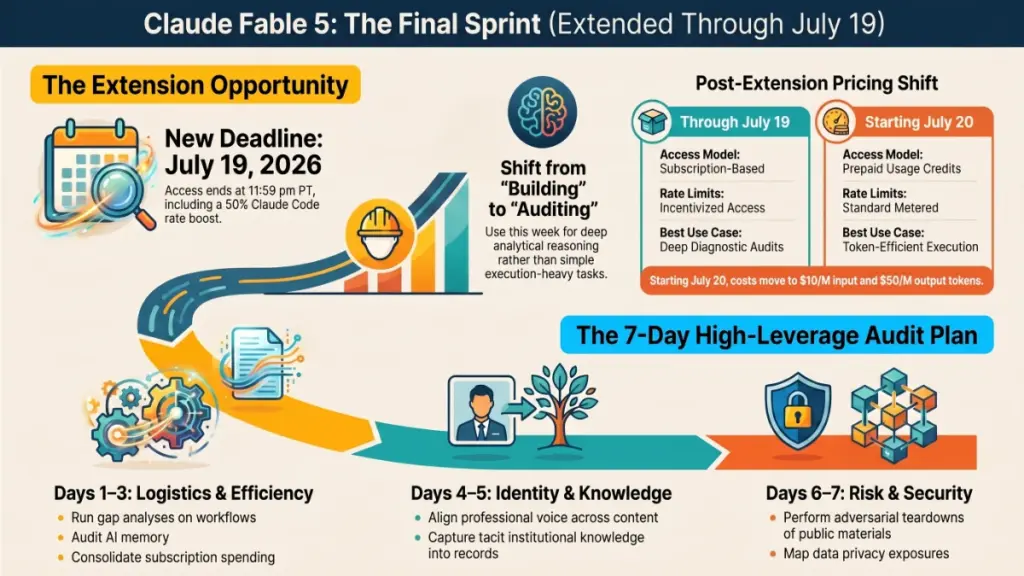
Anthropic has once more pushed back the shutdown date for Claude Fable 5, giving paid subscribers continued access to the model through Sunday, July 19, 2026, at 11:59 pm PT. The move, confirmed via subscriber email, an official X post, and an updated support page, also carries forward a 50 percent boost to Claude Code’s weekly rate limits. It is the second such extension inside a single week, a pattern that signals just how closely Anthropic is watching subscriber demand — and possibly, competitive pressure.
What Changed, and Why It Matters Right Now
The original access window was set to close on July 12. Instead, Anthropic rolled it forward to July 19, mirroring an earlier extension that pushed the deadline from July 7 to July 12. Each announcement has landed just hours before the previous cutoff, a cadence that suggests Anthropic is reacting in near real time to usage data and user feedback rather than following a fixed roadmap.
The timing is hard to ignore. This extension arrived the same week OpenAI released GPT-5.6 (internally code-named “Sol”). Rather than let subscribers lose access to its flagship model during a period of heightened competition in the large language model space, Anthropic chose to reset rate limits and extend the runway on its most capable offering at no additional cost.
For anyone tracking the frontier AI stack, that is a notable signal in itself: companies rarely hand out extra access to their top-tier model unless they’re feeling pressure to keep users engaged.
From Building To Auditing: A Shift In Strategy
During the first access window, the smart play for power users was building — creating durable workflows, skill libraries, and finished deliverables that would keep delivering value after the model’s availability changed.
This second bonus week calls for a different kind of work: diagnostic auditing. Because model quality directly affects the reliability of an audit, this is exactly the type of task where a frontier-grade reasoning model earns its keep. A shallow audit performed by a weaker model can be worse than no audit at all — it creates false confidence rather than real clarity.
The logic is simple: execution-heavy tasks can shift to lower-cost models once the credit-based pricing kicks in after July 19. Deep analytical thinking, however, is best done now, while top-tier reasoning capacity is still included in existing subscription plans.
Seven AI Audits To Run Before July 19
With one week of bonus access remaining, here are seven high-leverage moves worth prioritizing, ordered as a day-by-day plan:
- Day 1 — Run a full gap analysis. Draft an “ideal state” document covering your ideal AI-first workweek, team setup, and measurable 2026 goals, then have the model audit every existing automation, script, and workflow against that vision to surface the gaps.
- Day 2 — Audit your AI’s memory. Ask the model to review everything it has learned about you over time and flag outdated assumptions or preferences that may be quietly skewing its output.
- Day 3 — Audit your AI spending. Inventory every subscription, API bill, and per-seat tool against actual usage from the last 90 days, then look for consolidation opportunities with honest tradeoffs.
- Day 4 — Audit your professional voice. Feed in a body of published writing or talks and identify where your current tone has drifted from your original positioning; use the output as a style guide for future content.
- Day 5 — Capture institutional knowledge. Let the model interview you about decisions and context that exist only in your head, turning tacit knowledge into a searchable record before it’s lost.
- Day 6 — Run an adversarial teardown. Have the model critique your public-facing material from three angles — competitor, investigative journalist, and short-seller — then patch what it finds.
- Day 7 — Audit privacy and data exposure. Map what every connected app, agent, and integration in your stack can access, retain, or leak, since the real risk usually lives in how permissions combine rather than in any single tool.
Each of these tasks benefits from a large context window and stronger multi-step reasoning, since the value comes from synthesizing large, varied inputs — goals documents, financial records, years of published content, or an entire toolchain — in a single pass rather than piecing together fragments across sessions.
Why It Matters For Remote Workers, Developers, And Marketers
This extension isn’t just a scheduling footnote — it has real, practical implications for anyone relying on AI automation to do their job.
- Remote workers and solo operators get one more week to consolidate scattered AI subscriptions and tighten workflows before a costlier usage model takes effect.
- Developers benefit from the extended 50 percent rate-limit boost on Claude Code, useful for wrapping up code reviews, refactors, or technical audits that need deeper reasoning.
- Digital marketers and content creators have a limited window to run a voice-and-positioning audit across their published work using a model capable of holding years of material in context at once.
- Teams and small businesses can use the time to document institutional knowledge that would otherwise walk out the door with departing staff.
Waiting until after the deadline means running these same tasks on a metered, credit-based system — a meaningfully different cost calculation for anything token-intensive.
What Happens After July 19
According to Anthropic’s subscriber communication, Claude Fable 5 will shift to a prepaid usage-credit model starting July 20, priced at $10 per million input tokens and $50 per million output tokens. Anthropic has indicated it intends to restore the model to standard subscription plans once capacity allows, though no firm date has been given.
Two extensions inside a single week suggest Anthropic is paying close attention to how subscribers are actually using the model — and adjusting availability accordingly.
The Bottom Line
Anthropic has effectively handed subscribers a second, unplanned week with its flagship reasoning model. The highest-value use of that week isn’t building something new — it’s running the audits that require genuine analytical depth: memory checks, spend reviews, voice audits, knowledge capture, adversarial reviews, and privacy mapping. Once the credit-based pricing model takes over, that kind of deep diagnostic work gets considerably more expensive to run at scale.