


Microsoft Research’s Resource2Skill automatically converts tutorial videos, documentation, code repositories, and reference files into reusable AI agent skills. Instead of relying on manually written prompts, agents can retrieve and execute these structured skills, improving task performance by nearly 12 percentage points across seven software domains. The framework highlights a major shift toward scalable, knowledge-driven AI agents powered by existing human-created content.
Microsoft Research published Resource2Skill, a new framework this week. It converts tutorial videos, code repositories, articles, and reference files into a library of skills. AI agents can then retrieve and execute those skills directly.
Most agent systems today rely on hand-written prompts or an agent’s own trial-and-error history. Resource2Skill takes a different approach. It mines existing human-created content for procedural know-how and turns that content into something an agent can act on.
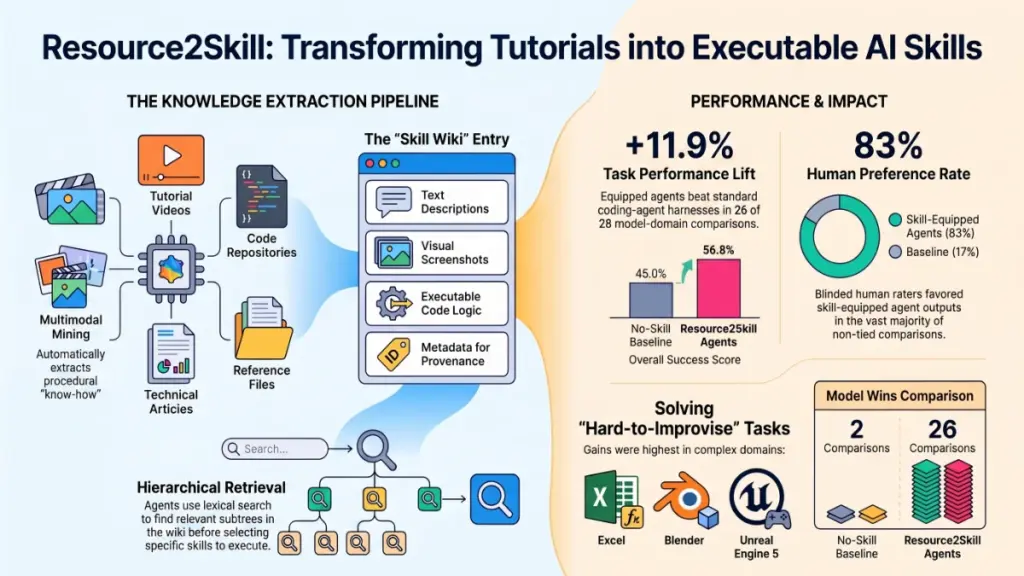
The results stand out. Across seven authoring domains, Resource2Skill lifted average task performance by 11.9 percentage points over agents without a skill library. It also beat off-the-shelf coding-agent harnesses in 26 of 28 model-domain comparisons. For teams building or evaluating agentic tooling, that’s a meaningful signal about where skill libraries are headed next.
Why It Matters
Most agent skill libraries today share the same two origins. Either a person writes them by hand, or the agent builds them from its own past runs. Both approaches miss a huge source of expertise: the tutorials, screen recordings, and how-to articles humans already produce to teach each other software. Text documentation alone often misses things like click order, timing, or the visual before-and-after of an editing step. Video captures that information well.
Resource2Skill treats that gap as solvable. It automatically extracts procedural knowledge from four resource types: tutorial videos, source repositories, technical articles, and reference artifacts. It stores that knowledge as structured, retrievable “skills.” An agent can pull these up mid-task. For developers, this shifts the bottleneck. Teams no longer need to manually write and maintain tool-use instructions. They can simply point the system at existing content instead.
How the Skill Wiki Works
Each extracted skill becomes a multimodal entry with several parts. A text component explains what the skill does and when to use it. A visual component adds thumbnails, screenshots, or rendered examples. A code component provides executable or adaptable logic. Metadata tracks provenance and supports filtering. The system organizes these entries into a hierarchical, domain-specific taxonomy called the “Skill Wiki,” rather than a flat list.
Here’s how retrieval works at inference time. The agent first narrows the wiki down to a topically relevant subtree using a lexical search step. A language model then reads the shortlisted entries and selects which ones to compose for the task. If the existing library doesn’t adequately cover a request, the system can trigger the same extraction pipeline online. It searches for new resources, distills fresh skills, and adds them to the pool on the fly.
Performance and Evidence
Microsoft tested the system across seven practical software domains: web development, spreadsheet authoring in Excel, audio production in Reaper, slide design, 3D scene creation in Blender, CAD drafting, and real-time 3D work in Unreal Engine 5. The team tested four agent backends — GPT-5.5, GPT-5.4, GPT-5.4 Mini, and GPT-5.4 Nano — both with and without access to the skill library. They also compared results against the Claude Code and Codex agentic harnesses.
The skill-equipped agents won every one of the 28 main model-domain comparisons against the no-skill baseline. They averaged a 56.8% overall score versus 45.0%. Gains ran largest in domains with dense, hard-to-improvise conventions: Excel, Blender, and web development. Unreal Engine 5 tasks showed the biggest jump of all. Free-form agents often failed to produce a usable scene there without skill access. A separate blinded human study backed up these findings. Five raters judged 200 paired outputs and favored the skill-equipped system in roughly 83% of non-tied comparisons.
Library size mattered too, but returns diminished over time. Performance rose steadily as the skill pool grew. The sharpest gains appeared before the pool reached roughly 200 entries. Performance largely flattened after that point.
Online Skill Acquisition: Where It Actually Helps
One finding stands out: on-the-fly skill acquisition only pays off in specific situations. Researchers tested a standard benchmark where the offline library already covered most requests. Adding up to 100 skills acquired online barely moved the score there — under a single percentage point. Then they tried a stress-test suite built to probe gaps the offline library didn’t cover. The same online-acquisition mechanism lifted scores by more than 21 percentage points on that suite.
In other words, online acquisition isn’t a broad performance booster. It works as a targeted fix for coverage gaps instead. This distinction matters for anyone weighing similar fallback mechanisms for their own agent stack. The payoff shows up specifically when the pre-built library runs out of relevant material, not as a general-purpose upgrade.
Pricing and Availability
Resource2Skill remains a research framework, not a shipping product. Microsoft released the paper alongside a code repository, a dataset, and a project page. The company hasn’t signaled plans to package this as a commercial offering or fold it into a specific product yet. Developers can review the published code and dataset now, but they shouldn’t expect an out-of-box deployment.
Industry Implications
This research lands alongside a broader shift toward standardized “agent skills” as a concept. Anthropic already ships its own hand-authored Agent Skills format. Several academic systems — Voyager, AWM, and SkillFlow among them — already grow skill libraries from an agent’s own interaction traces. Resource2Skill contributes something different: an automated, multimodal extraction step. Instead of a human writing the skill, or an agent inferring it from its own failures, this system mines tutorials and documentation that already exist at scale across the web.
This approach opens a path for companies that sit on large libraries of internal video walkthroughs or documentation. They could convert that archive into agent-usable capability without a manual authoring effort. It also raises the stakes for software vendors around tutorial content generally. Material created purely for human learners may increasingly double as training data for automated tools.
Limitations and Open Questions
A few caveats apply here. Microsoft’s own benchmark suite and judge models produced these results, and the paper’s authors selected and screened the underlying tasks. No one has yet published independent replication across different domains, agent backends, or judging methods. The evaluation also leans heavily on model-based judges — a GPT-5.4 vision judge covers most domains, and an audio-capable judge handles Reaper — rather than exclusively human raters. A smaller human study did point in the same direction, though.
Open questions remain too. It’s unclear how well the approach generalizes beyond the seven creative-software categories tested. The quality of extracted skills may also suffer when source tutorials run outdated, inconsistent, or simply low quality.
What to Watch Next
Resource2Skill remains a research contribution rather than a released product. The immediate question is whether Microsoft, or another company, builds it into an actual developer-facing tool. A broader trend deserves attention regardless. As agent frameworks mature, the industry keeps converging on “skills” as a shared abstraction for procedural knowledge. The open question is which method wins in production systems: hand-authored libraries, self-generated ones, or resource-mined libraries like this one. Developers evaluating agent tooling should watch for follow-up work on real-world, less-curated content. That’s where the practical value will ultimately get decided.