


Ever priced out a lead generation campaign from a local agency and nearly choked on the invoice? Somewhere between $500 and $2,000 for research, a lead magnet, landing pages, and an email sequence you could have sworn didn’t take that long to write. That’s the gap LeadFlux AI is stepping into.
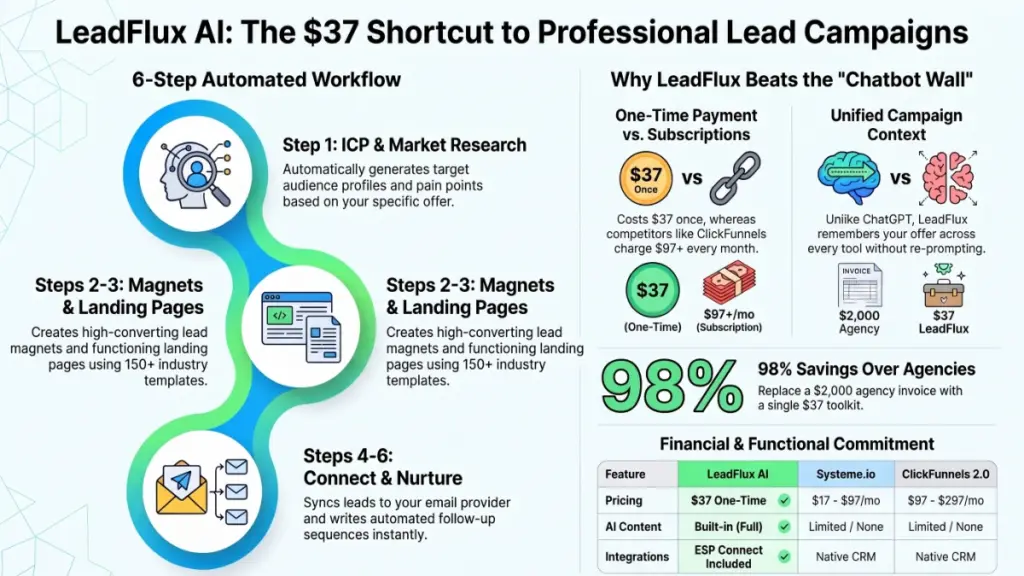
LeadFlux AI, sold as LeadFlux Starter, is a one-time-payment AI marketing tool that bundles six campaign-building tools into a single workspace: ICP research, lead magnet creation, opt-in copywriting, an AI landing page builder, outreach messaging, and an email nurture sequence generator. The pitch is simple — instead of paying an agency or wrestling with a chat window that forgets your offer every three prompts, you point one tool at your offer and get a full, connected campaign out the other end.
In this LeadFlux AI review, we’re digging into whether it actually delivers on that promise. Whether you’re a solopreneur tired of DIY-ing your own funnel, a local business owner who needs leads without agency prices, or someone who’s hit the wall trying to stitch a campaign together with ChatGPT, we’ll cover what LeadFlux does well, where it falls short, and whether LeadFlux AI pricing makes it worth your $37.
Product Overview
Product Overview
What Is LeadFlux AI?
LeadFlux AI is an AI-powered lead generation software designed to automate the entire process of building a marketing campaign — from audience research to a ready-to-send email sequence. Instead of using separate tools or prompting a generic chatbot piece by piece, LeadFlux AI acts as a lead campaign builder that keeps every element (research, copy, pages, and follow-up emails) consistent with a single offer you feed it. It’s positioned as a DIY alternative to hiring a marketing agency for local lead generation work.
Creator/Company Info
LeadFlux AI is developed and sold by Skillota. The product is fronted by an individual founder (referred to on the sales page simply as “the LeadFlux founder”) who describes years of watching local businesses overpay agencies for campaign work that, in their view, is mostly repetitive labor rather than specialized strategy. The product is sold through JVZoo, which acts as the retailer/payment processor for the transaction — this is a standard setup for digital marketing tools in this space and worth knowing before checkout, since JVZoo’s involvement doesn’t imply any endorsement of the product’s specific claims.
Primary Purpose and Problem It Solves
LeadFlux AI’s core purpose is compressing what would normally be a multi-day, multi-vendor process — market research, lead magnet creation, landing page design, and email copywriting — into a single afternoon inside one workspace. It targets a specific pain point: people who’ve tried using general AI chat tools to build a campaign and hit a wall, because each new chat session forgets the offer, forcing them to re-explain context repeatedly, and because a chat window can’t actually build a functioning landing page or connect it to an email platform. As an AI lead magnet builder and AI landing page builder combined with ESP (email service provider) integration, LeadFlux AI aims to close that “text to functioning campaign” gap.
Pricing Information
LeadFlux Starter: $37 one-time payment (no recurring subscription)
Includes 350 build credits to start
Optional add-on: 200 bonus credits for an additional $17 at checkout
Higher tiers exist — Pro and Elite — which appear to expand credit capacity and add more automation (e.g., “paste-a-URL” hands-off builds), though exact tier pricing isn’t detailed on the main sales page
A separate commercial/agency license upgrade is available for those who want to build and sell campaigns to paying clients, since Starter is licensed for personal/business use on your own offers only
Backed by a 30-day money-back guarantee
Access Details
LeadFlux AI is purchased and accessed entirely online. Buyers click the “Get Instant Access” checkout button on the sales page, complete payment through JVZoo, and receive immediate login access to the LeadFlux AI dashboard — no software download or installation required, as it’s a cloud-based/browser tool. The Starter package also includes five bonus training resources (a quickstart guide, an offer/lead-magnet idea vault, a traffic guide, a niche cheat-sheet, and an overview of the agency upgrade path) delivered alongside product access.
Key Features
Key Features
- ICP & Market Research Tool
What it does: This is the starting point of any campaign — you input your offer, and the tool generates a target audience profile: who they are, their pain points, and what messaging angle is likely to resonate.
Benefits: Skipping audience research is one of the most common reasons cold campaigns flop. Having this baked into the workflow means every downstream asset (magnet, copy, emails) is built around the same audience insight rather than guesswork.
Limitations: AI-generated ICP research is only as good as the offer input you give it — vague or generic offers will likely produce generic audience profiles. It also can’t replace real customer interviews or validated market data; treat it as a strong starting draft, not a finished research report.
Use case: A roofing contractor enters “emergency roof repair for homeowners” as their offer and gets back a profile highlighting pain points like storm damage anxiety and distrust of unlicensed contractors — informing the angle for their lead magnet.
- Lead Magnet Builder
What it does: Generates a downloadable lead magnet (checklist, cheat sheet, guide, workbook, etc.) formatted and written to match your offer and audience, choosing from roughly 10 different content formats.
Benefits: A well-made lead magnet is often the difference between someone opting in or bouncing. Having 10 format options means you’re not stuck defaulting to “yet another generic PDF.”
Limitations: As with any AI-generated content, output quality varies and typically needs a human editing pass for accuracy, tone, and brand voice — especially for niche or technical industries.
Use case: A gym owner selects “Checklist” format and gets a “5-Minute Home Workout Checklist” magnet built to match their fat-loss-focused landing page copy.
- AI Landing Page Builder
What it does: Builds the actual opt-in/capture page — not just copy, but a functioning designed page — using one of three methods: a drag-and-drop blank canvas, one of 150 pre-designed templates across 40 industries, or an AI copy studio that writes and assembles the page for you.
Benefits: This is arguably LeadFlux’s strongest differentiator versus a plain chatbot: it outputs an actual page, with geo-targeting and A/B testing built in, rather than just text you’d still need to build yourself. For non-designers, the template library removes the “looks obviously AI-made” risk.
Limitations: Templates are shared across all users, so heavily-trafficked niches may see repeated designs. Full customization for unique branding may require more manual tweaking than the demo suggests, and 40 industries — while broad — won’t cover every conceivable business type.
Use case: A dentist selects an industry template rather than starting from scratch, cutting page-design time from hours to minutes while still ending up with a professional-looking capture page.
- ESP Connect (Email Platform Integration)
What it does: Directly connects your landing page to your existing email service provider — Brevo, Mailchimp, ConvertKit, GetResponse, MailerLite, ActiveCampaign, Campaign Monitor, or via Zapier to virtually anything else — so opt-ins flow automatically into your list.
Benefits: This solves the single biggest gap in the “just use ChatGPT” approach: a chat window can generate text, but it can’t wire a live form to your email tool. This feature alone can save hours of manual setup and testing.
Limitations: You still need an existing account with one of the supported ESPs (or a Zapier subscription for others), and initial connection/testing to confirm leads land correctly still requires some setup time and troubleshooting familiarity.
Use case: A freelance consultant connects their new capture page to their existing Mailchimp account in a few clicks, and leads start populating their list without any manual export/import.
- Outreach Generator
What it does: Produces first-contact messages — cold emails and DM openers — designed to prompt a response rather than get ignored or deleted.
Benefits: Cold outreach copy is notoriously hard to get right; having AI-generated openers tailored to your ICP research saves significant time versus writing from a blank page.
Limitations: Cold outreach performance depends heavily on deliverability, list quality, and compliance with anti-spam regulations (e.g., CAN-SPAM, GDPR) — none of which the tool manages for you. Effectiveness will vary significantly by industry and audience.
Use case: A B2B service provider uses the generated opener as a base template, then personalizes the first line manually for each prospect before sending.
- Nurture Sequence Writer
What it does: Generates a full multi-email follow-up sequence (delivered in both HTML and plain text) that builds progressively — moving a lead from awareness to consideration to a decision/close, ready to drop into your ESP.
Benefits: Email nurture sequences are often the most neglected part of a campaign despite doing much of the actual selling. Automating this means your funnel keeps working after the initial opt-in without ongoing manual writing.
Limitations: Generic sequence structures (pattern interrupt → value drop → soft close) are a known email marketing framework, not unique to LeadFlux — meaning subscribers on multiple lists using similar AI tools may notice similar-feeling sequences over time. Sequences will likely need personalization to avoid sounding templated.
Use case: A financial coach launches a 3-email “Awareness → Consideration → Decision” sequence automatically triggered after opt-in, without having to write and manually
User Experience
User Experience
Learning Curve
LeadFlux AI is positioned as beginner-friendly, and the six-tool structure (research → magnet → copy → pages → outreach → nurture) does mirror a logical campaign-building sequence, which helps orient new users. That said, “beginner-friendly” doesn’t mean “zero learning curve.” The sales page itself is candid about this, stating outright that this isn’t a “press one button and money appears” tool and that it requires giving it a focused afternoon to learn what actually converts. Expect a short ramp-up to understand how each tool feeds into the next, particularly the page builder’s three different build methods (blank canvas, templates, AI copy studio).
Interface Analysis
Based on the interactive dashboard demo, the interface is organized around a central “Campaign Command Center” showing active campaigns, lead counts, credit balance, and a visual “funnel health” score. Each tool (ICP Builder, Lead Magnets, Outreach, Nurture Flow, Page Builder, Analytics) sits in its own dashboard section, which should make navigation intuitive for anyone familiar with typical SaaS dashboards or marketing platforms like ClickFunnels or Mailchimp. The visual progress tracker (Audience → Magnet → Pages → Outreach → Nurture) is a nice touch for staying oriented mid-build. That said, dashboard demos are inherently polished — real-world responsiveness, load times, and edge-case UI behavior (e.g., editing generated content, handling errors) can only be fully judged through hands-on use.
Onboarding Process
LeadFlux offers a free, no-signup, no-card-required interactive demo that walks new visitors through a mock campaign build in about three minutes — a genuinely useful way to preview the workflow before purchasing. Post-purchase, Bonus #1 (“Your First Campaign in 60 Minutes”) functions as the formal onboarding resource, walking buyers from an empty workspace to a completed campaign in one sitting. This suggests a guided, self-serve onboarding model rather than live onboarding calls or personalized setup — typical for a $37 self-service product.
Required Technical Knowledge
No coding or design skills are required — the drag-and-drop builder and pre-designed templates are clearly built for non-technical users, which fits its target audience of solopreneurs and local business owners. However, users should be comfortable with basic tasks like:
Navigating their existing email platform’s account/API settings to connect ESP Connect
Understanding basic marketing concepts (what a lead magnet or nurture sequence actually is) to get the most out of the outputs
Editing AI-generated copy for tone, accuracy, and brand fit, since raw AI output typically isn’t launch-ready as-is
Users with zero marketing background can likely still use the tool, but the bonus materials (particularly the Offer & Lead-Magnet Vault and Niche Goldmine Cheat-Sheet) suggest the creator anticipates a real need for guidance beyond just “generate and go.”
Support Options
The sales page doesn’t provide extensive detail on live support channels — no mention of live chat, phone support, or a dedicated onboarding specialist. What is confirmed:
A Support link in the footer, though the specific format (email ticketing, knowledge base, etc.) isn’t detailed on the page
An FAQ section addressing common pre-purchase questions (subscription status, experience needed, credit usage, commercial use)
The 30-day money-back guarantee, which functions as a built-in safety net — buyers are explicitly told to email for a refund if unsatisfied, implying at least email-based support is available
For a definitive answer on response times, support hours, or whether there’s an active user community (Facebook group, Discord, etc.), that would need to be confirmed directly with Skillota before purchase, as it isn’t specified on the sales page.
Pros and Cons
Pros and Cons
Pros
Genuinely solves the “chat tool” gap — Unlike prompting ChatGPT piece by piece, LeadFlux keeps context consistent across the ICP, magnet, copy, and emails since everything is built from a single offer input, avoiding the “re-explain everything each session” problem.
One-time payment, no subscription — At $37 with no recurring fee, the pricing model is friendly for solopreneurs and small business owners wary of stacking up monthly SaaS costs.
Built-in ESP integration is a real differentiator — Direct connections to major email platforms (Mailchimp, ConvertKit, ActiveCampaign, etc.) plus Zapier is the one feature a generic AI chatbot genuinely cannot replicate, and it removes a major technical bottleneck for non-technical users.
All-in-one workflow — Six tools covering research, content, design, and outreach in one dashboard means less tool-switching and more consistency across campaign assets.
Low-risk entry point — The 30-day money-back guarantee lowers the financial risk of trying the tool, especially at this price point.
Free interactive demo before purchase — Being able to test-drive the actual workflow with no signup or card required is a rare and genuinely useful transparency move in this product category.
Clear upgrade path — For users who want to eventually offer this as a service, the commercial license path is disclosed upfront rather than hidden, so there’s no confusion about what Starter does and doesn’t include.
Cons
Unverified income framing — While the sales page includes an earnings disclaimer, it leans heavily on the “$2,000 agency value” comparison throughout, which can create inflated expectations about real-world ROI that the disclaimer only partially offsets.
Shared template library — With 150 templates split across 40 industries, businesses in popular niches may end up with landing pages that look similar to competitors also using LeadFlux.
AI output still needs human editing — Like any AI-generated content tool, copy for the lead magnet, outreach messages, and nurture emails will likely need a personalization and accuracy pass before going live, especially for niche or regulated industries.
Limited transparency on Pro/Elite tiers and support details — Higher-tier pricing, feature breakdowns, and specific support channels (live chat, response times, etc.) aren’t clearly detailed on the main sales page, requiring more digging before a fully informed purchase decision.
Testimonials are early-access and unverified — The featured testimonials come from “early-access testers” rather than long-term or independently verifiable customers, so it’s hard to gauge real-world results at this stage.
Comparison with Alternatives
LeadFlux AI vs. The Competition
To help you decide whether LeadFlux AI is the right pick, here’s how it stacks up against two of the most common alternatives in the lead generation and funnel-building space: Systeme.io and ClickFunnels.
Main Competitors
- Systeme.io — An all-in-one marketing platform combining a page builder, email marketing, courses, and automation in one dashboard, positioned as a budget-friendly alternative to pricier funnel tools.
- ClickFunnels (2.0) — The category-defining sales funnel builder, now expanded into a broader all-in-one platform with courses, CRM, and workflow automation.
Feature and Pricing Comparison
LeadFlux AI (Starter) Systeme.io ClickFunnels 2.0
Pricing model $37 one-time Free plan available; paid plans $17/month (Startup), $47/month (Webinar), $97/month (Unlimited)
Ruzuku
No free plan; $97–$297/month across four tiers,
Funnel Secrets
billed monthly or annually
AI content generation Built-in AI for ICP research, lead magnets, copy, outreach, and nurture sequences Limited/no native AI content generation Limited/no native AI content generation
Landing pages 150 templates across 40 industries + AI copy studio Templates offer limited design flexibility, making it hard to create unique layouts
Systeme
Unlimited funnels, pages, and visitors on every plan,
Today Testing
with proven high-converting templates
Email marketing Connects to existing ESP (Mailchimp, ConvertKit, etc.) via ESP Connect Native email marketing included, unlimited emails even on the free plan
Ruzuku
Native email/CRM included, but pricing scales up with contact and email volume
Today Testing
Ongoing cost None after initial purchase Recurring monthly/annual Recurring monthly/annual, plus a 5% processing fee on Payments AI transactions
Best for One-off campaign builds for a specific offer Ongoing all-in-one marketing operations High-volume sales funnels and multi-step checkout flows
Note: Pricing reflects publicly available rates at the time of writing and may change — always confirm current pricing directly with each provider.
Unique Advantages of LeadFlux AI
No recurring cost. Both Systeme.io and ClickFunnels require ongoing monthly payments that add up over a year — Systeme.io’s cheapest paid tier alone runs $170–204/year, and ClickFunnels’ entry plan starts at $97/month. LeadFlux’s $37 one-time fee is a fundamentally different cost structure for someone building a single campaign.
Landy AI
AI does the heavy lifting on content, not just design. Systeme.io and ClickFunnels are primarily page/funnel builders — you still have to write your own research, magnet, and email copy. LeadFlux generates all of it from one offer input.
Lower barrier for a single, focused campaign. If you don’t need an ongoing all-in-one business platform, LeadFlux is cheaper and faster to get a single working campaign live.
Where LeadFlux AI Falls Short in Comparison
No native email marketing or CRM. LeadFlux connects to your existing ESP rather than replacing it — so unlike Systeme.io or ClickFunnels, you still need (and pay for) a separate email platform if you don’t already have one.
Less mature ecosystem. Systeme.io and ClickFunnels have years of iteration, large user communities, and proven templates. LeadFlux is a newer, narrower tool by comparison.
Not built for ongoing multi-campaign management. ClickFunnels and Systeme.io are designed to run your entire marketing operation long-term; LeadFlux is more purpose-built for building campaigns, with credits as the usage constraint.
When to Choose Each
Choose LeadFlux AI if: You already have an email platform, need to build one or a few campaigns without recurring costs, and want AI to handle research and copywriting, not just page design.
Choose Systeme.io if: You want an all-in-one platform (pages + email + courses + automation) at the lowest possible ongoing cost, and don’t need AI-generated content — its free plan supports 2,000 contacts, unlimited emails, and 3 sales funnels with no time limit.
Ruzuku
Choose ClickFunnels if: You’re running high-volume, high-stakes sales funnels with complex upsell/downsell sequences and need a proven, battle-tested platform — and your email, CRM, and checkout needs justify an all-in-one subscription rather than standalone tools.
Today Testing
Conclusion
Final Verdict: Is LeadFlux AI Worth It?
Let’s bring this back to where we started: that agency invoice for $2,000 and a week-long wait. LeadFlux AI’s core promise — compressing research, a lead magnet, landing pages, and a full email sequence into a single afternoon — largely holds up. Where it genuinely earns its price is in the two things a plain AI chatbot simply can’t do: keeping context consistent across every asset instead of making you re-explain your offer five times, and actually connecting your finished landing page to your email platform through ESP Connect. That combination is the real differentiator here, not just “AI writes copy for you.”
That said, go in with realistic expectations. This isn’t a push-button income machine, and the tool itself is upfront about that. You’ll still need to edit AI-generated copy for accuracy and brand voice, you’re working from a shared template library, and the flashy “$2,000 agency value” framing shouldn’t be mistaken for a guarantee of results. LeadFlux is a toolkit that removes the grunt work — it doesn’t remove the need to understand your offer and audience.
Our verdict: For solopreneurs, local business owners, and marketers who already have an email platform and just need a faster, cheaper way to build a real, functioning campaign, LeadFlux AI Starter is a low-risk, high-value pick at $37. The one-time payment, 350 included credits, $315 in bonuses, and 30-day money-back guarantee make this an easy tool to test without much on the line. If you’ve hit the “chatbot wall” trying to DIY a campaign, this is built specifically to solve that problem.
If instead you need a full all-in-one platform with native email and CRM, or you’re managing high-volume funnels, it’s worth weighing LeadFlux alongside alternatives like Systeme.io or ClickFunnels first.
Ready to see it for yourself? Skip the guesswork — run the free interactive demo with no signup required, and if it clicks, grab LeadFlux Starter for $37 backed by a full 30-day guarantee. Worst case, you get your money back. Best case, you walk away tonight with a finished lead campaign you’d have paid an agency a small fortune to build.