


Moonshot AI’s Kimi K3 is an open-weight AI model that challenges leading proprietary models in coding and agentic tasks. Early reactions from industry experts suggest it delivers frontier-level performance while allowing organizations to self-host, reduce API costs, and retain data control. Although independent benchmarks are still needed, Kimi K3 could significantly reshape how developers and businesses choose AI models.
Moonshot AI released Kimi K3 this week. The Beijing-based lab launched in 2023, and its new model is already drawing comparisons to top proprietary systems from OpenAI and Anthropic on coding and agentic tasks.
That comparison matters more than another leaderboard entry. It signals that open-weight models are closing the gap on the workloads that matter most in production: writing and reasoning about code.
Why It Matters
Most open-weight releases trail the frontier on real engineering tasks. They often look competitive on general benchmarks but fall short in practice.
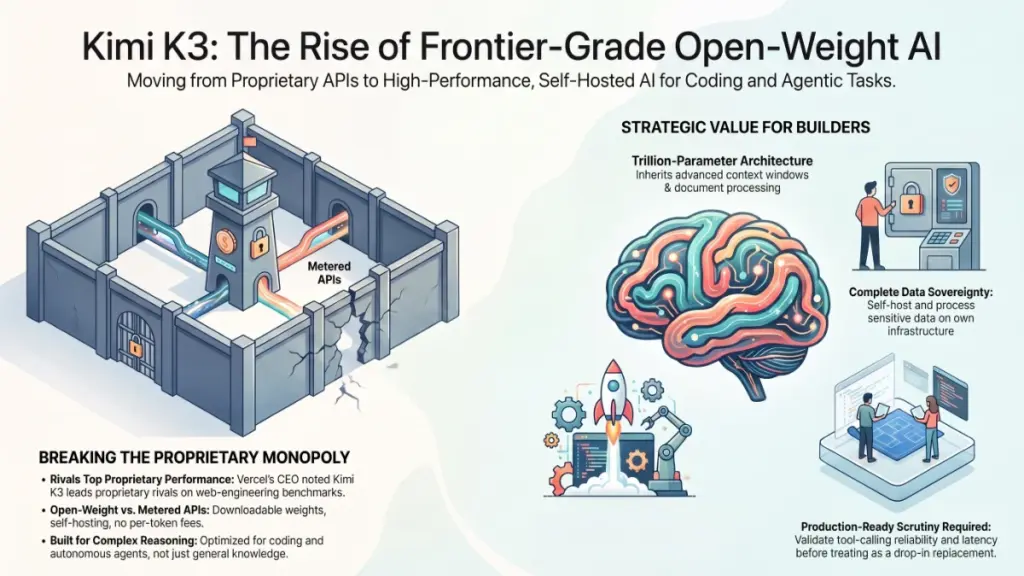
Kimi K3 breaks that pattern. Its coding and agentic performance reportedly rivals top American models. That changes the calculus for teams that defaulted to proprietary APIs simply because open alternatives weren’t good enough yet.
Three groups should pay attention:
- Developers and engineering teams gain a credible option for running a capable coding model on their own infrastructure. They no longer need to route every request through a third-party API.
- Founders and CTOs can now factor self-hosting into cost and data-governance decisions. They don’t have to assume a major capability trade-off.
- AI tool vendors may need to justify their pricing and lock-in. A free, downloadable alternative is earning credibility with independent testers.
Technical Details
Kimi K3 succeeds Kimi K2. That earlier model first put Moonshot AI on the map by pairing a very large context window with a trillion-parameter design built for processing lengthy documents.
The lab has also built MuonClip and Mooncake. Its researchers contributed earlier to Transformer-XL, RoPE, Group Normalization, and ShuffleNet — a research lineage that predates the company itself.
Moonshot has since expanded beyond document processing into coding, research, and autonomous agents. Kimi K3 targets that same direction.
Teams evaluating the model should watch three things: context length, agentic tool-use reliability, and coding benchmark scores relative to GPT-5.6 Sol, Claude Opus, and Gemini. Check these figures against Moonshot’s own documentation rather than assuming continuity from the K2 generation.
Performance and Early Evidence
The strongest signal so far isn’t a benchmark chart. It’s reactions from engineers who build developer tools for a living.
Vercel CEO Guillermo Rauch <cite index=”2-30″>called it “the first time that an open model is ahead of all proprietary ones”</cite> on a comprehensive web-engineering benchmark. Wharton’s Ethan Mollick offered a similar take, describing Kimi K3 as the closest an open model has come to the frontier.
These are informed, credible voices. But they don’t replace independent, reproducible benchmarking.
Early praise moves quickly through AI Twitter/X. Production-grade validation takes longer to surface — things like latency under load, tool-calling reliability, and failure modes on messy real-world codebases. Teams considering a switch should wait for third-party evaluations before treating Kimi K3 as a drop-in replacement.
Pricing and Availability
Kimi K3 is open-weight. Anyone can download the model weights instead of accessing them only through a metered API.
That openness drives its appeal for cost-sensitive teams. Self-hosting removes per-token API fees and gives organizations control over where their data gets processed.
Confirm licensing terms, hosting requirements, and any hosted-API pricing directly with Moonshot’s documentation. Terms on fast-moving open-weight releases can shift shortly after launch.
Industry Implications
Kimi K3 fits a broader pattern. Chinese labs keep releasing open-weight models that compete on capability while undercutting proprietary pricing.
For the open-source ecosystem, a genuinely competitive coding model lowers the barrier to entry. Smaller companies and independent developers can now build agentic products without a large API budget.
For proprietary vendors, the pressure shifts. They need to differentiate on reliability, tooling, and support rather than raw benchmark scores alone.
There’s also a talent-and-policy angle worth noting. Moonshot AI’s cofounder, Yang Zhilin, trained at Carnegie Mellon before returning to China to start the company. That path prompted public comments from investors like Vinod Khosla, who linked the move to US immigration policy. Frontier AI development no longer sits only in Silicon Valley, and buyers should expect more releases like this one.
Limitations and Open Questions
Several things remain unverified. Rauch’s and Mollick’s comments are notable, but they’re informal endorsements, not controlled evaluations.
Key questions remain open. How does Kimi K3 perform on tasks outside coding and web engineering? How does it handle enterprise-scale context windows in practice? What does inference actually cost once you factor in self-hosting infrastructure?
Independent benchmarks from groups that test coding models systematically will matter more than launch-week reactions.
Future Outlook
Independent testing could confirm Kimi K3’s early reception. If it holds up, the result adds real weight to a broader argument: open-weight models are catching proprietary ones on the tasks developers care about most, not just general knowledge benchmarks.
Expect competing labs — both Chinese and American — to respond with their own coding-focused releases in the coming months. Expect more scrutiny of Moonshot’s benchmark claims too, as outside researchers get hands-on access.
Conclusion
Kimi K3 is a legitimate data point in the open-weight-versus-proprietary debate, not a settled verdict. Its coding and agentic results are drawing praise from credible builders, and its open-weight availability makes it worth testing for teams weighing self-hosted alternatives to proprietary APIs. The real question is whether it holds up under sustained, independent evaluation over the next few weeks.