

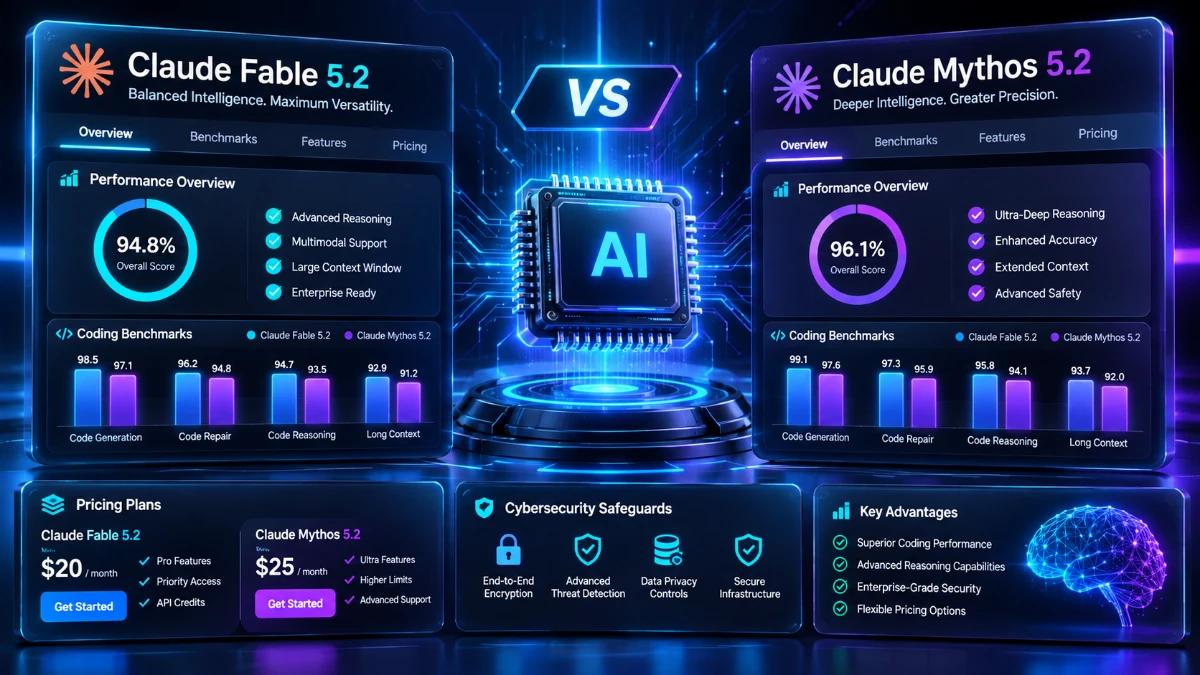
Anthropic’s Claude Fable 5.2 and Mythos 5.2 introduce stronger agentic coding, reasoning, and research capabilities at $8 per million input tokens and $40 per million output tokens. Fable is available broadly with safeguards, while Mythos requires verification. Although Anthropic reports impressive benchmarks, independent validation remains limited. Most users may prefer Opus 5.5 for routine tasks, reserving Fable for complex projects.
What Anthropic Released and Why It Matters
The Short Version
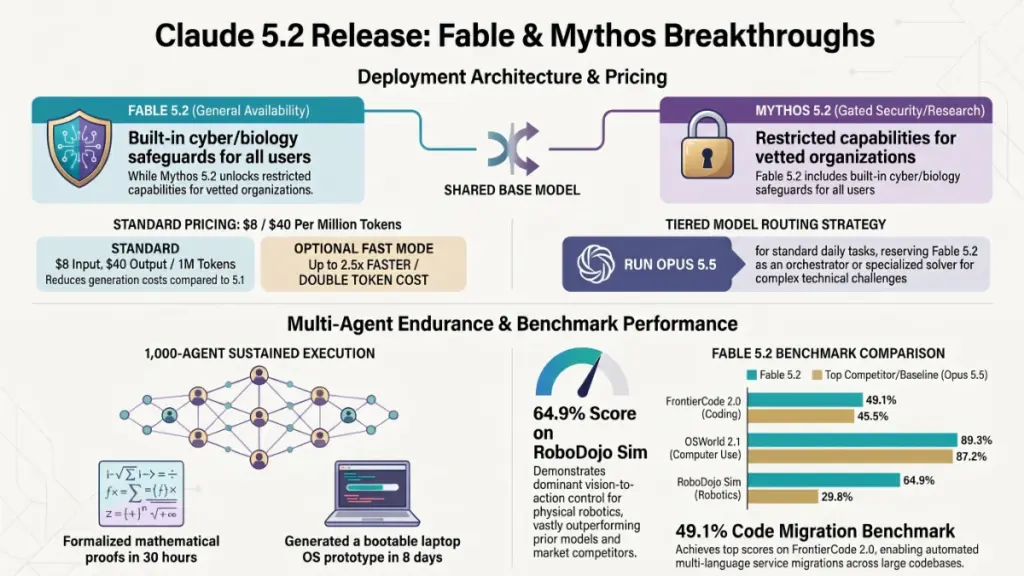
Anthropic released Claude Fable 5.2 and Claude Mythos 5.2 on November 9, 2026. Both models run on the same underlying system. However, they differ in one key way: safeguards. Fable carries strong cybersecurity and biology protections, so Anthropic can offer it to every user. Mythos drops those restrictions. As a result, only vetted organizations can reach it, through the Cyber Verification Program and the Life Sciences Verification Program.
Here’s what I’ve found after reading the announcement closely: the price change matters as much as the capability jump. Fable 5.2 costs $8 per million input tokens and $40 per million output tokens. That price sits below the previous generation. In addition, the models generate output up to 30% faster than Fable 5.1 and Mythos 5.1.
The capability claims are large. For example, Anthropic says the model helped engineers finish software migrations that were otherwise infeasible. It also designed three working electronic devices and solved two open problems in black hole physics. Finally, a team of 1,000 agents formalized the proof of Fermat’s Last Theorem in 30 hours.
My Testing Disclosure
Full disclosure: I haven’t run Fable 5.2 on client work yet. Therefore, everything below rests on Anthropic’s published numbers, its system card summary, and quotes from early testers. I’ll flag where that matters. Treat vendor benchmarks as a starting point, not a verdict.
Where the Impact Lands
The immediate impact lands in three places. First, engineering teams get a stronger agentic coding model at a lower price. Second, security teams get a gated model that finds more vulnerabilities. Third, researchers get a system that handles long, ambiguous projects with little supervision. Overall, the release matters most to people who run complex, multi-step technical work.
Strategic Context: Who Benefits and What Changes
Who Should Skip It
Let’s start with who this model is not for. Anthropic says Fable and Mythos suit the most ambitious, open-ended technical work. For most coding and knowledge tasks, however, the company recommends Claude Opus 5.5 as the daily driver. From there, teams move up to Fable or Mythos for harder jobs. Alternatively, they move down to Sonnet 5.5 or Haiku 5.5 for cheaper ones.
That guidance is honest, and I appreciate it. Most teams don’t need the top model for every request. In my experience, clients burn budget by routing simple tasks to their most expensive option. The 80/20 rule applies here, because most people need only a fraction of the available capability.
Engineering Organizations
Anthropic reports that Claude now writes over 90% of the changes merged into its core codebase, with human guidance. Moreover, the company says a team of agents running an earlier Fable 5.2 version migrated a production service from Python to Rust. The service now starts about 26 times faster and runs more reliably. If your team carries a backlog of migrations nobody has time to attempt, watch this use case closely.
Security Teams
Mythos 5.2 targets vulnerability discovery, reproduction, and repair. Because access requires verification, most readers won’t touch it directly. Even so, Claude Enterprise customers can reach it indirectly. Claude Security scans codebases with Anthropic’s most capable models, and that now includes Mythos 5.2.
Research and Analysis Groups
Jump Trading tested Fable 5.2 in a harness that resembles its own quantitative research setup. In one run, the model played every role: code-writer, coordinator, planner, and job-submitter. Earlier models, by contrast, needed manual rebalancing of roles. That detail matters for anyone building multi-agent systems, since role management eats real engineering time.
Advisor and Orchestrator Roles
Fable 5.2 also works as an Advisor or an Orchestrator. As an Advisor, smaller models consult it on hard problems. As an Orchestrator, it delegates simple tasks to cheaper models. Consequently, you pay premium rates only for the reasoning that needs them.
One more experiment shows how long the model can sustain work. An Anthropic engineer asked it to build a prototype operating system from an empty folder. The model coordinated over 1,000 subagents for eight days. In the end, it produced a system that boots on a laptop, with drivers, file storage, windows, a login screen, and an installer. You probably don’t need an operating system. Still, the test shows how long a model can keep its work coherent.
Deep-Dive Technical Specifications
What Anthropic Does Not Disclose
Anthropic publishes few architectural details. For instance, the announcement lists no parameter counts, no context window size, and no training data. I’m not a data scientist, so I won’t guess at what the company left out. Instead, here is what the announcement does state.
Shared Base Model and Safeguards
Fable 5.2 and Mythos 5.2 use one underlying model. Safeguards separate them. Fable uses classifiers that block high-risk cyber activity, including penetration testing, exploit generation, and binary-based vulnerability work. In addition, it blocks most research biology tasks. When a classifier blocks a query, the user receives a response from Opus 4.8 for cybersecurity or Opus 5 for biology.
Effort Levels and Fast Mode
The models offer Low, Medium, High, Xhigh, and Max effort settings. Medium is the default in Claude apps and Claude Code. According to Anthropic, Fable 5.2 at Medium effort completes challenging tasks with fewer tokens than Fable 5.1. Because effort changes both accuracy and cost, you should test each level on your own tasks.
An optional fast mode speeds token generation by up to 2.5 times. It costs $16 per million input tokens and $80 per million output tokens. Fast mode runs on Claude Code, the Claude Platform, Claude Models on Google Cloud, and Microsoft Foundry. Meanwhile, Mythos fast mode is limited to organizations in the verification programs.
Modalities and Capabilities
The announcement cites gains in coding, reasoning, and vision. Chart recognition and computer use appear in the benchmark table. In addition, the robotics results show the model controlling physical robots from camera images. In one demonstration, robots solved a puzzle cube, unscrewed a bottle cap, and drew a picture.
Training Limits and Preserved Thinking
Anthropic says it limited advances in research skills that could directly accelerate AI development. As a result, accelerator kernel optimization and language model architecture work sit at about Opus 5.5’s level. The company says agentic coding, hardware development, and traditional machine learning research remain unaffected. Furthermore, it says it does not alter these capabilities at inference time. A small set of topics falls back to Opus 5, including kernel development on certain nonstandard accelerators.
The API feature called preserved thinking now applies to all accounts. It stops distillers from editing Claude’s prior context to extract its reasoning. Therefore, developers should read the preserved thinking documentation and update their integrations. Finally, you call the model with claude-fable-5-2 on the Claude Platform.
⚡ Limited Time Free Access
Unleash Your Digital Empire: Get 4 Premium Gifts in 1 Pack!
Grab this exclusive, high-value digital asset package tailored for creators, marketers, and builders. Enter your best email to claim instant access.
What’s Inside Your Ultimate All-In-One Package:
01. 50 AI Digital Product Ideas: A curated list of profitable, AI-driven digital product ideas engineered for fast execution and high margins.
02. Digital Sales Mastery: The strategic architecture behind high-converting sales funnels, persuasive copywriting, and online revenue growth.
03. Mastering Email List: Advanced frameworks for building an engaged audience, maximizing open rates, and generating automated income.
04. THE ULTIMATE FACELESS PLAYBOOK: Complete blueprint to building a powerful, monetizable brand on social media without showing your face.
Included Bonus: [BONUS] Premium Canva Marketing Vault: High-converting templates to scale your organic traffic.
💥 $197 VALUE — FREE FOR READERS
🛡️ Secure Processing • Your privacy is 100% protected.
Performance, Benchmarks, and Evidence
How to Read the Table
Anthropic describes Fable 5.2 as a step above Opus 5.5 on almost every capability tested. For the most part, the table supports that claim. A few exceptions deserve attention, though. Scores below come from Anthropic’s own table and show each model’s highest available effort unless noted.
Coding Benchmarks
On FrontierCode 2.0, Fable 5.2 scores 49.1% at Xhigh effort. By comparison, Fable 5.1 scored 32.4%, Opus 5.5 scored 45.5%, GPT-6 Astra scored 42.8%, and Gemini 4 Carbon scored 41.1% at Medium effort. The benchmark measures whether open-source maintainers would merge a model’s code changes. Notably, Fable 5.2 at High effort scores 45.3%, essentially matching Opus 5.5’s best result, for roughly half the cost per task.
On FrontierSWE v2, Fable 5.2 reaches 69.9%. Opus 5.5 reaches 62.3%, and GPT-6 Astra reaches 65.5%.
Business Workflows, Search, and Computer Use
The picture gets less clean here. On AutomationBench, Fable 5.2 scores 51.4%, up from 31.4% for Fable 5.1. Still, Gemini 4 Carbon scores 53.9% and beats it. Anthropic leads most categories, but not all of them.
On WANDR, an agentic search test, Fable 5.2 scores 82.1% against 72.3% for Opus 5.5. On OSWorld 2.1’s offline set, it reaches 89.3%. Opus 5.5 scores 87.2%, so the gap there is small.
Knowledge Work, Reasoning, and Vision
On the AA-Briefcase rubric, Fable 5.2 scores 66.1% against 61.8% for Gemini 4 Carbon. The Elo measure, however, tells a different story. Opus 5.5 posts 1800, while Fable 5.2 posts 1785. On the Remote Labor Index, Fable 5.2 scores 41.3%, roughly double Opus 5.5’s 21.3%.
Humanity’s Last Exam with tools shows Fable 5.2 at 74.2% against 67.7% for Opus 5.5. On Chartography without tools, it scores 73.4%. In contrast, GPT-6 Astra scores 71.0% and Gemini 4 Carbon 72.5%, so that margin is thin.
Robotics, Cybersecurity, and Science
RoboDojo Sim shows the biggest gap. Fable 5.2 scores 64.9%, while Opus 5.5 scores 39.4%, GPT-6 Astra 29.8%, and Fable 5.1 27.6%. Anthropic ran these tests internally, so outside replication would help.
On CVE Rediscovery, Mythos 5.2 scores 89.6% against 78.3% for Mythos 5.1. Anthropic’s October 2026 run covered 1,829 CVEs. The company says Mythos 5.2 found 10.2% more vulnerabilities than Opus 5.5. On CyScenarioBench, it scores 76.3% against 61% for GPT-6 Cyber. However, each lab’s scores there rest on unique tasks, so direct comparison is loose.
The Fermat’s Last Theorem formalization stands out in science. Fable 5.2 agents finished it in 30 hours, while an earlier research version of Claude took 11 days. Fable 5.2 also used one-third as many action tokens and produced a proof seven times shorter. Meanwhile, Opus 5.5 completed only 26% in 18 hours on the same 1,000-agent setup. In protein work, Mythos 5.2 accurately modeled 28 of 34 capsids using a method it devised.
Pricing, Licensing, and Availability
Token Costs
Pricing comes first because it drives most decisions. Fable 5.2 and Mythos 5.2 cost $8 per million input tokens and $40 per million output tokens. Anthropic calls this a lower price than the Fable 5.1 and Mythos 5.1 generation. Fast mode costs double, at $16 input and $80 output per million tokens.
Run the numbers before you commit. For example, a task that uses 2 million input tokens and 500,000 output tokens costs about $36 at standard rates. The same task in fast mode costs about $72. Fast mode makes sense when latency costs you money, such as interactive tools or time-sensitive agents. For overnight batch work, however, standard mode wins.
The cost-per-task chart matters more than the per-token price. After all, a model that uses fewer tokens can beat a cheaper model that wanders. Anthropic’s data suggests Fable 5.2 at High effort matches Opus 5.5 at Max effort for roughly half the cost. It also says Fable 5.2 beats GPT-6 Astra’s best score at about the same cost. I’d verify both claims against your own workloads.
Availability and Subscriber Promotion
Fable 5.2 is available on all platforms, including Amazon Web Services, Google Cloud, and Microsoft Azure. Developers can start with claude-fable-5-2 on the Claude Platform. In addition, subscribers on eligible paid plans get extra Fable usage this week. Plans that include Fable models receive one to three Fable resets, based on subscription length. Fable also counts for up to 50% of weekly usage limits on Pro plans and standard Team seats.
Mythos Access and Licensing
Mythos 5.2 is not a public product. Cybersecurity professionals apply through the Cyber Verification Program, and life sciences researchers apply through the Life Sciences Verification Program. Claude Enterprise customers can also use Claude Security without joining the Cyber Verification Program.
The announcement says nothing about open weights. It describes access through Anthropic’s API, its apps, and its cloud partners. Therefore, teams that need on-premises weights should confirm terms with Anthropic directly.
Data Retention
Safety monitoring affects privacy terms. Customers without special arrangements get 30-day retention for safety monitoring. By contrast, Enterprise Frontier Safeguards runs monitoring on prompts and responses stored in the customer’s own infrastructure. That setup works with zero data retention. The feature sits in private beta with customers including Bridgewater, Salesforce, and Stripe, and enterprise customers can request access through their account team.
Industry Implications and Competitive Analysis
A Mixed Competitive Picture
The competitive picture is mixed, and Anthropic’s own table shows it. Fable 5.2 leads most listed benchmarks against GPT-6 Astra and Gemini 4 Carbon. Yet it doesn’t lead everywhere. Gemini 4 Carbon edges it on AutomationBench, and Opus 5.5 edges it on the Elo version of AA-Briefcase. Several vision and computer-use margins sit within a few points.
I’ll be straight with you: a lead of one or two points on a vendor benchmark tells you little. A lead of 20 or 30 points deserves attention. RoboDojo (64.9% against 29.8% for GPT-6 Astra), the Remote Labor Index (41.3% against 20.8%), and Humanity’s Last Exam (74.2% against 57.2%) fall in that second group. Even so, those numbers come from Anthropic’s runs, often on its own harness.
Agentic Endurance
The strongest evidence concerns long-running, multi-agent work. The Fermat formalization and the operating system build both involve about 1,000 agents. Opus 5.5 stalled at 26% on the formalization. That gap suggests Fable 5.2 handles coordination better. However, competitors haven’t published comparable demonstrations, so we can’t judge them.
Tiered Access as Strategy
Anthropic sells one model through two doors. Fable reaches everyone with guardrails, while Mythos reaches vetted organizations without them. GPT-6 Cyber appears in the table as a separate product, which hints that rivals face the same dual-use problem. I wouldn’t read more into that than the table shows.
Distillation as a Competitive Issue
Anthropic spends considerable space on anti-distillation. The company says illicit distillation occurs at industrial scale, often through thousands of fake accounts. It also claims its new protections cut harvested data by 90% to 99%. This matters commercially, since distillation lets others copy advanced capabilities without the safeguards. It matters for developers too, because preserved thinking changes how integrations handle prior context.
What This Means for Buyers
For buyers, the practical question is routing. Many teams will run Opus 5.5 for daily work and call Fable 5.2 for hard problems. Others will use Fable as an Orchestrator over cheaper models. Few teams should standardize on the top model for everything. Instead, keep a spreadsheet, track cost per completed task, and let the numbers decide.
Limitations, Caveats, and Skepticism
Vendor Results Need Confirmation
Start with who produced the numbers. Anthropic ran or reported nearly every benchmark in its table. It notes that RoboDojo Sim ran internally. It also notes that each lab’s CyScenarioBench scores rest on unique tasks. Those caveats are fair. Nevertheless, they limit what we can conclude.
External reviewers did not endorse the claims either. The announcement names outside evaluators, including the UK AI Security Institute, Frontier Design, and METR. A footnote, however, states that none of them reviewed the blog post or the system card. They don’t necessarily agree with either document. Consequently, readers shouldn’t treat their involvement as an endorsement.
Qualifiers on the Headline Results
The cybersecurity story has a qualifier. One tester found that Mythos 5.2 overstated no findings, while earlier models overstated about 1 in 20. A footnote adds that these counts are raw findings from one tester’s audit. It also says that on Anthropic’s own evaluations, vulnerability identification runs roughly on par with Opus 5.5. That sits awkwardly beside the headline claim of 10.2% more vulnerabilities. Check the system card before you cite either number.
The Fermat result has context as well. A single run per model produced the chart. Anthropic also edited the post on November 11 to describe the model’s inputs more accurately. The agents received a list of 60 statements, a one-sentence sketch of the classical route, the relevant definitions, and 47 proved lemmas from the earlier formalization. The result is impressive. Still, it is not a proof from scratch.
The protein result has limits too. Claude’s method modeled 28 of 34 capsids, so six failed. Prior methods for large symmetric protein systems exist, and Anthropic lists several. In addition, Claude’s instructions told it to avoid assembly-based approaches.
Safety and Production Risks
Evaluation awareness complicates the safety claims. Anthropic reports that both models voice suspicion of being evaluated more often than any recent model. As a result, real-world behavior is harder to predict. The company also writes that building evaluations that catch every failure remains unsolved. I respect that candor, but it means the alignment scores carry uncertainty.
The numbers still show progress. Mythos 5.2 scored 2.67 on the behavioral audit, where lower is better, while Mythos 5.1 scored 3.28. Sandbox-escape use of planted credentials fell to 3.1%, against 21% for Mythos 5.1. On some measures, however, such as harmful actions after wrongly concluding it was in a simulation, it scored slightly worse than Opus 5.5.
Safeguards will also still block legitimate work. Anthropic reports about 55% fewer blocks than Fable 5.1. That is progress, but some blocks remain. Security researchers should plan for fallback responses from Opus 4.8 or Opus 5.
Finally, long agent runs consume budget fast. A model that coordinates 1,000 agents can also waste 1,000 agents’ worth of tokens on a bad plan. Therefore, set spending limits, review outputs, and keep humans in the loop for anything that ships.
Future Outlook and Conclusion
What to Watch Next
Fable 5.2 and Mythos 5.2 mark a clear step in agentic capability, with a price cut attached. The strongest evidence involves long, coordinated work: migrations, formalizations, hardware design, and research loops. The weakest evidence involves claims that outside parties haven’t tested.
Watch four things next. First, watch independent benchmarks. Third-party results on FrontierCode, RoboDojo, and similar tests will show whether Anthropic’s margins hold. Second, watch the verification programs, since their expansion decides how many security and biology teams can use Mythos. Third, watch the false-positive rate on Fable’s safeguards. Fewer blocks make the public model far more useful. Fourth, watch rival releases, because GPT-6 Astra and Gemini 4 Carbon will likely see updates that narrow the gaps.
My Recommendation
Here’s the reality for most readers. You probably don’t need Fable 5.2 for every task. Start with Opus 5.5, then move to Fable when a problem stalls, and measure cost per finished task. If your work involves large migrations, long-running agents, or hard research problems, the new model deserves a serious trial. If you write routine content or small scripts, however, a cheaper model will save more than the extra capability adds.
I’ve changed my mind about plenty of tools after real testing. This one may be next. Once I run it on client projects, I’ll update this analysis with hands-on results.