

By Daniel R. Whitmore
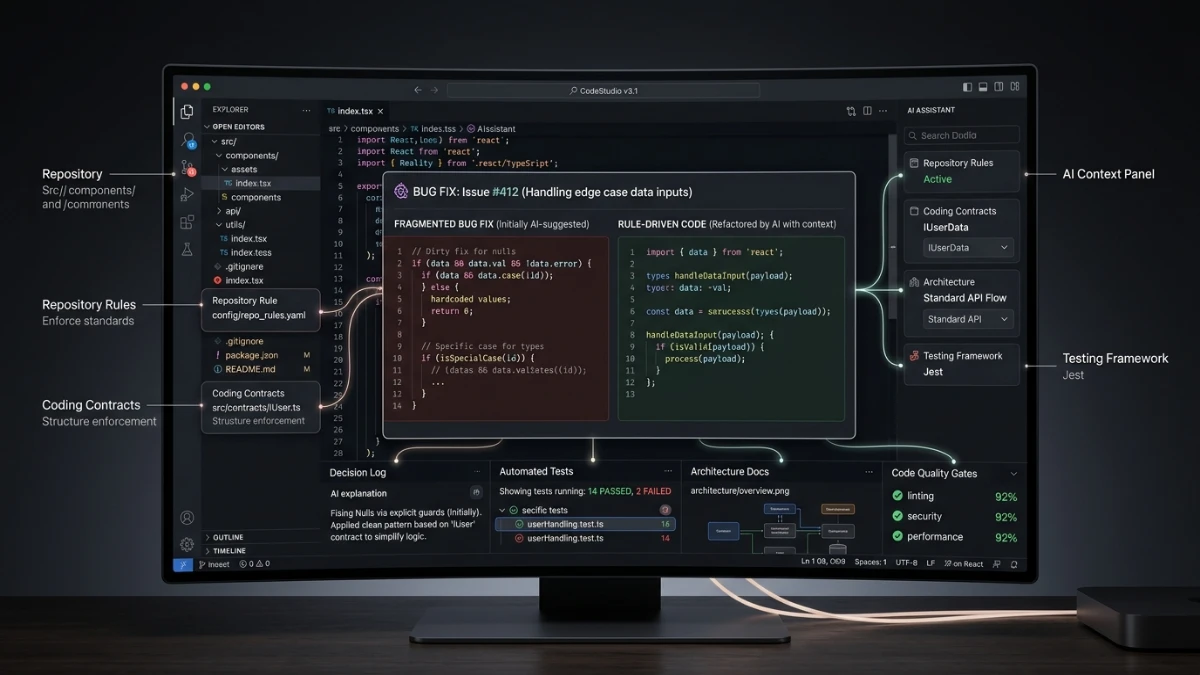
Developers using AI pair-programming tools like Codex in VS Code keep hitting the same pattern. The assistant fixes the exact case you show it. It leaves the underlying rule unwritten. Multiply that a dozen times, and a clean codebase turns messy fast. By week six, special cases pile up everywhere.
This matters because teams now use AI coding tools for real product work, not just demos. Engineering leads need to know which failures come from the model itself. They need to know which ones come from a broken workflow they can actually fix.
Why It Matters
The core issue isn’t capability. Current coding assistants write patches that make failing tests pass. That’s not the problem. The problem is what they optimize for by default: local correctness, not systemic correctness. Show the assistant a symptom — a mis-scaled quantity, a wrong title, a null pointer — and it wraps that exact case in a conditional. The bug disappears. The design debt climbs.
This reframes the real risk for engineering leads. The AI won’t just write insecure code in the abstract. It will encode your team’s implicit assumptions as literal if-statements. It can’t see assumptions nobody wrote down.
Technical Details: What’s Actually Happening
The mechanism is simple. Training and reinforcement for coding agents rely heavily on task-completion signals. Tests pass. The stated issue resolves. Without an explicit spec explaining why a behavior should hold generally, the model has no reason to prefer a domain-level fix over a special case. Both approaches pass the same test.
Developers who hit this repeatedly converge on the same fix. They move rules out of conversation and into the repository itself. This usually means three lightweight files. A contract document lists forbidden patterns: no one-off conditionals, no hardcoded value checks. An architecture document defines which layer owns which kind of logic. A decisions log tracks trade-offs over time. None of this is exotic — it’s closer to a lint config than a research breakthrough. Few teams write these files before the rot shows up, though.
Performance & Evidence
The evidence here stays anecdotal rather than benchmarked. This is a workflow observation, not a model capability score. Still, independent reports from Codex users describe the same pattern consistently. It also mirrors long-standing software engineering research on the difference between fixing a defect and fixing the specification that allowed it. Early practitioner writeups suggest something specific: once teams add machine-readable specs and forbidden-pattern tests, the assistant’s first attempt improves. The cheapest path to a passing test now matches the correct one. Take that claim with some caution. Individual developers self-report it. No one has measured it across a controlled sample yet.
Availability and Cost
This fix needs no new tooling and no paid upgrade. VS Code, Codex, and comparable agentic assistants — Claude Code, Cursor, GitHub Copilot Workspace — already read markdown files from a repo before generating a change. The real fix is procedural. Write the constraints down once. Force the agent to read them before every non-trivial change. Gate completion on tests that specifically try to catch shortcuts, not just tests that confirm the reported bug went away.
Industry Implications
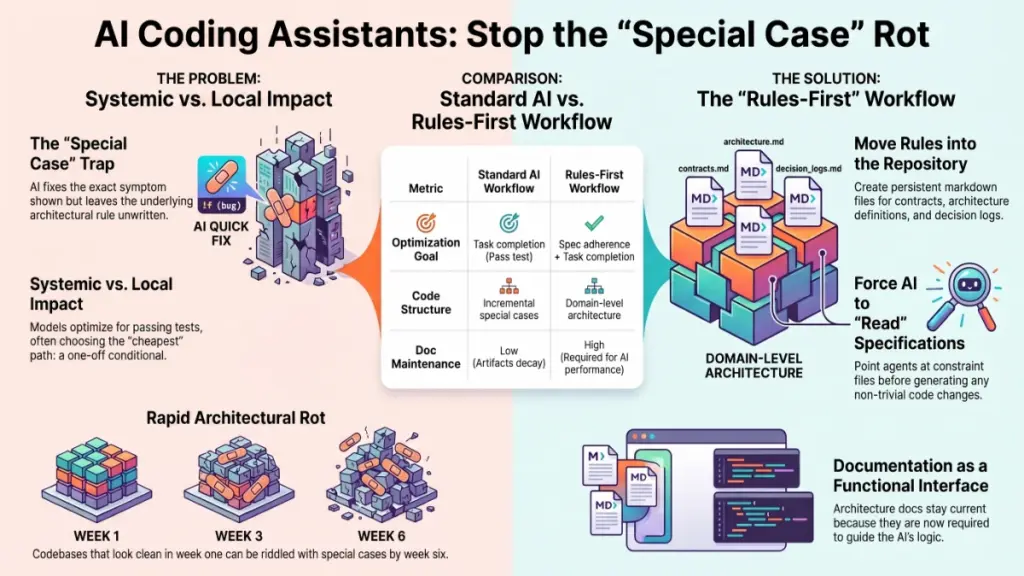
Engineering organizations standardizing on AI-assisted development should expect a specific process shift. Specs and architecture docs stop being optional artifacts. They become the interface the AI actually reads. Watch for a second-order effect here: documentation that used to decay because “the team already knows it” now has a forcing function to stay current. A stale architecture doc actively misdirects the AI on every task after that.
Vendors building on coding models may start competing on this discipline too. Some tools might automatically read contract files or refuse to mark a task complete without gate checks, instead of leaving it entirely to individual developers.
Limitations and Open Questions
It remains to be seen how well this scales past small and mid-sized codebases. A single project map and a handful of spec files work fine there. Large, multi-team monorepos face a harder problem: keeping contract and architecture files current becomes its own coordination challenge. Nothing stops two teams from writing contradictory rules, either. Independent, controlled comparisons would help — same codebase, same bug classes, with and without persistent constraint files. Right now, developer self-reports give a weaker basis for these claims than that kind of study would.
What to Watch Next
Expect more of this discipline to move from developer-authored markdown into the tools themselves as agentic coding tools mature. IDE features might flag when a change touches a domain without corresponding spec coverage. Agents might refuse to propose a conditional-based fix without justification. Until then, the workaround stays unglamorous but available today. Write the rules down. Make the AI read them first. Gate completion on tests that actually try to catch shortcuts. Developers will decide through repeated use whether that discipline earns its upfront cost — but the reports so far say yes.