

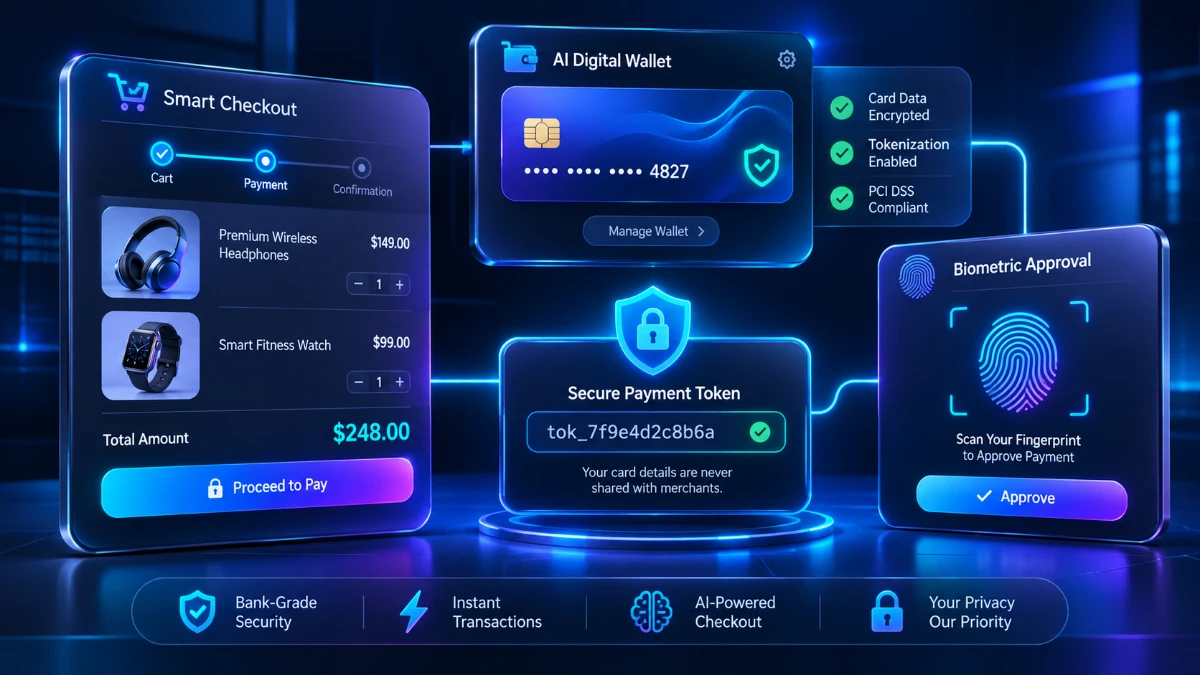
ChatGPT Wallet, introduced by OpenAI on November 13, 2026, enables eligible users to approve AI-agent purchases through tokenized payments and biometric security checks. Initially available to US ChatGPT Pro subscribers aged 18 and older with eligible US-issued cards, it aims to make agentic shopping safer. However, limited availability, missing performance data, and unanswered security questions mean merchants should prepare while consumers await broader access.
Lead & Significance
What OpenAI announced
On November 13, 2026, OpenAI introduced ChatGPT Wallet. The product lets AI agents pay for purchases on a user’s behalf. Importantly, it does this without exposing the user’s real card details to the agent or the merchant.
At first, the launch is narrow. ChatGPT Wallet arrives through dots, and only ChatGPT Pro subscribers in the US can use it. Users must also be 18 or older. In addition, they need an eligible US-issued card.
Why the design matters
The design matters more than the rollout size. OpenAI built the wallet with American Express, Mastercard, and Visa. Each purchase requires a security check from the user, such as Face ID or a fingerprint scan. After that check, the payment network issues a payment token. That token replaces the real card number, security code, and expiration date.
This approach answers the biggest objection to agentic shopping. People worry that an agent might spend money they never approved. Likewise, they worry about handing card numbers to software. OpenAI’s answer is simple: the agent never sees the card. Meanwhile, the user approves every purchase, and the card keeps its rewards and dispute protections.
Scale and urgency
Scale explains the urgency. OpenAI says 1.2 billion people use ChatGPT each week. Many of them already research products and compare options inside the app. Until now, however, they had to leave and finish the purchase elsewhere. ChatGPT Wallet closes that gap.
How I approached this analysis
I have spent years helping clients wire marketing tools into checkout flows. From that work, I know payment integrations fail in predictable ways. They fail on trust, on fraud rules, and on edge cases nobody tested. Therefore, I read this announcement for what it says about those three areas.
One note on sourcing: this analysis relies on OpenAI’s own announcement. I have not tested the product. Furthermore, OpenAI published no performance data, so I flag those gaps where they matter. Below, you will find the mechanics, the business impact, the open questions, and practical steps for merchants.
Strategic Context & Why It Matters
The problem Wallet solves
Agentic commerce has a trust problem. An agent that can browse a store can also make mistakes. For example, it can pick the wrong size, buy from the wrong seller, or repeat an order. Consequently, users will not give such a tool open access to a credit card.
ChatGPT Wallet limits that risk in three ways. First, it hides the real card from the agent. Second, it requires a user check before each purchase. Third, it records each approval. Together, these controls create a paper trail for every transaction.
Who benefits
Several groups gain from this design.
Consumers get convenience without surrendering card data. In addition, they keep card rewards and dispute rights for eligible problems, such as a defective item.
Card networks and issuers stay in the transaction. OpenAI says banks and networks bring their expertise to evaluating transactions. That language signals that OpenAI did not try to replace the payment rails. Instead, it plugged into them.
Merchants keep their customer relationships. According to OpenAI, users transact directly with businesses, and businesses retain control over pricing, fulfillment, returns, and customer service. Many merchants fear that an AI layer will turn them into anonymous suppliers. Therefore, this design addresses that fear, at least in principle.
OpenAI itself gains a path to revenue and engagement. However, the announcement does not mention fees. Even so, it shows a company moving from answering shopping questions to closing sales.
How workflows change
The shopping journey shortens. First, a user asks an agent to find a product. Next, the agent compares options. Then the user reviews the items, the total, and the selected card. Finally, the user approves with a biometric check, and the agent completes the purchase.
That sequence removes several steps. For instance, the user no longer opens a store, builds a cart, or types a card number. Merchants also lose the browsing session where they normally upsell.
Marketers should pay attention here. If agents choose products, product data becomes the main sales pitch. As a result, clear titles, accurate prices, and current availability will matter more than banner design. I have watched clients spend months on landing pages. In an agent-led flow, however, a clean product feed may outperform them.
The delegation roadmap
OpenAI also describes a future step. Over time, it expects users to delegate purchases entirely to their agent. First, users would set parameters, such as spending limits, purchase categories, and time periods. Then they would pre-approve purchases within those rules.
OpenAI says this future mode will use enhanced safeguards, including biometric checks and clear records of authorization. Still, this is a roadmap, not a shipped feature. Today, every purchase needs a live approval.
That distinction is important. Fully delegated buying creates the largest convenience gain. At the same time, it creates the largest risk. Therefore, the company is wise to start with per-purchase approval.
Deep-Dive Technical Specifications
OpenAI disclosed the payment flow in detail. However, it disclosed little about model architecture. This section covers what the announcement actually specifies.
Architecture of a purchase
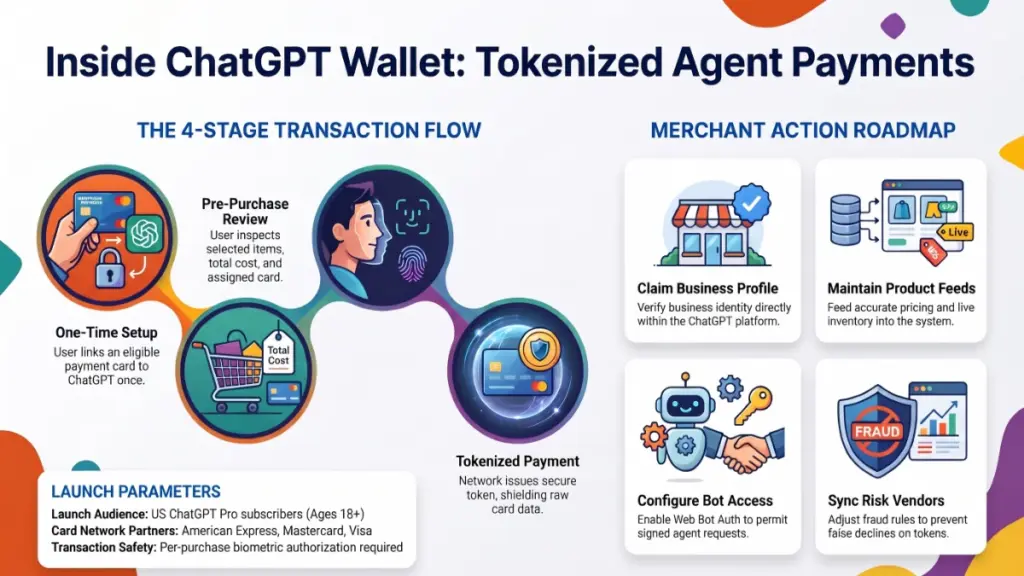
The flow has four stages.
Stage 1: One-time card setup. The user adds a card once. After that, the user does not re-enter payment details for later purchases.
Stage 2: Pre-purchase review. Before each purchase, the user sees the products, the total, and the selected card.
Stage 3: Security check. Next, the user approves with a biometric check. OpenAI cites Face ID and fingerprint scans as examples. Each approval creates a record of what the user authorized the agent to buy.
Stage 4: Tokenized payment. Once the user approves, the payment network supplies a payment token. The token acts as a substitute for the real card and carries a card number, a security code, and an expiration date. The charge lands on the user’s selected card.
The key point is simple: neither the business nor the agent receives the actual card details. Because the token works inside existing checkout flows, merchants do not need a separate payment system.
Why tokens matter
A payment token limits damage when something goes wrong. For example, if a merchant’s database leaks, the token does not reveal the real card number. Similarly, if an agent misbehaves, it cannot copy data it never held. Networks already use tokenization for mobile wallets, and OpenAI applies the same principle to agents.
However, the announcement does not say whether tokens are single-use or tied to a specific merchant. It also omits how long a token stays valid. Those details affect security. Consequently, I would want answers before trusting the system with large purchases.
Identity and access for agents
The wallet is only half the problem. Agents also need to reach checkout pages. Unfortunately, many sites block automated traffic by default. Those defenses protect stores from bots, but they can also stop legitimate agents.
OpenAI’s playbook addresses this directly. It tells merchants to configure their CDN or firewall to recognize signed requests using Web Bot Auth. With Web Bot Auth, a site can verify that a request comes from a known agent. The merchant can then allow it through.
In addition, the playbook says browser access does not require a plugin or a product feed. An agent can shop a standard website as a person would. Plugins and feeds improve the experience, but they are not mandatory.
Integration surfaces for businesses
OpenAI lists several ways for businesses to work with agents.
- Claim your business in ChatGPT. Once verified, a business can update its details and upload a product feed with current pricing and availability.
- Configure bot access. Merchants should check that CDN, firewall, and security rules do not block ChatGPT agents.
- Coordinate with risk providers. Wallet tokens work with existing checkout flows. However, risk systems may still flag agent purchases as suspicious.
- Build a plugin. A plugin lets agents check availability, manage carts, or take other actions through a merchant’s systems.
- Add WebMCP tools. Websites can expose tools that agents call directly.
Modalities, context windows, and parameters
The announcement does not discuss context windows, parameter counts, or model modalities. After all, ChatGPT Wallet is a payments and trust layer, not a model release. Therefore, any article that lists model specifications for it is guessing. I will not do that.
Performance, Benchmarks & Evidence
OpenAI published no benchmark scores for ChatGPT Wallet. It released no approval rates, no decline rates, and no fraud statistics. Admittedly, that absence is not unusual for a limited launch. Still, it limits what anyone can conclude.
What the evidence supports
The announcement offers four facts that readers can verify against the source.
- ChatGPT reaches 1.2 billion weekly users, according to OpenAI.
- Wallet launched on November 13, 2026, through dots.
- Availability is limited to US Pro subscribers aged 18 and older with eligible US-issued cards.
- American Express, Mastercard, and Visa partnered on the build.
American Express also gave a statement. Luke Gebb, the company’s executive vice president and head of global innovation, said Wallet marks Amex’s first integration of its Agentic Commerce Experiences. He added that eligible cardholders can use their Amex card while verifying and approving each purchase. Moreover, he said the companies plan to learn from this first phase and expand to more cardholders over time.
That statement tells us two things. First, Amex treats this as a pilot. Second, Amex expects a wider rollout if the pilot works.
The metrics that will decide success
Without published data, the useful question is what to measure. In my view, five metrics matter most.
Authorization rate. How many agent purchases clear on the first attempt? Risk systems may flag legitimate agent orders, so a low rate would hurt the product quickly.
Approval completion rate. How many users finish the biometric check after reviewing a purchase? Friction here would stall adoption.
Dispute rate. How often do agent purchases lead to chargebacks or disputes? OpenAI says eligible disputes remain protected. Therefore, the volume will show whether agents buy the wrong items.
Bot-block rate. How often do merchant defenses stop an agent before checkout? Notably, OpenAI itself warns that some sites may block purchases unintentionally.
Repeat usage. Do Pro subscribers return to Wallet after the first purchase? Ultimately, retention will show real value.
I built a similar scorecard for a client’s checkout redesign a while back. We tracked about six numbers across roughly four weeks. In the end, the decline rate told us more than all the others combined. I expect the same here.
Why OpenAI limited the launch
OpenAI explains the limited rollout plainly. It wants to learn from real-world use. Additionally, it wants to work with businesses, banks, and payment networks on compatibility and reliability. That reasoning is sound. After all, payment failures damage trust fast, and a small launch contains the damage.
Pricing, Licensing & Availability
Cost to users
OpenAI did not announce a separate fee for ChatGPT Wallet. Instead, access depends on a ChatGPT Pro subscription. Because the announcement does not state the subscription price, check OpenAI’s pricing page for the current figure.
I cannot tell you whether Wallet will stay a Pro feature. OpenAI says it plans to expand availability. However, it gives no timeline.
Cost to merchants
The announcement mentions no merchant fees. Since Wallet’s tokens run through existing payment systems, merchants likely pay their usual processing costs. Nevertheless, I would confirm that with your payment provider rather than assume it.
Who can use it today
The eligibility rules are strict.
- A ChatGPT Pro subscription is required.
- Users must be 18 or older.
- In addition, users must live in the US.
- The card must be eligible and US-issued.
- Finally, access comes through dots, where the user’s dot completes purchases.
If you fall outside any of these, you cannot use Wallet yet.
API and open-weight access
The announcement does not describe a public Wallet API. Likewise, it involves no open-weight model. Developers who want to participate should therefore start with the Commerce Partner Playbook. It covers product data, agent access, and risk-system coordination. In addition, OpenAI lists plugins and WebMCP tools as the technical hooks.
⚡ Limited Time Free Access
Unleash Your Digital Empire: Get 4 Premium Gifts in 1 Pack!
Grab this exclusive, high-value digital asset package tailored for creators, marketers, and builders. Enter your best email to claim instant access.
What’s Inside Your Ultimate All-In-One Package:
01. 50 AI Digital Product Ideas: A curated list of profitable, AI-driven digital product ideas engineered for fast execution and high margins.
02. Digital Sales Mastery: The strategic architecture behind high-converting sales funnels, persuasive copywriting, and online revenue growth.
03. Mastering Email List: Advanced frameworks for building an engaged audience, maximizing open rates, and generating automated income.
04. THE ULTIMATE FACELESS PLAYBOOK: Complete blueprint to building a powerful, monetizable brand on social media without showing your face.
Included Bonus:
[BONUS] Premium Canva Marketing Vault: High-converting templates to scale your organic traffic.
💥 $197 VALUE — FREE FOR READERS
🛡️ Secure Processing • Your privacy is 100% protected.
Industry Implications & Competitive Analysis
A shift from search to transaction
Shopping used to follow a clear path. A person searched, clicked an ad, browsed a store, and paid. By contrast, agentic commerce collapses those steps. The agent searches, compares, and buys. As a result, the store page becomes a back-end resource rather than a destination.
That change threatens ad-driven models. If an agent picks the product, a banner ad has less influence. Instead, product data quality, price, and availability gain weight. Therefore, marketers who rely on display ads should plan for that shift.
How Wallet compares with the alternatives
OpenAI is not the first company to touch payments. For example, digital wallets from major platforms already store cards and use tokens. The difference lies in the actor. Existing wallets help a human pay faster, whereas Wallet lets an agent act for the human, with a human check at the moment of purchase.
I will be careful here. The announcement does not compare Wallet with specific competitors, and I have not tested competing agent payment products side by side. Therefore, I can only describe how the design differs in principle.
Three design choices stand out.
Existing rails, not new ones. OpenAI routes payments through card networks and issuers. A competitor, in contrast, could build a closed system instead. As a result, OpenAI’s choice reduces merchant integration work.
Per-purchase biometric approval. Many automated systems favor speed. OpenAI, however, deliberately adds friction. That friction builds trust now, although it may cost convenience later.
Merchant-direct transactions. Users buy from businesses directly. By comparison, some marketplace models place the platform between buyer and seller. OpenAI chose not to do that.
Pressure on the payments ecosystem
The announcement names several partners. Forter, Riskified, Sardine, and Signifyd work on fraud prevention, while Adyen, Checkout.com, and Stripe provide payment services. OpenAI says it is working with all of them so their systems recognize legitimate agent purchases.
This list reveals the real bottleneck. Fraud engines learned to distrust automated behavior. Indeed, an agent that moves fast, skips browsing, and uses a token can resemble a fraudster. Risk vendors must now separate good bots from bad ones. Because that work takes time, results will vary by provider.
What merchants should do now
If you run an online store, take these steps.
- Claim your business. Verify your business in ChatGPT and update your details.
- Upload a product feed. Keep pricing and availability current, because stale data causes failed orders.
- Audit your bot defenses. Check your CDN and firewall rules, and add support for signed requests using Web Bot Auth.
- Call your payment provider. Ask how it treats agent-initiated purchases. Then ask what you can do to reduce false declines.
- Consider a plugin or WebMCP tools. These let agents manage carts and check stock through your own systems.
I learned this the hard way: clients often treat integrations as a launch-day task. They are not. In fact, the first month reveals the problems, so you need monitoring in place before then.
What marketers and agencies should do
Agencies should add agent readiness to their service lists. First, audit client product data. Next, test whether agents can reach checkout. Finally, report on agent-driven revenue as its own channel. Early movers will learn faster than late ones.
Small businesses can start with the basics. Accurate product pages and clean feeds cost little. Moreover, they help every channel, not just this one.
Limitations, Caveats & Skepticism
Limited reach
The audience is small. Wallet serves US Pro subscribers with eligible US-issued cards, which excludes most ChatGPT users. Remember that the 1.2 billion weekly figure describes ChatGPT overall, not Wallet’s addressable base. Do not confuse the two.
Unverified claims
OpenAI calls Wallet the first wallet that lets agents pay without access to actual card details. It also says Wallet requires a security check for every purchase. These are the company’s own statements. Furthermore, no third-party audit appears in the announcement, and I have not verified them independently.
Likewise, the phrase “setting a new bar for secure payments by agents” is a marketing claim. Treat it as one until independent testing supports it.
Real-world production risks
Several risks deserve attention.
False declines. OpenAI admits that risk systems may flag legitimate agent purchases, which can cause declines and cancellations. Notably, a failed purchase after a biometric approval feels worse than one before it.
Blocked agents. OpenAI notes that some sites may block purchases unintentionally. Merchants must fix this on their side, because users cannot.
Agent errors. The user reviews items, total, and card before approval. However, that review only helps if the user reads it. People approve prompts quickly, so approval fatigue is a known problem in security design.
Dispute coverage. OpenAI says users keep protections for eligible disputes. Yet the word “eligible” carries weight. The announcement does not define which disputes qualify. Therefore, read your card issuer’s terms before relying on it.
Unclear token details. The announcement does not say whether tokens are single-use or merchant-bound. It also omits token lifetime. Those details shape the security model.
What the announcement leaves out
The document omits many items I would want. For instance, it gives no fee schedule, no decline statistics, and no refund workflow. It also gives no timeline for expansion beyond the US. I expect OpenAI to fill some of these gaps, and I will update my view when it does.
To be completely honest, I like the design. It shows restraint. OpenAI could have chased speed and skipped the approval step. Instead, it chose a slower path with clearer accountability. Still, a good design is not a proven product.
Future Outlook & Conclusion
What comes next
OpenAI has outlined its direction. It plans to expand availability as it learns from early use. In addition, it expects to work with banks, networks, and businesses on compatibility and reliability. Eventually, it also expects users to delegate purchases entirely, within limits they set.
American Express echoed the same arc by saying it plans to widen these experiences to more cardholders over time. Mastercard and Visa joined the build, although the announcement quotes only Amex.
What developers and merchants should watch
Watch five signals over the next several months.
- Expansion beyond Pro. A move to other subscription tiers would widen the audience sharply.
- Delegated purchasing. Spending limits, category rules, and time windows will test the safeguards.
- Risk-vendor updates. Watch whether Forter, Riskified, Sardine, and Signifyd report improved recognition of agent traffic.
- Payment provider support. Updates from Adyen, Checkout.com, and Stripe will show how smoothly tokens flow.
- International rollout. Today’s eligibility rules cover the US only.
Bottom line
ChatGPT Wallet is a careful first step into agentic payments. It hides card data, requires approval per purchase, and keeps existing card protections. Moreover, it works with current checkout systems rather than replacing them.
The launch is small, and the evidence is thin. OpenAI published no performance data, and its security claims await outside testing. Nevertheless, merchants should act now. First, fix product data. Second, check bot defenses. Third, talk to payment providers. These steps cost little and help in any scenario.
If you sell online, treat agents as a new kind of customer. They need accurate data, open doors, and reliable checkout. Meanwhile, if you build tools, watch how OpenAI handles delegation next. That feature will decide whether agentic commerce becomes routine or stays a novelty.
Source: OpenAI, “Introducing ChatGPT Wallet,” November 13, 2026. Figures and claims come from that announcement unless noted otherwise.