


Disclosure: I based this review on publicly available information from the AI Traffic Secrets sales page, FAQ, and pricing page. This article may contain affiliate links, and a purchase through them could earn a commission at no extra cost to you.
AI Traffic Secrets is a WordPress plugin that automates daily AI article creation, images, SEO, schema, and publishing using your own OpenAI or Anthropic API key. Its $27–$97 one-time pricing is attractive, but important claims—including SEO scoring, content quality, and traffic results—remain independently unverified. It looks more like a productivity tool to test than a guaranteed traffic solution.
If you’ve tried to grow a blog, you know the wall everyone hits. Content moves the needle. But content also costs the time and money you don’t have. AI Traffic Secrets is a WordPress plugin built to fix that. You install it, connect your own OpenAI or Anthropic API key, and drop in keywords. From there, it writes, illustrates, optimizes, and publishes a full article every day on a schedule you set.
That’s a big promise. Auto-blogging tools have earned a bad reputation for good reason — most pump out thin, repetitive filler that nobody reads and Google doesn’t reward. So the real question isn’t whether this plugin can publish on autopilot. Plenty of tools do that already. The question is whether the output is any good, and whether the sales page claims hold up.
One note before we start: I haven’t personally installed or run this plugin, and I want to say that upfront instead of pretending otherwise. This review carefully reads the product’s own claims, pricing, and stated mechanics. I flag anywhere the vendor hasn’t published independently verifiable information — which, for the traffic and results claims especially, covers most of it.
Quick Verdict
AI Traffic Secrets is a “bring your own API key” WordPress content-automation plugin. It’s built around three ideas: publish daily, publish long (1,500+ words), and grade every post against a 100-point SEO rubric before it goes live. On paper, that’s a more disciplined approach than most auto-bloggers use, since they tend to optimize for volume alone.
It suits people who already understand content marketing and want to cut the grunt work of daily writing. It won’t suit someone hoping a plugin alone can build a profitable site from nothing. The pricing stays low ($27 to $97, one-time per the sales page), so your real ongoing cost is AI API usage. The vendor claims this runs “pennies” per post, but budget for it yourself rather than take that on faith.
The sales page’s traffic and revenue examples come from the vendor, and it labels them explicitly as non-typical. I’d treat this as a productivity tool worth testing against its 60-day refund window — not as a guaranteed traffic machine.
Product Overview
| Detail | Information |
|---|---|
| Product Name | AI Traffic Secrets |
| Category | WordPress plugin / AI content automation |
| Creator | Not disclosed by name on the sales page |
| Launch Date | Not stated on the sales page |
| Price | $27 (Starter), $67 (Professional), $97 (Agency) — stated as one-time |
| Refund Policy | 60-day money-back guarantee, via support ticket |
| Website | Sold through ClickBank as retailer |
| Best For | Bloggers and affiliate marketers who already have a content strategy and want daily publishing automated |
| Overall Rating | 3.5 / 5 — a reasonable concept and fair pricing, but the sales page’s traffic claims stay unverified, and only real use can show the actual writing quality |
What Is AI Traffic Secrets?
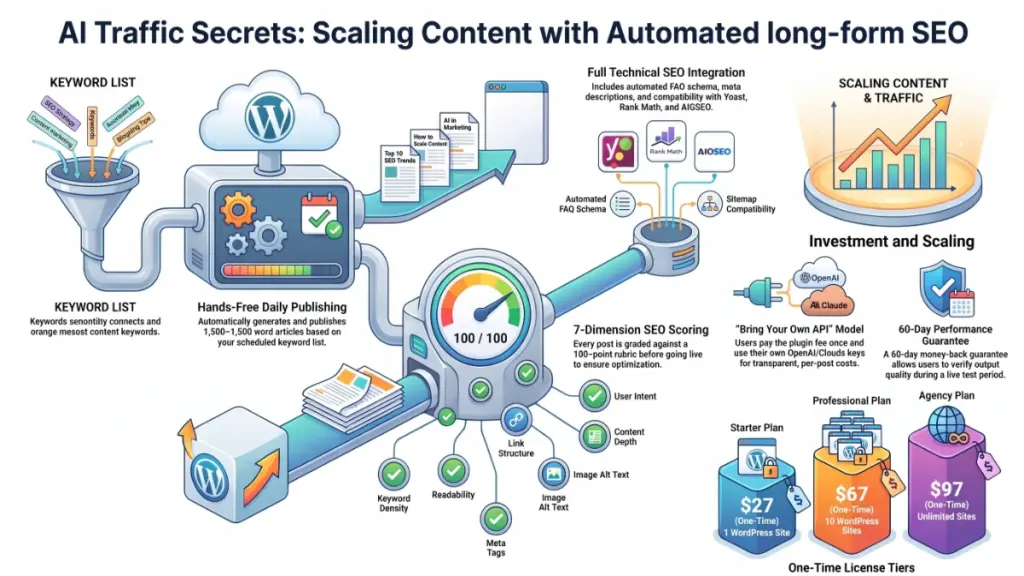
Strip away the marketing language and AI Traffic Secrets is a WordPress plugin that connects your site to an AI provider’s API. You choose OpenAI’s GPT-4o or Anthropic’s Claude, and you supply your own key. According to the sales page, once you configure it, the plugin does the following on your schedule:
- Pulls the next keyword from a list you provide
- Writes a full article, said to run 1,500 to 1,900 words
- Generates a featured image and in-content images using OpenAI’s image model
- Adds internal links, meta descriptions, and FAQ/Article schema markup
- Formats the post for Rank Math, Yoast, or AIOSEO
- Scores the finished post on what the vendor calls a “7-dimension, 100-point SEO system” before publishing
- Generates a matching Instagram/TikTok caption and hashtag set
The problem it targets is real. Consistent publishing is one of the better-supported levers for organic growth. But writing a genuinely useful 1,500-word post every single day is hard to sustain solo, and hiring it out gets expensive fast. Here’s where I’d push back on the framing, though: automation alone doesn’t close that gap. A scored, scheduled AI article is still an AI article. Its actual usefulness to a reader depends on execution details the sales page simply doesn’t show you.
Main Features
Daily Scheduled Publishing
The core mechanic works like this: you set a schedule, the plugin queues your keywords, and it publishes without you touching WordPress. The sales page describes a “weekly no-repeat” system, so it won’t reuse the same keyword within a short window. If it works as described, this fixes the single biggest failure point in most people’s content plans — inconsistency — without you having to remember to log in.
Choice of AI Provider
You can point the plugin at OpenAI (GPT-4o) or Anthropic Claude, using your own API key. This differs meaningfully from most AI content tools, which bundle AI costs into a monthly subscription. Here, the plugin charges a fixed, one-time price, while your ongoing cost depends entirely on your chosen provider’s rates per article. The vendor’s “pennies per post” claim sounds plausible for text generation at that length. But image generation through gpt-image-1 will add more to your per-article cost than the copy alone — budget for that rather than assume it away.
7-Dimension SEO Scoring
The plugin grades every post on a 100-point rubric before publishing. The sales page never discloses what the seven dimensions actually measure, and that’s the biggest transparency gap in the whole pitch. A scoring system only helps you if you know what it measures and whether those criteria track with what actually ranks. Without that detail, I’d want to see this feature in action before crediting it with the results the page claims elsewhere.
Built-In Schema and On-Page SEO
The plugin lists FAQ schema, Article schema, meta descriptions, and compatibility with the three most-used WordPress SEO plugins (Rank Math, Yoast, AIOSEO) as included. This saves real time if accurate. Busy people skip manual schema on daily posts constantly, and skipping it is exactly what holds otherwise-decent content back from features like FAQ rich results.
AI-Generated Images
The plugin automatically generates featured and in-content images using OpenAI’s image model, regardless of which text provider you choose. This removes one more manual step. AI-generated imagery carries its own quality variance, though, and you can’t assess that without seeing actual output.
One-Click SEO Fixer
The sales page describes this as a tool that re-runs the scoring and optimization pass on older, already-published posts. If it genuinely re-optimizes existing content rather than just re-scoring it, this could extend the plugin’s usefulness to an existing backlog, not just new posts. The sales page doesn’t explain in enough detail exactly what it changes, though.
Social Snippets
Each post comes with an Instagram/TikTok-ready image, caption, and hashtag set. This is a nice addition if you repurpose blog content to social — though it’s a minor feature next to the core publishing engine.
Benefits
Set against the core problem — daily quality content costs too much money or energy to sustain — the stated benefits track fairly directly:
- Time saved: the plugin handles daily writing, image sourcing, and on-page SEO without manual input, if it performs as described.
- Lower per-article cost than hiring a writer: at “pennies” per post in API costs, this undercuts the $50+ per article the sales page cites for freelance writers, assuming that estimate holds once you factor in image generation.
- Consistency: automated scheduling removes the human factor of forgetting to publish, which often causes blogs to stall out in the first place.
- SEO and AEO groundwork: schema markup and structured, scored content give both traditional search and newer AI-answer-engine surfaces something reasonable to work with, even though the specific “100-point” claim can’t be independently verified.
The throughline across all of these: the real benefit is automating the mechanics, not guaranteeing outcomes. Traffic and rankings depend on far more than whether a post technically carries schema and a passing score.
My Assessment (Based on Available Information)
What I Can and Can’t Judge
I want to be direct about this section’s limits rather than dress it up as hands-on testing I didn’t do. I haven’t installed AI Traffic Secrets, connected an API key, or watched it publish a post. So I can’t tell you what the writing actually reads like, how the images actually look, or whether the “grading” produces posts that genuinely outperform ungraded ones.
What Holds Up
I can assess the pitch’s internal consistency, and it holds up better than a lot of auto-blogging offers I’ve looked at over the years. It doesn’t promise thin content. It explicitly positions itself against thin-content tools and ties its differentiation to length, structure, and scoring — the right things to optimize for, at least in principle. The bring-your-own-API-key model works in its favor too. It’s a more honest cost structure than a flat monthly fee that hides how much of your money goes to compute versus markup.
What’s Missing
Before I’d recommend this without reservation, I’d want to see:
- What the seven scoring dimensions actually measure
- Sample output — an actual published article, not a dashboard screenshot
- How the tool generates a “unique angle” daily on a cycling keyword list without drifting into repetitive structure over months
- Independent, third-party-verifiable traffic data, not just the vendor’s own reported before/after numbers
None of this means the product fails to work as described. It means the sales page alone can’t confirm that it does. Treat the 60-day refund window as your actual test period if you buy it.
Ease of Use
According to the FAQ, setup takes four steps: install the plugin, paste in your AI API key, add your keywords, and set a schedule. That’s a low technical bar. If accurate, most WordPress users comfortable installing any plugin can get this running without developer help. The sales page doesn’t reference separate documentation or an onboarding walkthrough, though — a gap if you want to see the setup process before buying.
Performance
A sales page can’t demonstrate speed, stability, or day-to-day reliability. Those show up only over weeks of actual use — whether the daily schedule fires consistently, whether the AI provider’s API ever times out mid-generation, whether image generation occasionally fails silently. The marketing material doesn’t address any of this. I’d flag this category most strongly as “verify during your refund window” rather than take on faith.
Pricing
| Plan | Price | Sites | Notable Inclusions |
|---|---|---|---|
| Starter | $27 | 1 WordPress site | All 9 core features, both AI providers |
| Professional | $67 | 10 sites | Same features + priority email support |
| Agency | $97 | Unlimited | Same features + client-site use + “AI Weekly Live” training |
All three tiers list the same nine core features — scoring, both AI providers, schema, and so on. The differentiation comes down to site count, plus, at the top tier, support priority and included training. That’s a sensible structure if you run just one blog: Starter gets you everything functionally, and you’d only pay more for multi-site or client work.
The sales page states a one-time price, which is unusual, so double-check it at checkout. “Free updates” without a recurring fee is a meaningful claim — confirm it rather than assume it holds indefinitely. And remember: your real ongoing cost is AI API usage on top of this plugin price, which isn’t included.
Pros
- Bring-your-own-API-key model keeps ongoing costs transparent and likely lower than subscription-based AI writers, assuming the “pennies per post” estimate holds.
- Longer minimum word count (1,500+) beats most auto-blogging tools, which typically top out around 300–500 words of filler.
- Built-in schema and SEO-plugin compatibility removes a step most people skip when publishing manually.
- Low one-time entry price beats hiring a writer or paying for a subscription content tool, if the pricing structure really is one-time as stated.
- 60-day refund window gives you real runway to test the actual output before committing.
- Tiered site licensing makes sense if you plan to scale from one blog to an agency model without re-buying core features.
Cons
- The 7-dimension scoring criteria stay undisclosed, so you can’t independently judge whether “100 points” correlates with anything Google or AI answer engines actually reward.
- The sales page shows no sample output or demo — you buy based on described mechanics, not visible results.
- Traffic case studies come from the vendor, not a third party, and the page explicitly labels them as non-typical — treat them as illustrative at best.
- AI image generation adds real cost on top of the “pennies per post” text-generation estimate, and the combined figure isn’t clearly broken out.
- The sales page doesn’t disclose creator identity or launch date — a minor but notable gap for a product that asks for API-key-level access and daily publishing control over your site.
- A daily “unique angle” on a cycling keyword list is a hard problem to solve — long-running auto-publishing tools often repeat structural patterns even when topics rotate, and a sales page can’t show you whether this one avoids that.
Comparison With Competitors
| AI Traffic Secrets | Typical Subscription AI Writers (e.g., Jasper, Copy.ai style tools) | Basic Auto-Blogger Plugins | |
|---|---|---|---|
| Pricing model | One-time plugin fee + your own API costs | Monthly subscription, AI cost bundled in | Often cheap or free, minimal ongoing cost |
| Typical article length | 1,500–1,900 words (stated) | Varies, often shorter unless prompted extensively | 300–600 words, frequently thin |
| Built-in SEO scoring | Yes, 100-point system (criteria undisclosed) | Rare, usually a separate tool | Rarely included |
| Schema markup | FAQ + Article schema included | Not typically automatic | Rarely included |
| Publishing automation | Fully scheduled, hands-off | Usually requires manual publish or a separate automation tool | Often automated, but with low-quality output |
| Image generation | Included via gpt-image-1 | Sometimes included, often a paid add-on | Rarely included |
If the claims hold up, the honest differentiator here is combining daily automated publishing with longer-form content and built-in SEO structure. Most tools give you one or two of those, not all three. The trade-off: you rely on a single vendor’s undisclosed scoring logic instead of an established SEO tool with a transparent methodology.
Who Should Buy It?
- Bloggers or affiliate marketers who already have a working content and monetization strategy and specifically need the daily-writing bottleneck removed
- People managing multiple WordPress sites who want to standardize a publishing cadence across all of them (Professional/Agency tiers)
- Anyone comfortable supplying and monitoring their own OpenAI or Claude API key and budget
- Users who plan to actively use the 60-day refund window to evaluate real output rather than assume it’ll work from the sales page alone
Who Should Skip It?
- Anyone expecting a plugin alone to generate traffic or income without a real niche, monetization plan, or existing audience — the vendor’s own disclaimer says as much
- People not comfortable maintaining an API key and its associated billing
- Anyone who needs full editorial control or a distinct brand voice — daily AI-generated posts at scale are harder to hand-tune than a human-written schedule
- Sites in heavily regulated or high-stakes niches (medical, legal, financial), where unsupervised AI publishing carries real accuracy risk
Frequently Asked Questions
Does AI Traffic Secrets guarantee traffic or rankings? No. The vendor’s own disclaimer states the traffic examples are illustrative only, and results vary by niche, effort, and market conditions.
What does it cost beyond the plugin price? Your own OpenAI or Anthropic API usage, billed by that provider, plus image generation costs through gpt-image-1. The vendor estimates “pennies” per post for text, but this claim isn’t independently verified and doesn’t clearly account for images.
Can I use it on more than one site? Yes. Starter covers one site, Professional covers 10, and Agency covers unlimited sites, including client work.
Do I need SEO or writing experience to use it? According to the FAQ, no — you provide keywords, and it handles writing, optimization, and publishing. That said, SEO basics will help you judge whether the output is actually good.
Will Google penalize AI-generated content from this tool? Google’s public guidance penalizes low-quality, unhelpful content regardless of how it was produced, not AI authorship itself. Whether this tool’s output clears that bar depends on actual quality, and a sales page can’t prove that.
Is there a refund if it doesn’t work for me? Yes. The vendor offers a 60-day money-back guarantee through its support ticket system.
What’s the difference between the three pricing tiers? All three include the same nine core features. The differences come down to site count (1 / 10 / unlimited), support priority, and, for Agency, client-site usage rights and included training.
Is the pricing really one-time, or will there be recurring fees? The sales page states pricing as one-time with free updates included. Confirm this at checkout — “free updates forever” on a one-time fee only means something if it actually holds up over time.
Who created AI Traffic Secrets? The sales page doesn’t name the creator. Research this independently if creator transparency matters to your purchase decision.
Does it work with my existing SEO plugin? The sales page states compatibility with Rank Math, Yoast, and AIOSEO for meta data output.
Final Verdict
AI Traffic Secrets builds on a defensible idea: automate the mechanics of consistent, structured, reasonably long-form publishing, while keeping AI costs transparent through your own API key. That’s a more sensible design than the flood of thin-content auto-bloggers it positions itself against. The pricing — especially the $27 Starter tier — stays low enough that your real financial risk stays small, if the 60-day refund works as described.
What keeps this from an unreserved recommendation? Too much of the pitch rests on claims you can’t check from the sales page alone — the scoring system’s specifics, the real quality of the writing and images, and traffic numbers the vendor reports rather than a third party verifies. None of that means it fails to work. It means only real, sustained use can answer whether this actually produces good, ranking content — not marketing copy.
If you’re a blogger or marketer who already has a working niche and monetization plan, and the daily writing grind is your actual bottleneck, this offers a low-cost, low-commitment way to test whether automated publishing closes that gap. Treat the refund window as your real trial period, and judge it by the posts it actually produces on your site — not by the numbers on its landing page.