

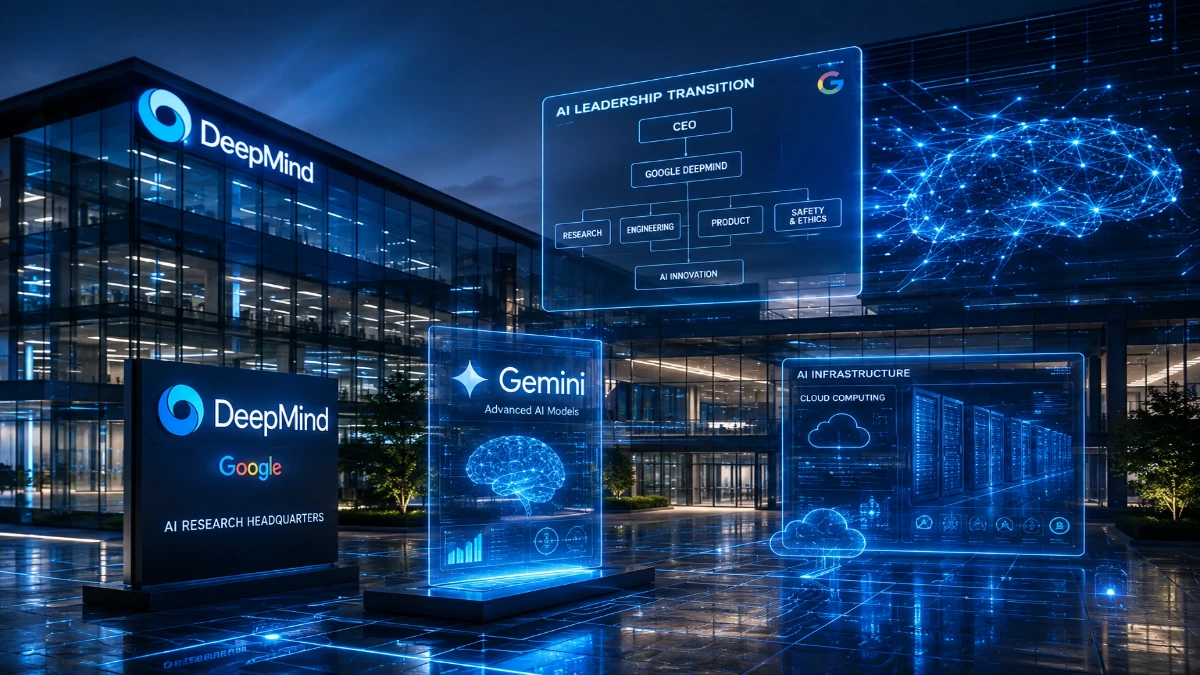
Sundar Pichai announced a major leadership shakeup at Google DeepMind today. Demis Hassabis is stepping back from day-to-day operations, taking on a new role as Chief Scientist of Alphabet instead. Meanwhile, Koray Kavukcuoglu now runs Google DeepMind as SVP. Additionally, Jeff Dean, a 27-year Google veteran, is leaving to start an independent research company.
Model releases grab headlines every week. This story is different, though. It tells us where Google thinks the AI race is actually heading.
Why It Matters
Leadership reshuffles like this rarely happen by accident. Instead, they signal where a company is placing its bets, and who it trusts to execute on them.
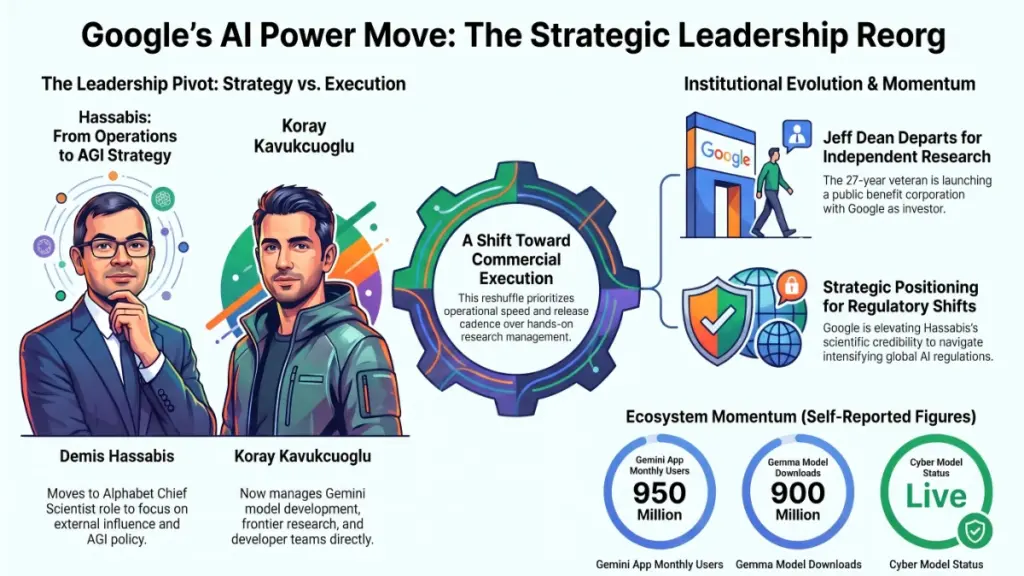
Google isn’t sidelining Hassabis. It’s redirecting him. Specifically, Pichai’s internal message names Hassabis as the new Chair of Google DeepMind and Chief Scientist of Alphabet. This role focuses on external influence over AGI development, not internal operations. Hassabis will also keep leading Isomorphic Labs, Alphabet’s drug-discovery venture. In short, Google is making a clear trade: it values Hassabis’s scientific credibility and public voice more than his hands-on management right now.
Kavukcuoglu, by contrast, takes the operational reins. He previously served as GDM’s CTO and Alphabet’s Chief AI Architect, and now he runs Gemini model development, frontier research, the Gemini app, and developer teams. He reports directly to Pichai. For developers and companies building on Gemini, then, Kavukcuoglu is now the person accountable for shipping speed.
Who’s Actually Running Things Now
Anyone building on Google’s AI stack should ask one question: who owns the roadmap? As of today, the answer is Kavukcuoglu.
He’s spent 13 years at DeepMind, according to Pichai’s note. During that time, he helped start the deep learning team and contributed to breakthroughs like WaveNet and DQN. As a result, he brings real research credibility, not just management experience. That matters if you’re trying to predict Gemini’s future release pace.
Hassabis, on the other hand, moves into a very different kind of role. Pichai describes it as focused on AGI strategy and “engaging externally.” In practice, expect more public commentary and policy influence from Hassabis. At the same time, expect operational calls — pricing, release timing, feature priorities — to come from Kavukcuoglu’s team instead.
The Bigger Departure: Jeff Dean and Sanjay Ghemawat
The reshuffle isn’t the most surprising part of this story. In fact, the bigger news is who’s leaving. Jeff Dean and Google Senior Fellow Sanjay Ghemawat are launching an independent public benefit corporation, one focused on accelerating research in machine learning, science, and engineering.
Dean’s fingerprints cover much of Google’s infrastructure history. Early on, he worked on Google’s search infrastructure; later, he helped build the neural network research that shaped the current AI era. Losing that kind of institutional depth matters, even in an amicable exit.
Still, Google isn’t cutting ties completely. The company will stay on as a founding investor and Cloud partner for the new venture, and the two sides also plan to collaborate on ML systems research going forward. Even so, spinouts from Big Tech companies have a mixed track record of staying independent long-term. It’s worth watching, therefore, whether this venture operates as a true independent lab or functions more like a Google satellite.
What Google Is Actually Claiming About Momentum
Pichai’s message leans heavily on adoption numbers, framing the timing as one of strength rather than disruption. According to the announcement, the Gemini app has surpassed 950 million monthly users. Similarly, Gemma models have passed 900 million downloads. On top of that, a new “Cyber” model is now live, and demand for Flash remains strong.
These figures matter to developers and enterprise buyers evaluating platform stability, since user and download counts signal ecosystem momentum. However, they say little about actual model quality or production reliability. Notably, the announcement includes no independent verification for any of these numbers. So, for now, treat them as Google’s self-reported figures rather than third-party confirmed data.
Industry Implications
Most developers and companies using Gemini won’t feel an immediate impact, since Kavukcuoglu already had deep involvement in model development as CTO. In other words, this looks more like a promotion within a known structure than a disruptive pivot.
The bigger strategic question, however, involves regulation. Google is positioning Hassabis as its AGI-and-policy figurehead just as regulatory attention on frontier AI intensifies worldwide. That’s a defensible use of a scientist with Nobel-level credibility. Yet it also means the person most associated with Google’s AI safety positioning now sits one step removed from actually shipping models.
Competitors should watch this move carefully too. For instance, OpenAI, Anthropic, and other frontier labs can read this reorganization as a signal, since companies rarely restructure AGI-adjacent leadership unless they sense the competitive timeline shifting.
Limitations and Open Questions
This is a leadership announcement, not a technical disclosure, so it leaves several questions open. For one, we don’t yet know how Hassabis and Kavukcuoglu will actually divide responsibilities day to day. Similarly, we don’t know what Dean and Ghemawat’s new venture will build first. The word “independent” needs scrutiny too, given Google’s stated role as investor and Cloud partner. Finally, remember that the adoption figures in this announcement are company-reported; nobody has independently audited them yet.
What to Watch Next
The real test of this reorganization won’t show up for months. First, watch whether Gemini’s release cadence changes under Kavukcuoglu. Next, watch whether Hassabis shifts his public statements toward AGI policy advocacy. Finally, keep an eye on what Dean and Ghemawat’s new company actually builds, and whether “independent” holds up once funding ties to Google become clearer.
Announcing a leadership change is easy, after all. The operational consequences, on the other hand, take much longer to show up in shipped products and published research.