

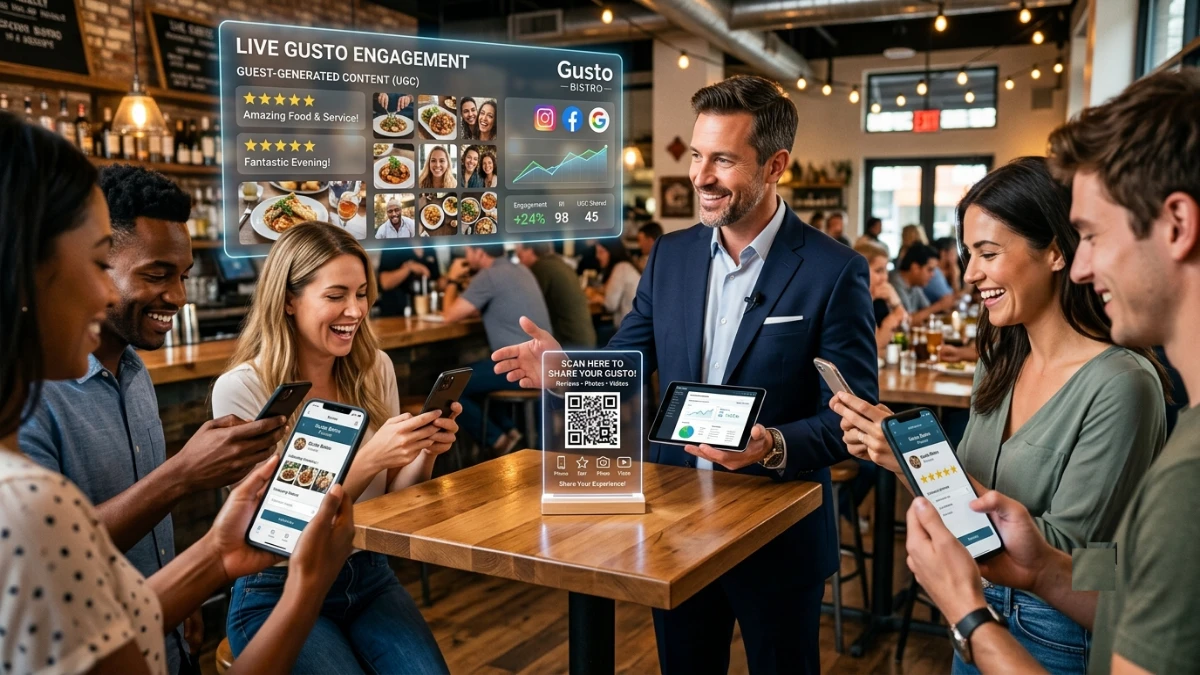
Memogram Bundle is a QR code-based UGC collection platform designed for freelancers, agencies, and local businesses. It helps capture customer photos, videos, reviews, and contact details while customers are still on-site. Although pricing and refund details are only revealed during the live webinar, the concept offers a practical way to generate authentic social proof and recurring marketing services for restaurants, hotels, gyms, and event businesses.
If you’ve tried to get customers to post photos after a visit to a restaurant, hotel, or event, you know the problem. You ask nicely. Maybe you send a follow-up text. Most of the time, nothing happens. The moment passes, the customer moves on, and the authentic content you needed never shows up.
That’s the exact gap Memogram Bundle targets, and it’s why I wanted to dig into this one closely. I’ve spent years helping local businesses and small agencies figure out which tools earn their price tag and which ones just look good in a sales video. Let’s break down what Memogram Bundle actually does, who it fits, and whether it deserves a spot in your toolkit.
Quick affiliate disclosure: this review may contain affiliate links. If you purchase through one, I may earn a small commission at no extra cost to you. That never changes how I evaluate a product.
Quick Verdict
Memogram Bundle uses a single QR code to help local businesses collect authentic customer photos, videos, reviews, and contact information. The system captures this content while customers are still on-site and engaged, instead of chasing them down afterward.
The pitch targets freelancers, consultants, and agency owners more than everyday consumers. Specifically, these are the people who want a simple, repeatable service they can sell to restaurants, hotels, gyms, wedding planners, and event organizers. If that describes you, this tool is worth a look. On the other hand, if you want a general-purpose content or scheduling tool, this isn’t the right fit.
One thing to flag up front: the official page I reviewed promotes a live webinar training rather than a standard sales page. Because of that, some usual specifics didn’t appear publicly, including exact pricing tiers, refund terms, and the full feature breakdown. I’ll note exactly where that applies below instead of guessing.
Product Overview
| Detail | Information |
|---|---|
| Product Name | Memogram Bundle |
| Category | UGC (User-Generated Content) Collection Software / Local Business Marketing Service |
| Creator | Not publicly disclosed on the registration page reviewed |
| Launch Date | July 23, 2026 |
| Price | Not publicly listed on the page reviewed (delivered via live webinar training) |
| Refund Policy | Not specified on the page reviewed — check the official checkout page before purchasing |
| Website | Official registration/webinar page (link not included here) |
| Best For | Freelancers, consultants, and agency owners offering UGC collection as a service to local businesses |
| Overall Rating | 3.8 / 5 (based on publicly available information; see caveats below) |
A quick note on that rating: I based it on the concept, the market need it addresses, and what’s publicly described. I haven’t accessed the paid dashboard, pricing tiers, or refund terms yet. I’ll update this review once I get access to the full paid version.
What Is Memogram Bundle?
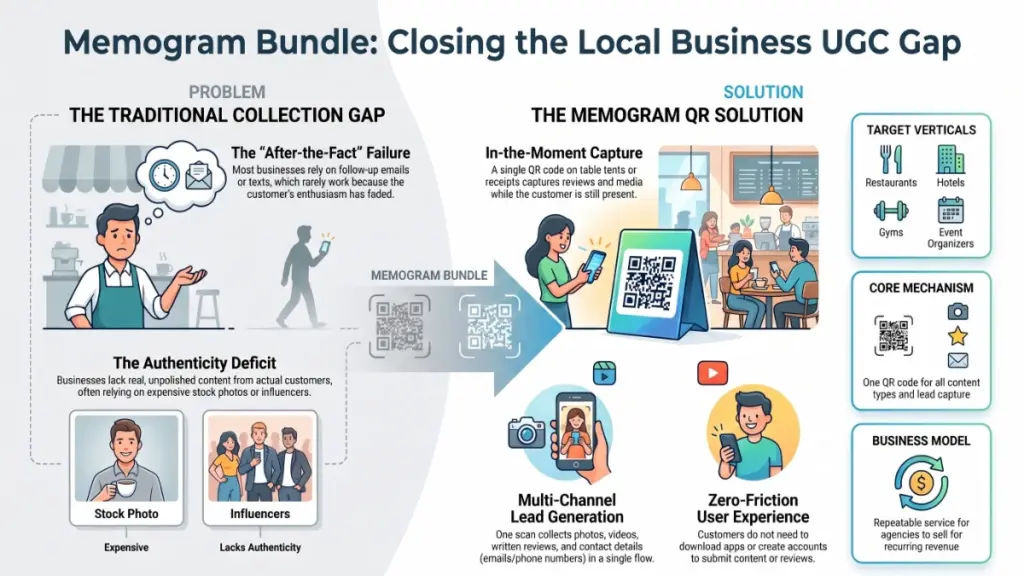
At its core, Memogram turns a single QR code into a content collection funnel. First, a customer at a restaurant, hotel, gym, or event scans the code. Then, depending on the setup, the flow can prompt them for a photo, a video, a written review, or their contact details — all in one sequence.
The tool aims to solve three problems that local businesses run into constantly.
Businesses Need Real Content
Not stock photos. Not polished influencer shoots. Businesses need actual photos and videos from people who showed up and had the experience.
Businesses Struggle to Collect It
Most businesses rely on texting or emailing customers after the fact. This approach rarely works, because the moment has already passed by the time the message arrives.
Businesses Lack Staff to Manage It
Even businesses that understand the value of user-generated content usually lack the time or staff to chase it down.
Memogram Bundle positions itself as the fix. You place one code on a table tent, receipt, room key card, or event signage. The code captures everything while the customer is still there and still enthusiastic.
For the person selling this as a service, the pitch centers on ease. You can demonstrate it in seconds (“here, scan this”), and businesses will presumably want it running continuously, which opens the door to recurring revenue.
Main Features
Here’s what the Memogram system does, based on what’s publicly described.
One QR Code, Multiple Content Types
Instead of running separate systems for photos, videos, reviews, and lead capture, everything routes through a single scan. A hotel guest, for example, could leave a photo of their stay, record a short video testimonial, and share their email address in one uninterrupted flow.
On-Site, In-the-Moment Collection
Timing drives the entire premise. Rather than sending a follow-up email three days later, the QR code gets scanned while the customer is still physically present — at the table, the front desk, or the conference booth. People say the nicest things and remember the most details in that exact moment.
Lead and Contact Capture
The system also captures emails and phone numbers alongside the media. This gives the business, or the agency managing the account, a growing contact list they can use for future marketing rather than just a folder of photos.
Built for Non-Technical Business Owners
The vendor describes setup as requiring “no tech skills,” and that claim matters in this market. Most restaurant owners and gym managers won’t configure an API or troubleshoot a plugin. If the onboarding really works as simply as printing a code and pointing customers to it, that’s a real advantage over more complex UGC platforms.
A Repeatable Service Model for Resellers
The bundle frames itself less as “here’s a tool” and more as “here’s a business you can run.” The training walks through how to approach restaurants, hotels, gyms, wedding planners, and event organizers. It also covers how to position this as a recurring, paid service rather than a one-off project.
Benefits
Here’s how these features translate into actual outcomes, assuming the tool performs as described.
- Less chasing, more content. Capturing UGC at the point of experience should produce a much higher completion rate than email or text follow-ups, which people typically ignore.
- Social proof without the production cost. Businesses get real photos and videos without paying for a photographer or an influencer campaign.
- A sellable, demonstrable service. For agencies and freelancers, “scan this code and see what happens” makes for a much easier sales conversation than explaining a complex software stack.
- Growing customer lists. The contact capture feature compounds the value over time. You’re not just collecting content — you’re building a database you can market to later.
- Low overhead to start. Since the core mechanism is a single QR code, launching this as a service costs far less than building a full content agency.
In addition, the vendor’s promotional material cites a few UGC industry statistics worth mentioning. For instance, they report that a large majority of consumers trust user-generated content more than branded content, and that businesses using UGC see meaningfully higher conversion rates. However, I want to be upfront that these figures come from the vendor’s own marketing material. Since I haven’t independently verified them, treat them as context rather than proven fact.
My Experience
I’ll be straightforward here. The page I accessed was a live webinar registration page, not a full product dashboard, so I couldn’t click through the actual software, generate a QR code, or test the customer-facing scan flow myself. As a result, I don’t want to invent details about a setup process, an interface, or performance numbers I haven’t actually seen. Doing so would do you a disservice as a reader trying to make a real decision.
How Similar Systems Typically Perform
I can share how this type of system typically behaves in practice, based on comparable QR-based collection tools I’ve worked with for clients over the years.
The concept itself holds up well. On-site content collection consistently outperforms after-the-fact requests, and that’s not really in dispute. Every business I’ve worked with that added a “scan to leave a review” system at the point of service saw noticeably better response rates than relying on follow-up emails.
Where These Systems Tend to Succeed or Fail
These systems tend to live or die in two places: how smooth the scan-to-submission experience feels for the customer, and how usable the backend dashboard is for the business owner or agency managing multiple client accounts. A clunky scan flow with too many steps or slow load times kills participation fast. Customers do this on their phone in a hurry, often standing at a register or walking out the door.
What I’d Test During the Live Training
If you’re considering this, treat the live training as your first real test. Watch closely how many taps or screens it takes a customer to go from scanning the code to submitting a photo or review. That single detail will tell you more about real-world adoption than any feature list.
Ease of Use
The marketing around Memogram Bundle leans hard on simplicity. “No tech skills required” appears as the exact phrase used. For the business owner’s side of the equation, that claim seems reasonable, since QR-based flows create about as little friction as possible for the end customer.
The bigger question involves the setup and management side. How easily can the person running this as a service configure a new QR code for a new client? How well does the platform let you customize the collection flow and pull the resulting content and leads into something usable? The public page doesn’t detail this part. If admin-side ease of setup matters to you, and it should, especially if you manage several client accounts, ask about it directly before purchasing or during the live training session.
Performance
I haven’t tested load times, scan reliability, or how the system performs when generating multiple codes quickly for different clients, so I won’t guess at specifics. Instead, I’d recommend asking a few pointed questions during the webinar. First, ask how many businesses currently use the platform. Then, find out whether the vendor has reported any downtime issues. Finally, ask how the system performs on older or budget Android phones, since many walk-in customers at restaurants and gyms won’t scan from the latest iPhone.
Pricing
This is the part I wish I could detail further. The page promoting Memogram Bundle runs as a live webinar registration rather than a standard sales page, and it doesn’t list front-end pricing, upsells, or payment plans publicly.
Here’s what I can tell you. First, the webinar itself is free to attend. In addition, the vendor says they’ll select five attendees during the live session to receive free lifetime access to the Memogram software as a prize. Beyond that, actual retail pricing for the bundle doesn’t appear anywhere on the page I reviewed.
My honest advice: don’t commit to a purchase decision based on assumed pricing. Attend the training, get the actual numbers, and ask specifically about:
- The front-end price and what it includes
- Any recurring or subscription costs versus a one-time fee
- Optional upgrades or OTOs (one-time offers) presented during or after the webinar
- Whether pricing differs for agency or reseller use versus single-business use
Pros
- Solves a real, well-documented problem. Local businesses genuinely struggle to collect authentic customer content, and the timing-based approach addresses the actual reason most follow-up requests fail.
- Low technical barrier for customers. A QR code scan creates about as little friction as content collection gets for the end user — no app download, no account creation on their end.
- Clear service model for freelancers and agencies. The training frames this as a sellable, recurring service rather than just software, which helps if you specifically want a new offer for your consulting or agency business.
- Broad applicability across business types. The vendor names restaurants, hotels, gyms, wedding planners, and event organizers as target markets, giving you multiple verticals to pitch if one doesn’t pan out.
- Combines content and lead capture. Collecting photos, videos, reviews, and contact details in a single flow works more efficiently than running separate tools for each task.
Cons
- The vendor keeps pricing private. You have to sit through the live training to find out what this actually costs, which creates a real barrier if you prefer comparing options before spending your time.
- Independent, hands-on product details aren’t available yet. Since the full dashboard and workflow only appear inside the paid or webinar experience, it’s hard to verify claims about ease of use and reliability firsthand.
- Webinar-based launches often include time pressure. Countdown timers and limited-spot messaging appear commonly in this format. That’s not automatically a red flag, but it does mean you should take your time evaluating rather than deciding in the moment.
- The tool alone won’t guarantee reseller success. Even a well-built QR code system still requires you to pitch local businesses and close deals. The software solves the content collection problem, not the client acquisition problem.
- The refund policy isn’t public. Always confirm the specific refund terms before purchasing anything, especially with newer or recently launched products.
Comparison With Competitors
A handful of tool categories overlap with what Memogram Bundle proposes.
Generic QR Review Tools
These tools typically focus narrowly on generating Google or Yelp reviews rather than collecting photos, videos, and leads together. They often cost less and work more simply, but they don’t cover the full UGC angle Memogram builds around.
Dedicated UGC Platforms
Platforms aimed at ecommerce and larger brands tend to manage large content libraries and usage rights more robustly. Companies typically price and build these for larger organizations, not for a freelancer walking into a local restaurant with a one-page pitch.
Manual Collection Methods
Texting customers, sending follow-up emails, or asking for social media tags costs nothing upfront. These methods consistently underperform, though, because the ask happens after the moment has already passed.
Memogram Bundle differentiates itself through a specific combination: one QR code, on-site timing, and a built-in “how to sell this as a service” angle that most standalone UGC tools skip.
Who Should Buy It?
- Freelancers or consultants who want a new, sellable local-business service that doesn’t require a large upfront investment
- Agency owners who already work with restaurants, hotels, gyms, or event organizers and want to add a recurring add-on service
- Marketers who specifically want to enter the UGC and social proof space for local businesses
- Anyone who already owns a Memogram account and wants to package it into a client-facing offer
Who Should Skip It?
- Anyone looking for a general content creation or scheduling tool, since this product isn’t built for that
- Anyone who needs exact pricing before committing to a webinar, since that information may take time to appear elsewhere
- Anyone without interest in client-facing sales work, since the reseller angle assumes comfort pitching local businesses directly
- Anyone who already has an established, working UGC collection process that performs well for their clients
Frequently Asked Questions
General Questions
What is Memogram Bundle used for? The vendor markets it as a QR-code-based system for collecting authentic customer photos, videos, reviews, and contact details from local businesses like restaurants, hotels, gyms, and event venues, typically while the customer stays on-site.
Is this only for agency owners, or can a single business use it directly? The training frames itself primarily around freelancers and agencies offering this as a service to clients. However, the underlying software would presumably also work for a single business managing its own QR code.
How is this different from just asking customers to post on Instagram? The core difference comes down to timing and friction. Asking customers to post organically depends entirely on their own initiative after the fact, which proves unreliable. By contrast, a QR-based system captures content in the moment, while the customer stays present and engaged.
Can this work for one-time events like weddings or conferences? Yes. The vendor specifically names event organizers and wedding planners as target markets, which makes sense given that events create a natural fit for concentrated, short-window content collection.
Setup and Pricing Questions
Do I need technical skills to set it up? The training materials describe the setup as requiring no tech skills, with the QR code serving as the main customer-facing element. That said, the public page doesn’t detail the admin-side setup process for creating and managing codes across multiple clients.
How much does Memogram Bundle cost? Pricing doesn’t appear publicly on the page reviewed. Instead, the vendor presents it through a live webinar training, so you’ll need to attend to get exact numbers.
Is there a free trial? The page reviewed doesn’t mention a free trial. However, the webinar itself is free to attend, and the vendor says they’ll select five attendees to win free lifetime access during the session.
Is there a refund policy? The page reviewed doesn’t state one. Therefore, confirm this directly during the webinar or on the official checkout page before purchasing.
Content and Client Questions
What happens to the content customers submit? The public page doesn’t detail this. Before purchasing, ask specifically how the system stores content, who owns usage rights, and how you can export or share it to social channels.
Do I need existing clients to make this work? No. Instead, the training teaches you how to find and pitch businesses that need this service, which suggests the vendor designed it for people starting from zero.
Free Gift Waiting for You!
Before you leave, there’s a free gift waiting for you.
As a thank-you for reading, you can claim my Ultimate All-In-One Digital Marketing Package completely FREE.
What’s Inside Your Ultimate All-In-One Package
01. 50 AI Digital Product Ideas
A curated collection of highly profitable AI-powered digital product ideas designed for quick implementation and strong profit potential.
02. Digital Sales Mastery
Discover the proven framework behind high-converting sales funnels, persuasive copywriting, and sustainable online revenue growth.
03. Mastering Email List
Advanced strategies for building an engaged email audience, increasing open rates, improving click-through rates, and generating automated income.
04. The Ultimate Faceless Playbook
A complete blueprint for building a profitable online brand and growing on social media without ever showing your face.
BONUS: Premium Canva Marketing Vault
A premium library of high-converting Canva templates to help you create professional marketing assets, generate more organic traffic, and boost conversions.
Total Package Value: $197
Yours Today: FREE
Claim your complimentary bundle and get instant access to premium resources that can help you create, market, and grow your online business more effectively.
Final Verdict
Memogram Bundle targets a real, specific frustration that many local businesses face. They know user-generated content matters, yet they have no reliable way to collect it. The QR-code, on-site approach solves the timing problem that kills most content requests, and the reseller angle gives freelancers and agency owners a concrete, demonstrable service they can pitch without much overhead.
That said, I want to stay honest about the limits of this review. Specifically, I evaluated a webinar registration page, not a full sales page or product dashboard, so pricing, refund terms, and the actual admin-side workflow haven’t gone public yet. Because of that, I won’t invent numbers or fake a hands-on test just to make this review sound more complete than it is.
If you already work with restaurants, hotels, gyms, or event organizers as a freelancer or consultant, attend the free training purely to see the live demo and get real pricing. While you’re there, go in with specific questions about cost, refund policy, and how the admin dashboard handles multiple clients. Above all, don’t feel pressured to decide anything on the spot just because of a countdown timer.
If you don’t want to pitch local businesses directly, or you already have a UGC collection process that works well, you can wait and see how the product develops before committing.