


A Quick Note on What This Is
Faceless Forge FastPass is a $270 upsell that builds on the free Hermes AI agent with templates, prompts, content libraries, and commercial licensing. While Hermes is a verified open-source project, the article finds little independent evidence proving the FastPass delivers better results than using Hermes directly. It encourages buyers to ignore the countdown timer, research user experiences, and make an informed purchasing decision.
It is not a first-person product review. Nobody involved in producing this has purchased, installed, or run Faceless Forge. Pretending otherwise would defeat the purpose of writing something trustworthy. Instead, this is a close reading of the actual sales page — the “FastPass” upsell screen someone sees right after paying $27 for the “Core” product. It also includes independent research into the one part of the pitch you can actually check against outside sources: the claims about Hermes, the open-source AI agent the whole system runs on.
If you’re deciding whether to click “Add it to my order — +$270,” this document gives you the information the page itself doesn’t emphasize. That way, you can make the call with clearer eyes.
What You’ve Actually Landed On
This page follows a specific, well-documented sales pattern: the post-purchase order bump, sometimes called an OTO (one-time offer). The pattern works like this. Someone buys a cheap “front-end” product — here, $27 for Faceless Forge Core. Before they’ve opened it, used it, or decided whether they even like it, the seller shows them a much bigger offer with a countdown clock attached.
This structure exists because it boosts conversion rates, not because it’s the only way to sell a legitimate product. Naming that plainly matters, because it changes how you should read everything else on the page. You aren’t browsing as a curious shopper comparing options. You’re seeing this pitch in the ninety seconds after a purchase, when buyer momentum peaks and second-guessing drops. That timing is a deliberate design choice. Factor it into your decision.
What’s Actually In the Box
Strip away the repeated framing (“the whole operation,” “you’re the director,” “own it, don’t rent it”) and the FastPass breaks down into five discrete additions stacked on top of the $27 Core.
The Five Components
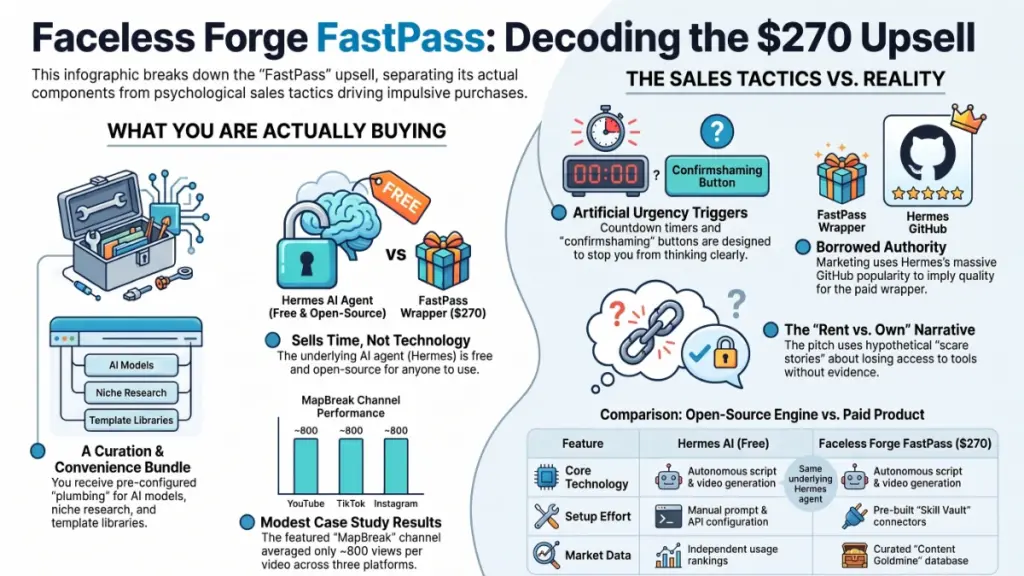
1. The Skill Vault. Connector configurations let the Hermes agent call roughly 200 third-party AI models for video, image, and voice generation. In practice, this is pre-built plumbing, so you don’t have to wire up each model’s API yourself.
2. Unlimited channels + Command Center. This removes any cap on how many YouTube, TikTok, and Instagram channels you can run through the system, and it adds a dashboard for managing them from one place.
3. The Content Goldmine. This is a library of pre-researched niches, video ideas, hooks, titles, scripts, thumbnail templates, and content calendars.
4. Channel-in-a-Box. These are fully pre-configured channel packages — niche, branding, agent settings, starter topics — built for quick import and launch.
5. The Agency license. This grants legal permission to run the system commercially for paying clients, and it includes client sub-account tooling plus a sales kit for pitching that service.
What This Actually Amounts To
None of these five pieces qualify as exotic technology. They’re a prompt and configuration library, a content-idea database, some templates, and a licensing tier. Hermes itself does the genuinely technical heavy lifting: running an autonomous agent that writes scripts, generates video, and posts on a schedule. Hermes remains free and open-source on its own, independent of this purchase.
That distinction isn’t necessarily a knock against the product. Curated prompt patterns and done-for-you niche research can save real time, especially for someone who’d otherwise spend weeks on trial and error. But this is a different kind of value than “proprietary technology.” Weigh the price against that more modest reality.
Reading the Persuasion Techniques
Sales pages use persuasion techniques constantly, and that alone doesn’t make an offer bad. A few patterns on this specific page deserve names, though, because the page designed them to be felt rather than noticed.
The Countdown Timer
The page displays a clock (“36:22… after that, anything can happen”) without explaining what actually happens when it hits zero. It also never explains why the price would need to change at all for a digital bundle with no real inventory constraint. Artificial urgency ranks among the oldest tools in direct-response marketing. Its purpose is to short-circuit the “let me think about it and come back later” instinct — a reasonable instinct to have before spending $270.
Confirmshaming in the Decline Button
The only way to skip the upsell is clicking “No thanks — I’ll add my upgrades one at a time.” That phrasing does two things at once. First, it implies you’ll pay more eventually anyway. Second, it frames the reasonable choice — declining an unplanned $270 charge seconds after your first purchase — as a lesser, slower path. Marketers call this pattern confirmshaming, and it works by attaching social or psychological cost to the “no” option.
Loss-Framing Over Gain-Framing
Notice the language: “pass on a piece now and you build without it later,” and “miss one, and you feel the gap every time you sit down to work.” Behavioral research on loss aversion consistently shows people weigh potential losses more heavily than equivalent gains. Describing declined features as things you’ll “miss,” rather than simply “optional extras you can add if needed,” is a deliberate framing choice, not a neutral description.
The “Rented vs. Owned” Emotional Narrative
The page tells a vivid hypothetical story: months of work building channels, then “one morning the email lands… we’re shutting the service down,” and everything vanishes because you never really owned it. The page presents this as a cautionary tale, but it isn’t a documented case study. It’s a generic scenario designed to make the $270 purchase feel protective rather than optional. Some SaaS tools genuinely carry this risk, but this narrative offers no evidence about this specific product.
Borrowed Authority
The page leans heavily on Hermes’s independent popularity to build trust in Faceless Forge, a separate paid product built around it. This deserves its own section below, because it’s the one claim on the page you can actually check against outside sources.
None of this means the underlying product lacks value. It means the page pushes you to decide fast and decide yes — exactly when you most need to slow down.
Fact-Checking the Hermes Claims
This part of the pitch isn’t just marketing copy. It references a real, external, independently tracked open-source project, so you can verify it rather than just evaluate the framing.
Hermes Agent, built by Nous Research, is a genuine and currently prominent open-source AI agent. Independent reporting confirms that Hermes overtook a rival agent called OpenClaw on OpenRouter’s global daily usage rankings in May 2026. Hermes also accumulated well over 100,000 GitHub stars within roughly three months of its February 2026 launch. Multiple independent outlets covering the AI agent space reported this milestone around the same time, which lends more credibility than a single self-reported statistic would.
So the underlying claim checks out: Hermes really is a fast-growing, widely-used open-source agent. That’s genuinely notable, and a product built on top of Hermes has a fair reason to mention it.
Here’s the catch, though — and the sales page itself quietly admits it in the fine print. Those rankings, star counts, and usage statistics describe Hermes, a free project maintained by Nous Research. They say nothing about the quality, effectiveness, or track record of Faceless Forge, an unaffiliated, independently sold training package built around Hermes. The page’s own disclaimer states this directly: the statistics “refer to the open-source agent (not to Faceless Forge).”
This follows a recognizable pattern. A seller attaches a paid product to genuinely credible, independently verified technology, and some of that credibility transfers in the reader’s mind even though it doesn’t logically apply to the paid layer built on top. This isn’t a lie — Hermes really is popular — but it isn’t evidence about the thing you’d actually pay $270 for either.
The One Case Study, and What It Doesn’t Show
The page points to “MapBreak,” a channel the product’s creator reportedly runs using this same system: 36 videos, roughly 30,000 organic YouTube views, auto-posted across three platforms with no human production.
Read that carefully. Thirty thousand views spread across 36 videos and three platforms works out to roughly 800 views per video on average. That’s a real, functioning automated channel, and it demonstrates something genuine about Hermes’s technical capability to produce and post video content unattended. As a business result, though, it looks modest. That view count doesn’t generate meaningful ad revenue, and the page carefully cites views only, never income. That framing keeps the claim legally safe, but it also strips out the thing you’d actually want to know: does this make money, how much, and over what timeframe?
A single case study is also just one data point. It doesn’t reveal the failure rate — how many channels the creator tried that didn’t work, or how typical MapBreak’s performance looks against other attempts.
Doing the Math the Page Wants You to Skip
The page argues you’d otherwise need to hire a video editor, scriptwriter, thumbnail designer, and SEO specialist, plus pay for a stack of tool subscriptions — and that this bill “lands again and again, for as long as you post.” That comparison works hard to make $297 total look cheap.
But most buyers aren’t actually weighing that comparison. The realistic alternative isn’t “$297 once vs. hiring a full production team forever.” It’s “$297 once vs. running Hermes yourself for free, using your own prompts, your own niche research, and your own trial and error.” Hermes itself costs nothing, since it’s open-source. The FastPass charges you for curation, pre-built configuration, and time saved — not for access to technology you couldn’t otherwise get.
Whether that trade is worth $270 depends on how you value your own time versus your own money. It also depends on how much you trust that the specific prompt patterns and niche picks in the Goldmine and Channel-in-a-Box packs beat what you’d land on yourself after a few weekends of experimenting with a free tool.
Questions Worth Answering Before You Buy
A few things the page doesn’t tell you would materially change the value calculation:
- What’s the actual success rate across buyers? One creator’s 30,000-view channel says nothing about typical outcomes. Look for independent reviews, forum threads, or community results from people who aren’t the seller.
- How much of the $270 in value is genuinely unavailable elsewhere for free? Hermes is free, and creators have publicly documented many prompt-engineering techniques for content generation. Ask what specifically in the Goldmine or Vault you can’t approximate with some searching.
- What does “unlimited channels” actually cost you in practice? Running many channels through commercial AI models — video, voice, image generation — usually costs money even when the software license is free. Check what ongoing API costs look like at scale before assuming “no subscription” means “no ongoing cost.”
- Which platforms actually tolerate fully automated, faceless, AI-generated content long-term? YouTube, TikTok, and Instagram have all adjusted their policies around AI-generated and low-effort content over time. A system built today carries policy risk the page never mentions.
- Is the 30-day guarantee actually straightforward to use? The page says “no hoops,” but that’s the seller’s own characterization, not a documented refund process. Check third-party complaints, through JVZoo (the listed retailer) or elsewhere, before assuming the refund process runs smoothly.
What’s Real, What’s Marketing, and What’s Unknown
Here’s where things actually stand.
Real and verifiable: Hermes is a legitimate, currently popular open-source AI agent with independently confirmed usage rankings and GitHub activity. It genuinely runs autonomous, scheduled content pipelines, as the MapBreak example demonstrates at a technical level.
Marketing framing, not fact: The countdown timer’s urgency, the implied inevitability of needing every add-on, the “rented tools” cautionary narrative, and the borrowed authority that transfers Hermes’s popularity onto an unaffiliated paid product.
Genuinely unknown from this page alone: Whether Faceless Forge’s specific curated content, prompts, and niche selections outperform a free, self-directed approach using the same underlying agent. Whether typical buyers see results anywhere close to the one case study shown. What the real refund experience looks like in practice.
What the Fine Print Is Really Doing
The wall of legal disclaimers at the bottom of the page deserves a moment, because most readers skip it — and skipping it means missing useful signal.
A large portion qualifies as standard income-disclaimer boilerplate that any legitimate info-product seller in the U.S. should include. This required-adjacent language keeps the company on the right side of FTC rules around earnings claims. That part isn’t a red flag by itself; reputable companies use similar language too.
The disclaimers get more interesting where they quietly concede points. The statement that public rankings and star counts “refer to the open-source agent (not to Faceless Forge)” essentially admits in small print what the big print implies otherwise. Likewise, a note buried in the fine print clarifies that “unlimited use” of certain hosted tools actually means a high monthly cap, not literal unlimited use — a meaningful qualifier the headline marketing claims never mention. Neither disclosure is unusual for this style of marketing, but both offer useful correctives before you assume the headline claims apply exactly as stated.
The page also spends real estate explicitly stating this isn’t a business opportunity, isn’t a multi-level-marketing scheme, and isn’t a franchise under specific legal tests. That language suggests the seller had legal review, which cuts both ways. It shows some seriousness about compliance, but similar structures have drawn scrutiny before in this industry, which is exactly why sellers add this kind of language in the first place.
A Few Honest Answers to Questions the Page Frames Differently
Is this a scam? Nothing here indicates outright fraud. Hermes is real, the technical claims about what an agent can do are broadly plausible, and a stated refund window exists. “Scam” isn’t the right word here. “Aggressively optimized sales funnel with thin independent evidence for the paid layer” fits better, even if it’s less punchy.
Do I need the FastPass to get value from Hermes? No. Hermes itself is free and open-source, and its core agent capabilities exist independent of this purchase. The FastPass charges for curation and convenience, not for capability you couldn’t otherwise access.
Is $297 total expensive for what’s included? Compared with hiring a production team, it’s cheap. Compared with the free alternative of running Hermes yourself, it’s a bet that your own time is worth more than the price difference — a bet that may or may not pay off depending on your situation.
Should the countdown timer factor into the decision? No. The page never explains a credible mechanism for what changes when the timer expires. Artificial urgency is a well-documented tool for reducing deliberation time on purchases, not a real supply constraint.
Bottom Line
Real technology sits underneath this offer, and the company doesn’t fabricate Hermes’s popularity — that part holds up under outside scrutiny. What doesn’t hold up, because no outside evidence exists either way, is whether the $270 layer built on top of that free technology is worth the price for a typical buyer, compared with simply using Hermes directly and building your own workflow.
If you’re leaning toward buying, do what the countdown timer specifically discourages: close the tab, sit with the decision for a day, and look for independent buyer experiences before committing. A genuinely good product built on a genuinely good open-source foundation should survive that pause. A funnel that depends on urgency to convert usually can’t.