

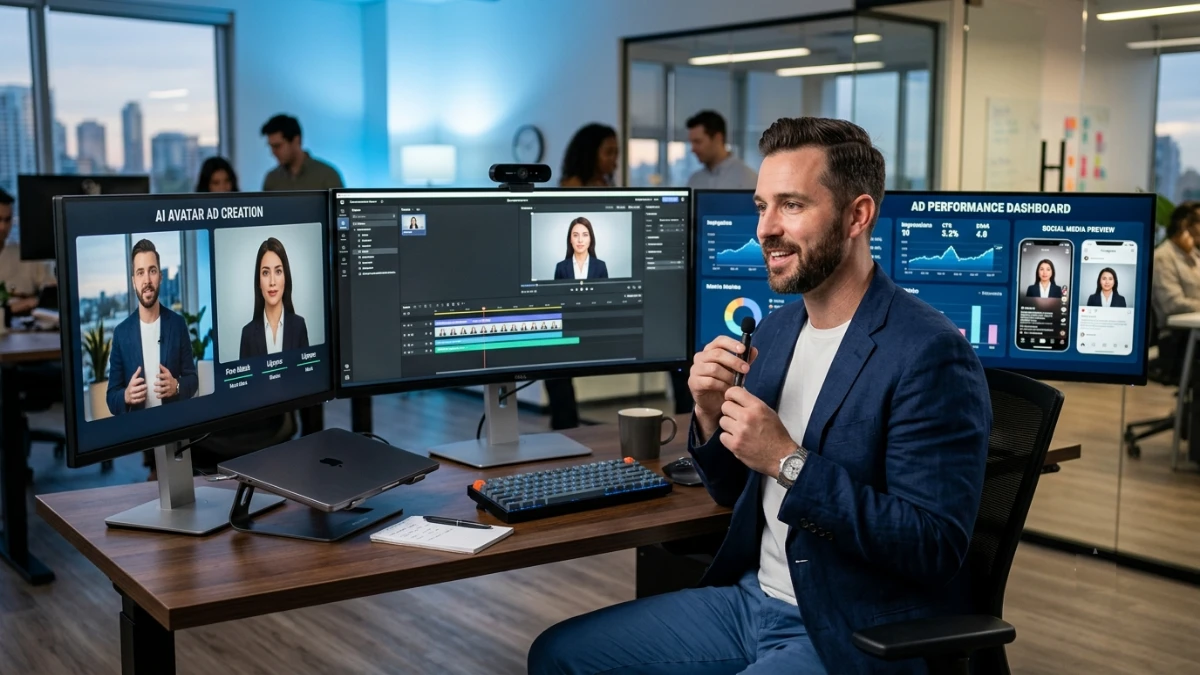
AI spokesperson and UGC video tools can dramatically reduce production costs and speed up ad testing, but they aren’t perfect replacements for real creators. They perform best for short-form ads, rapid creative testing, and localized campaigns. Marketers should prioritize compliance, disclose AI-generated content, and use human creators when authenticity and emotional trust are essential.
Spend time in a media buyer’s Slack channel this year. You’ll see it: an AI-generated “creator” delivers a hook so smooth you pause and ask if she’s real. Meanwhile, someone in the thread says they got a 3x ROAS off a video with no camera, no actor, no studio. Yet someone else says their version looked like a video game character reading a hostage note.
In other words, both things are true at once. That’s the part nobody selling these tools wants to explain.
I’ve spent the past year testing AI avatar and UGC-style video tools across live ad accounts, including ecommerce, info-product, and local service business creative. Not as a hobby, and not on a demo account with cherry-picked prompts. Instead, I ran these on real campaigns with real budgets, where a bad hook wastes real money. So here’s what I learned: where this technology delivers, where it falls apart, and what you need to know before building a workflow around it.
What Are AI Spokesperson and UGC Ad Tools, Exactly?
Essentially, these tools generate a video of a synthetic person. First they build a face, a voice, and body movement. Then they read a script you provide. Some platforms use fixed avatars — think corporate training-video tools like Synthesia or HeyGen. Others, meanwhile, target the “looks like organic social content” style that direct-response marketers want. For example, picture a person talking into a phone camera in a bedroom or car. This borrows the visual language of a TikTok or Instagram Reel instead of a polished commercial.
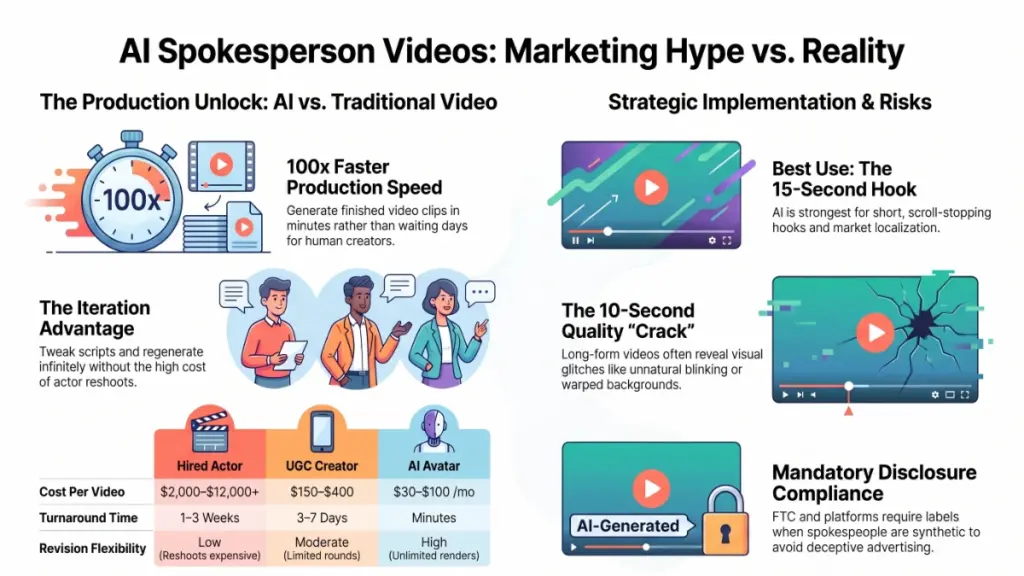
The pitch, in short, is simple. A UGC creator usually costs $150–$300 per video and takes three to five days for one take. With these tools, however, you generate the character yourself. You write the script yourself. And you get a finished clip in minutes.
Naturally, that pitch appeals to anyone who’s run a creative testing operation. After all, ideas were never the real bottleneck in direct response — production speed was. Because whoever tests more hooks, faster, usually wins the account, AI video tools promise to remove that bottleneck entirely.
The Two Categories You’ll Actually Encounter
Consistent-character avatar platforms keep one face, one voice, and one visual identity stable across a whole video or campaign. This matters more than it sounds, because early AI video had a reputation-killing flaw. The character’s face would subtly shift between shots. As a result, you’d watch three different women take turns finishing the same sentence.
Prompt-and-render generalist tools cover broader AI video generators — Sora-style, Kling, Runway, and similar platforms. These can produce a talking figure, but they weren’t purpose-built for spokesperson consistency. As a result, they offer more flexibility for b-roll and scene variety. However, they also demand far more manual correction to keep a character looking like the same person shot to shot.
In fact, most paid “courses” circulating in marketing circles right now aren’t new AI models at all. Instead, they’re structured prompt frameworks and GPT-based scripting layers built on top of these existing tools. That distinction matters, and I wish someone had explained it to me before I paid for my first one.
Does It Actually Look Real? Here’s the Honest Answer
In short: sometimes, for short clips, under the right conditions. Not consistently. Certainly not for free.
For instance, I tested a leading avatar-consistency tool on a 30-second hook. At first, the opening three or four seconds looked genuinely convincing. Lighting stayed even, and lip sync was close enough that I looked twice. On top of that, the voice had natural pacing instead of the flat robotic cadence people associate with older text-to-speech. Past the ten-second mark, though, small things slipped. For example, a hand gesture clipped through the frame. An eyeblink pattern repeated in a way real people don’t do. And background elements warped slightly during a head turn.
Still, that’s often enough for a 15–30 second ad hook designed to stop a scroll. After all, viewers don’t study the footage — they decide in half a second whether to keep watching. A full 20–45 minute VSL (video sales letter), however, asks for something much harder. Because longer runtime creates more chances for the illusion to crack, audiences tend to scrutinize more, not less. That’s especially true a few minutes in, once they’re weighing whether to trust the offer.
So here’s my honest takeaway after dozens of test renders: these tools work best for short-form hooks and mid-roll b-roll. They struggle most with extended, uncut talking-head segments. Anyone who claims a full 45-minute VSL looks flawless with zero cuts to real footage is telling you one of two things. Either they have an unusually good setup, or they’re overselling where this technology actually stands.
The Real Cost Comparison: AI Avatars vs. Actors vs. UGC Creators
Here’s where the math gets genuinely interesting. This part of the pitch holds up best under scrutiny.
| Approach | Typical Cost Per Video | Typical Turnaround | Revision Flexibility |
|---|---|---|---|
| Hired actor / studio shoot | $2,000–$12,000+ | 1–3 weeks | Low — reshoots are expensive |
| Freelance UGC creator | $150–$400 | 3–7 days | Moderate — limited revision rounds |
| AI avatar tool (subscription) | $30–$100/month for unlimited renders | Minutes to hours | High — regenerate as many times as you want |
In fact, that last column holds the real unlock, more than the cost savings do. When a hired actor’s take falls flat, you don’t reshoot that afternoon. Instead, you schedule another session, if you reshoot at all. When an AI-generated version falls flat, on the other hand, you simply tweak the prompt and render again. Because of this, teams running serious creative testing volume value that speed more than the dollar savings. Think five, ten, twenty hook variations a week.
However, the comparison gets murkier on quality ceiling. A great human actor with good direction still beats current AI avatars on nuance and emotional range. The same goes for trust-building eye contact over long stretches. So does your offer depend on deep parasocial trust? Think health offers, high-ticket coaching, anything where the audience needs to feel a real human vouching for something. If so, I wouldn’t bet the whole campaign on synthetic talent yet. But does your offer live or die on hook volume and fast iteration instead? Think ecommerce, low-ticket DTC, top-of-funnel scroll-stoppers. In that case, the economics favor AI heavily.
What These Tools Are Actually Good At
Rapid hook testing. This is the strongest use case, full stop. For example, you can test ten different opening lines, characters, or tones against the same offer in a single afternoon. Simply put, no traditional production workflow can match that.
Localization and market testing. You can swap accent, language, or on-screen persona for different geographic markets without re-booking talent for each region. That’s a real, practical advantage. For instance, one advertiser mentioned running a UK-accented version of a slimming offer this way, and saw early profitability. Still, that’s one result, not a guarantee of what you’ll see.
B-roll and supporting footage. Custom scene generation replaces generic stock footage and adds real specificity. For example, picture a synthetic customer “unboxing” a product in your exact brand aesthetic. This beats a stock clip half your competitors already use.
Early-stage concept testing before committing production budget. First, validate which angle resonates with a rough AI version. Then, spend real money on a professional shoot once you know what works.
Where It Falls Short (and Where I’d Be Careful)
Long-form trust-building content. As covered above, extended VSLs remain the hardest use case to nail convincingly right now.
Anything resembling a testimonial. This is where the legal and ethical lines get sharp. It deserves its own section below.
Emotionally complex or high-stakes messaging. Grief, serious health struggles, financial desperation — this subject matter needs authenticity as the entire point, not a nice-to-have. As a result, synthetic delivery tends to feel hollow here, even when the visuals look technically clean.
Platforms with aggressive AI-content detection. Meta, TikTok, and Google have all tightened policies and detection around synthetic media. Consequently, a workflow that works today can trigger disapprovals or account flags as detection improves. In other words, building an entire creative pipeline around one platform’s current blind spot is a fragile long-term strategy.
The Compliance Question Nobody’s Marketing Page Wants to Slow Down For
This part matters most. It’s also the part most sales pages for these tools bury in the footer.
Specifically, the FTC’s endorsement guidelines require clear disclosure when a spokesperson isn’t a genuine customer or a real person. Using an undisclosed AI character to imply a real customer experience, therefore, crosses a line. A “testimonial” that never happened moves from creative production into deceptive advertising. Meanwhile, platform policies from Meta, TikTok, and Google are moving the same direction. They increasingly require, or default to, disclosure labels on AI-generated people in ads.
In short, there’s a meaningful difference here. Consider these two things:
- Using an AI-generated spokesperson to deliver a scripted ad, clearly a marketing message and not presented as a genuine customer story
- Using an AI-generated “customer” to simulate a testimonial or before/after result that never actually happened
The first, in other words, is a production choice. The second, however, is what regulators and platforms actively crack down on. It’s just bad practice too, since fabricated social proof erodes audience trust the moment someone discovers it. What’s more, detection tools keep getting better at spotting it.
So, are you building an AI video workflow into your marketing? Bake disclosure into your process from day one instead of treating it as an afterthought. After all, a brief on-screen or spoken disclosure that a spokesperson is AI-generated costs you almost nothing in conversion. And it protects you from a genuinely expensive problem later.
Should You Learn This as a Marketing Skill?
Here’s an angle people talk about less than the “replace your actors” pitch. It might be the more durable opportunity. Most small and mid-sized businesses have no idea how to produce convincing AI video, yet most of them need video ad creative badly. For example, picture a local service business, an ecommerce brand without an in-house creative team, or a coach who’s never worked with a videographer. They all face the same wall. So can you reliably produce clean, disclosed, well-directed AI spokesperson content? If so, that’s a service skill with real demand behind it right now, before it becomes commoditized.
That said, “right now” carries a lot of weight in that sentence, because this category moves fast. The tools that impress you today, for instance, will look primitive in eighteen months. Early 2023 AI images already look obviously fake by 2026 standards — this category moves at roughly that pace. So, are you weighing whether to invest serious time into this skill set? Here’s the honest calculus. The underlying technique — prompt structuring, character consistency workflows, script-to-scene direction — transfers forward even as specific tools change. The tool-specific button-clicking knowledge, however, won’t age nearly as well.
Practical Checklist Before You Build a Workflow Around This
- Test on a small budget first. Don’t commit your whole testing budget to AI creative before you validate it converts for your specific offer and audience.
- Keep a human-shot control running. Compare AI-generated hooks against your best-performing human-shot creative, rather than assuming AI wins by default.
- Build disclosure into your ad copy or on-screen text from the start. Otherwise, retrofitting compliance after you scale a campaign hurts far more than building it in from day one.
- Match the tool to the format. Use AI avatars for short hooks and b-roll. But stay skeptical of tools promising flawless long-form VSLs with zero real footage.
- Watch platform policy updates closely. Ad platform rules on synthetic media are still evolving. So what’s allowed today may require labeling, or face restrictions, within months.
- Don’t buy based on a single case study. One advertiser’s 2.5x or 4.7 ROAS result is one data point, not a guarantee. Sales pages built around isolated wins rarely disclose how many tests failed.
Common Questions Marketers Ask Before Trying This
How much creative testing volume do I actually need to justify switching?
If you’re only producing one or two ad concepts a month, the speed advantage of AI avatars won’t move the needle much. After all, a single UGC creator keeps up with that pace just fine. However, the economics start favoring AI once you test five or more hook variations weekly. That’s roughly where hiring, scheduling, and reshoot delays with human creators start to bottleneck your account.
Can I mix AI-generated footage with real human footage in the same ad?
Yes, and in fact, this often works as the strongest approach rather than a compromise. For example, take a real human-shot testimonial or product demo and intercut it with AI-generated b-roll. That combination tends to read as more credible than an entire ad built from synthetic footage alone. You still save significant production time on the supporting shots.
Will my ad get flagged or rejected for using an AI spokesperson?
It depends on the platform and how you present the character. Generally, a clearly scripted, disclosed marketing message tends to fare better under current policies. Anything that could pass as an organic testimonial faces more scrutiny. Because policy enforcement in this space keeps evolving quickly, what passes review today isn’t guaranteed to pass in six months. So build in some slack for that.
Do I need to know scriptwriting or copywriting to get good results?
Actually, you need it more than tool vendors imply, not less. An AI avatar delivering a mediocre script, after all, just produces a well-rendered mediocre ad. The direct-response fundamentals still do the heavy lifting: a strong hook, a clear promise, a believable proof point. In other words, the AI layer changes production speed. It doesn’t replace the strategic thinking behind what makes an ad convert.
Is this worth learning as a service to sell to other businesses?
A real gap exists right now. Plenty of businesses need video ad creative, but few know how to produce convincing AI video responsibly. That gap won’t stay open forever, though, because as tools get more automated and templated, the value shifts. Specifically, it moves from “knowing how to operate the tool” toward “having good creative judgment and compliance awareness.” So if you’re investing time here, weight your learning toward the strategic and legal side, not just the button-clicking.
What I’d Tell a Marketer Starting From Scratch Today
If you’re brand new to this, skip the temptation to build a full VSL right out of the gate. Instead, start with a single 15-second hook variation against an offer where you already have performance data. That gives you a real baseline to compare against. Then, run it alongside your existing best-performing creative rather than in isolation. Otherwise, a new format always looks more impressive in a vacuum than next to your actual control.
Above all, watch for where the illusion breaks, not just whether it looks convincing in the first few seconds. That tells you whether this format fits your specific offer. It also tells you when to save the technology for b-roll and supporting scenes. Meanwhile, stick with human talent for anything that needs real emotional weight.
Finally, get your disclosure language ready before you scale spend behind this. It takes five minutes to add when you set up a campaign. Yet it becomes a much bigger headache when you retrofit it after a platform flag or a customer complaint.
The Bottom Line
Overall, AI spokesperson and UGC video tools offer a real production advantage, not vaporware. The speed and cost benefits for creative testing are genuine. And I’ve seen them work firsthand on short-form hooks and b-roll. Still, this category gets oversold in two specific ways. Watch for the claim that long-form content is fully solved. And watch for the framing that audience-detection doesn’t matter, as long as the video looks convincing enough.
So does your paid social bottleneck come down to creative volume? If so, test this seriously — with a small budget, a human-shot control, and disclosure built into your process from the start. But is someone selling you on the idea that nobody will ever tell the difference? If so, treat that specific claim with real skepticism. The technology is good. It isn’t, and probably shouldn’t try to be, undetectable. Ultimately, the marketers who last in this space treat disclosure as part of the product, not an obstacle to work around.