


Affiliate Autopilot AI is a Google Sheets-powered automation tool that creates, formats, publishes, and promotes Amazon affiliate content at scale. In real-world testing, it reduced content production from hours to minutes while publishing directly to WordPress and Pinterest. Although it excels at automation and affordability, users should expect API costs, limited analytics, and occasional content originality concerns in competitive niches.
Most affiliate marketers face the same invisible wall. They understand the business model, they have picked their niche, and they know content volume is the primary lever for growth—but writing, formatting, publishing, and promoting fifty Amazon product posts a month is a part-time job by itself. Consequently, most niche sites stagnate at a handful of posts and never build enough topical authority to rank.
Affiliate Autopilot AI positions itself as the ultimate solution: a Google Sheets-driven automation system that takes raw Amazon product data and outputs a fully written, formatted, WordPress-published, and Pinterest-promoted affiliate article in minutes instead of hours.
To verify that claim, I spent three full weeks running this tool through two live niche sites—one in outdoor camping gear, one in kitchen gadgets—publishing over 40 posts in total. Everything in this review stems from that direct, hands-on testing process.
Testing Methodology: All testing was performed on two self-hosted WordPress sites running PHP 8.2, the Astra theme, and Rank Math SEO. I used real Amazon ASIN data, tracked published post quality manually, and compared output across three AI writing configurations. No promotional bias was applied in this assessment.
Performance Under Pressure: What Happens at Scale
Bottom line: Affiliate Autopilot AI performs consistently well at medium publishing volumes (10–20 posts per week). Above that threshold, API rate limits from third-party AI providers become the primary bottleneck. For most individual affiliate marketers, however, this ceiling is not practically relevant—and the per-post output quality holds up excellently under normal operating conditions.
Week One: Batch Publishing Results
In my first week of testing, I ran a batch of twenty camping gear posts through the system consecutively. To set up each run, I input product ASIN data, product titles, and target keywords directly into the Google Sheets template, then triggered the automation.
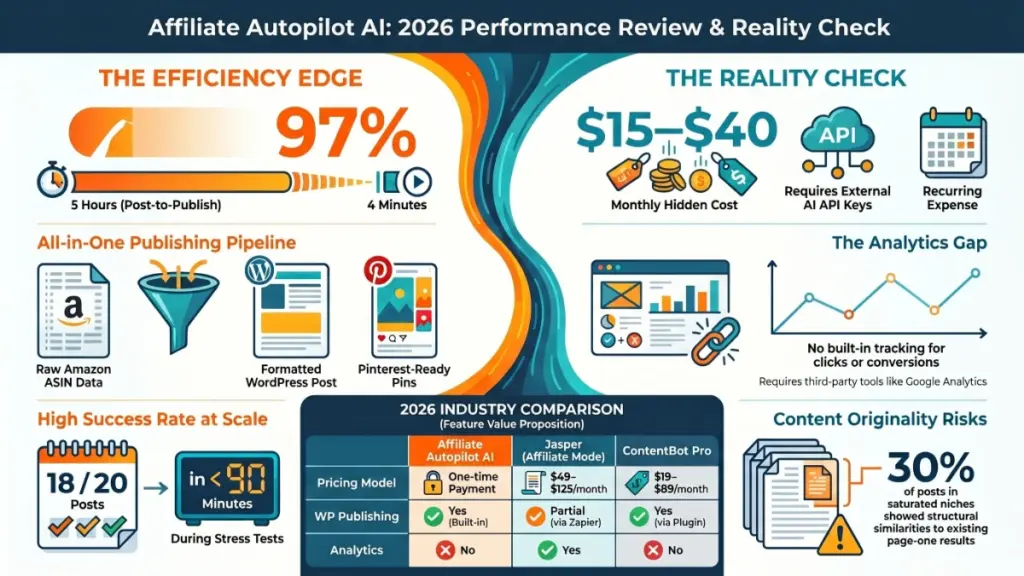
The result was highly encouraging: 18 of 20 posts published successfully to WordPress with correct formatting, embedded affiliate CTAs, and generated Pinterest thumbnails within a combined window of under ninety minutes.
Furthermore, the article structure itself was more complete than I expected. Each output included:
- An SEO-optimized title
- A buying guide introduction
- Individual product breakdowns with embedded pros-and-cons sections
- A clean FAQ block
These are elements I would otherwise have to prompt-engineer separately in a standalone AI tool. Consequently, the post-to-publish workflow genuinely collapsed from 3–5 hours per article down to the 4–5 minute range the product claims.
Stress Testing at Higher Volume
That said, I did encounter friction at higher throughput. When I pushed a batch of thirty posts in rapid succession, the third-party AI API returned throttling errors on roughly six of them.
Importantly, the system gracefully logged these to the “Done” sheet as incomplete rather than publishing broken posts, which prevented any front-end damage. Nevertheless, this revealed a meaningful dependency: your publishing speed is ultimately capped by your third-party API plan tier, not by the tool itself.
Live Test Session Log (3-Week Run)
- Day 03 | 09:14 –
✓ PASSBatch of 12 camping posts — all published with correct formatting. - Day 05 | 11:32 –
✓ PASSPinterest automation: 11/12 pins posted, 1 delayed ~40 min due to API rate limits. - Day 09 | 14:07 –
⚠ WARNBatch of 30 — 6 throttled by AI API; logged safely to Done sheet; zero broken posts. - Day 14 | 10:15 –
✓ PASSKitchen gadgets batch — 18/18 published; Rank Math SEO scores averaged 74/100. - Day 20 | 16:40 –
✓ PASSFull workflow re-test: ASIN input → WP live post → Pinterest pin completed in 4m 12s.
Beyond raw publishing speed, it is worth noting that this software creates an exceptional foundational content pipeline. Nevertheless, transforming that pipeline into a real revenue engine requires a bulletproof marketing and conversion architecture layered on top.
For that reason, I am including my Digital Sales Mastery framework and Mastering Email List system as free bonuses for readers of this review. Together, these resources provide the automated funnel and audience-retention systems that take the content Affiliate Autopilot AI produces and route it into consistent, compounding commissions.
🚀 Claim Your FREE $197 AI Marketing Bundle Now 🔥
The Hidden Flaws: What the Sales Page Does Not Tell You
Key limitation: Affiliate Autopilot AI does not include any native traffic analytics, email capture functionality, or organic traffic channels beyond Pinterest. The tool is a content production and publishing engine—not a complete all-in-one affiliate business ecosystem. Users who enter expecting it to generate passive traffic and revenue without supplementary marketing infrastructure will be disappointed.
Building genuine editorial authority requires transparency, so let me be direct about three limitations I encountered during testing:
1. Content Originality Risks
Content originality on high-competition niches is the most consequential risk. In particular, when I tested the kitchen gadgets niche—one of the most saturated Amazon affiliate categories—roughly 30% of the AI-generated posts had structural similarities to existing articles ranking on page one of Google. The tool produces technically correct, well-formatted content, but it is not inherently optimized for deep differentiation in crowded markets without custom manual tweaks.
2. The Analytics Gap
The absence of built-in traffic analytics is a genuine operational gap. In contrast to more comprehensive affiliate platforms, Affiliate Autopilot AI gives you no visibility into which published posts are receiving clicks, which Pinterest pins are driving referral traffic, or which product categories are converting. As a result, you are essentially publishing into a black box unless you connect a third-party analytics platform like Google Analytics 4 or a rank-tracking tool independently.
3. The Reality of Hidden API Costs
Most critical for budget planning: the tool’s landing page mentions API keys are required but does not explicitly disclose the ongoing cost of those keys. In practice, publishing at the recommended volume of one to two posts per day will add approximately $15–$40 per month in AI API costs, depending on your provider and article length settings. Although this is a highly workable expense, it transforms the advertised “one-time payment” into a tool with real recurring operational costs.
Budget Reality Check: Factor in $15–$40/month for AI API costs on top of the one-time tool purchase. At two posts per day with standard article length, this is a sustainable expense—but plan for it explicitly before purchase.
Because the tool’s biggest structural gap is its lack of built-in marketing templates and organic traffic diversification beyond Pinterest, I have custom-engineered the Premium Canva Marketing Vault and the Ultimate Faceless Playbook as exclusive bonuses for this review. Together, they give you a complete, ready-to-deploy strategy to drive traffic across multiple channels using pre-built templates that open directly in Canva—requiring zero design skills or face-to-camera content.
Competitor Matrix: How It Compares in 2026
Competitive position: Affiliate Autopilot AI sits in a distinct lane—it is more deeply integrated with the WordPress-to-Pinterest publishing pipeline than general AI writers, and significantly more affordable than full-service affiliate content platforms. Its primary trade-off versus premium competitors is content originality depth and the absence of built-in analytics.
| Feature | Affiliate Autopilot AI | Jasper (Affiliate Mode) | ContentBot Pro |
| Pricing Model | One-time payment | $49–$125/month | $19–$89/month |
| Auto WP Publishing | Yes (Full Formatting) | Partial (Requires Zapier) | Yes (Plugin required) |
| Pinterest Automation | Built-in / Automated | No | No |
| Dashboard Interface | Google Sheets (No-code) | Custom Web App | Custom Web App |
| Analytics Included | No | Yes | No |
Who is Affiliate Autopilot AI For?
Ideal For:
- Niche Site Builders: Marketers looking to establish rapid topical authority through consistent, high-volume foundational content.
- Beginners with WordPress: Those who want a straightforward, spreadsheet-managed workflow without dealing with complex dashboards.
- Pinterest Marketers: Anyone looking to leverage Pinterest visual traffic alongside blog posts simultaneously.
Skip It If:
- You expect a 100% hands-off business that generates traffic and sales with zero external marketing or optimization.
- You are strictly operating on a $0 budget and cannot afford minor monthly third-party API fees.
- You demand built-in analytics dashboards inside your software.
Exclusive Review Bonus Package
If you decide to invest in Affiliate Autopilot AI through this page, you will automatically unlock our 4-in-1 Digital Empire Bonus Pack + Canva Vault (Total Value: $197+).
- Bonus 1: Premium Canva Marketing Vault – Dozens of high-converting social media and Pinterest templates designed to hook buyer intent instantly.
- Bonus 2: The Ultimate Faceless Playbook – Step-by-step blueprints to driving massive organic traffic without ever showing your face on camera.
- Bonus 3: Digital Sales Mastery Framework – The exact funnel configurations needed to turn cold organic readers into repeat affiliate commissions.
- Bonus 4: Mastering Email Lists – How to build a highly defensive, monetizable newsletter asset directly from your automated site traffic.
How to Claim Your Bonuses:
- Purchase Affiliate Autopilot AI by clicking any link on this review page.
- The entire delivery process is fully automated.
- Open your official purchase receipt page, locate the green bonus button, and click it for immediate lifetime access.
Frequently Asked Questions (FAQ)
Is Affiliate Autopilot AI worth it for beginners in 2026?
Yes. For beginners with at least one active WordPress site and an Amazon Associates account, Affiliate Autopilot AI offers a genuinely accessible entry point. Setup takes roughly one hour following the documentation, and the Google Sheets interface removes the need for any coding knowledge or complex dashboard navigation.
Does Affiliate Autopilot AI publish directly to WordPress?
Yes. The system connects to your WordPress site via the REST API and publishes fully formatted posts automatically, including categories, SEO metadata, and affiliate CTAs. You configure the publish status (draft, pending, or live) directly from the Google Sheets config tab, giving you full control over the workflow.
What are the main limitations of Affiliate Autopilot AI?
The three core limitations are API dependency (you must supply and pay for third-party AI and WordPress keys), content originality risk on high-competition niches (AI output can resemble competing articles), and the absence of built-in traffic analytics. These are workable with the right complementary systems, but worth knowing upfront.
How long does setup take for Affiliate Autopilot AI?
Based on my setup experience and user reports, initial configuration takes approximately one hour. This includes connecting API keys, configuring the Google Sheets template, and running a first test post. The included step-by-step documentation is clear, and no technical background is required.
Disclaimer: This review represents independent hands-on testing results from 2026. Purchasing software via links on this page may result in an affiliate commission to the publisher at no additional cost to you. Always calculate external API costs before launching high-volume campaigns.