


TL;DR — Quick Verdict GuruOS is an ambitious all-in-one platform that bundles AI course creation, community management, gamification, and marketing automation into a single dashboard. For solo creators and small agencies looking to launch info-products fast, it offers genuine value — particularly the agent training system and the gamified community tech. That said, it carries real limitations in customization depth and content quality control. Overall Score: 3.6 / 5
Here’s the problem I hear every single week from clients: they want to turn their expertise into a digital product, but they’re drowning in the tool stack required to actually do it. Teachable for courses. Skool for community. ClickFunnels for the funnel. ConvertKit for email. Then an AI writing tool on top. Before they’ve made a single dollar, they’re spending $800+ per month just on subscriptions.
GuruOS claims to solve exactly that. Specifically, it pitches itself as the “world’s first AI operating system” that learns your brand, builds your courses, launches your funnels, and grows your community — all from one platform.
I’ve been stress-testing AI business tools since the GPT-3 beta days in 2021, and I’ll be honest: when I first read that sales page, my eyes rolled so hard I almost needed a chiropractor. “Self-building, self-launching” is the kind of language that usually signals vaporware. Consequently, I went in skeptical — and I spent the better part of three weeks pushing GuruOS through real workflow scenarios before writing a single word of this review.
Here’s what I found.
Scale Your Knowledge with Course Command AI
Explore the Global Hub
Who Is GuruOS Actually For?
Before we get into features, let me be direct about the audience fit — because this tool is not for everyone.
GuruOS is a strong fit if you are:
- A solo creator, coach, or consultant who wants to launch a paid course or community in under 30 days
- A small marketing agency that wants to productize AI-powered course and community setup as a service
- Someone currently paying for 3–5 separate tools (Teachable + Skool + ClickFunnels equivalent) and looking to consolidate
GuruOS is probably not right if you are:
- An enterprise team that needs deep CRM integration, SSO, or compliance controls
- A creator who demands full white-label control at the entry-level price point (you’ll need the Platinum tier for that)
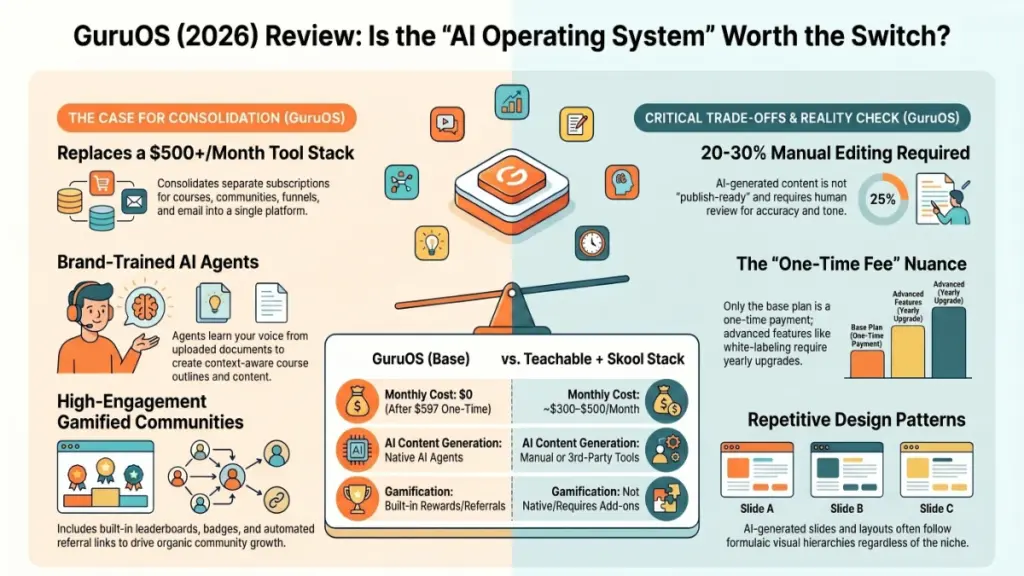
- Someone who expects the AI outputs to be publish-ready on the first pass without any editing
With that framing in place, let’s get into the actual product.
Pricing: The Real Numbers You Need to Know
Look, I’ll be straight with you — pricing transparency matters a lot to me, and GuruOS has a slightly unusual structure.
The base “GuruOS Premium” plan is a one-time payment of $597. That includes 50 workspaces, 5 communities per workspace, 15 products per workspace, and 50 AI agents per month. Furthermore, the sales page heavily emphasizes a “founders deal” with urgency timers, which — fair warning — is a classic launch tactic. Take that pressure with a grain of salt.
The real cost picture looks like this:
| Tier | Price | Key Additions |
|---|---|---|
| GuruOS Premium | $597 one-time | Core platform, 50 workspaces, commercial rights |
| Gold Upgrade | +$197/year | Unlimited everything, agency client access (15), premium agents |
| Elite Upgrade | +$127/year | Multi-language, DFY agency site, branding removal |
| Platinum Upgrade | +$197/year | Whitelabel, 100 client slots, team member access |
| Full Bundle | $997 one-time | All upgrades included (use coupon: GURU for $50 off) |
Specifically for agencies, the bundle at $997 is genuinely compelling when you compare it against paying $600–$800/month across individual tools. That said, note the Gold, Elite, and Platinum tiers carry yearly fees — so the “no recurring fees” headline on the sales page applies strictly to the base plan.
The Agent Training System: Where GuruOS Earns Its Stripes
The core mechanic of GuruOS is something they call “operating system training.” You upload your documents, paste your content, add links — and the platform’s agents absorb your voice, frameworks, and style. Subsequently, every piece of output it generates is supposed to reflect your specific brand, not generic AI fluff.
I tested this by feeding the system a mix of my existing blog posts, a client’s internal SOPs, and a short video transcript. The results genuinely surprised me. The course outlines the Course Agent produced weren’t just keyword dumps — they had a logical transformation arc that matched the input material reasonably well. Using this system felt a bit like hiring a junior researcher who actually read your notes rather than hallucinating from thin air.
Pro tip I learned during testing: The more specific your uploads, the better the outputs. Vague “describe your business” prompts produce generic content. However, when you feed it detailed case studies or specific methodology documents, the quality jumps noticeably.
The multiple agent types — Course Agents, Coaching Agents, Traffic Agents, Lead Chat Agents — each have clearly defined roles. Moreover, you can customize them with your own prompts, rename them, and style their chat interfaces. This modularity is one of GuruOS’s genuine differentiators versus a tool like Teachable, which handles hosting but not content generation.
Scale Your Knowledge with Course Command AI
Explore the Global Hub
Course & eBook Creation: Solid Foundation, Imperfect Execution
The Course Agent workflow walks you through a structured module-and-lesson creation process based on what GuruOS calls a “proven course formula.” In practice, this means the AI pushes you toward a transformation-focused structure — which is actually good pedagogy.
Furthermore, the eBook creation feature adds something I didn’t expect: it designs the layouts visually, pulling from a library of professional templates. You can download a polished flipbook or PDF that genuinely looks like a paid product, not a Word document someone formatted at midnight.
Here’s where things get frustrating, though. The slide presentations generated by the Course Agent are visually decent but formulaic. After about the third course I built in the platform, I noticed the design patterns repeating. Specifically, the AI tends to lean on the same visual hierarchy — headline, three bullet points, icon placeholder — across different niches. For a proofreading course and a dog care course, the layouts looked nearly identical. That matters if you’re selling premium-tier courses where brand differentiation is the whole point.
Additionally, the AI writing quality requires editing. I’d estimate about 20–30% of the generated lesson content needs a human pass for accuracy, tone, or specificity. Consequently, if you planned to ship courses without reviewing them, you’ll be disappointed. That’s not a knock unique to GuruOS — it’s true of every AI content tool I’ve tested — but it’s worth calibrating your expectations.
The Gamified Community: Genuinely Impressive Tech
This is the feature that honestly moved the needle for me. The community builder inside GuruOS isn’t just a discussion forum — it includes leaderboards, achievement badges, referral link technology, and a points-to-rewards system.
To give you an analogy: building a standard course community is like setting up a library — people come when they need something, then leave. GuruOS’s gamification layer turns it into something closer to a loyalty program at a coffee shop. Members earn points for completing lessons, posting in discussions, and referring friends. Furthermore, those points can be redeemed for coupons or prizes you set up.
The referral link technology in particular is smart. Each member gets a unique share link, and when someone joins through it, the referrer earns points automatically. Specifically for early-stage creators who don’t have an ad budget, this creates a word-of-mouth flywheel that most community platforms charge extra for or don’t offer at all.
The AI auto-posting and scheduling feature — where the system generates community discussion threads and queues them on a schedule — is another genuine time-saver. I set it to post twice daily in a test community and ran it for a week without touching it. The content stayed on-topic and engagement-appropriate, though it occasionally read a bit generic.
Marketing & Traffic Agents: Promising But Needs Human Oversight
The Traffic Agents generate social media content, ad copy, and launch campaigns in your brand voice. Theoretically, they take your trained agent data and produce content “the algorithms love” because it’s not generic AI output.
In practice? The social content is competent but not breakthrough. Think solid B+ output — the kind of post that won’t embarrass you, but also won’t go viral. Additionally, the landing page builder is drag-and-drop and functional, with built-in payment checkout via Stripe, PayPal, and Razorpay. For a one-platform solution, having payment processing baked in is a legitimate convenience win.
The SEO community thread feature — where member-generated posts get indexed by Google similar to Reddit threads — is an interesting long-play strategy. However, it requires a large, active community to generate meaningful search traffic. For a brand new creator starting from zero, this is a future benefit, not a day-one advantage.
One frustration worth flagging: The lead capture agents that embed on your landing pages are useful, but their default conversation flows feel a bit rigid. Specifically, customizing the agent’s conversation logic requires more technical comfort than the “no tech experience needed” pitch implies.
The Hidden Flaw: The Upsell Architecture
Here’s the thing nobody mentions loudly on the sales page. The base $597 plan has meaningful limits — 50 agents per month, 15 products per workspace, 5 communities per workspace. For a solo creator launching one course, that’s sufficient. However, if you want unlimited workspaces, the best premium agents (which are locked behind the Gold tier), or the ability to white-label the platform for clients, you’re looking at the full bundle at $997 or the stacked yearly upgrade fees.
Furthermore, removing the “Powered by GuruOS” branding from your communities and agents requires the Elite upgrade. If you’re positioning a client’s community as your own branded service, showing a competitor’s watermark is awkward. Consequently, agencies should realistically budget for the full bundle from day one rather than the entry plan.
I learned this particular lesson the hard way with a different tool a few years back — signed up at the base tier, built workflows around it, then discovered the feature I actually needed was three upgrade tiers up. Don’t make that mistake here.
GuruOS vs. The Competition
| Feature | GuruOS (Base) | Teachable + Skool Stack | Kajabi |
|---|---|---|---|
| Course Hosting | Included | Teachable | Included |
| AI Course Creation | Native agents | Manual or 3rd-party | Limited AI |
| Community | Included | Skool | Included |
| Gamification | Built-in | Not native | Limited |
| Referral Tech | Built-in | Requires add-on | |
| Sales/Funnel Pages | Included | Separate tool | Included |
| Monthly Cost | $0 (one-time) | ~$300–$500/mo | ~$149–$399/mo |
| Content AI Agent | Core feature | None | Basic |
| White-label | Platinum only | no | no |
The all-in-one value proposition holds up when you run the numbers against the Teachable + Skool + ClickFunnels stack. Specifically, if you’re currently paying $400–$500 per month across separate tools, GuruOS pays for itself within two to three months even at the bundle price.
Long-Term Value: Is This a Real Investment?
The company behind GuruOS — the same team behind FlexiFunnels and Rewardsly — has raised significant funding and runs a team of 100+ employees. That matters for platform longevity. I’ve been burned before by well-reviewed tools that got acquired or shut down 18 months after launch. Consequently, the institutional backing here is a genuine stability signal.
Furthermore, the GuruOS Blueprint Academy (6 modules, 30+ lessons based on the founders’ $20M+ in info-product launches) is included at no extra cost. I’ve seen standalone “how to launch a course” programs sell for $500–$2,000. Even if you’re skeptical of the AI features, the academy alone has practical value for someone who’s never launched a digital product before.
That said, I’d want to see GuruOS demonstrate stronger model updates and content quality improvements over the next 6–12 months before recommending it as a forever-platform for serious creators. Right now, it’s a strong launchpad — not a final destination for high-ticket course creators.
The Final Verdict
GuruOS Rating: 3.6 / 5
| Category | Score |
|---|---|
| Course Creation | 3.5/5 |
| Community & Gamification | 4.5/5 |
| Marketing Agents | 3.5/5 |
| Pricing Value | 4.0/5 |
| Platform Stability | 4.0/5 |
| Content Quality | 3.0/5 |
Buy GuruOS if: You’re a solo creator or small agency who wants to launch a course and community without stitching together 5 separate tools. The gamification and referral technology alone justify the investment compared to building on Skool.
Skip GuruOS if: You need enterprise-level integrations, deeply customized AI outputs without editing, or a white-label solution without paying for the full bundle. Additionally, if your primary goal is a single flagship course with heavy branding investment, a dedicated platform like Kajabi gives you more design control.
My recommendation: Start with the full bundle at $997 (use code GURU for $50 off) if you have any agency intentions. For pure solo creators, the $597 base is a reasonable starting point — just know the Gold upgrade will likely tempt you within 60 days.
Scale Your Knowledge with Course Command AI
Explore the Global Hub
Frequently Asked Questions
Does GuruOS really require no technical experience?
Mostly yes for core workflows — training agents, creating courses, and setting up communities. However, customizing lead agent conversation logic and advanced webhook settings (available in Gold) require at least basic comfort with configuration interfaces. Consequently, true beginners should allow a week to get fully oriented.
Is the GuruOS one-time pricing permanent or will it go monthly?
According to the sales page, the one-time pricing is a launch-window offer and the platform will move to monthly billing at an unspecified date. Specifically, the Gold, Elite, and Platinum upgrade tiers already carry yearly fees, so “no recurring fees” applies strictly to the base Premium plan.
Can GuruOS replace Skool for community building?
For most use cases under 50,000 members, yes — particularly if you want gamification built in without paying for extra tools. Furthermore, GuruOS lets you export your member list, so you’re not locked in if you ever want to migrate. For very large communities where Skool’s UX and SEO reputation matter more, Skool remains the stronger choice.
What kind of support does GuruOS offer?
The platform includes 24/7 in-app support and a knowledge base. Based on my experience during testing, response times via their support channel were in the range of a few hours for non-urgent issues. Specifically, their in-app training documentation was reasonably thorough and covered the main workflows without requiring external tutorials.
Is the GuruOS Blueprint Academy worth it for experienced marketers?
If you’ve already launched multiple info-products, the academy will largely confirm what you know. Specifically, the value for experienced marketers lies in the AI workflow integrations, not the foundational launch strategy. For complete beginners, however, the Academy is a genuine shortcut that could save months of trial and error.
Scale Your Knowledge with Course Command AI
Explore the Global Hub