


Live chat jobs offer legitimate remote work earning $30K-$85K annually, with top companies like Apple and Shopify paying $19-$28/hour plus benefits. Success requires 50+ WPM typing, strong written communication, and emotional intelligence. AI is augmenting—not replacing—these roles. Choose employee positions over contractor gigs for stability, prioritize technical setup, and treat the role as a skill-based career. Ideal for disciplined communicators seeking flexibility without advanced degrees.
The remote work revolution has fundamentally transformed customer service, and live chat jobs have emerged as one of the most accessible, flexible career paths available today. If you’re searching for legitimate work-from-home opportunities that offer real income potential without requiring advanced degrees or years of experience, remote chat support positions deserve your serious consideration.
But here’s the reality most job boards won’t tell you: not all live chat jobs are created equal. The difference between earning $12 per hour as an independent contractor versus $26 per hour with full benefits often comes down to which companies you target and how you position yourself during the hiring process.
This comprehensive guide draws from the latest 2026 market data, direct insights from industry professionals, and updated salary trends to give you the complete picture of what live chat work actually looks like today—and how to maximize your earning potential in this growing field.
What Are Live Chat Jobs? Understanding the Role in 2026
Live chat jobs involve providing real-time customer support through text-based conversations on company websites, mobile apps, or messaging platforms. Unlike traditional call center work, these positions allow you to assist customers entirely through typed communication—no phone calls required.
The Day-to-Day Reality
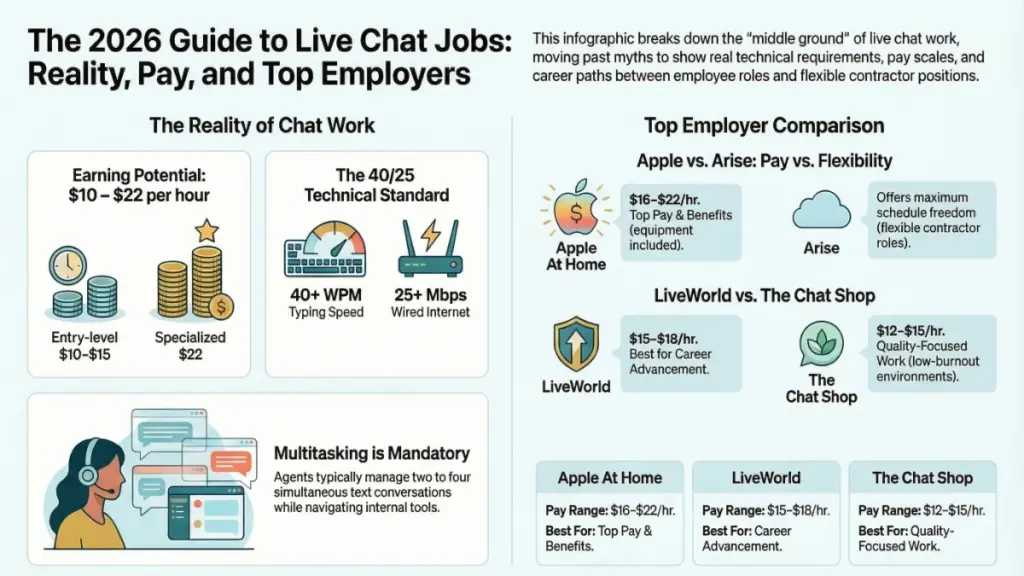
As a live chat agent, you’ll typically handle between two and four simultaneous conversations through a centralized dashboard. Your responsibilities include answering product questions, troubleshooting technical issues, processing orders or returns, and occasionally upselling services—all while maintaining a friendly, professional tone through written messages.
The work requires more than just fast typing. Successful chat agents must master multitasking, demonstrate emotional intelligence without vocal tone, and navigate complex knowledge bases while managing multiple customer threads simultaneously. Most companies provide paid training on their specific products and internal systems, so deep technical expertise isn’t always required upfront.
Essential Skills for 2026
The customer service landscape has evolved significantly. According to recent industry analysis, employers now prioritize three core competency categories:
Human Skills: Communication, empathy, and resilience remain foundational. The ability to read between the lines, respond calmly under pressure, and adapt your tone across different customer personalities determines your success.
Professional Skills: Clear business writing is non-negotiable for chat support. You’ll need excellent time management to meet service level agreements while handling multiple conversations.
Digital Skills: Comfort with CRM systems, AI-assisted knowledge search, and multi-channel platforms is now expected. The most successful agents don’t compete with AI—they collaborate with it, using technology to surface relevant information faster and focus on complex problem-solving.
Live Chat Job Salaries in 2026: Real Numbers You Can Expect
Let’s address the income question directly, because outdated salary information plagues this industry. Current 2026 data shows significant variation based on experience level, location, and employment type.
Current Salary Ranges
According to the most recent compensation data, chat support professionals can expect:
| Experience Level | Annual Salary | Hourly Rate |
|---|---|---|
| Entry-Level (0-1 years) | $30,000 – $45,000 | $14 – $22 |
| Mid-Level (2-4 years) | $45,000 – $55,000 | $22 – $26 |
| Senior-Level (5+ years) | $65,000 – $85,000 | $31 – $41 |
| Technical/Specialized | $75,000 – $110,000 | $36 – $53 |
The national average for chat support representatives sits at approximately $51,629 annually as of March 2026, with top earners in high-cost markets like San Francisco and San Jose reaching $75,000-$80,000. Entry-level positions typically start between $14-$18 per hour, while experienced agents with specialized skills command $25-$35+ hourly rates.
Geographic Variations
Location significantly impacts earning potential. The highest-paying markets for chat support roles include:
- Corte Madera, CA: $67,305 average
- San Francisco, CA: $65,608 – $79,335
- San Jose, CA: $62,574 – $75,533
- Nome, AK: $67,209 average
- Seattle, WA: $73,240 average
However, remote work has democratized access to these higher-paying markets. Many companies now hire nationally while paying competitive rates regardless of your physical location.
Top Companies Hiring for Live Chat Jobs in 2026
The employer you choose dramatically impacts your experience, income stability, and growth potential. Based on current hiring data and employee reviews, here are the standout companies actively recruiting remote chat support professionals:
Premium Employers ($19-$28/hour)
Apple (At-Home Advisors)
- Pay: $19-$26/hour with benefits for part-timers
- Perks: Equipment provided (iMac, headset), 4-6 weeks paid training
- Requirements: Technical aptitude, schedule consistency
- Best For: Apple product enthusiasts seeking premium benefits
American Express
- Pay: $20-$28/hour full-time
- Perks: Exceptional benefits package, prestigious brand experience
- Best For: Those seeking financial services industry experience
Shopify
- Pay: $19-$26/hour
- Perks: Flexible scheduling, e-commerce specialization, growth opportunities
- Best For: Tech-curious individuals interested in entrepreneurship platforms
Zapier
- Pay: $60,000-$85,000/year ($29-$41/hour)
- Perks: Fully remote culture, async-first environment, premium pay
- Best For: Those with technical aptitude seeking top-tier remote culture
Solid Mid-Range Options ($15-$22/hour)
Amazon
- Pay: $16-$22/hour
- Perks: Equipment provided, seasonal-to-permanent pathways, various shifts
- Best For: Those wanting stability with a major brand
CVS Health
- Pay: $17-$23/hour
- Perks: Healthcare industry exposure, benefits, growing sector
- Best For: Interest in healthcare without clinical requirements
Discover Financial
- Pay: $18-$24/hour
- Perks: Financial services training, primarily daytime shifts
- Best For: Career pathing into financial services
The Chat Shop
- Pay: $12-$15/hour (employee status)
- Perks: Quality-focused environment, limited simultaneous chats (1-2 vs. industry standard 3-4)
- Best For: Those prioritizing work quality over maximum volume
Entry-Level Friendly Options ($12-$18/hour)
Liveops
- Pay: $12-$25/hour (contractor, varies by program)
- Perks: True schedule flexibility, work multiple brands
- Trade-offs: No benefits, contractor status
- Best For: Those needing maximum schedule control
TTEC & Teleperformance
- Pay: $14-$22/hour
- Perks: Paid training, frequent hiring, equipment often provided
- Best For: Breaking into remote work with minimal experience
The AI Revolution: How Technology Is Reshaping Chat Support
Perhaps the most significant development affecting live chat jobs in 2026 is the integration of artificial intelligence into customer service workflows. Understanding this shift is crucial for anyone entering or advancing in this field.
AI as Collaboration Tool, Not Replacement
Contrary to fears of mass automation, current data shows AI is augmenting rather than eliminating chat support roles. According to Upwork’s 2026 In-Demand Skills Report, demand for customer service and admin support skills remains stable even as AI adoption accelerates.
The key insight: AI handles routine inquiries while human agents focus on complex problem-solving, emotional intelligence, and relationship building. Companies are specifically seeking professionals who can “merge technical skill sets with more foundational ones”—those who direct and refine AI outputs while applying human judgment.
New Skill Requirements
Modern chat agents must now demonstrate:
- AI Tool Proficiency: Using AI-assisted knowledge search and response suggestion tools
- Data Literacy: Understanding analytics dashboards and performance metrics
- Complex Problem-Solving: Handling escalations that AI cannot resolve
- Emotional Intelligence: Navigating nuanced situations requiring empathy and judgment
The World Economic Forum predicts automation may affect 22% of current jobs by 2030, but customer-facing roles requiring human connection remain among the most resilient.
How to Land High-Paying Live Chat Jobs: A Strategic Approach
Success in securing premium chat support positions requires more than submitting generic applications. Here’s the proven methodology that separates hired candidates from the rejected pile:
1. Optimize Your Technical Setup First
Companies increasingly disqualify candidates during onboarding due to preventable technical issues. Before applying, ensure you have:
- Wired internet connection with 25+ Mbps download speed (WiFi alone often disqualifies)
- Backup mobile hotspot for outage protection
- Noise-canceling headset ($40-$80 investment)
- Dedicated quiet workspace free from distractions
- Modern computer capable of running multiple browser tabs and applications
Companies verify these requirements during onboarding with speed tests and video calls. Arriving prepared signals professionalism.
2. Demonstrate, Don’t Declare Your Communication Skills
Hiring managers assess your written communication from the first sentence of your application. Instead of claiming “excellent communication skills,” demonstrate them:
Weak: “I have excellent written communication skills and type fast.”
Strong: “In my previous role, I maintained a 95% customer satisfaction score while handling 50+ daily chat interactions, averaging 65 WPM with 98% accuracy.”
Explicitly include your typing speed (WPM) in your resume—anything above 50 WPM is worth mentioning. If below this threshold, invest two weeks in free typing training before applying.
3. Master the Chat Simulation
Most reputable companies include live chat simulations in their hiring process. This test evaluates your ability to:
- Type quickly while thinking critically
- Manage multiple conversation threads simultaneously
- Maintain professional yet natural tone under pressure
Preparation Strategy: Open three browser tabs and practice composing responses to different scenarios within set timeframes. Focus on transforming stiff, scripted language into conversational, helpful responses.
4. Target the Right Companies Strategically
Your application success rate increases dramatically when you match your priorities to the right employer:
- Seeking career growth? Target LiveWorld, Shopify, or companies with documented advancement paths
- Prioritizing income stability? Focus on employee positions (Apple, American Express, CVS) over contractor roles
- Need maximum flexibility? Consider Liveops or Arise Virtual Solutions, but budget for inconsistent income
- Building technical skills? Prioritize SaaS companies like Zapier, HubSpot, or Zendesk
Pros and Cons of Live Chat Jobs: The Honest Assessment
After analyzing thousands of employee reviews and industry reports, here’s the unvarnished truth about remote chat work:
Advantages
✓ 100% Remote: No commute, geographic flexibility, work-from-anywhere potential
✓ Flexible Scheduling: Options for part-time, weekend, or overnight shifts
✓ Low Barrier to Entry: No degree required for most positions
✓ Transferable Skills: Develop capabilities applicable to customer success, operations, or management
✓ Growing Demand: Companies continue shifting from phone to chat support
✓ Clear Metrics: Performance is measurable, reducing subjective evaluation
✓ Cost Savings: Eliminate commuting costs (average $500-$800 monthly savings)
Challenges
✗ Income Ceiling: Most positions cap around $22-$26/hour without specialization
✗ Contractor Risks: Independent contractor roles offer no benefits or job security
✗ Physical Strain: Repetitive typing can cause wrist/hand issues without proper ergonomics
✗ Emotional Labor: Handling frustrated customers requires mental resilience
✗ Isolation: Remote work lacks face-to-face interaction
✗ Performance Pressure: Constant monitoring of response times and customer satisfaction scores
✗ Upset Customers: You’ll encounter angry people; your metrics may suffer for factors outside your control
Career Advancement: Turning Chat Jobs Into Long-Term Success
Live chat positions frequently serve as launching pads for higher-paying careers. Understanding these pathways helps you position yourself strategically from day one.
Internal Advancement Opportunities
Top companies like LiveWorld and Shopify offer documented promotion tracks:
- Chat Agent → Senior Agent (6-12 months): Handle escalations, mentor new hires
- Senior Agent → Team Lead (1-2 years): Supervise 8-15 agents, manage schedules
- Team Lead → Operations Manager (2-3 years): Oversee multiple teams, strategic planning
- Operations → Director of Customer Experience (4+ years): Executive-level responsibility
Alternative Career Paths
Customer service experience opens doors to:
- Customer Success Manager ($65K-$100K): Proactive account management vs. reactive support
- Technical Support Specialist ($55K-$80K): Product-specific troubleshooting
- Quality Assurance Analyst ($50K-$70K): Reviewing interactions and improving processes
- Training & Development ($55K-$75K): Onboarding and coaching new agents
- Product Operations ($60K-$90K): Using customer insights to improve products
The key differentiator for advancement? Treating the role as a skill-based career rather than temporary income. Top performers track metrics, seek feedback, develop specialized knowledge, and actively pursue growth opportunities.
2026 Market Outlook: Is Now the Right Time to Enter?
The remote customer service market shows strong fundamentals for 2026 and beyond. Several trends support continued opportunity:
Industry Growth Drivers
- Remote Work Normalization: 28% of the global workforce now operates remotely, with 16% of companies fully remote
- Digital-First Customer Service: Companies increasingly prefer chat over phone for cost efficiency and customer preference
- E-commerce Expansion: Online retail growth drives demand for support professionals
- Healthcare Digitalization: Telehealth and digital health platforms create specialized support roles
Skills in Highest Demand
According to Upwork’s 2026 analysis, the fastest-growing skills in customer service and admin support include:
- E-commerce Management (+130% growth)
- Medical Virtual Assistance (+44% growth)
- Supply Chain & Logistics Project Management (+37% growth)
Additionally, AI-related customer service skills like chatbot development (+71%) and AI integration (+178%) command premium rates.
Final Verdict: Are Live Chat Jobs Worth It in 2026?
Based on comprehensive analysis of current market data, salary trends, and industry developments, live chat jobs represent a legitimate, viable career path for 2026—with important caveats.
Live chat jobs are worth pursuing if you:
- Value flexibility and remote work above all else
- Possess strong written communication skills and emotional intelligence
- Can maintain discipline and self-motivation without direct supervision
- Approach the role as a career foundation rather than passive income
- Select employers carefully, prioritizing employee status over contractor arrangements
Look elsewhere if you:
- Expect easy money without skill development
- Cannot handle emotional stress or difficult customers
- Require guaranteed income above $60,000 annually without specialization
- Struggle with self-directed work or technology
Your Action Plan: Getting Started Today
If live chat work aligns with your goals, here’s your immediate roadmap:
- Assess Your Setup: Test internet speed, typing speed (aim for 50+ WPM), and workspace
- Research Target Companies: Select 3-5 employers from this guide matching your priorities
- Prepare Application Materials: Craft specific examples demonstrating communication skills
- Practice Simulations: Use free online tools to practice multitasking chat scenarios
- Apply Strategically: Submit 5-10 applications rather than mass-applying
- Follow Up: Many companies have lengthy hiring processes; persistence differentiates successful candidates
The remote chat support industry offers genuine opportunity for those who approach it strategically. With updated salary data showing averages of $51,000+ annually and top performers earning $75,000+, this field rewards skill development and strategic employer selection.
The market is active—companies like Amazon, Apple, Shopify, and dozens of others are hiring right now. Your competitive advantage comes from preparation, professionalism, and choosing the right opportunity rather than accepting the first available position.
Ready to start your search? Begin with the companies listed in this guide, verify current openings on their career pages, and approach the application process with the same professionalism you’ll bring to the role itself.