


A note on this piece: This isn’t a hands-on review. I haven’t purchased or tested the 7-Figure Accelerator. You won’t find a personal rating, a “my experience” section, or a fabricated testimonial anywhere below. Instead, this summarizes what’s publicly documented about the program, its creator, and the complaints and reviews surrounding it. Weigh it yourself before you spend anything.
What the Program Claims to Be
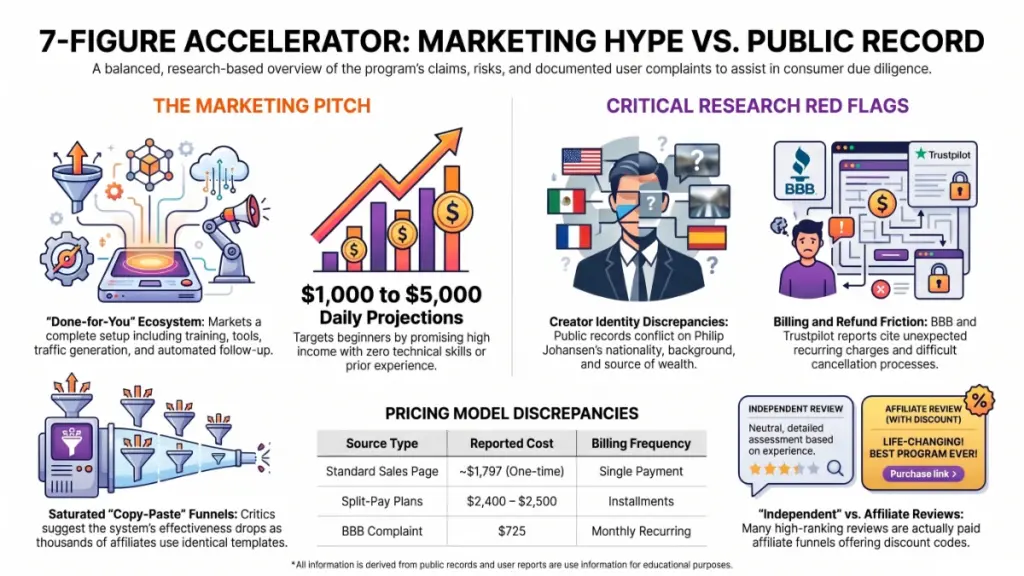
The 7-Figure Accelerator markets itself as a done-for-you system for high-ticket affiliate marketing. It promises to teach the high-ticket affiliate marketing model from the ground up, using a done-for-you approach meant to remove most of the technical and creative barriers that typically stop beginners.
Marketing copy frames the program as a full ecosystem rather than a single course. It bundles training videos, live coaching, community access, and done-for-you tools, and it covers the business model itself, digital infrastructure setup, traffic generation, automated follow-up, and scaling.
Sales pages go further. They target buyers with zero tech skills, no prior experience, and no product of their own, and dangle income figures as high as $1,000–$5,000 per day.
Who Is Philip Johansen?
His background is murky, and the inconsistency itself is worth flagging.
One review site calls him a Norwegian-born entrepreneur who built his online business income from essentially nothing, citing failed dropshipping attempts before he pivoted to high-ticket affiliate marketing. Another describes him as a Danish entrepreneur now living in Dubai, ranked in the global top one percent of affiliates.
A BlackHatWorld forum thread adds a third story. Treat it as informal and unverified — it’s a marketing forum, not a source — but posters there claim he’s Danish, once worked as a plumber, and won a lottery in Denmark before moving to the UAE. One commenter went further, suggesting his money comes from investing lottery winnings rather than from affiliate marketing.
These accounts don’t even agree on his nationality. I can’t verify any of them independently. That inconsistency matters, because his personal success story functions as the main “social proof” behind the program.
Pricing
Pricing details shift depending on the source, and possibly by promotion.
One review describes checkout offering a one-time fee of roughly $1,797, occasionally discounted, or a split-pay plan totaling $2,400–$2,500. Separately, a Better Business Bureau complaint describes recurring monthly charges rather than a one-time payment (see below). Given that discrepancy, don’t trust any single number you read. Check the live checkout page yourself, and read the billing terms carefully before you enter a card number.
Complaints on Record
BBB Scam Tracker
A filed complaint lays out a clear timeline. The member joined in August 2023, tried to cancel within 30 days believing they qualified for a full refund, and was told the membership would continue and would keep being charged. The company then charged $725 the following month despite the cancellation request. The complainant disputed the charges through their credit card company and called the billing structure part of an alleged pyramid scheme. That’s the complainant’s own characterization, not a legal finding.
Trustpilot
Reviews are mixed. Some customers report positive experiences, including helpful support and a motivating community. Others raise concerns about the program’s marketing approach, value, and refund policy. Some reviewers have made strong accusations about the business and its promotional methods, while others describe the program as a legitimate training opportunity with areas that could be improved. Because these opinions vary widely, potential buyers should review independent feedback, understand the refund terms, and carefully evaluate whether the offer matches their expectations before making a purchase.
One Trustpilot comment speculated about a link to FTC enforcement action against unrelated affiliate marketers, guessing Johansen might face similar scrutiny eventually. I want to be direct here: this is one commenter’s speculation. I found no confirmed FTC action against Johansen or 7-Figure Accelerator, so I’m not treating the claim as fact.
Independent Review Sites
A detailed critical review reported a 1-star Trustpilot review from a student who said the coaches gave only generic, unhelpful advice, and that the program was genuinely effective mainly for students who joined back in early 2022. The implication: once thousands of affiliates run the identical copy-paste funnel, it stops converting as well.
Another review site described member complaints that the company altered the structure of landing pages and email templates provided to members. At least one member alleged the company did this to exploit emotional triggers deliberately. Some reviewers and forum commenters have called the model a “Ponzi scheme.” I’ll flag that plainly: an affiliate-commission structure alone doesn’t meet the legal definition of a Ponzi scheme, and I found no regulatory action confirming that label applies here.
A More Measured Take
Not every source comes down hard against the program. One review concluded that 7 Figure Accelerator is not a scam — it’s a legitimate digital training program with real content, a public creator, and established billing platforms — and that the main issues are marketing tone, upsells, and occasional refund friction. That review frames the complaints as typical of high-ticket course businesses generally, not evidence of fraud specifically.
A Red Flag Worth Naming Directly: Paid “Reviews”
Search “7 Figure Accelerator review” and you’ll find plenty of pages that look like independent reviews but function as affiliate sales funnels. Many offer a discount code or bonus “vault” for buying through their link. One page opens with a dramatic personal narrative, then discloses that the writer is an active member of the program, and joining through their link unlocks a discount and a private bonus vault.
That disclosure doesn’t automatically make the content false. But it does mean a large share of what ranks well for this product’s name is marketing dressed up as evaluation, not independent testing. Filter for that as you research further.
Where That Leaves Things
Here’s the honest state of public information, pulled together:
- The creator’s own biography shifts depending on which source you read.
- Pricing shifts too, and at least one complaint describes unexpected recurring charges after a cancellation attempt.
- Reviews split genuinely. Some describe real support and community. Others describe generic coaching, a no-refund policy, and unproven allegations of pyramid-scheme dynamics.
- A meaningful share of “reviews” are paid affiliate content, not neutral assessments.
- No confirmed regulatory action — FTC or otherwise — turned up against Philip Johansen or 7-Figure Accelerator specifically. Only informal speculation exists, and I’m not treating that as fact.
If You’re Considering It
Take these steps regardless of what you decide:
- Get the current refund and cancellation policy in writing before you pay anything. Several complaints center on billing and cancellation, not on the training content itself.
- Check whether checkout is one-time or recurring. The BBB complaint above describes a monthly charge; other sales pages describe a one-time fee. Confirm which applies to the offer in front of you.
- Treat glowing “review” sites with a discount link as marketing, not due diligence. Cross-check claims against Trustpilot, BBB, and forum discussions directly.
- Remember that “no website, no ads, no product needed” describes the marketing pitch, not a guaranteed outcome. The program’s own materials include standard earnings disclaimers stating results aren’t typical — take that at face value.