

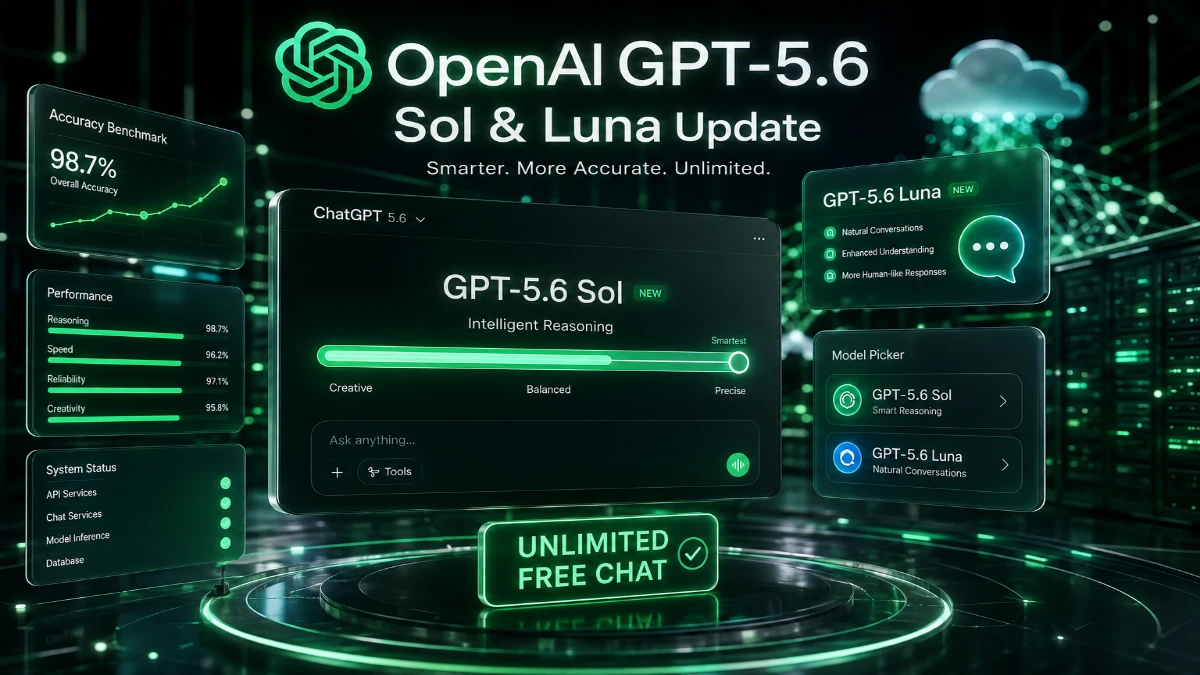
OpenAI announced updates to ChatGPT on August 6, 2026, refining GPT‑5.6 Sol for Plus and Pro subscribers while pushing GPT‑5.6 Luna out to Free and Go users with unlimited text chats. The changes affect how ChatGPT’s two tiers of users experience the product day to day — and they signal something bigger about where OpenAI thinks the real competitive battle is happening.
I’ve been testing AI tools professionally since the GPT-3 API waitlist days, and I’ll tell you what jumped out at me here: this isn’t a flashy new model launch. It’s a tuning pass aimed squarely at the million-plus people who use ChatGPT every week for ordinary tasks — quick questions, planning, research, decisions. That’s a different kind of announcement than “we shipped a smarter model,” and it matters for anyone building workflows on top of this tool.
Why It Matters
Most AI news coverage obsesses over frontier benchmarks. This update is about something more mundane and, frankly, more relevant to how most people actually use these tools: consistency and factual reliability across everyday conversations.
For marketers and consultants like me who rely on ChatGPT for client research, quick fact-checks, or drafting under deadline, factual accuracy isn’t a nice-to-have — it’s the difference between a tool you trust and one you have to double-check constantly. OpenAI is explicitly targeting that gap here, and the free-tier expansion changes the calculus for smaller teams and solo operators who’ve been rate-limited into upgrading.
Technical Details
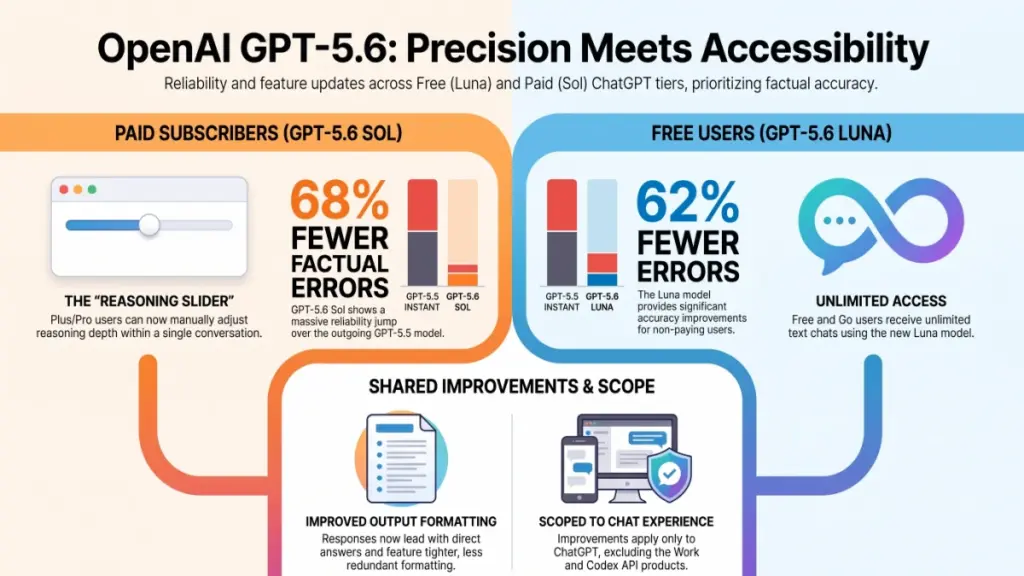
The core change is behavioral rather than architectural. GPT‑5.6 Sol now powers both the “Instant” and “Thinking” experiences in ChatGPT’s chat interface, replacing the split between fast and deep-reasoning models with one model that adjusts effort level based on a new slider. Plus and Pro users can dial reasoning depth up or down per conversation rather than switching models entirely.
On the free tier, GPT‑5.6 Luna becomes the default model this week, with unlimited text chats and a “Think” button for harder questions rolling out afterward. According to OpenAI, file uploads, image generation, and other tool-based features remain rate-limited even for free users — so the unlimited access applies specifically to text conversation, not the full feature set.
One detail worth flagging for anyone building on the API: this update is scoped to the ChatGPT chat experience only. OpenAI notes that the version of GPT‑5.6 Sol powering Work and Codex products isn’t changing as part of this release. If you’re evaluating this for a coding workflow or enterprise integration, don’t assume the improvements carry over.
Performance & Evidence
OpenAI’s internal evaluation reported meaningful reductions in factual errors on prompts involving financial, medical, and legal detail — the kind of content where a wrong date or misstated rule actually costs someone money or causes real harm. The company reported roughly 62% fewer responses containing at least one factual error with GPT‑5.6 Luna, and around 68% fewer with GPT‑5.6 Sol, compared to the outgoing GPT‑5.5 Instant.
Here’s where I’ll apply some healthy skepticism, because that’s the job: these are OpenAI’s own internal evaluations, not independent third-party benchmarks. I’ve been burned before trusting vendor-reported numbers that didn’t hold up once a tool hit real client work. Error-rate reductions on curated evaluation sets don’t always translate cleanly to the messy, ambiguous prompts people actually throw at ChatGPT. Independent testing — the kind researchers and reviewers run outside the company’s own eval harness — will be the real signal to watch here.
The comparison example OpenAI published, involving a cycling-route weather query, is a decent illustration of the intended behavior shift: tighter formatting, leading with the direct answer, and less reflexive over-explaining. Whether that consistency holds up across thousands of edge cases is a separate question from whether it looks good in a company’s own demo.
Pricing & Availability
The updated GPT‑5.6 Sol and reasoning slider are live now for Plus and Pro subscribers on web, mobile, and desktop. GPT‑5.6 Luna becomes the default for Free and Go users this week, with unlimited text chats and Think-button access following next week, subject to what OpenAI describes as abuse guardrails.
No pricing changes accompanied this announcement — this is a capability shift within existing tiers, not a new pricing structure. For teams already paying for Plus or Pro, there’s no new cost to unlock the update.
Industry Implications
For developers and product teams building on top of ChatGPT’s consumer surface rather than the API, this narrows a gap that’s mattered for competitive positioning: free-tier users on Claude, Gemini, and other platforms have had varying degrees of generous access, and OpenAI’s unlimited free text chat closes some of that distance.
For marketers specifically — my own turf — the practical impact is smaller than the headline suggests. Most professional workflows I build for clients run through the API or paid tiers anyway, where rate limits were never the binding constraint. The bigger story is reliability. If the factual-error reductions hold up under independent scrutiny, that’s a genuine argument for using ChatGPT over competitors for research-heavy tasks — but “if” is doing a lot of work in that sentence until someone outside OpenAI runs the numbers.
Limitations & Open Questions
A few things remain unverified. OpenAI’s factual-accuracy claims come from internal evaluations without a published, independently reproducible benchmark set, so treat the 62% and 68% figures as a starting point rather than settled fact. It’s also unclear how the new effort slider performs on ambiguous prompts where the “right” amount of reasoning isn’t obvious — that’s exactly the kind of case that tends to expose the seams in a system like this.
It’s also worth noting the age-appropriate safety measures OpenAI describes for users it believes are under 18, including restrictions on romantic roleplay and age-restricted content. These are meaningful commitments, but as with the performance claims, how well they hold up in practice is something only real-world use and outside audits will confirm.
Future Outlook
This update reads as OpenAI shoring up its consumer base ahead of whatever comes next on the frontier-model side. Expanding free access and tightening reliability are retention plays as much as product improvements — they make it harder for casual users to have a reason to try a competitor’s free tier instead.
Developers evaluating this for production use should wait for independent benchmarking before treating the reliability claims as a decision-making input. For everyone else, the practical takeaway is simple: if you’re a Free or Go user, expect a noticeably different default experience this week, and if you’re on Plus or Pro, the new slider is worth experimenting with on your actual workflows rather than assuming default settings are optimal.
Conclusion
This isn’t the kind of release that reshapes the model landscape overnight, and OpenAI isn’t positioning it that way either. It’s an incremental, usage-focused update — better factual grounding, more consistent behavior between quick and deep responses, and broader free access. Whether the accuracy gains are real in practice, beyond OpenAI’s own testing, is the open question worth watching. Independent evaluators and everyday users will settle that faster than any press release can.