

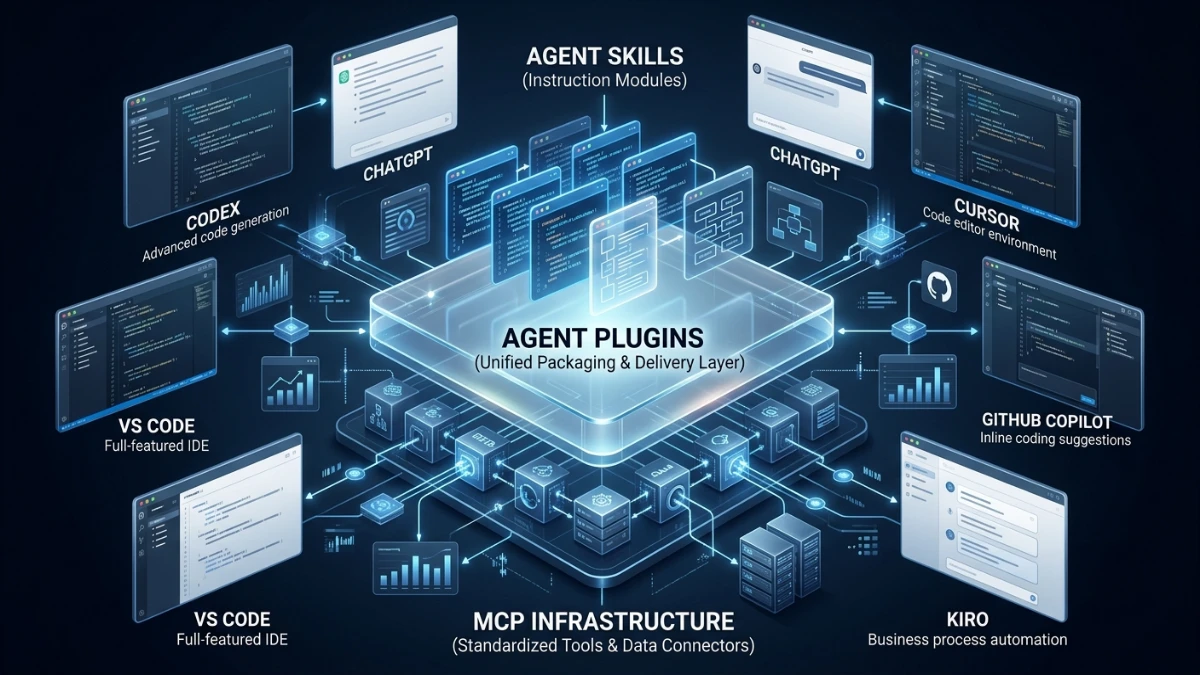
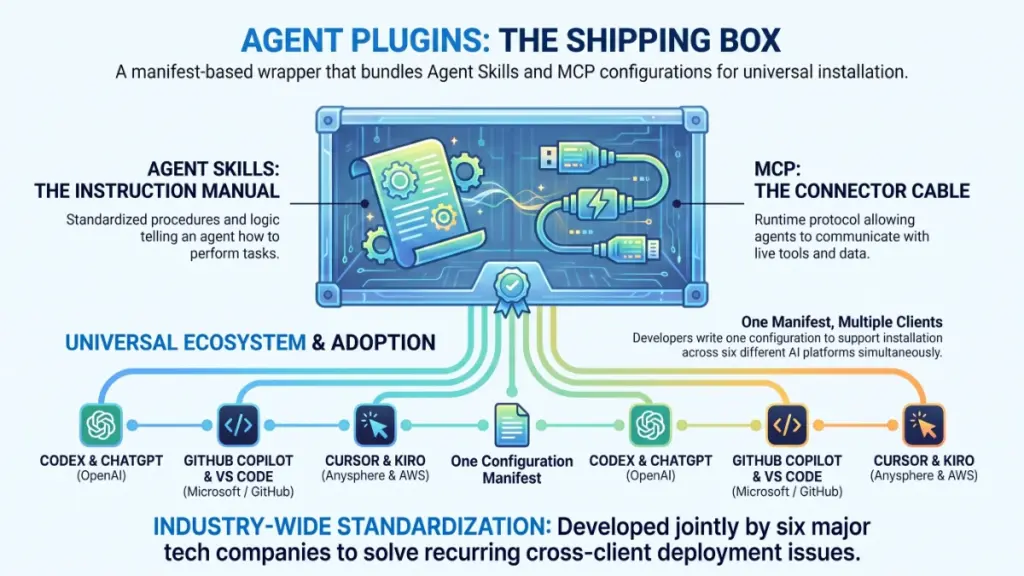
On August 6, 2026, OpenAI Developers announced Agent Plugins. AWS, Cursor, GitHub, VS Code (Microsoft), and Vercel helped build it. In plain terms: it’s a shared format that bundles an Agent Skill with its MCP server configuration. You install both together, into any compatible agent client, without writing client-specific setup instructions. Six clients support it on day one: Codex, ChatGPT, Cursor, GitHub Copilot, Kiro, and VS Code.
Here’s what I found after digging through the announcement. This isn’t a new instructional format competing with Agent Skills. It doesn’t replace MCP either. It’s the missing layer that sits on top of both.
Why It Matters
If you’ve built even a handful of Agent Skills or MCP servers, you already know this pain. A skill that depends on a specific MCP server needs setup steps for each client. You write one flow for Cursor, another for VS Code, another for Copilot. Multiply that by every skill-plus-tool combo you maintain. Pretty soon you’re maintaining install docs instead of shipping product.
Agent Plugins fixes that. You write one manifest. Any of the six supporting clients reads it and installs the skill plus its MCP wiring together. Consultants and teams who build reusable AI workflows across multiple tools will feel this immediately. In my experience testing dozens of these setups, that’s basically everyone doing this seriously. This change gives you real time back.
Technical Details: What’s Actually in the Box
The layering deserves precision here. People use “plugin,” “skill,” and “MCP” interchangeably in casual conversation, and that’s where confusion creeps in:
- MCP standardizes how an agent talks to a live tool or data source at runtime.
- Agent Skills standardize how instructions and procedures get packaged for an agent to load.
- Agent Plugins standardize how a skill and its MCP configuration ship and install together, across different clients.
Picture MCP as the connector. Agent Skills is the instruction manual. Agent Plugins is the box that ships the manual and the cable as one product. OpenAI’s own language describes the new standard as something that “packages Agent Skills and supports MCP server configurations.” It wraps existing formats. It doesn’t replace them.
Do You Need to Rewrite Anything?
The announcement’s phrasing suggests no. It reads like a wrapper around assets you’ve already built, not a mandate to redo them in a new format. But I’ll be straight with you: the post left out the exact manifest schema. It didn’t confirm whether a CLI can auto-generate a plugin from an existing skill and MCP config. It didn’t explain how versioning works either. If you’re planning to package something for production, don’t guess at these details.
Availability and Client Support
| Client | Maker |
|---|---|
| Codex | OpenAI |
| ChatGPT | OpenAI |
| Cursor | Anysphere |
| GitHub Copilot | GitHub / Microsoft |
| Kiro | AWS |
| VS Code | Microsoft |
This list tracks closely with the five co-developing organizations, plus Vercel as a named collaborator. Vercel doesn’t have a branded client on the day-one list, though. Five separate companies built this together. OpenAI didn’t ship it solo and hope for adoption. That fact signals a shared, recurring problem, not a one-vendor pitch.
Is This a Rival to Anthropic’s Agent Skills Format?
No. The standard explicitly packages Agent Skills. It doesn’t define a competing instructional format. If anything, it validates Agent Skills as the format worth standardizing distribution around, rather than trying to displace it.
Limitations and Open Questions
This standard is one day old as of this writing. Treat the following as genuinely open, not settled:
- Manifest schema — the announcement doesn’t detail field names, required versus optional keys, or versioning.
- Tooling — nobody has confirmed an official CLI for generating a plugin manifest from existing assets.
- Registry and discovery — it’s unclear whether a central plugin registry is planned, the way MCP has one.
- Security and consent model — MCP has a documented consent model for tool calls. We don’t yet know whether plugins add their own permission layer or simply inherit the underlying MCP server’s model.
- Update mechanics — the announcement doesn’t address how authors ship updates or how clients detect them.
Independent testing and real production usage will settle most of these questions. The announcement post won’t.
The Bigger Picture
This standard lands the same week as other vendors converging on portable, shared standards for agent tooling. Watch that pattern if you’re building on any of this infrastructure. Here’s the practical takeaway for now: Agent Plugins offers a genuinely useful packaging layer if you maintain skills tied to MCP servers across multiple clients. The spec is still filling in, though. Check the official spec site directly before you build anything that depends on unconfirmed details. And expect this guide’s specifics to age quickly as the standard matures.