

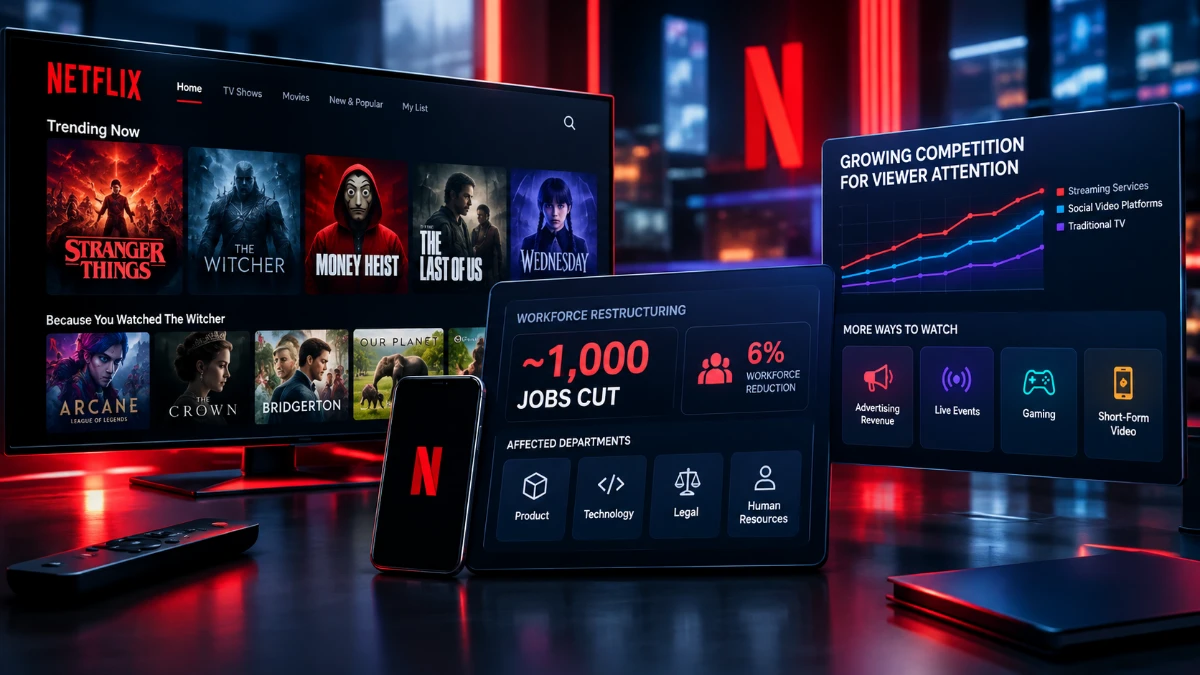
Netflix is cutting approximately 1,000 jobs, or about 6% of its workforce, across product, technology, legal, and HR. The move follows a failed bid for Warner Bros. Discovery assets and intensifying competition from YouTube, TikTok, and Instagram. Despite the layoffs, Netflix says it remains on track to meet its full-year forecast while prioritizing advertising, live events, gaming, and new viewing experiences.
Netflix is cutting about 6% of its workforce, or close to 1,000 employees. The company confirmed the figure to TechCrunch on October 14, 2026. The Wall Street Journal first reported the layoffs, citing an internal memo to staff.
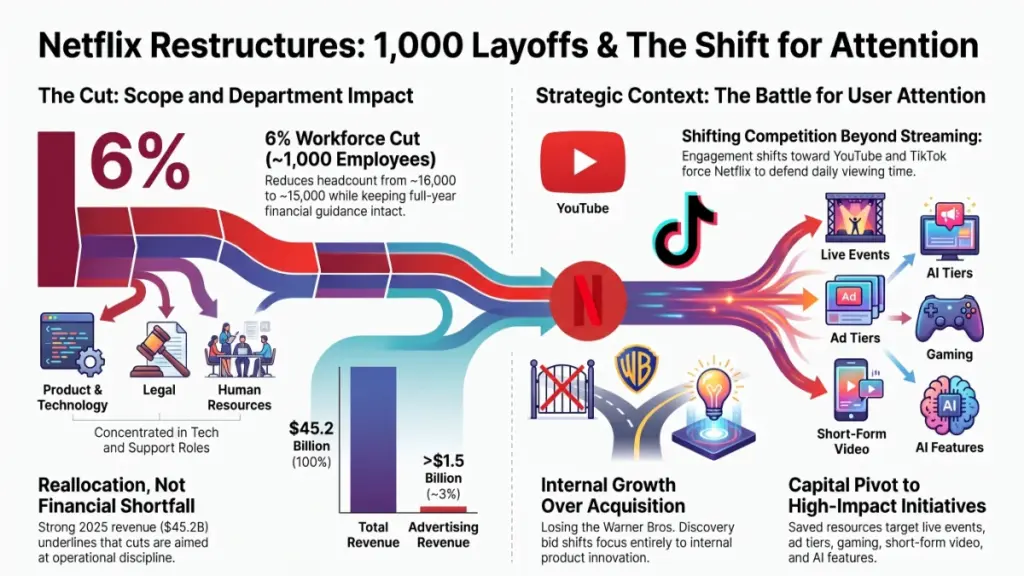
The cuts hit several functions. Most affect the product, technology, legal, and human resources departments. Netflix did not describe the reductions as a sign of weakness. The company said it will “continue to invest aggressively in high impact areas” to improve its service. It also said it remains on track to deliver its full-year forecast.
Those statements matter. They frame the layoffs as a reallocation of resources, not a response to a financial shortfall. Netflix employed 16,000 full-time staff at the end of last year, according to its annual filing. A 6% reduction therefore touches a meaningful share of the company, but it leaves the vast majority of the organization intact.
Co-CEOs Ted Sarandos and Greg Peters wrote the memo. The Journal quoted them describing the company’s mission to entertain the world as ambitious. They said delivering on it requires discipline about where Netflix prioritizes its people and resources.
The timing adds context. Netflix recently lost a protracted bidding war for Warner Bros. Discovery’s streaming and studio businesses. Paramount Skydance won that contest earlier this year. The loss closed off a major route to growth. Now Netflix must pursue its goals through internal investment.
This article examines what the layoffs mean for Netflix, its employees, and its competitors. It separates confirmed facts from analysis. It also explains which questions remain open.
Strategic Context and Why It Matters
Who is affected
The confirmed cuts concentrate in four departments: product, technology, legal, and human resources. Netflix has not published a detailed breakdown by team or region. It has not said how many roles each department will lose. Readers should treat any such breakdown as unconfirmed until the company releases one.
The mix of functions is notable. Product and technology teams build the service that viewers use. Legal and HR teams support the company’s operations and its workforce. Cuts across both groups suggest a broad review of headcount rather than a narrow restructuring of a single unit.
Who benefits
Companies often present layoffs as a way to sharpen focus. Netflix’s statement follows that pattern. The company says it will keep investing in “high impact areas.” Analysts will likely read that as a signal that Netflix wants to move money toward content, live events, advertising, and engagement features.
Shareholders may benefit if the cuts lower costs while protecting the full-year forecast. The company explicitly said it is on track to meet that forecast. That claim gives investors a reason to view the move as disciplined rather than defensive. Time will test whether the claim holds.
Employees who remain may gain clearer priorities. They may also face heavier workloads and lower morale. Research on layoffs generally shows mixed effects on remaining staff, so this outcome depends on how Netflix manages the transition. The source article does not address this point, so it stays an open question.
What workflows change
Product and technology reductions can shift how quickly Netflix ships features. Fewer engineers and product managers usually mean fewer parallel projects. Teams must choose which initiatives to keep. Netflix has not said which projects it will pause or end.
Legal and HR cuts may change internal processes. Smaller teams often automate routine work or narrow their scope. Netflix has bet on AI-supported features, according to TechCrunch, but the report does not link those bets to the layoffs. Any connection remains speculation.
The competitive backdrop
Netflix once dominated the TV app category. That position has weakened. TechCrunch reports that social apps such as TikTok and Instagram, along with YouTube, now compete aggressively for the same viewing time. According to various market research firms, TikTok is catching up to Netflix on user engagement. YouTube reportedly surpassed Netflix in average daily viewing in 2025.
This shift changes the nature of the contest. Netflix no longer competes only with other streaming services. It competes with every app that captures attention. A viewer who watches short videos on a phone is a viewer who does not open Netflix. That reality pressures the company to defend engagement, not just subscriber counts.
The layoffs fit that pressure. Companies facing attention competition often rethink where they spend money. Netflix appears to be doing the same.
Deep-Dive Analysis: Workforce, Structure, and Strategy
This section replaces the usual technical specification review. It breaks down the structural facts available in the source reporting.
Headcount math
Netflix reported 16,000 full-time employees as of the end of last year. A 6% cut equals roughly 960 positions. TechCrunch rounds that figure to “close to 1,000.” The company’s headcount at the time of the announcement may differ from the year-end figure. If Netflix hired or reduced staff during 2026, the percentage would shift. The company did not provide updated totals in the cited reporting.
After the cuts, the company would employ roughly 15,000 people if no other changes occur. That estimate rests on the year-end number and the confirmed percentage. It is arithmetic, not a company statement.
Department focus
The four affected departments serve different purposes:
- Product defines what the service does and how viewers interact with it.
- Technology builds and runs the streaming infrastructure and apps.
- Legal manages contracts, licensing, regulatory matters, and disputes.
- Human resources handles hiring, compensation, and workforce policy.
Netflix did not say whether the cuts fall evenly across these groups. It also did not say whether creative, content, or marketing teams face reductions. The phrase “most of the cuts” implies other groups may lose staff too. Readers should watch for follow-up disclosures.
The Warner Bros. Discovery factor
Netflix pursued Warner Bros. Discovery’s streaming and studio businesses and lost to Paramount Skydance. TechCrunch notes that the assets include studios, HBO, streaming platforms, games, and TV networks such as CNN and HGTV. Netflix saw “great potential” in those holdings, according to the report’s characterization.
The deal would have given Netflix a vast library and new distribution channels. It would also have required legal, product, technology, and HR work to integrate the businesses. Losing the bid removes that integration burden. Some planned capacity may no longer be needed. This is an inference. Netflix has not tied the layoffs to the failed bid, and TechCrunch only notes that the cuts follow it.
Strategic bets already underway
Netflix has pursued several strategies to extract more value from subscribers. TechCrunch lists the following:
- Raising prices.
- Expanding its ad-supported tier.
- Investing in live events and sports.
- Investing in gaming.
- Investing in children’s programming.
- Building AI-supported features.
- Adding video podcasts.
- Testing short-form video.
- Redesigning its mobile app to compete with social media.
This list shows a company reaching beyond long-form films and series. Netflix wants to hold attention across more formats. Each initiative demands product and technology resources. The layoffs force the company to decide which of these bets deserve the most support.
Financial Evidence and Engagement Data
This section replaces the benchmark review. It covers the performance data in the source article.
Revenue and advertising
Netflix reported revenue of $45.2 billion in 2025. Advertising revenue rose to more than $1.5 billion. Those figures show a large and growing business. They also show that advertising remains a small share of total revenue. Roughly 3% of 2025 revenue came from ads, based on the reported numbers. That share is a simple calculation from two disclosed figures.
The numbers explain why the company keeps investing in its ad tier. Advertising offers a second revenue stream beyond subscriptions. It also gives Netflix a way to serve price-sensitive viewers. Growth here could offset slower subscriber gains.
Engagement metrics
Engagement data comes from third-party market research, not from Netflix. TechCrunch cites reports from “various market research firms.” Those reports say two things:
- Social apps like TikTok are catching up to Netflix on user engagement.
- YouTube surpassed Netflix in average daily viewing in 2025.
Readers should note the source limits. Market research firms use different methods. Their numbers can disagree. TechCrunch does not name the firms or publish their figures. The claims therefore deserve caution, even though they match a broader industry narrative.
Guidance
Netflix says it is on track to deliver its full-year forecast. The company did not repeat the forecast figures in the cited coverage. Investors will want to compare the next earnings report against the guidance. If results match, the layoffs will look like a planned efficiency move. If results miss, observers will question the company’s framing.
How to read the evidence
The evidence supports three conclusions:
- Netflix remains a large, profitable-scale business with $45.2 billion in 2025 revenue.
- Competition for attention has intensified, per outside research.
- The company is shifting resources while insisting its financial outlook has not changed.
The evidence does not prove that the layoffs will improve performance. It also does not prove that engagement will recover. Those outcomes depend on execution.
Financial Terms, Availability, and Access to Information
This section replaces the pricing and licensing review. Netflix did not announce new subscription prices or licensing terms with the layoffs. The company’s pricing strategy matters to the story, however.
TechCrunch notes that Netflix has been raising prices and expanding its ad-supported tier. Those two moves target different customers. Higher prices extract more revenue from existing subscribers. The ad tier lowers the entry cost and monetizes viewers through advertising instead.
The layoffs do not change service availability. Subscribers should see no immediate change in access. Netflix has not announced any plan to withdraw features or content because of the cuts. Product changes may emerge later, but the company has not confirmed any.
The Wall Street Journal broke the story and cited the internal memo. TechCrunch then confirmed the figures with Netflix directly. Readers who want primary information should watch for the company’s regulatory filings and earnings calls. Those documents will provide verified numbers on headcount, costs, and outlook.
Creators, marketers, and builders who follow the streaming industry often use digital resources to track trends and build their own products. The following offer may help readers who want practical tools.
⚡ Limited Time Free Access
Unleash Your Digital Empire: Get 4 Premium Gifts in 1 Pack!
Grab this exclusive, high-value digital asset package tailored for creators, marketers, and builders. Enter your best email to claim instant access.
What’s Inside Your Ultimate All-In-One Package:
01. 50 AI Digital Product Ideas: A curated list of profitable, AI-driven digital product ideas engineered for fast execution and high margins.
02. Digital Sales Mastery: The strategic architecture behind high-converting sales funnels, persuasive copywriting, and online revenue growth.
03. Mastering Email List: Advanced frameworks for building an engaged audience, maximizing open rates, and generating automated income.
04. THE ULTIMATE FACELESS PLAYBOOK: Complete blueprint to building a powerful, monetizable brand on social media without showing your face.
Included Bonus:
[BONUS] Premium Canva Marketing Vault: High-converting templates to scale your organic traffic.
💥 $197 VALUE — FREE FOR READERS
🛡️ Secure Processing • Your privacy is 100% protected.
Industry Implications and Competitive Analysis
The new competitive set
Netflix once measured itself against cable, broadcast networks, and other streamers. That frame no longer fits. The TechCrunch report names YouTube, TikTok, Instagram, and other social apps as direct rivals for attention. Each of those platforms offers endless free content. Each also builds habits through short, frequent sessions.
Netflix’s response mixes defense and imitation. It adds short-form video, video podcasts, and a redesigned mobile app. These moves borrow from social platforms. They aim to make Netflix feel less like a destination and more like a daily habit.
Rivals in streaming
Paramount Skydance now holds the Warner Bros. Discovery streaming and studio assets that Netflix wanted. That outcome strengthens a direct rival. Paramount Skydance gains studios, HBO, and other brands. Netflix must compete against a larger and more diversified competitor.
The lost bid also changes Netflix’s growth path. Acquisitions offer fast scale. Organic investment takes longer. Netflix must now build its advantages through its own content, technology, and engagement features.
Labor market and industry signals
TechCrunch tags this story under “tech layoffs.” Netflix joins a long list of technology and media companies that have trimmed staff. Each announcement reinforces a pattern. Large firms cut staff in support functions while promising continued investment in priority areas.
Workers in product, tech, legal, and HR should note which functions Netflix chose. Support and platform roles faced the heaviest cuts. That choice may signal how the company values different kinds of work. It may also reflect where Netflix sees duplication or lower strategic return.
Advertising and live content
Netflix’s ad revenue exceeded $1.5 billion in 2025. The company continues to expand its ad tier. Live events and sports offer premium inventory for advertisers. They also draw large audiences at the same moment, which helps with engagement.
Competitors pursue the same strategy. Social and video platforms already sell advertising at enormous scale. Netflix must prove that its premium content and live programming can command competitive ad rates. This effort depends on product and tech resources, which makes the layoffs in those departments especially interesting.
What rivals will watch
Competitors will look for signs that Netflix’s engagement strategy works. They will watch time-spent metrics, ad growth, and subscriber trends. They will also watch whether Netflix keeps hiring in the areas it calls “high impact.” If it does, the layoffs reflect reallocation. If it does not, the layoffs may signal broader retrenchment.
Limitations, Caveats, and Skepticism
What the reporting does not say
The source article leaves several questions unanswered:
- No department-level numbers. Netflix has not said how many people each team loses.
- No timeline. The company has not published when affected employees will leave.
- No severance details. Reports so far do not describe packages or support.
- No named “high impact areas.” Netflix has not listed which projects it will fund more.
- No direct link to the Warner Bros. bid. TechCrunch notes the timing but does not assert causation.
Treat the engagement claims carefully
The statement that YouTube surpassed Netflix in average daily viewing in 2025 comes from unnamed market research firms. Methods vary, and definitions of “viewing” differ across platforms. A viewer who watches a short clip on a phone counts differently than one who watches a two-hour film. Readers should avoid treating these comparisons as precise.
Corporate framing
The company’s memo uses confident language. It describes discipline, ambition, and aggressive investment. Corporate memos naturally emphasize strengths. Independent analysts should verify the claims against actual results. The statement about the full-year forecast is a promise, not a result.
Risks in production
Layoffs carry operational risk. Losing product and technology staff can slow development. It can also remove institutional knowledge. Teams may struggle to maintain existing systems while launching new features. Netflix’s ambitious list of initiatives raises this risk. Short-form video, games, live events, podcasts, and AI features all demand skilled people.
Legal and HR reductions carry their own risks. Smaller legal teams must still manage content licensing, regulatory matters, and disputes. Smaller HR teams must still support a large workforce and hire for priority roles.
Speculation to avoid
Some commentators may link the layoffs to AI adoption or to automation. The source article does not support that link. TechCrunch mentions Netflix’s AI-supported features only as part of its broader engagement strategy. Readers should not assume that AI caused these cuts.
Future Outlook and Conclusion
Netflix has taken a significant step. It is cutting about 1,000 jobs while telling the market that its financial outlook has not changed. The company wants to concentrate resources on areas that raise engagement and revenue.
Several milestones will clarify the picture:
- The next earnings report. It should show whether Netflix is meeting its full-year forecast.
- Headcount disclosures. Filings may reveal the net effect of the cuts and any new hiring.
- Product launches. New features in gaming, live events, short-form video, and podcasts will show where the company directs its effort.
- Advertising growth. Ad revenue above $1.5 billion in 2025 sets a benchmark for the coming year.
- Engagement data. Independent research will show whether Netflix closes the gap with YouTube and social apps.
Netflix still operates at enormous scale, with $45.2 billion in 2025 revenue. It also faces a changed market. Attention is the scarce resource, and every major platform fights for it.
The layoffs reflect that fight. They show a company trying to sharpen its priorities after a failed acquisition and amid rising competition. Whether the strategy works will depend on execution over the next several quarters. Observers should watch the results, not the memo.
Source: Ram Iyer, TechCrunch, October 14, 2026. The Wall Street Journal first reported the layoffs.