


Moonshot AI’s Kimi K3 has emerged as one of the world’s top AI models, narrowing the gap between open-weight and proprietary systems. Strong benchmark results, faster long-context processing through Kimi Delta Attention, and competitive coding performance signal a major shift in AI development. The biggest competitive advantage is now moving beyond models toward memory, orchestration, and workflow automation.
Moonshot AI’s new Kimi K3 model has forced a rapid rethink of how close open-weight, Chinese-built systems really are to the world’s leading AI labs. Within a single news cycle, independent benchmark trackers placed K3 inside the same performance tier as Anthropic’s Claude Fable 5 and Opus 4.8, and ahead of several well-known closed models on coding and frontend tasks. For anyone building products on top of large language models, that’s a signal worth paying attention to.
The Headline: A Six-Lab Frontier
Until recently, the “frontier” of AI capability was widely understood to be a two-lab race. That framing no longer holds.
- Independent evaluator Artificial Analysis reports that the number of labs scoring above 51 on its Intelligence Index jumped from two to six in roughly six weeks.
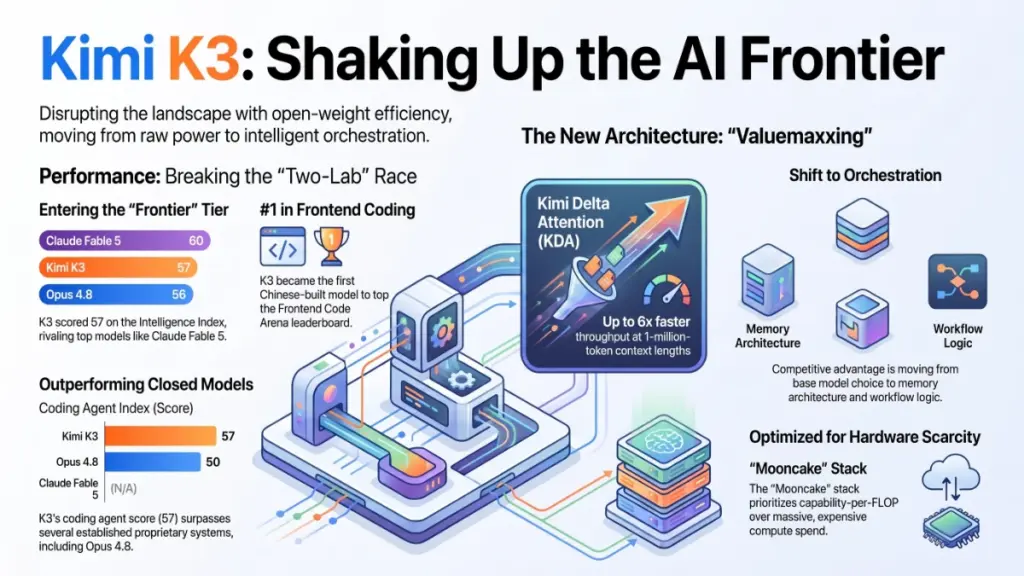
- Kimi K3 landed at 57 on that index — just behind Claude Fable 5 at 60, and ahead of Opus 4.8 at 56.
- On the same firm’s Coding Agent Index, K3 scored 57, putting it in line with GPT-5.6 Terra and GPT-5.5, and ahead of Opus 4.8.
- K3 also posted an 84% result on Terminal-Bench v2, 64% on DeepSWE, and 23% on SWE-Atlas-QnA.
Analysts covering the release, including commentators such as Rich Sutton-adjacent researcher voices and industry figures like Rus Salakhutdinov, described the jump as the first time a Chinese open-weight model felt genuinely competitive with top-tier proprietary systems on real coding and agentic work, rather than just narrow benchmark wins.
Frontend Coding: A Symbolic First
One of the more talked-about results came from the Frontend Code Arena, a leaderboard focused on visually grounded coding tasks like building interactive dashboards. K3 reportedly took the top spot there for the first time for a Chinese-built model, edging out leading U.S. systems on tasks that require translating a design brief into working UI code.
Separately, benchmarking firm DataCurve noted that K3 debuted at the #3 position on the DeepSWE software-engineering benchmark — the first time an open-weight model has reached frontier-level results on that particular test.
Not Everyone Agrees on How Big the Gap Closed
There’s genuine disagreement in the research community about what these numbers actually mean.
The bullish view: K3 narrows the gap enough that U.S. labs will feel pressure to ship faster, and some analysts argue it already surpasses specific Western models on meaningful task categories.
The skeptical view: Other researchers point out that K3 likely still trails on broader generality, inference efficiency, and on evaluation sets that aren’t publicly disclosed — meaning the real-world gap could be several months larger than headline scores suggest.
The efficiency argument: Perhaps the most consequential thread in the discussion isn’t about raw scores at all. Several technical commentators argue K3 undercuts the long-standing assumption that frontier capability is mostly a function of compute spend. Instead, they point to architectural choices — mixture-of-experts routing, aggressive quantization, and infrastructure design tuned for hardware scarcity (Moonshot’s so-called “Mooncake” stack) — as evidence that capability-per-FLOP is compressing faster than raw compute budgets are growing.
Under the Hood: Kimi Delta Attention
The technical detail generating the most engineering interest is K3’s attention mechanism, referred to as Kimi Delta Attention (KDA). Rather than paying the full computational cost of attending across an entire long context window, KDA maintains a fixed-size, continuously updated internal memory state — a “fast-weights” style approach.
The practical claims being circulated:
- Up to 6x faster and cheaper throughput at 1-million-token context lengths
- Pricing that stays comparatively flat as context length grows, instead of scaling steeply
If these figures hold up under independent, wider-scale deployment testing, this would represent one of the more meaningful architecture-level advances in this release cycle — and a template other labs may borrow from.
Infrastructure and Deployment Signals
The release also triggered a wave of infrastructure activity:
- Early deployments of K3 on heterogeneous hardware setups, including multi-GPU nodes connected over high-speed RDMA networking
- Renewed attention on Huawei’s “950 SuperPoD” hardware announcement, feeding a broader narrative about China building AI infrastructure under supply constraints
- Continued serving-stack updates from vLLM, including expanded AMD hardware support and reports of production-grade deployments running on Nvidia’s DGX B200 systems
K3 also drew praise for its performance in low-level kernel and GPU performance engineering — a niche but increasingly important skill set for teams optimizing inference costs at scale.
The Real Story: Value Is Moving to Orchestration, Not Just Models
Perhaps the most important takeaway for builders isn’t about any single model’s score — it’s about where the competitive advantage is shifting.
As frontier-level intelligence becomes cheaper and more widely available (open-weight or not), several industry voices argue the durable differentiator is no longer “which base model do you use,” but:
- Memory architecture — how an AI agent retains and reuses knowledge across sessions instead of re-deriving it from scratch every time
- Orchestration and harnesses — the scaffolding, tools, and workflow logic wrapped around a model
- Domain-specific tuning — customizing agent behavior for a particular business process rather than relying on general-purpose defaults
A widely shared framing describes this shift as moving from “tokenmaxxing” (chasing raw model output) to “valuemaxxing” (optimizing for the actual business outcome an agent produces.
New memory designs are converging on what’s being called a “wiki memory” approach: agents build and maintain a structured, task-specific knowledge layer over raw documents, synchronized through the Model Context Protocol (MCP), instead of repeatedly re-reading and re-interpreting the same source material. Vector database provider Qdrant has published production guidance on related multi-tenant retrieval patterns, and memory-layer startup mem0 has framed continual learning as fundamentally a memory-management problem rather than a model-weights problem.
MCP and “agent skills” as a category also continue to mature, with recent updates including custom skill support in Perplexity’s Agent API and new desktop and engine-integration skills from AI agent company Nous.
Why It Matters for Developers, Marketers, and Remote Teams
For non-researchers, this news cycle has three practical implications:
1. More competitive pricing is coming. As open-weight models close the performance gap with closed frontier systems, expect continued downward pressure on API pricing across the large language model market — good news for SaaS teams running high-volume automation workloads.
2. Model choice is becoming less of a moat. If you’re building AI-powered products, the emphasis of the AI automation conversation is shifting toward how well your tools handle memory, retrieval, and multi-step workflows — not just which underlying model you’ve plugged in.
3. Long-context, high-throughput agents just got cheaper to run. Architectural advances like Kimi Delta Attention point toward AI agents that can hold much larger working context — codebases, customer histories, multi-week projects — without the runaway costs that have limited long-context agentic use cases until now.
What Independent Benchmarks Still Say Caution Is Warranted
Not every metric points to open-weight models closing the gap uniformly. On cybersecurity-focused evaluations, closed models still appear to hold a real lead over open alternatives on long-horizon tasks, even as that gap narrows. And on abstract reasoning benchmarks like ARC-AGI, a separate model, Thinking Machines’ Inkling, currently holds the top open-weight scores — a reminder that “frontier” performance isn’t a single number, but a bundle of very different capabilities that don’t all move together.
The Bottom Line
Kimi K3’s release is less a single dramatic breakthrough and more a data point confirming a trend that’s been building for months: the performance distance between the best closed models and the best open-weight models is shrinking, and the competitive battlefield for AI companies is shifting from raw model capability toward orchestration, memory, and workflow design. For developers, marketers, and automation-focused teams evaluating their AI tool stack, the practical advice is the same as it’s been all year — benchmark your own use case, don’t assume yesterday’s pricing or performance hierarchy will hold, and keep an eye on how quickly the “second tier” of frontier labs keeps growing.