


Hermes Cracked is a training and automation package built around the free Hermes AI agent. It provides setup tutorials, business frameworks, and AI tools like SkillXray and SkillForge. While the $27 front-end offers decent value for beginners, the expensive OTO funnel, technical learning curve, and ambitious income claims require careful evaluation before investing further.
Research note: This review draws on publicly available product information, the official sales and JV pages, and my general experience evaluating AI agent tools and info-product funnels. I have not personally completed a paid run-through of every OTO. I’ll tell you what I can verify, flag what I can’t, and give you my honest read on whether this funnel makes sense for your situation. If I use affiliate links for this product anywhere on this page, I’ll say so plainly at the top.
Quick Verdict
| Rating | 3.2 / 5 |
| Best for | Tech-comfortable solopreneurs who already use or want to use Hermes and want a structured system for building a side-income asset |
| Skip if | You’re not willing to learn a CLI-based tool, you want plug-and-play automation, or you’re skeptical of info-product funnels in general |
| Front-end price | $27 (one-time) |
| Full funnel cost | Up to ~$1,155 (FE + all OTOs at highest tiers) |
| Key pros | Built on a genuinely popular open-source agent; transparent about what Hermes is; two real web apps included; one-time pricing |
| Key cons | Steep OTO ladder; Hermes itself is free (you’re paying for the system, not the tool); the “#1 AI agent” claim needs context; income claims are illustrative, not typical |
The AI Agent Gold Rush Has a New Entrant
Here’s a scenario I’ve watched play out a dozen times in the last two years. A client calls me and says: “James, I keep hearing about AI agents. Everyone insists they’re going to replace half my workflow. I need to either get on board or explain to my boss why we’re not.” They’re not sure what an agent actually is, and they definitely don’t know which one to use. On top of that, they’ve already been burned once by a shiny AI tool that overpromised and underdelivered.
Hermes Cracked is trying to solve a real version of that problem – at least for the solopreneur end of the market.
So here’s the core pitch: Hermes is a free, open-source AI agent built by Nous Research (not by the people selling this product). It runs locally, and it’s genuinely popular – the OpenRouter rankings cited in the marketing materials are real and publicly verifiable. Hermes Cracked, by contrast, is a training and tooling package that teaches you how to set it up, configure it for real business use cases, and run what the vendor calls “income assets” – a print-on-demand shop, a faceless video channel, a digital product funnel, and so on – using Hermes as the operational core.
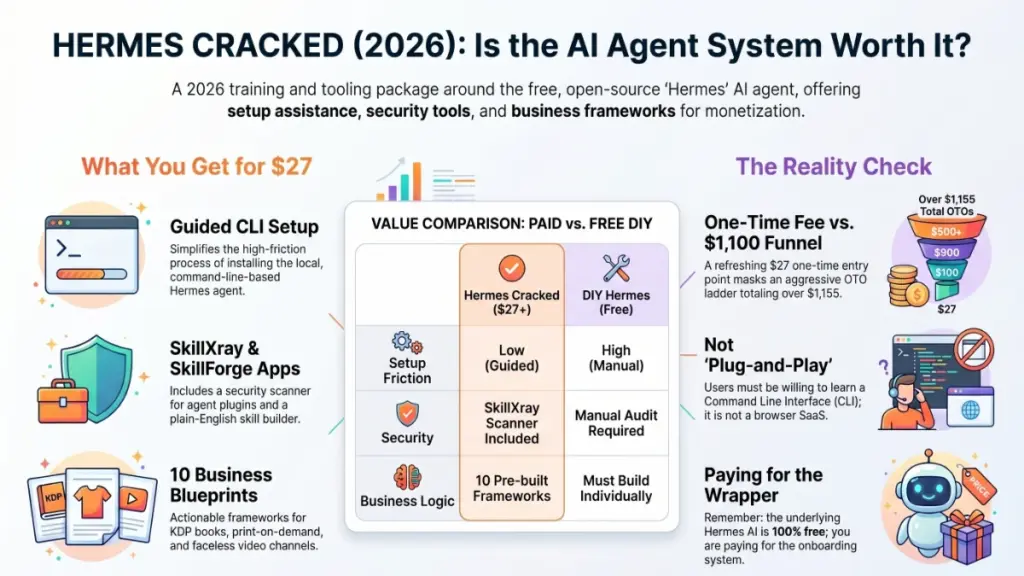
Specifically, the $27 front-end gets you the setup guide, a structured prompt library, ten business model blueprints, and two live web apps: SkillXray (a scanner that checks Hermes skills for security vulnerabilities before you install them) and SkillForge (a plain-English skill builder). Beyond that, the OTO ladder sells you 100 pre-built skills, a branded operator dashboard, business playbooks, and agency licensing.
Is any of that worth paying for? Let me work through what I can actually verify.
What Hermes Actually Is (And What You’re Really Buying)
Before anything else, it’s worth getting clear on something the sales page mentions but buries a little: Hermes itself is free. You can download it right now from GitHub – 171,000+ stars at time of writing, which is easy to check and not a made-up number. In other words, you don’t need to buy Hermes Cracked to use Hermes.
What you’re actually buying is the system built on top of it: the setup walkthrough, the prompt library, the business model frameworks, and the two web apps. That’s a legitimate value proposition. However, it matters that you understand the distinction going in. If you’re technically comfortable and already know your way around a CLI-based local AI agent, you may not need much of what the front-end offers. Conversely, if the idea of installing and configuring a local agent makes you nervous, the structured walkthrough might genuinely save you hours of frustration.
Among the deliverables, the two apps – SkillXray and SkillForge – are the most concrete items in the front-end. Both are live at verifiable URLs (scan.hermescracked.com and forge.hermescracked.com), which is a meaningful transparency signal. The security scanner angle is also genuinely interesting: a 2026 paper by Liu et al., cited in the marketing, claims around 26% of agent skills carry a vulnerability. I can’t independently verify that specific statistic, but the underlying concern is real. Third-party skills for AI agents are a genuine attack surface, and therefore a scanner that flags issues before install has obvious practical value.
Bottom line on what you’re buying: A structured onboarding system for a free, popular open-source agent, plus two functional web apps. How much value you get depends almost entirely on how much friction that structure removes for your specific situation.
The Funnel: Understanding What You’re Walking Into
Look, I’ll be straight with you – the OTO ladder here is aggressive. Let’s map it out clearly, because the sales page makes it easy to focus on the $27 front-end without fully registering what the full commitment could look like.
| Tier | What it is | Price |
|---|---|---|
| Front-end | Setup system, prompts, 10 business models, 2 apps | $27 |
| OTO 1 | 100 pre-built Hermes skills | $67 |
| OTO 2 | Branded operator dashboard + CLI skin | $67 |
| OTO 3 | Business playbooks and templates | $297 |
| OTO 4 | Agency license (3 tiers) | $97–$697 |
| Bundle | Gold bundle + Platinum white-label OTO | Up to $794 |
If you go all the way through the OTO ladder at the top agency tier, you’re looking at over $1,100 total. That’s not a $27 purchase – it’s a $27 entry point into a funnel designed to upsell you several times over.
Now, that’s not inherently dishonest. It’s a standard info-product structure, and plenty of legitimate products use it. Even so, it’s something you should know before you click “buy.” The front-end price functions as an impulse buy. Meanwhile, the real product the vendor wants you to end up with is either the bundle or the full OTO stack.
My practical advice: if you’re genuinely interested, start with the front-end only. Give yourself time to see whether the system actually works for your situation before committing to OTO 3 ($297) or an agency license. The 30-day refund window gives you room to evaluate. Above all, don’t let “limited launch pricing” framing rush you into buying OTOs you haven’t had a chance to assess.
What the Marketing Claims – And What I Can Actually Verify
The Hermes Cracked JV page makes several claims that deserve a closer look, because while the marketing is enthusiastic, some of it needs context.
AI agent in the world – The OpenRouter rankings cited are real, and Hermes does rank highly on OpenRouter’s public App & Agent leaderboard. The GitHub star count is likewise verifiable. However, “world’s #1 AI agent” is strong framing for a specific leaderboard snapshot on a single platform. Furthermore, the ranking reflects Hermes the open-source project, not Hermes Cracked the paid product. So the underlying claim is defensible; the phrasing is maximalist marketing.
Around 30% of OpenClaw users have switched to Herme” – The marketing cites this as “documented across the AI press,” but I wasn’t able to independently verify a specific source for that figure. It may well be accurate. Still, I can’t confirm it from publicly available information, so treat it with appropriate skepticism.
Income potential – To their credit, the sales page includes proper disclaimers (results not typical, examples are illustrative), and those disclosures are more thorough than average for this category. Nevertheless, the headline framing – income assets you own,” “up to $577.50 per customer” on the JV page – creates an impression of passive income that the fine print quietly walks back. The business models themselves (KDP books, print-on-demand, faceless video) are real categories where people genuinely earn money. But they also require significant effort, iteration, and often an existing audience. The AI agent assists; it doesn’t function as a turnkey income machine.
SkillXray powered by “NVIDIA’s open-source SkillSpector” – I couldn’t find independent documentation for a product called SkillSpector from NVIDIA. It may be real and simply not indexed in ways I found, or it may be a mischaracterization. Either way, if this specific integration matters to you, verify it directly before purchasing.
Genuine Strengths Worth Acknowledging
So far I’ve been direct about the marketing claims that need context. Here, though, is where I think Hermes Cracked has real merit.
One-time pricing is genuinely refreshing. In a landscape where nearly every AI tool charges $50–$100 per month, a one-time purchase is a meaningful differentiator. Yes, the OTOs add up – but each one is also a single payment, not a recurring drain on your budget.
The open-source foundation acts as a built-in trust signal. Because Hermes itself is open and auditable, the vendor can’t fabricate screenshots or invent capabilities that don’t exist. What you see is what the underlying tool actually does – and that’s a higher standard than most closed-source AI tools I review.
SkillXray addresses a real security problem. As agent ecosystems grow, so does the attack surface for malicious or poorly-written skills. A scanner that flags issues before install is genuinely useful, and the fact that it runs as a web app (rather than a local tool you have to configure separately) meaningfully lowers the barrier to using it.
The ten business model frameworks are varied and concrete. Ten documented frameworks is a substantive deliverable, and the range – from KDP and print-on-demand to content repurposing and tool sites – means there’s likely something relevant for a wide variety of solopreneurs, not just one narrow use case.
Real Limitations to Factor In
Hermes has a real learning curve. This is a local, CLI-based AI agent, not a browser-based SaaS you log into and start using in ten minutes. If you’ve never configured a tool from the command line, the setup walkthrough will help – but it won’t eliminate the friction entirely.
The “income assets” framing sets expectations higher than the reality. A print-on-demand shop or faceless YouTube channel built with AI assistance can absolutely work. However, both require ongoing management, iteration based on market response, and sustained time investment. The phrase “income assets you own” is technically accurate, yet it risks implying more passivity than the work actually demands.
No independent user reviews exist yet. Because this is a new launch (June 2026 at time of writing), there’s no third-party feedback to draw on. As a result, any testimonials on the sales page should carry less weight than usual until external reviews accumulate.
OTO 3’s price point is steep relative to what’s described. $297 for “operating playbooks and templates” is a significant ask. Playbooks are useful in principle, but at that price I’d want to see highly specific, differentiated content – not repackaged general business advice. Without access to the actual materials, I can’t tell you which category it falls into.
How It Compares to the Alternatives
If the core appeal is “I want to use a local AI agent to build something,” there are several paths worth comparing side by side.
| Hermes Cracked | DIY Hermes Setup | AutoGPT / similar | Paid AI workflow tools | |
|---|---|---|---|---|
| Setup friction | Low (guided) | High | Medium | Low |
| Cost | $27–$1,100+ one-time | Free (time cost) | Free–moderate | $30–$100+/month |
| Business frameworks | Yes (10 included) | No | No | Varies |
| Open-source agent | Yes | Yes | Yes | Usually no |
| Security scanning | Yes (SkillXray) | Manual only | No | N/A |
| Skill library | OTO 1 ($67) | Community-sourced | Growing | N/A |
If you’re technically comfortable and self-directed, the DIY path is genuinely viable – Hermes’s documentation and community are solid. On the other hand, if you want structure and a faster start, the Hermes Cracked front-end is reasonably priced for what it includes. The OTOs are where you need to make individual, case-by-case decisions rather than buying the whole stack upfront.
Who This Is Actually For
Buy the front-end if:
- You’ve been curious about local AI agents but didn’t know where to start
- You’re a solopreneur interested in building a digital side income and want structured business frameworks to follow
- The SkillXray security scanner is appealing to you as a standalone tool
- A $27 one-time exploratory spend feels comfortable relative to the potential payoff
Consider OTO 1 and OTO 2 if:
- You’ve used the front-end for a few weeks and the system is genuinely working for you
- You want to expand your skill library (OTO 1) or prefer a cleaner operator interface (OTO 2)
- You’re running client work and OTO 4’s agency licensing is commercially relevant to your business
Skip this entirely if:
- You want a fully managed, browser-based AI tool with zero setup friction
- You’re expecting meaningful passive income with minimal ongoing effort
- Command-line tools feel like a foreign language and you don’t want to change that
- You’re generally skeptical of info-product funnels – because that skepticism is, honestly, reasonable here
Final Verdict
Hermes Cracked is, on balance, a more honest product than most in its category. It’s built on a real open-source agent with verifiable popularity, it includes functional web apps rather than just PDFs, and the pricing structure is one-time rather than recurring. Those are all genuine positives worth acknowledging.
At the same time, the marketing is enthusiastic in ways that need tempering. The “#1 AI agent” framing reflects one leaderboard on one platform, not a universal fact. The income potential is real, but it isn’t passive. The OTO ladder is aggressive. Moreover, a couple of specific claims – the SkillSpector attribution and the 30% OpenClaw switcher figure – I couldn’t independently verify.
My honest read: the $27 front-end is a reasonable exploratory bet if you’re genuinely interested in Hermes-based workflows. The OTOs deserve individual evaluation rather than impulse purchase during a launch window. Above all, go in with realistic expectations about the work involved in turning any of these business models into actual income.
That’s not a knock on the product. It’s simply the reality of building anything with AI.
FAQ
Is Hermes Cracked the same as Hermes? No. Hermes is a free, open-source AI agent built by Nous Research. Hermes Cracked is a separate training and tooling package that teaches you how to set it up and use it for business purposes. You can download and use Hermes without buying Hermes Cracked.
Do I need technical experience to use this? Some, yes. Hermes is a CLI-based local agent, so you interact with it through a terminal rather than a browser. The setup walkthrough reduces friction, but this isn’t a zero-configuration tool. If command-line interfaces are unfamiliar territory, factor in a meaningful learning curve before you start.
Is the income potential real? The business models covered – KDP, print-on-demand, faceless video, and others – are real categories where people generate income. However, the “income assets you own” framing implies more passivity than the reality supports. These models require genuine effort, ongoing iteration, and time to gain traction. The AI helps accelerate the work; it doesn’t replace it.
What’s the refund policy? The sales page states a 30-day money-back guarantee for first-time purchases. As with any digital product, verify the current terms at the point of purchase rather than relying on pre-launch information.
Should I buy all the OTOs at once? No – at least not until you’ve tested the front-end. Start there, and if the system is genuinely working for you after two to three weeks, then evaluate OTO 1 (skills library) and OTO 2 (operator dashboard) on their individual merits. OTO 3 at $297 is a meaningful jump and deserves real scrutiny before you commit.