


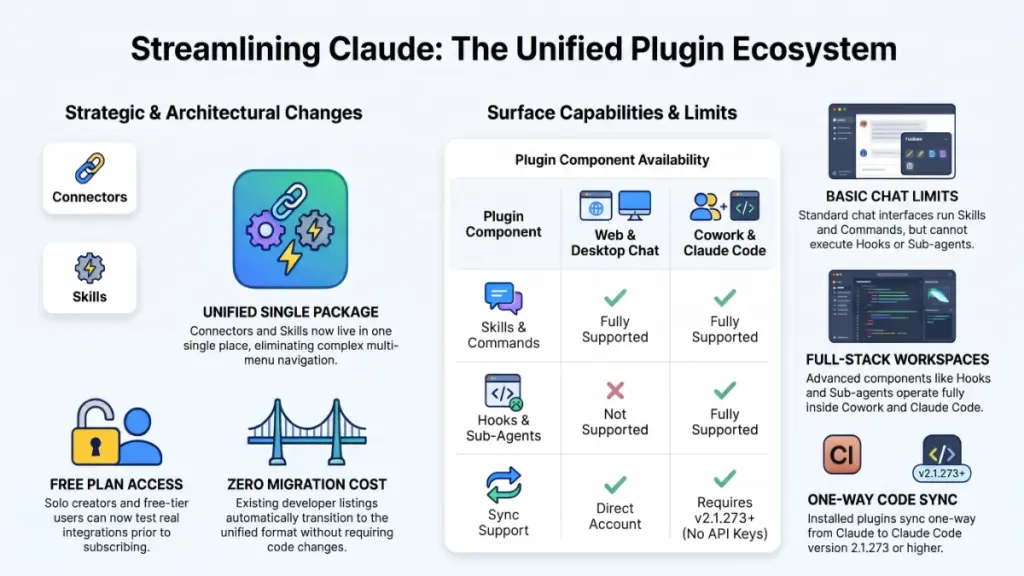
Anthropic has merged Claude’s connectors and skills into a unified plugin system and opened access to Free-plan users alongside Pro, Max, and Ultra subscribers (Team and Enterprise remain “coming soon”). While the update adds no new AI capabilities, it streamlines extension discovery across Claude and Claude Code though hooks and sub-agents still only run in Cowork and Claude Code, not standard chat.
Lead and Significance
Anthropic has merged two of Claude’s building blocks into one. Connectors and skills now arrive together as plugins. The company announced the change on X at 20:56 UTC on November 23, 2026. Its post said there is now “one way to connect your tools to Claude, teach it a new skill, or do both.”
The second headline matters just as much. Anthropic said plugins are live on the Free, Pro, Max, and Ultra plans. Team and Enterprise are “coming soon.” Until now, Anthropic’s help page limited plugins to paid plans. As a result, Free users never had them.
Here’s what I’ve found after reading the announcement, the September developer post, and the help documentation. The change is real, but it is smaller and more specific than the buzz suggests. Anthropic did not release a new model. Likewise, it did not add a new capability to chat. Instead, it reorganized how people find and install extensions, and it widened who can use them.
Why discovery matters
Even so, that counts as news. In fact, discovery is the bottleneck for most extension ecosystems. First, users do not install what they cannot find. Likewise, developers do not build for users they cannot reach. Therefore, a single entry point fixes both problems at once.
Anthropic also says there are 10,000+ plugins to browse. However, I did not verify that count. Specifically, it comes from Anthropic’s messaging and from a third-party write-up of it. So treat it as a claim, not a measurement.
This article covers what changed, what stayed the same, and where Anthropic’s own pages disagree. It also explains what the change means for marketers, solo creators, and small teams. A note on sourcing: I built the factual core from Anthropic’s X post, its September 25, 2026 developer announcement, its Help Center page on plugins, and a November 23 summary published by CellCog. I flag every place where I interpret rather than report.
Strategic Context and Why It Matters
Start with the problem Anthropic is solving. Before this change, Claude had separate concepts. For example, connectors linked Claude to outside tools and data. Meanwhile, skills taught Claude how to do a specific kind of work. Finally, plugins bundled these pieces for people who wanted more. As a result, each piece lived in its own corner of the product.
Admittedly, that structure made sense to the people who built it. However, it confused almost everyone else. For instance, a marketer who wants Claude to pull data from a tool and then write a report in a house style needs both pieces. Under the old model, that person hunted through different menus and different directory sections.
The new model removes that split. A plugin can hold a connector, a skill, or both. Now, users browse one place. Then they add one thing. Likewise, developers publish one kind of package.
Who benefits
Free-plan users gain the most visible upgrade. In effect, they get access to an extension system that was previously a paid feature. For a solo creator testing Claude before paying, that matters. Specifically, they can try real integrations before they commit money.
Developers also win. Anthropic told them in September that the plugin format is “the main way to build third-party extensions for Claude.” It also told them that existing listings need no changes. If you already published a skill, connector, or plugin in the Claude directory, the merge costs you nothing. In short, the larger audience arrives without extra work.
Paid users get a cleaner path. Meanwhile, Pro, Max, and Ultra subscribers already had plugins. In other words, they now get one way in instead of several. That is a modest gain, but daily friction adds up.
Who waits
Team and Enterprise customers wait. Anthropic’s post marks them “coming soon” and gives no date. This detail confuses people, so let me be precise. Anthropic’s help page already lists Team and Enterprise among the plans that have plugins. CellCog reads the “coming soon” label as applying to the unified experience, not to plugins themselves. Of course, that reading is an interpretation, and Anthropic has not confirmed it. I think it is the most sensible one, but I would not plan a rollout around it.
Workflows that change
Three workflows shift in practice.
Tool onboarding. For example, a team can now evaluate an integration on a Free account. As a result, the cost of a trial drops to zero.
Skill sharing. Marketers who write repeatable instructions, like a brand voice guide or a reporting template, can package them the same way developers package code.
Cross-product consistency. Anthropic said in September that one discovery experience would roll out across Claude and Claude Code. Consequently, users who work in both products see the same catalog.
Overall, none of this makes Claude smarter. Instead, it makes Claude easier to extend. For most business users, that is the more useful improvement.
Deep-Dive Technical Specifications
This is not a model release, so the usual specifications do not apply. There are no parameter counts, context windows, or new modalities to report. Therefore, I will not invent them. Instead, what exists is a packaging and compatibility story. The details come from Anthropic’s help page as summarized by CellCog.
What a plugin contains
A plugin is a package. It can bundle several component types:
- Skills. Reusable instructions for a specific kind of work.
- Connectors. Links between Claude and outside tools or data sources.
- Commands. Shortcuts that trigger specific behavior.
- Hooks. Automated actions tied to events.
- Sub-agents. Specialized helpers that handle delegated tasks.
However, not every component runs everywhere. That is the most important technical detail in this announcement.
What runs where
Anthropic’s help page splits behavior by surface.
In chat on the web and in the desktop Chat tab, skills and commands work. However, hooks and sub-agents do not run there. Anthropic states it plainly: hooks and sub-agents run in Cowork and Claude Code, not in chat.
By contrast, in Cowork and Claude Code, the full set runs. Skills, commands, hooks, and sub-agents all work.
This split has a practical consequence. For example, a plugin built around sub-agents will do little in a plain chat window. As a result, users who install it on a Free account and use only chat may see a fraction of its value. Therefore, developers should state clearly which surfaces their plugin supports. Likewise, users should check before they assume.
Sync with Claude Code
Plugins you add in Claude sync to Claude Code. Specifically, the requirement is version 2.1.273 or later. Also, you must sign in with the same account. Anthropic describes the sync as one-way. In other words, changes flow from Claude to Claude Code, not the reverse.
Moreover, the sync does not work when Claude Code runs on an API key or through a cloud provider. Notably, this limit matters for enterprise developers. In fact, many large organizations route Claude Code through a cloud provider for billing and compliance reasons. As a result, those teams will not get the sync and must manage plugins another way.
Directory and developer requirements
On September 25, 2026, Anthropic opened a submission portal for plugins. It promised that “over the coming weeks, one discovery experience will roll out across Claude and Claude Code.” Finally, November 23 marks that rollout reaching users.
The developer-facing guarantee is simple. Existing skills, connectors, and plugins need no changes. In effect, this is a compatibility promise, and it removes a major source of risk for anyone who already built something.
Unfortunately, I could not find any technical documentation of limits on the Free plan. For example, the post does not say whether Free users get every plugin. Likewise, it does not say whether usage caps differ. Those gaps matter, and I cover them in the caveats section below.
Performance, Benchmarks and Evidence
No benchmarks exist for this change, because it is not a performance release. I will say that directly instead of padding the section with unrelated numbers. What I can offer is an evidence review: what Anthropic documented, what third parties confirmed, and what remains unverified.
Verified by primary sources
Anthropic’s own X post confirms the core facts. The post names the one-way-in framing and lists the plans with access. In addition, it marks Team and Enterprise as coming soon. Notably, the post drew roughly 245,000 views about two hours after publication, according to CellCog’s check. However, that number shows attention, not adoption.
In September, Anthropic’s post confirmed the strategic direction. First, it described plugins as the main extension format. Second, it promised one discovery experience. Third, it told developers that no action is required.
Finally, Anthropic’s help page confirms the technical behavior. It documents the per-surface split and the Claude Code sync requirements.
A documented disagreement
Here is the one place Anthropic’s pages conflict. The help page, last updated in October, says plugins are available to all paid plans: Pro, Max, Ultra, Team, and Enterprise. However, the November 23 post adds Free to the list. Because the post is newer, I treat it as the current state. But the help page still carries the older wording, and Anthropic has not publicly explained the gap.
This kind of lag is common. In fact, documentation trails announcements by days or weeks. Still, I would expect the help page to update soon. Until it does, a reader who checks only the help page will reach the wrong conclusion about Free access.
What the evidence cannot tell us
Three gaps stand out.
First, the 10,000+ plugin count. It is Anthropic’s number. The CellCog summary says its authors did not open the plugin directory to confirm it. I did not either. Moreover, directory counts often include many near-duplicate or low-use entries. Therefore, a large number does not mean a large number of useful plugins.
Second, Free-plan limits. Neither the post nor the summary says whether Free users get full access or reduced usage.
Third, the Team and Enterprise date. No one has given one.
How I would test it
Here is how I would evaluate this on a real account. First, I would create a fresh Free account and open the plugin directory. Next, I would install three plugins: one skill-only, one connector-only, and one that bundles both. Then I would run the same task on each. After that, I would record setup time, errors, and any usage warnings. Finally, I would repeat the test on a paid plan to see what differs.
Ultimately, that test would turn Anthropic’s claims into evidence. I have not run it yet, and I will not pretend otherwise. If you run it first, compare notes with your team before you commit to a workflow.
Pricing, Licensing and Availability
Anthropic did not announce a price for plugins. Instead, the announcement is about access, not cost. Here is what the sources establish.
Plan availability
| Plan | Plugin status per Anthropic’s November 23 post |
|---|---|
| Free | Live |
| Pro | Live |
| Max | Live |
| Ultra | Live |
| Team | Coming soon |
| Enterprise | Coming soon |
The help page, last updated in October, lists Pro, Max, Ultra, Team, and Enterprise. In contrast, Free is the new addition.
What the plugins cost
The sources do not state a separate fee for using plugins. However, individual plugins come from third-party developers, and those developers may charge for their own services. For example, a connector to a paid tool still requires an account with that tool. So check each listing before you assume it is free.
Licensing and open-weight terms
Nothing in this announcement involves open-weight models or model licensing. Rather, plugins extend Claude. They do not release Claude’s weights. Developers who publish plugins should read Anthropic’s directory terms, which I did not review for this article.
API availability
The sources do not describe an API change. In fact, the sync to Claude Code does not work when Claude Code runs on an API key. Therefore, that detail suggests the account-based experience and the API-based experience stay separate for now.
Limited Time Free Access
⚡ Limited Time Free Access
Unleash Your Digital Empire: Get 4 Premium Gifts in 1 Pack!
Grab this exclusive, high-value digital asset package tailored for creators, marketers, and builders. Enter your best email to claim instant access.
What’s inside your ultimate all-in-one package:
- 50 AI Digital Product Ideas. A curated list of profitable, AI-driven digital product ideas engineered for fast execution and high margins.
- Digital Sales Mastery. The strategic architecture behind high-converting sales funnels, persuasive copywriting, and online revenue growth.
- Mastering Email List. Advanced frameworks for building an engaged audience, maximizing open rates, and generating automated income.
- THE ULTIMATE FACELESS PLAYBOOK. Complete blueprint to building a powerful, monetizable brand on social media without showing your face.
Included bonus: Premium Canva Marketing Vault: high-converting templates to scale your organic traffic.
💥 $197 VALUE — FREE FOR READERS
🛡️ Secure Processing • Your privacy is 100% protected.
Industry Implications and Competitive Analysis
This move reshapes competition in AI assistants. However, it does not settle it. Let me explain what I can support and what I am inferring.
The platform play
Anthropic is building an ecosystem, and ecosystems depend on third-party developers. Calling plugins “the main way” to extend Claude sends a clear signal. Therefore, developers should build here. In addition, merging connectors and skills simplifies that message. Finally, opening the system to the Free plan grows the audience those developers can reach.
That is a classic platform strategy. First, a bigger user base attracts more builders. In turn, more builders attract more users. Clearly, Anthropic is trying to start that loop.
How rivals compare
I cannot give you a verified feature-by-feature comparison with competing assistants. The sources I used do not cover them, and I have not tested every rival’s extension system for this article. What I can say is that extension ecosystems now matter across the market. In fact, every major AI assistant offers some way to connect tools or customize behavior. Instead, the differences lie in discovery, quality control, and how much power extensions get.
Anthropic’s differentiators appear to be three things. First, the unified package format. Second, the cross-surface reach into Claude Code and Cowork. Third, a skills standard that other platforms may adopt. CellCog’s related coverage notes that Anthropic donated Agent Skills, the SKILL.md standard used by 70+ agent platforms, to the Agentic AI Foundation. However, I did not verify that claim independently. If it holds, skills written for Claude could travel to other platforms. Consequently, that portability would reduce lock-in and increase the value of writing a skill.
Effects on marketing and small business teams
Here is what this means in practice for the readers I work with most.
Solo creators can now test integrations at no cost. As a result, the buying decision changes. You can find out whether a plugin helps before you upgrade.
Agencies can package repeatable work. For example, a skill that encodes your client reporting format becomes an asset you can reuse across accounts.
Small businesses gain a cheaper way to add automation. But they also take on a risk. Specifically, each connector grants Claude access to a business tool. Therefore, your team should decide who approves new plugins.
Third-party vendors
Vendors like CellCog now compete for attention inside a bigger directory. CellCog publishes its own plugin in the Claude directory, and its summary discloses that conflict openly. Overall, that disclosure is the right practice. Accordingly, I recommend you read any vendor-authored coverage with that in mind, including the source I relied on here. CellCog also states it had no part in this change and received no advance notice.
Competitive risk for Anthropic
A large directory creates a quality problem. Inevitably, ten thousand plugins will include weak, abandoned, and possibly unsafe ones. Therefore, Anthropic must police that catalog. Otherwise, users who install a bad plugin will blame Claude, not the developer. The company has opened a submission portal, but I found no public detail on review standards. Still, that gap is worth watching.
Limitations, Caveats and Skepticism
Look, I’ll be straight with you. This is a good change, but several parts deserve skepticism.
Unverified claims
The 10,000+ plugin figure is unverified. In general, raw counts flatter ecosystems. Instead, I would rather know how many plugins have active users and recent updates. Unfortunately, Anthropic has not shared that.
The Free-plan scope is unclear. Anthropic’s post says plugins are live on Free. However, it does not say whether Free users face tighter limits. So do not assume parity with paid plans.
Surface limits
Hooks and sub-agents do not run in chat. As a result, a user on a Free plan who stays in chat may find that some plugins do far less than their listings suggest. Therefore, read each plugin’s description for supported surfaces.
Security and privacy risk
Every connector opens a path between Claude and your data. Before you install one, ask what data it can read and what actions it can take. Next, ask who maintains it. Finally, ask whether your company policy allows it. Moreover, these questions matter more on a Free account, where users often skip them.
Skills carry a quieter risk. A skill shapes how Claude behaves. Therefore, a malicious or sloppy skill could steer outputs in subtle ways. So review any skill before you trust it with client work.
Documentation lag
Anthropic’s help page still states the older plan list. Meanwhile, expect confusion in the near term. For instance, your team may read the documentation and conclude Free users lack access. Instead, point them to the post and test it directly.
Sync limits
The one-way sync and the API-key exclusion mean developers cannot treat Claude and Claude Code as a single managed environment. As a result, enterprise teams on cloud providers will need a separate process.
Source limits
I relied on secondary reporting for some details. CellCog’s summary quotes Anthropic’s pages, but I did not independently open every page. I also did not browse the plugin directory. Therefore, treat the specifics in this article as accurate to my sources, not as an audit.
Future Outlook and Conclusion
Anthropic merged connectors and skills into plugins and opened the system to Free users. That is the whole story, and it is a meaningful one. First, it lowers the barrier to extending Claude. Second, it simplifies the developer pitch. Third, it aligns Claude, Cowork, and Claude Code under a single catalog.
What to watch next
Watch five things over the coming weeks.
- The Team and Enterprise date. Anthropic has promised it but not scheduled it.
- Free-plan limits. Any usage caps or restricted plugins will shape real adoption.
- Help page updates. The documentation should catch up with the post.
- Directory quality. Look for review standards, removal of abandoned plugins, and clearer metadata.
- Skills portability. If other platforms adopt the SKILL.md standard, the value of a well-written skill grows.
What I would do this week
If you run a marketing team, pick one repeatable task. Then package it as a skill. Next, test it on a Free account and a paid account. Afterward, record what differs. Last, share the results with your team.
Meanwhile, if you build tools, confirm your listing still works and review how it appears in the unified directory. Anthropic says you need no changes, but a quick check costs little.
Finally, if you are a solo creator, try two or three plugins before you upgrade anything. After all, free access exists to let you do that.
The broader lesson is one I keep relearning. Indeed, packaging decisions shape adoption as much as features do. Anthropic did not build a new capability here. Instead, it made existing capabilities easier to find and easier to use. For most people, that is what turns a feature into a habit.
Nobody really knows how large this ecosystem will grow. The 10,000+ figure is a starting claim, not a result. So check back in a few months. Next, count the plugins people actually use. Finally, decide how much of your workflow belongs in them.
Sources
- Claude on X, 20:56 UTC, November 23, 2026
- Build plugins for Claude, Anthropic, September 25, 2026
- Use plugins in Claude, Anthropic Help Center
- Claude Plugins: Connectors and Skills Merge, Free Plan Too, CellCog, November 23, 2026 (vendor-authored; CellCog publishes a plugin in the Claude directory)