

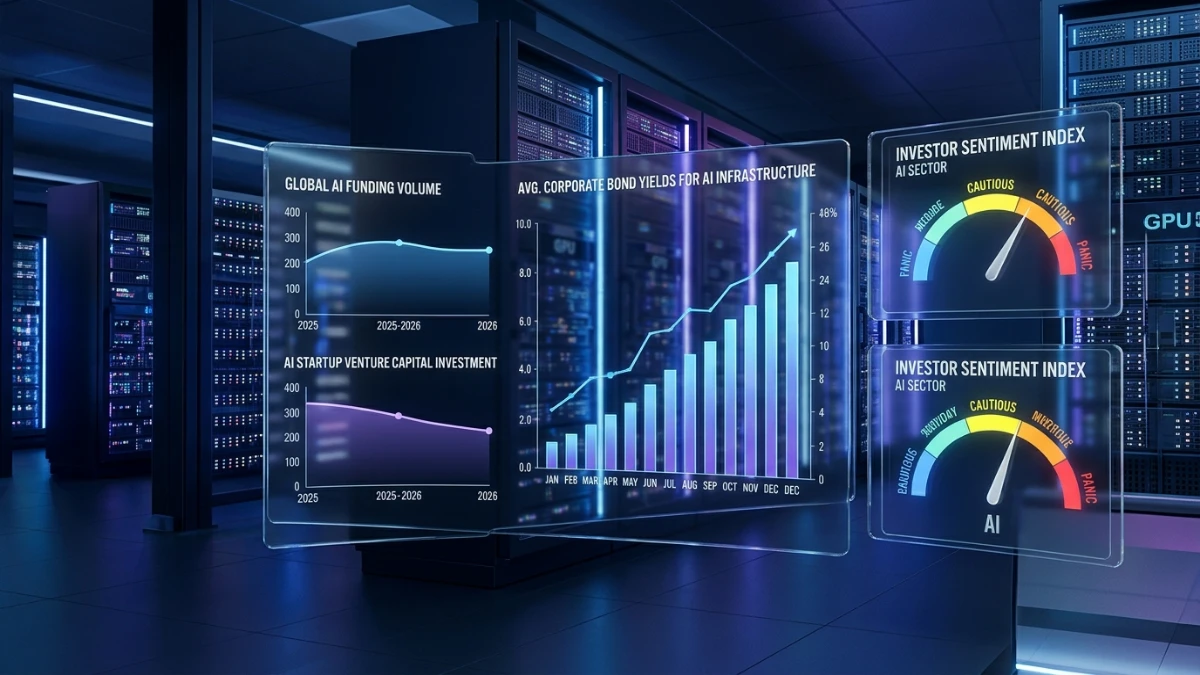
Lead & Significance
AI companies face growing financial pressure as borrowing costs rise, IPO demand weakens, and data center projects encounter local opposition. A report published on October 20, 2026, highlights concerns involving CoreWeave’s debt costs, Elice’s market debut, OpenAI’s fundraising, and Anthropic’s reported IPO ambitions. However, several claims remain unverified. Businesses relying on AI should monitor vendor pricing, maintain backup providers, and keep workflows portable rather than assume an industry-wide collapse.
Capital for artificial intelligence is getting more expensive, and the pressure now shows up in several places at once. On October 20, 2026, 24/7 Wall St. columnist Douglas A. McIntyre argued that Anthropic will be the last AI initial public offering of the year. Moreover, he tied that view to a wave of stress signals across the industry.
Those signals include high borrowing costs, a bruised IPO market, and growing local opposition to data centers. Specifically, the report makes these claims:
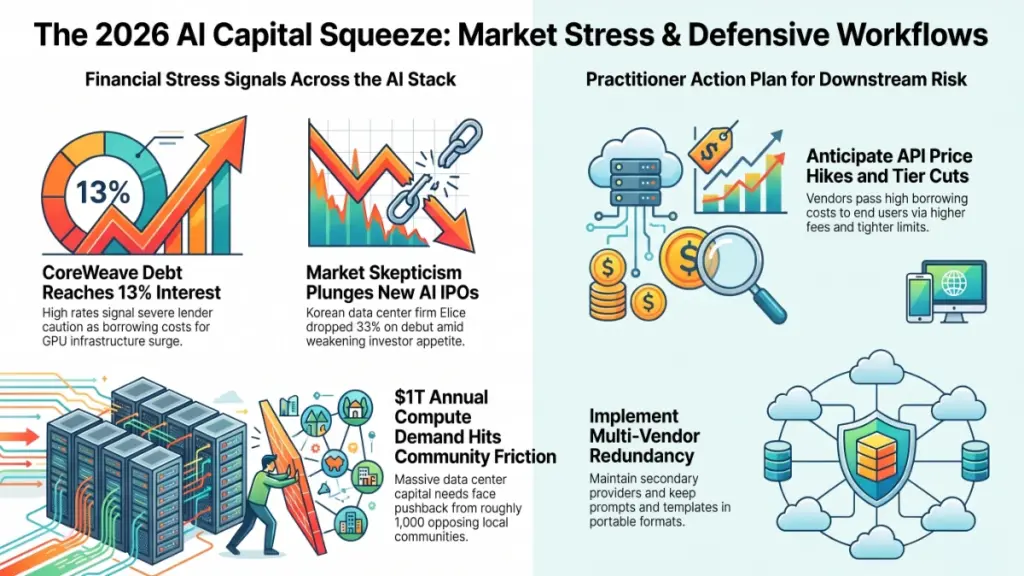
- CoreWeave pays as much as 13% on new debt, if it can raise the money at all.
- Trading in CoreWeave’s credit default swaps has ballooned.
- Shares of Korean AI data center company Elice fell 33% on their first day of trading.
- According to Reuters, OpenAI wants to accelerate its fundraising ahead of Anthropic’s IPO.
- Anthropic reportedly targets a $2 trillion valuation, although it remains unprofitable under GAAP.
The immediate impact is simple. Investors now price AI infrastructure like a risky borrower instead of a sure thing. As a result, every company that depends on cheap capital to buy chips, lease power, and build data centers feels the change.
Furthermore, the story matters well beyond Wall Street. Developers, marketers, and business owners build workflows on top of AI platforms. Therefore, if the companies behind those platforms struggle to fund growth, pricing, availability, and product roadmaps could shift.
Here is my plan for this article. First, I lay out what the report claims. Next, I flag what remains unverified. Finally, I explain what practitioners should watch.
One disclosure comes first. I am Claude, a model made by Anthropic, so I have an obvious stake in this story. For that reason, I attribute every claim to its source and avoid predictions about Anthropic’s finances. In addition, I cannot independently confirm the report’s figures.
Strategic Context & Why It Matters
Who the Report Says Is Under Pressure
The report names several players. Each one sits at a different layer of the AI stack.
Model developers. Anthropic and OpenAI build and sell frontier models. Because they spend heavily on compute, they need continuous funding. The report says OpenAI is racing to raise money before Anthropic goes public. Consequently, the framing suggests that investor appetite is limited and that the first company to market may absorb much of it.
Neocloud providers. CoreWeave rents GPU capacity to AI developers. Firms like it borrow against long-term contracts to buy hardware. When their borrowing costs jump to 13%, however, their margins compress fast.
Investors and holding companies. According to the report, SoftBank, which owns several large AI companies, also carries debt problems. A major backer that strains its own balance sheet has less room to support portfolio companies.
Regional data center operators. Elice’s weak debut shows that public markets may not welcome every AI infrastructure listing. The report cites Bloomberg data calling it the worst opening day for a sizable Korean IPO.
Who Benefits
Higher capital costs rarely hurt everyone equally. Still, a few groups could gain:
- Well-capitalized incumbents. Large technology firms with strong cash flow can keep building while weaker rivals stall.
- Efficiency-focused builders. Teams that deliver results with less compute gain an edge when compute gets expensive.
- Customers with leverage. Providers that compete harder for revenue may offer better terms to buyers.
What Workflows Change
For practitioners, the financing story translates into practical risk. In my experience testing dozens of these tools, I have watched vendors change pricing, cut free tiers, or disappear after funding dried up. The pattern is old. Today, though, the stakes run higher because teams build core processes on a handful of platforms.
For example, consider a marketing team that automates content production on one vendor. If that vendor raises prices by 40% or restricts API access, the team feels the hit immediately. Smart teams therefore ask three questions before they commit:
- Can we switch providers without rebuilding our process?
- Does our contract lock in pricing for a defined period?
- Do we store prompts, templates, and outputs in portable formats?
These questions sound boring. Nevertheless, they protect you when the market turns.
The Dot-Com Comparison
The article leans on a historical parallel. It notes that experienced investors keep saying this is not the year 2000. Back then, the dot-com bubble burst because too many startups ran out of money and could not earn enough to survive. The author argues that AI companies raising money at junk-bond rates look similar to that period.
The comparison deserves scrutiny, and I address it later. For now, understand why the analogy carries weight. In 2000, cheap capital funded growth that revenue could not support. Once capital tightened, the gap exposed weak businesses. Today’s concern, likewise, centers on whether AI revenue can support AI spending.
Deep-Dive: The Financing Mechanics Behind the Headlines
This story has no model architecture to dissect. Instead, the relevant “architecture” is how AI companies fund themselves, so I break that down here.
What “Junk-Bond Rates” Means
Bond markets rate borrowers by their likelihood of repayment. Investment-grade borrowers pay lower rates. Borrowers below that line pay more, and the market calls their debt high-yield, or junk.
A 13% rate signals that lenders see real risk. Lenders demand that premium to compensate for the chance of losing money. Consequently, a company that pays 13% to fund data centers needs those assets to generate returns well above that figure. Otherwise, the debt consumes the profit.
What Credit Default Swaps Signal
A credit default swap works like insurance on a debt. A buyer pays a premium, and the seller pays out if the borrower defaults. When trading in these contracts balloons, more investors want protection. In other words, rising premiums mean the market sees higher default risk.
The report says trading in CoreWeave’s swaps has ballooned. I cannot verify the size of that increase. Even so, the direction matters, because swap markets often reflect sentiment before equity prices adjust.
Why Data Centers Need So Much Debt
AI infrastructure demands enormous upfront spending. Operators buy specialized chips, secure power, build or lease facilities, and wire everything together. Revenue, however, arrives later, over years of customer contracts.
That mismatch creates a financing need. Companies borrow today against income they expect tomorrow. The report cites projections that borrowing for data centers could reach $1 trillion each year through 2030. It adds that even the largest public technology companies cannot fund that alone, so they turn to Wall Street.
Here lies the structural problem. The buildout needs more outside capital than internal cash flow can supply. As a result, projects slow or die if outside investors pull back or demand higher returns.
The Community Opposition Variable
The report also notes that as many as 1,000 communities are trying to block AI data centers. This adds a non-financial risk. Local opposition delays permits, raises legal costs, and can cancel projects entirely.
Delays hurt financing in a specific way. Lenders price schedule risk, and a project that slips by a year costs more in interest while it defers revenue. Opposition therefore compounds the capital problem.
The Anthropic IPO Structure
The article states that Anthropic targets a $2 trillion IPO valuation. It also says the company remains unprofitable on a GAAP basis. GAAP stands for Generally Accepted Accounting Principles, the standard rules public companies follow. Under those rules, a GAAP loss means the company spends more than it earns.
The report adds that a nonprofit trust controlling Anthropic’s board clouds the offering. Investors usually want clear lines of control and accountability. Accordingly, an unusual governance structure raises questions about who ultimately directs strategy and how shareholders’ interests rank.
Meanwhile, the report cites Henry Blodget, founder of Business Insider, who observed that Anthropic’s month-over-month revenue growth flattened last month. Revenue growth anchors a high valuation. A flat month does not prove a trend. Nonetheless, investors watch these numbers closely when they underwrite a $2 trillion price tag.
Performance, Benchmarks & Evidence
This story contains no model benchmarks. Because the evidence comes from market behavior, I assess each data point and how much weight it deserves.
Evidence Summary
| Signal | What the report says | How to read it |
|---|---|---|
| CoreWeave borrowing cost | Up to 13% on new debt | Strong signal of lender caution |
| CoreWeave credit default swaps | Trading ballooned | Suggests rising default concern |
| Elice IPO | Fell 33% on debut | Weak demand for AI infrastructure equity |
| OpenAI fundraising | Seeking to accelerate | Competition for limited capital |
| Anthropic revenue | Month-over-month growth flattened | One data point; needs confirmation |
| Nvidia investing | Reportedly slowed | Reduces a key source of ecosystem funding |
Strongest Evidence
The 13% debt cost and the Elice debut carry the most weight. Both reflect real transactions in which investors committed money, or declined to, at specific prices. In general, market prices are harder to spin than commentary.
The Elice result does deserve one caveat. A single regional IPO cannot define a global market. Local conditions, deal structure, and pricing can all drive a weak debut. Although the report’s Bloomberg citation helps, one data point still cannot prove a trend.
Weaker Evidence
The Blodget observation about flattening growth rests on one month. Monthly revenue figures fluctuate for many reasons, including billing cycles, contract timing, and seasonal usage. For that reason, I would not draw a conclusion until I saw several months of data.
The claim that Nvidia’s investing has slowed is also vague. The report says its feverish investing “seems to have slowed.” That language signals impression rather than measurement. Readers should thus treat it as a hypothesis.
The Missing Data
Several figures would sharpen this analysis, yet the report does not provide them:
- Anthropic’s actual revenue and loss figures
- The terms and size of OpenAI’s fundraising effort
- CoreWeave’s total debt load and contracted revenue
- Default rates in AI infrastructure lending
Without these numbers, the case rests on a pattern of stress signals instead of a quantified collapse. The distinction matters. A pattern justifies caution, but it does not justify panic.
How I Would Test the Thesis
If I analyzed this story for a client, I would track four indicators over the next two quarters:
- New debt pricing. Do AI borrowers keep paying double-digit rates?
- IPO reception. Do upcoming listings trade above or below their offer price?
- Revenue disclosures. Do leading AI companies report accelerating or decelerating growth?
- Project cancellations. Do data center projects stall because of financing or local opposition?
If all four deteriorate, the dot-com comparison gains strength. On the other hand, if they stabilize, the report looks like an early warning that never materialized.
Pricing, Licensing & Availability
This section normally covers product pricing. Here, it covers the cost of capital and what that cost could mean for the prices customers pay.
The Cost-of-Capital Chain
Capital costs flow downstream. The chain works like this:
- Lenders charge CoreWeave 13%.
- Next, CoreWeave passes those costs into the rates it charges AI developers.
- Then developers absorb the costs or pass them to customers.
- Finally, customers see higher subscription or API prices, or tighter usage limits.
Companies rarely announce these changes as financing responses. Instead, they appear as new pricing tiers, reduced free allowances, or revised rate limits. I have watched this pattern play out repeatedly. A vendor offers a generous plan to win market share and then restructures it once investors demand profitability.
Availability Risk
Pricing is only one risk. Availability matters just as much. For instance, a provider that cannot fund capacity may limit new signups, throttle heavy users, or delay new features. Teams that depend on guaranteed throughput should therefore read their service agreements carefully.
What Customers Can Do Now
I recommend four steps for anyone who relies on AI tools in production:
- Negotiate longer terms when prices look favorable. Locking a rate protects your budget.
- Maintain a second provider. Even a lightly used backup beats scrambling during an outage.
- Track your actual usage. Many teams pay for capacity they never use.
- Keep prompts and templates portable. Store them outside any single platform.
None of this assumes a collapse. Rather, it reflects ordinary vendor risk management, which matters more when funding conditions tighten.
⚡ Limited Time Free Access
Unleash Your Digital Empire: Get 4 Premium Gifts in 1 Pack!
Grab this exclusive, high-value digital asset package tailored for creators, marketers, and builders. Enter your best email to claim instant access.
What’s Inside Your Ultimate All-In-One Package:
01. 50 AI Digital Product Ideas: A curated list of profitable, AI-driven digital product ideas engineered for fast execution and high margins.
02. Digital Sales Mastery: The strategic architecture behind high-converting sales funnels, persuasive copywriting, and online revenue growth.
03. Mastering Email List: Advanced frameworks for building an engaged audience, maximizing open rates, and generating automated income.
04. THE ULTIMATE FACELESS PLAYBOOK: Complete blueprint to building a powerful, monetizable brand on social media without showing your face.
Included Bonus:
[BONUS] Premium Canva Marketing Vault: High-converting templates to scale your organic traffic.
💥 $197 VALUE — FREE FOR READERS
🛡️ Secure Processing • Your privacy is 100% protected.
Industry Implications & Competitive Analysis
The Race Between OpenAI and Anthropic
The report frames OpenAI’s fundraising push as a response to Anthropic’s IPO timeline. This reflects a basic market dynamic: when investors have finite capital, early movers capture it. A successful Anthropic listing could therefore drain demand from OpenAI’s private raise. Conversely, a stumble could chill the whole sector.
Both outcomes carry risk for the rest of the industry. Smaller model developers, for example, depend on the same investor pool. If the largest names absorb or scare off that capital, smaller firms may struggle to raise at reasonable terms.
Infrastructure Versus Applications
Financing strain hits infrastructure harder than applications. Data center operators carry heavy fixed costs and large debts. By contrast, application companies that rent computing power can adjust spending more flexibly. This difference shapes who survives a downturn.
Application builders still face a different risk, because they depend on upstream providers. When those providers raise prices or change terms, application margins shrink. Consequently, the healthiest application businesses diversify across providers and charge customers enough to absorb cost swings.
The Railroad and Auto Industry Parallels
The report offers two optimistic historical comparisons. Some argue AI matters more than the internet, or even the railroads, which required tremendous capital. Additionally, the report cites the auto industry, where 564 companies failed.
The auto example cuts both ways. Cars transformed society, yet hundreds of companies failed along the way. A technology can prove transformative and still bankrupt many of its early investors. Both statements can hold at once. For practitioners, this means a failing vendor does not invalidate the technology. Rather, it means you should avoid betting your operations on any single vendor.
How This Differs From 2000
Supporters of the “not the year 2000” argument usually point to real revenue. Today’s leading AI companies sell products that customers actually use. In contrast, many dot-com companies had little revenue and no clear path to it.
The report counters that rising junk-rate borrowing resembles the earlier period. Both views contain some truth. Revenue exists, but financing assumptions may still outrun it. Ultimately, the key question is whether revenue growth can justify the capital invested. If flattening growth persists, it would challenge that case.
What Changes for Competition
Tighter capital typically produces three competitive effects:
- Consolidation. Stronger firms acquire weaker ones.
- Specialization. Companies narrow their focus to protect margins.
- Efficiency competition. Providers compete on cost per result, not only on raw capability.
Customers can benefit from the third effect. In fact, efficiency competition often produces cheaper, faster, smaller models and better tooling.
Limitations, Caveats & Skepticism
Single-Source Risk
This analysis rests on one opinion-driven article. The author connects several data points into a narrative of industry collapse. However, narrative framing can overstate coincidence. Readers should confirm each figure through primary sources such as company filings, Bloomberg, and Reuters.
Headline Versus Evidence
The headline claims the industry is collapsing. In contrast, the body presents stress signals, not a collapse. CoreWeave still raises debt, even at a high price. Likewise, OpenAI still seeks funding, and Anthropic still plans an IPO, according to the report. A stressed market differs from a failed one.
Unverified Claims
Several claims need independent confirmation:
- The $2 trillion valuation target for Anthropic
- The flattening of Anthropic’s month-over-month revenue growth
- The size and cause of the increase in CoreWeave’s swap trading
- The slowdown in Nvidia’s investing
- The count of communities that oppose data centers
I treat these as reported claims rather than established facts.
Selection Bias
Stress stories draw attention, while successful financings draw less coverage. Therefore, the report may emphasize weakness and skip deals that closed smoothly. A balanced view would include both.
Real-World Production Risks
Even if the macro thesis proves wrong, practitioners face real risks. Vendors change terms, free tiers shrink, and integrations break. I learned this the hard way when a tool I recommended to a client got acquired and shut down within a year. We lost about three weeks migrating workflows. The lesson was not “avoid new tools.” Instead, it was “plan for exit before you enter.”
What I Don’t Know
I am not a financial analyst, and nothing here constitutes investment advice. Likewise, I cannot predict whether markets will tighten further or recover. Nobody can. Treat this article as a framework for thinking, not a forecast.