

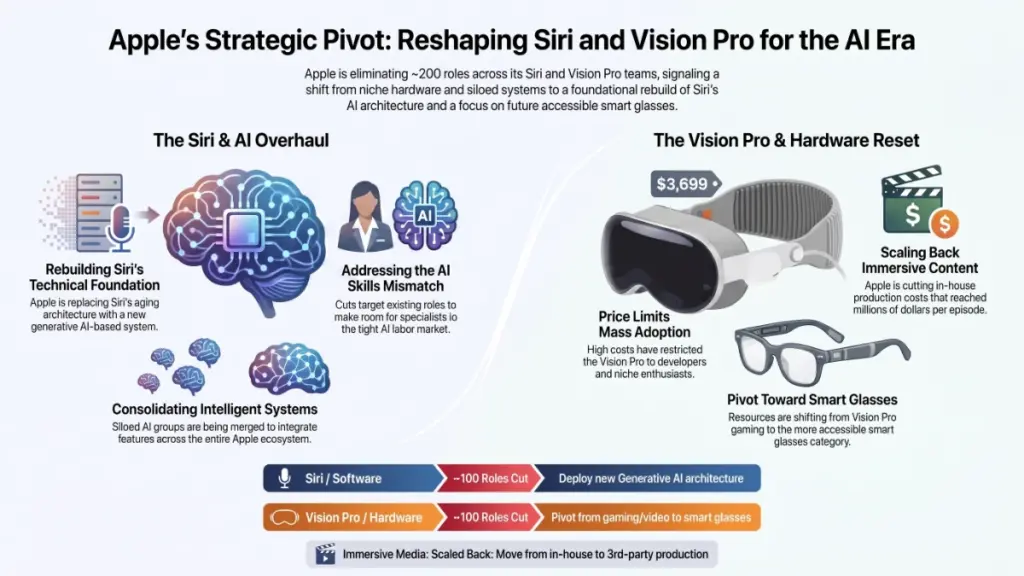
Apple has eliminated more than 200 positions across its Siri and Vision Pro organizations. The cuts tie directly to the company’s push to rebuild its voice assistant around a new AI architecture. Roughly 100 roles came from the Vision Pro unit. Another 100 came from Siri and related software teams, according to people familiar with the matter.
Apple has moved cautiously on generative AI compared to rivals. This restructuring signals a willingness to disrupt existing teams to get its AI strategy right. The changes touch both software (Siri, Intelligent Systems Experience) and hardware (Vision Pro gaming and immersive video). That spread suggests Apple is reallocating resources company-wide, not just trimming one underperforming unit.
Why It Matters
Apple has lagged behind Google, OpenAI, and Anthropic in shipping consumer-facing generative AI features. Siri’s overhaul has become one of its most closely watched, and most delayed, projects. Apple is cutting roles while building new ones around Siri at the same time. That combination points to a skills mismatch: the assistant’s new technical foundation apparently demands different expertise than the existing team could offer.
This matters for the broader AI talent market too. A company the size of Apple rarely restructures around a new model architecture without ripple effects. Competitors and startups often gain access to experienced engineers who no longer fit the new org chart. Apple, meanwhile, has to compete for AI specialists in that same tight labor pool.
What’s Changing at Siri
Apple is building a new version of Siri on a fresh technical architecture. That shift required different expertise than the existing team had, prompting the company to eliminate a limited number of roles while creating new ones to support the rebuilt assistant.
The cuts also hit Apple’s Intelligent Systems Experience team, a group within its software engineering organization that works on AI features across its devices. More product teams now build their own AI-powered functions independently. Apple appears to be consolidating that work under a more centralized structure rather than leaving it spread across separate groups.
Apple confirmed the changes in a public statement. The company said it was realigning teams to <cite index=”2-14″>”evolve our business to deliver the best experiences for our users.”</cite> It added that new roles are being created even as a limited number of existing positions get affected, and it framed the transition as one it plans to support internally.
Vision Pro: Gaming Team Shut Down, Immersive Video Scaled Back
Apple is largely shutting down the Vision Pro team that focused on gaming for the headset. The company is also shrinking the unit responsible for producing immersive video content. Employees learned the changes reflect a realignment based on actual customer usage patterns and a shift of resources toward future products.
The economics explain much of the decision. A single 3D immersive video for Vision Pro requires multiple crews of Apple employees and contractors. One episode of an immersive series can cost several million dollars to produce. Apple’s limited base of active Vision Pro users has made that spending harder to justify.
Apple isn’t exiting immersive video entirely. The company plans to keep producing a smaller slate in-house while pushing third-party studios to fill the gap. Vision Pro’s gaming support never gained meaningful traction among users, despite Apple maintaining a dedicated team for it. That weak adoption likely made gaming an easier target for cuts than content production.
Pricing and Product Context
Vision Pro launched in February 2024 at a starting price that has since settled at $3,699. Its cost and bulk have limited the device to a niche audience of developers, enthusiasts, and enterprise buyers rather than mainstream consumers. This pricing reality underpins Apple’s shift in priorities: the company now directs near-term hardware resources toward smart glasses, a category it views as more accessible, instead of expanding Vision Pro’s demanding features like advanced gaming or immersive video.
Apple has told staff that Vision Pro and visionOS aren’t being discontinued. Reports suggest the company is still considering a next-generation Vision Pro model, with a possible release as early as the end of 2028. That timeline remains unconfirmed and years out, so readers should treat it as a data point rather than a commitment.
Industry Implications
Developers building on visionOS should read the gaming team’s shutdown as a clear signal. Apple doesn’t currently see spatial gaming as a near-term growth area for the platform, and that stance may cool third-party investment in the category. Content studios, on the other hand, may find opportunity in Apple’s shift toward third-party production, provided the company backs it with meaningful licensing or funding terms.
The Siri rebuild remains the more consequential story for the AI industry. Apple has built its AI strategy around privacy and on-device processing, a clear point of differentiation from competitors that lean more heavily on cloud-based models. Whether the new architecture delivers a meaningfully more capable assistant, or simply helps Apple catch up to features rivals shipped years ago, remains an open question until the product actually launches.
Limitations and Open Questions
Apple hasn’t disclosed a launch timeline for the rebuilt Siri or technical specifications of the new architecture. The company also hasn’t confirmed exact figures beyond the roughly 200 roles affected. Its public statement didn’t name specific teams or directly confirm the Vision Pro gaming team’s closure; those details come from people familiar with the matter who weren’t authorized to speak publicly.
Independent confirmation of Siri’s new capabilities will only arrive once Apple ships the product. Until then, claims about what the “new technical architecture” enables reflect Apple’s own framing rather than outside testing or benchmarks.
What to Watch Next
Apple’s smart glasses roadmap deserves close attention in the near term, since the company appears to prioritize that category over expanding Vision Pro’s software ecosystem. On the AI side, the real test will come when the rebuilt Siri ships. At that point, observers can judge whether it closes the gap with assistants from Google, Amazon, and AI-native competitors, or whether Apple’s cautious, privacy-first approach continues to slow its rollout relative to the rest of the industry.
Restructurings like this one often follow a change in technical direction. The scale here stands out, though: cuts across both a flagship hardware line and Apple’s most-anticipated AI product suggest the company is treating 2026 as a reset year for both efforts, not just running an incremental update cycle.