

Meta released Muse Glimmer today. It’s a 30-billion-parameter model built for local agent workflows, and it runs on a single consumer GPU. Meta licensed it under Apache 2.0. I’ve spent enough late nights fighting API rate limits and cloud inference bills to know why this release matters: it’s not another benchmark-chasing model. It’s a bet that the next wave of “always-on” agents — the ones handling function calls, local coding tasks, and evaluation jobs in the background — needs to live on the device, not in someone else’s data center.
Why It Matters
Developers building AI agents have faced a tough choice. They either accept the latency and cost of hitting a hosted API constantly, or they run a smaller, weaker local model and take the quality hit. Muse Glimmer tries to close that gap. Meta compressed a genuinely capable model down to something that fits on a MacBook or a gaming PC.
That matters most for teams building agents that need to run continuously. Think local coding assistants, screenshot-reading automation, or LLM-as-a-judge evaluation loops. Sending every request to a remote API is often too slow, too expensive, or simply not an option for privacy reasons. If Muse Glimmer performs as advertised, it lowers the barrier to running that kind of workload entirely offline.
Technical Details
Meta distilled Muse Glimmer from Muse Spark, the larger model that Meta Superintelligence Labs introduced in April. The training pipeline had three stages. First, logit distillation from the larger model’s outputs. Second, a mid-training phase focused on longer context and agentic data. Third, a final round of supervised fine-tuning plus reinforcement learning.
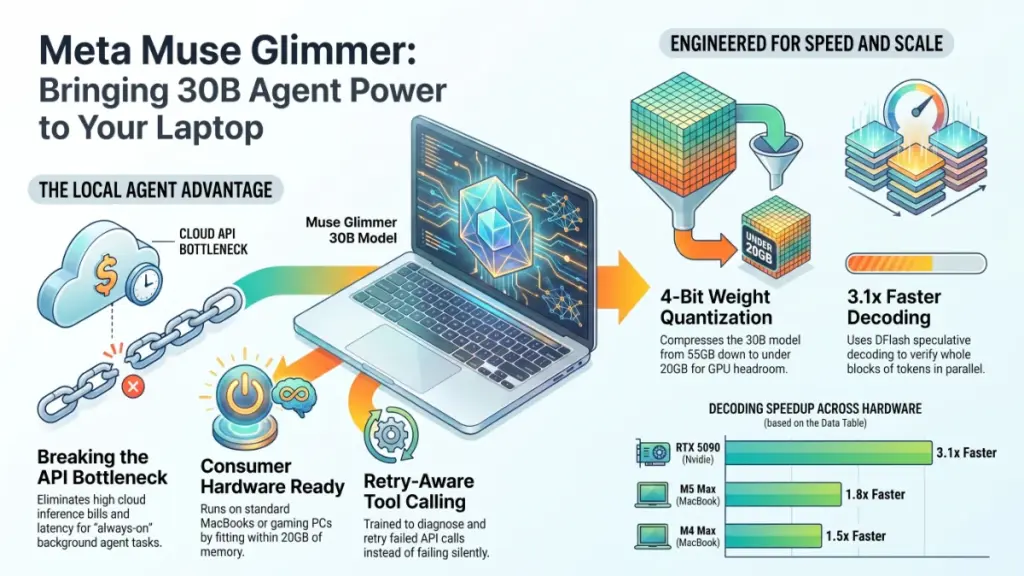
A 30B-parameter model at full 16-bit precision needs more than 55GB of memory. No consumer GPU offers that much. So Meta quantized the weights to roughly 4-bit precision, and this brought the language model itself under 20GB. That leaves headroom within a 24GB or 32GB card for the KV cache, an image-perception encoder, and a speculative-decoding “drafter” component.
Meta calls that drafter DFlash. It proposes whole blocks of tokens at once, and the main model verifies them in parallel, rather than generating one token at a time. It’s the kind of architectural detail that sounds abstract until you look at the throughput numbers.
Performance & Evidence
Meta reports big speed gains from the DFlash drafter. Decoding runs 3.1x faster on an RTX 5090, 1.8x faster on a MacBook with an M5 Max chip, and 1.5x faster on an M4 Max. These are Meta’s own figures. That’s worth noting, because decoding speedups measured in a controlled test don’t always hold up. Real agent workloads bring longer contexts, messier tool calls, and multiple concurrent tasks.
The model also supports adjustable reasoning strength. Meta trained it on data spanning more than a hundred languages. One detail stands out: Meta trained the model to diagnose and retry failed tool calls instead of simply stopping. That sounds small, but it matters a lot in practice if you’ve ever watched an agent silently die on a malformed API response.
Independent benchmarks against comparably sized local models haven’t surfaced yet. Developers still need to run it against their own agent workloads. Until then, treat Meta’s numbers as a starting point, not a verdict.
Pricing & Availability
Muse Glimmer is available now on Hugging Face. Meta released it under an Apache 2.0 license. That means it’s free to download, modify, and deploy commercially, without the licensing friction that comes with more restrictive open-weight releases.
Optimized builds for llama.cpp, MLX, and ExecuTorch should arrive in the coming days. Meta lists Ollama, LM Studio, Unsloth, Together AI, Fireworks AI, and OpenRouter as supported partners. Teams that need to scale inference beyond a single device can turn to vLLM and SGLang, per Meta’s recommendation.
Meta also says it’s working with AMD, Arm, Dell, Intel, and Nvidia on hardware-specific optimizations. That suggests Meta wants this model — and the local-agent category more broadly — to run well across a wide range of consumer and edge hardware, not just its own preferred stack.
Industry Implications
This release fits a broader pattern. Meta keeps releasing open-weight models that push more inference workload off centralized APIs and onto local hardware. That’s a meaningful shift for developers and smaller teams. Agentic workflows that used to be gated by API costs or connectivity requirements now become viable on a single workstation.
Enterprise users with data-residency or offline requirements may find a capable local agent model more useful than a marginally smarter hosted one. The broader open-source ecosystem benefits too: a permissively licensed 30B model with agent-specific training data adds real competitive pressure on proprietary API providers and other open-weight releases like Gemma.
Still, “runs locally” doesn’t automatically mean “cheaper” or “better” for every use case. Teams still need to weigh hardware costs, maintenance overhead, and update cycles against the convenience of a hosted API.
Limitations & Open Questions
A few things remain unverified. Meta’s speedup and quality figures come from its own testing under its Advanced AI Scaling Framework, not from a third party. Nobody outside Meta has confirmed how the model performs on messier, real-world agentic tasks — flaky tool APIs, ambiguous instructions, long-running multi-step workflows. That picture will get clearer once developers put it through their own paces.
It’s also unclear how Muse Glimmer’s quality compares directly to similarly sized open models, at least until independent benchmarks arrive. And the 4-bit quantization may affect output quality on demanding reasoning tasks differently than it does on the full-precision Muse Spark model it’s distilled from.
Future Outlook
If the local-agent category keeps gaining traction, expect more labs to follow this pattern: distilled, quantized, hardware-optimized models built for on-device agentic use rather than general chat. Meta’s parallel push with Muse Code, aimed at large codebases, points the same way. Meta appears to be building a family of task-specific local models, not betting everything on one general-purpose release.
The real test comes next. Developers need to run Muse Glimmer against their own agent workloads over the coming weeks. Independent benchmarks, community fine-tunes, and real production deployments will tell a more complete story than Meta’s launch numbers alone.
Conclusion
Muse Glimmer represents a serious attempt to make capable, always-on local agents practical on consumer hardware. Real architectural choices back it up: aggressive quantization, speculative decoding, retry-aware tool calling. These go beyond a simply smaller checkpoint of a bigger model. The claimed performance gains look promising. But as with any vendor-reported benchmark, independent testing and real-world use will determine whether Muse Glimmer holds up outside Meta’s own test conditions.