

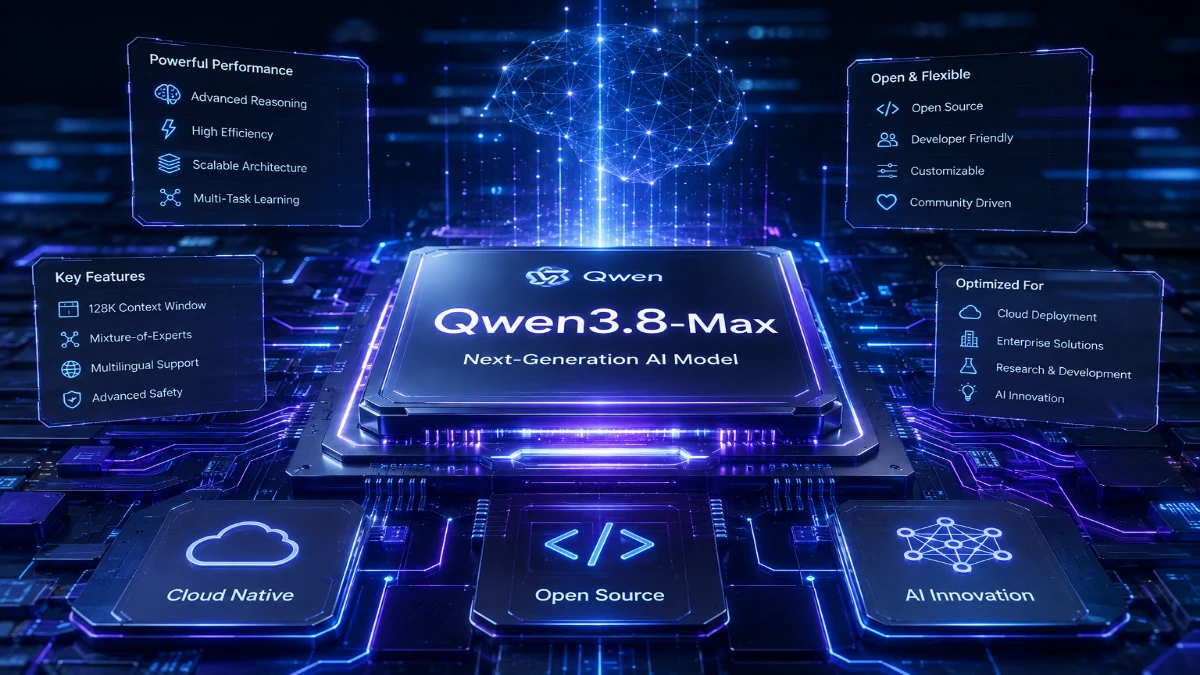
Alibaba’s Qwen team released Qwen3.8-Max today. The headline detail isn’t just the model’s size — it’s openness. In fact, Qwen3.8-Max is the first Qwen-Max-class model the team plans to open-source. The weights land on Hugging Face and ModelScope next week, which gives developers and enterprises direct access to a flagship-tier model, not just an API endpoint.
This matters because Max-tier models have historically stayed closed. Vendors offered access only through hosted APIs. By opening the weights on a model this capable, Qwen changes the calculus for teams that need to run inference on their own infrastructure, fine-tune for a specific domain, or avoid dependency on a single vendor’s pricing and uptime.
Why It Matters
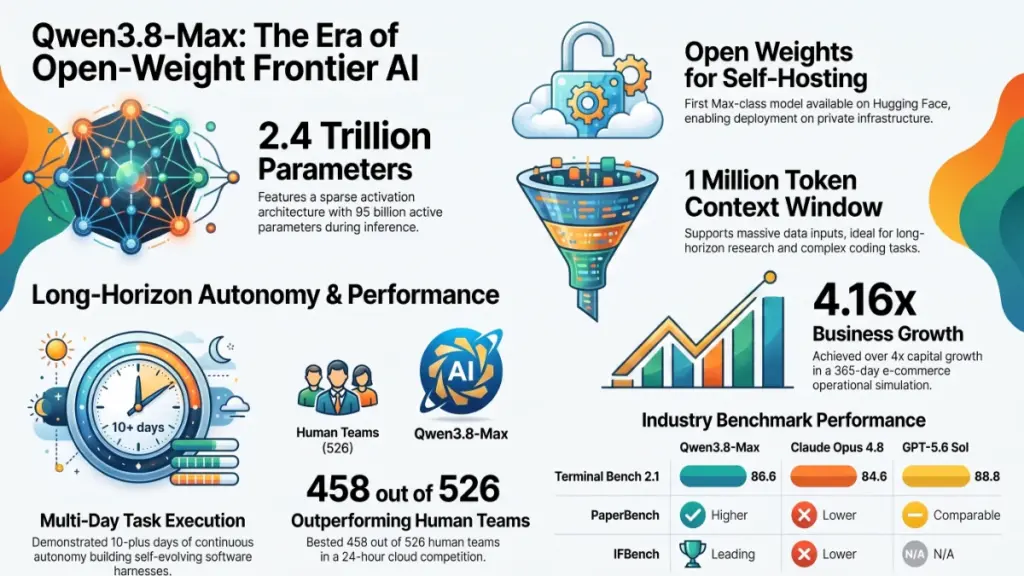
Qwen3.8-Max builds on the Qwen 3.5 architecture and scales to 2.4 trillion total parameters, with 95 billion active at inference time. According to the Qwen team, the release targets four areas: coding, everyday work automation, long-horizon multi-day tasks, and multimodal agent capability.
Throughout the announcement, the emphasis falls on autonomy over long stretches of time, not single-shot question answering. Qwen frames this as a shift: models no longer just follow a fixed plan. Instead, they adapt through feedback loops — revising a coding harness, refining a research method across multiple rounds, or climbing a competition leaderboard through repeated submissions. Independent testing will ultimately determine whether these autonomous-run claims hold up outside curated demonstrations. Even so, the scale of the showcased runs stands out regardless of framing.
Technical Details
- Parameters: 2.4 trillion total, 95 billion active (mixture-of-experts style sparse activation)
- Architecture base: Qwen 3.5
- Context window: Up to 1,000,000 tokens in some integrations (per the Codex configuration example)
- Reasoning control: A
reasoning_effortparameter offers three levels — xhigh (default), medium, and low — so developers can trade off cost, speed, and depth - Thinking preservation:
preserve_thinkingstays enabled by default across workloads - API compatibility: QwenCloud supports OpenAI-compatible chat completions and responses APIs, plus an Anthropic-compatible interface that lets developers drop the model into Claude Code with just an environment variable change
For developers already standardized on Claude Code’s tooling, this Anthropic-API compatibility layer is a practical detail. As a result, it lowers the switching cost for teams that want to test Qwen3.8-Max without rebuilding their harness.
Performance and Evidence
Qwen’s benchmark tables compare Qwen3.8-Max against Claude Opus 4.8, Claude Fable 5, GPT-5.6 Sol, and its own predecessor, Qwen3.7-Max, across dozens of coding, agent, and multimodal benchmarks.
Coding Benchmarks
Overall, results are mixed relative to the top closed models. On Terminal Bench 2.1, Qwen3.8-Max posted an 86.6, ahead of Opus 4.8 and Fable5’s 84.6, though behind GPT-5.6 Sol’s 88.8. By contrast, it scored below both Opus 4.8 and Fable5 on SWE-bench Pro. On PaperBench, however, it posted a notably higher score than Opus 4.8 and came close to GPT-5.6 Sol’s mark, while still trailing Fable5. In short, Qwen3.8-Max closes much of the gap to the leading closed models, and on benchmarks such as PaperBench and IFBench, it even moves ahead of Opus 4.8. That said, GPT-5.6 Sol and Fable5 still lead on a number of coding and reasoning categories.
Long-Horizon Case Studies
Three showcased case studies back the benchmark numbers with narrative detail. First, Qwen3.8-Max ran for 10-plus days, building a self-evolving CLI harness on its own. Next, it spent roughly five days reproducing a published data-selection method for LLM training, then improved on it — reportedly gaining 2.7 points on the AIME24 math benchmark over the original paper’s approach. Finally, it entered a real Alibaba Cloud Tianchi competition under a 24-hour limit and, according to Qwen, outperformed 458 of 526 competing human teams.
Because these are vendor-reported results from Qwen’s own test conditions, the usual caveat applies: independent replication would strengthen the claims considerably. This holds especially true for the research-reproduction case, where “improving on a paper” is a claim that benefits from outside verification.
Long-Horizon Business Simulation
Additionally, the model posted a long-horizon business simulation result, ending a 365-day e-commerce operations benchmark with roughly 4.16x the starting capital — ahead of the reported second-place result from GLM 5.2. Again, this is an internal benchmark administered by Qwen, which is worth keeping in mind when weighing the figure.
Pricing and Availability
Qwen3.8-Max is available now through QwenCloud, accessible via API using OpenAI-compatible or Anthropic-compatible endpoints. However, Qwen did not publish per-token pricing in the announcement itself, so developers should check QwenCloud’s pricing page directly before budgeting production usage. Meanwhile, open weights arrive next week, letting organizations self-host rather than rely solely on the hosted API.
Industry Implications
For developers already using Claude Code, Codex, Qwen Code, Qoder, or OpenClaw, the model is designed to slot into existing tools with minimal reconfiguration — the announcement includes copy-paste setup instructions for each. Consequently, this lowers the barrier to running side-by-side comparisons against incumbent models on real workloads, not just isolated benchmark scores.
Arguably, though, the open-weight release is the bigger structural story. A model at genuine Max-class scale — 2.4 trillion parameters — is now available for self-hosting, which puts pressure on the pricing and openness posture of other frontier labs. This matters most for enterprises in regulated industries, where compliance rules often block sending data to third-party APIs.
Limitations and Open Questions
Every performance figure in this release comes from Qwen’s own testing infrastructure and benchmark selection. Notably, the benchmark tables acknowledge that some comparison scores come from other vendors’ official system cards or leaderboards, not from identical test conditions, and several fields remain marked as unavailable. This is a reasonable practice, but it means direct model-to-model comparisons should be read as approximate, not exact.
Similarly, the showcased long-horizon runs — the 10-day coding project, the five-day research loop, the chip-design optimization — offer compelling demonstrations, yet they remain handpicked examples rather than a random sample of task outcomes. Real-world production workloads bring messier requirements and less controlled environments, so they may not replicate the same trajectory.
Future Outlook
The most concrete near-term milestone is the open-weight release next week, which lets the broader community independently verify performance instead of relying on Qwen’s self-reported figures. Afterward, expect third-party benchmark reruns, community fine-tunes, and adoption reports from teams testing it against Claude, GPT, and Gemini-class models on their own workloads.
Conclusion
Qwen3.8-Max lands as a serious contender on paper, and its open-weight release stands out from most Max-tier model launches. On the benchmark tables, it narrows — and in some categories surpasses — the gap to Claude Opus 4.8, though it still trails Claude Fable 5 and GPT-5.6 Sol on a number of coding and reasoning tasks. Ultimately, the real test comes once the open weights ship next week: whether the long-horizon autonomy claims hold up under independent, real-world testing.