


Claude Opus 5 is now available in GitHub Copilot, bringing stronger agentic coding capabilities for complex, multi-step development tasks. It focuses on efficient tool use, autonomous code changes, regression verification, and improved reasoning. Available first to Copilot Pro+, Business, and Enterprise users, the rollout is gradual, with usage-based pricing and enhanced security safeguards for potentially harmful coding requests.
Anthropic just brought its newest flagship model, Claude Opus 5, into GitHub Copilot. The model targets complex, long-running coding tasks. It handles careful reasoning, coordinated tool use, and reliable execution across many steps. That goes well beyond simple, single-shot code completions.
This matters for teams already running Copilot daily. Model choice now shapes how much work you can safely hand to an agent. It also shapes how much still needs a human checking the output. A model that plans, verifies, and corrects its own work changes that math.
Why it matters
Most coding assistants get judged on autocomplete quality or quick answers. Agentic coding tests something different. Can the model hold a multi-step task in mind? Can it make a change, confirm nothing broke, and adjust course without constant hand-holding?
GitHub’s release notes point to strong early results here. The company says Opus 5 performed well on agentic workflows in its testing. That includes autonomous code changes, regression verification, and tasks that require coordinating multiple tools in sequence. GitHub also flagged efficiency: the model favored targeted edits over sprawling ones and cut down on unnecessary execution overhead.
That efficiency point deserves attention. Agentic models that call tools excessively, or that re-verify work over and over, burn through usage-based billing fast. If Opus 5 truly economizes on tool calls while staying accurate, teams running it at scale save both time and money. Still, treat vendor benchmarks with some caution. Independent testing under real production workloads will tell the fuller story.
Technical and safety details
GitHub’s changelog skips parameter counts and context window figures for this release. That’s typical for how Anthropic and its distribution partners disclose Opus-tier models. One detail GitHub does specify: Opus 5 ships with enhanced safeguards around high-harm cyber content. These safeguards may block some security-adjacent requests. Developers doing legitimate security research should expect occasional friction here. GitHub’s workaround: add benign context and rephrase the request, or switch to a different model in the picker.
This fits a broader industry pattern. As coding agents grow more capable at autonomous execution, providers keep tightening the line between “helpful with security code” and “capable of generating exploit-ready material.” It’s a reasonable trade-off overall. It could still slow down defensive security teams whose normal Copilot usage resembles an attacker’s on the surface.
Availability and access
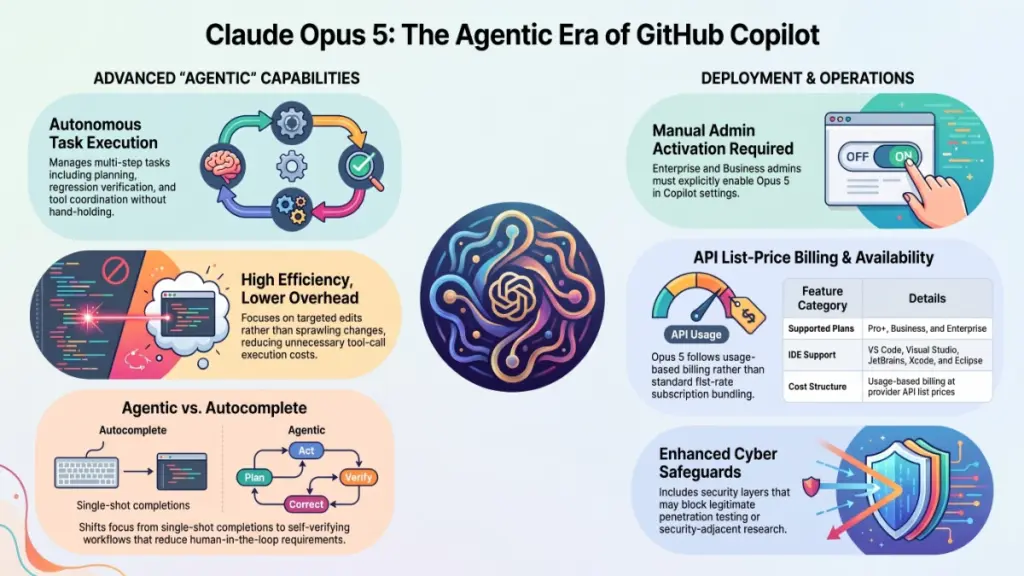
Copilot Pro+, Business, and Enterprise plans get access to Claude Opus 5 first. You can select it in Visual Studio Code, Visual Studio, the Copilot CLI, the GitHub Copilot cloud agent, the Copilot app, github.com, GitHub Mobile, JetBrains, Xcode, and Eclipse. GitHub is rolling the model out gradually, so not every account will see it right away.
Enterprise and Business admins need an extra step. They must enable the Opus 5 policy in Copilot settings before it shows up for their users. Teams planning to standardize on this model should flag that requirement to their admins now.
Pricing follows provider API list price under Copilot’s usage-based billing. That means it isn’t bundled into a flat rate the way lower-tier models often are. Teams running heavy, multi-step agentic work should estimate expected usage before rolling this out broadly. List-price billing on a high-capability model can add up faster than a per-seat subscription would suggest.
Where this fits in the broader field
Opus 5 now competes directly with other frontier coding models already sitting in the same Copilot picker, including recent releases from Google and xAI. GitHub keeps expanding that picker instead of betting on one provider. That choice reflects the current market: no single lab holds a durable lead on agentic coding benchmarks, and developer preference still shifts by task type and codebase.
Independent, task-specific benchmarking remains the more trustworthy signal here. GitHub’s own summary is, after all, a vendor announcement about its own product integration. Developers evaluating Opus 5 for real work should watch for third-party agentic coding benchmarks and community reports over the coming weeks. Pay particular attention to regression-verification accuracy and tool-call efficiency on large, messy codebases, not just curated demo repositories.
What to watch next
The rollout is still gradual. Broader access, and a fuller picture of real-world performance, will take shape over the next several weeks. Watch how Opus 5 performs on long-horizon tasks outside curated benchmarks. Watch how often the cyber-content safeguards trigger false positives for legitimate security work. And compare usage-based billing costs against Copilot’s flat-rate tiers once teams start running the model on production-scale codebases.