


Moonshot AI has unveiled Kimi K3 with strong official benchmark results across coding, reasoning, and agentic tasks. Independent evaluators largely confirm its performance, including a #1 ranking on LMArena’s Frontend Code Arena. However, K3 remains unranked by BenchLM due to methodology differences and unavailable open weights. Developers should view it as a promising model while waiting for the July 27 open-weight release.
Moonshot AI has published the official launch benchmarks for its new large language model, Kimi K3, confirming performance figures across coding, reasoning, agentic tasks, and vision. The release, dated July 16, 2026, arrives alongside the first wave of independent verification from LMArena, Artificial Analysis, and Vals — yet third-party trackers like BenchLM are still declining to give K3 a formal composite ranking. For anyone building AI-driven workflows or evaluating which model to run in production, that gap between “officially published” and “independently ranked” is the story worth understanding.
What Happened
Kimi K3 moved from rumor to documented product this week. Moonshot’s launch page lists model ID kimi-k3, a 1-million-token context window, native visual input support, and reasoning that currently operates at maximum effort by default.
Pricing lands at:
- $3.00 per million input tokens (cache-miss)
- $0.30 per million cached input tokens
- $15.00 per million output tokens
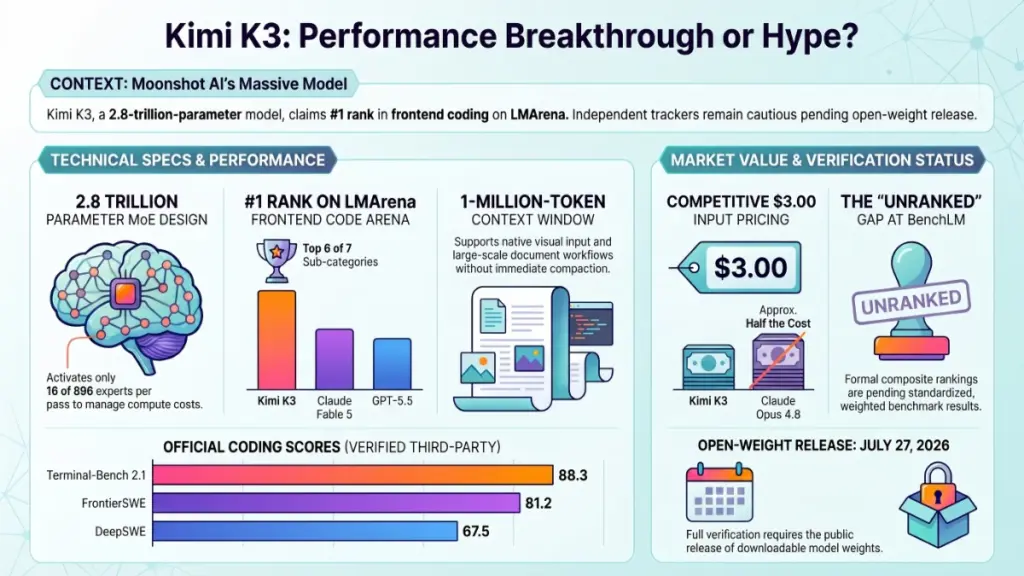
The architecture itself is notable on paper. Moonshot describes K3 as a 2.8-trillion-parameter Mixture-of-Experts system that activates just 16 of 896 experts per inference pass — a design aimed at keeping compute costs manageable despite the model’s overall size.
Arena Signals Before the Official Reveal
Before Moonshot’s own documentation went live, evidence of K3’s capabilities was already leaking through blind testing platforms. Independent tracker TestingCatalog identified a stealth entry on LMArena, nicknamed “Kivine,” whose output patterns matched what would become the K3 checkpoint.
In one head-to-head coding battle, the stealth model built an elaborate universe-simulation interface — complete with a first-person camera spin when a planet was selected — while Claude Fable 5 delivered a faster, more structurally solid result. It was a single anecdotal matchup, not a scored benchmark, but it hinted at K3’s apparent bias toward visual ambition over raw execution speed.
A separately circulated image, shared through a WeChat post, previewed six coding scores that Moonshot’s official table later confirmed exactly:
- 67.5 on DeepSWE
- 81.2 on FrontierSWE
- 72.9 on Kimi Code Bench 2.0 (internal)
- 88.3 on Terminal-Bench 2.1
- 77.8 on Program Bench
- 42.0 on SWE Marathon
K3 Takes the Top Spot on LMArena’s Code Board
Once LMArena formally unblinded the model, speculation turned into a measurable result. K3 jumped 17 spots from its predecessor’s #18 position to claim #1 on LMArena’s Frontend Code Arena, edging out Claude Fable 5 and topping six of seven frontend sub-categories. It placed second only in the Gaming category.
On the numbers:
- 1679 Elo on the Frontend Code Arena (1,757 votes)
- 1486 Elo on the general text leaderboard (3,026 votes)
- 1530 in coding-specific prompts
- 1506 on hard prompts
Worth flagging for readers who lean on leaderboard rankings when picking tools: these are live preference boards with relatively young vote samples. The margin of error still runs around ±11 points on the text leaderboard and ±17 points on the code board — wide enough that today’s #1 spot isn’t necessarily locked in.
Independent Benchmarking Firms Weigh In
Artificial Analysis ran its own evaluation suite and published results that place K3’s general capability roughly on par with Claude Opus 4.8 and GPT-5.5 — trailing Claude Fable 5 and GPT-5.6 Sol at the very top of the field.
Its scorecard:
- 57.11 — Intelligence Index
- 76.24 — Coding Index
- 50.07 — Agentic Index
- 62 output tokens per second
- 1.99 seconds to first token
- ~$0.94 estimated cost per completed task
That cost figure is significant for teams doing ROI math on AI tooling: it’s close to GPT-5.6 Sol’s pricing and roughly half of Claude Opus 4.8’s, though still notably higher than open-weight alternatives.
Vals AI published a separate, independently owned composite putting K3 at 74.7 on its Vals Index v1.2, with a 80.9 on its hosted Terminal-Bench 2.1 variant, 71.6 on CorpFin v2, and 48.9 on MedCode.
Why It Matters for Developers, Marketers, and AI-Curious Teams
For developers and technical teams: K3’s frontend-coding dominance on LMArena signals a genuine strength in generating complex, visually rich UI code — useful if your workflow leans on AI for rapid prototyping or interface generation. But the coding benchmarks that matter for production-grade software (like weighted SWE-bench Pro results) aren’t part of this release yet, so treat K3 as promising rather than proven for serious engineering work.
For digital marketers and automation specialists: the $3/$0.30/$15 per-million-token pricing structure, paired with a 1M-token context window, makes K3 a candidate for long-document workflows — think large content audits, multi-file campaign briefs, or bulk SEO analysis — provided your provider setup supports the full context without triggering compaction.
For anyone comparison-shopping AI models: the gap between “official launch numbers” and “independently ranked results” is exactly the kind of nuance that gets lost in hype cycles. K3’s own reported figures are internally consistent with what outside evaluators found, which is a good transparency signal — but a model isn’t fully vetted until its weights are public and third parties can run their own head-to-head tests.
Why K3 Still Isn’t Formally Ranked
Independent benchmark aggregator BenchLM is keeping K3 out of its weighted composite rankings for now, and the reasoning is instructive for anyone evaluating AI tools on trust and methodology.
The core issue is coverage mismatch. K3’s coding results — DeepSWE, FrontierSWE, Program Bench, Terminal-Bench 2.1 — are harness-specific scores rather than the standardized, weighted benchmarks (like SWE-bench Pro or LiveCodeBench) that BenchLM uses for cross-model comparison. Vals AI’s 74.7 composite score is respectable, but it blends private and hosted task sets that aren’t directly comparable to other models’ published numbers.
There’s also a methodology wrinkle in the flagship BrowseComp result. Moonshot reports 91.2% accuracy, but only when context compaction is triggered at the 300K-token mark. Run the same test across the full 1M-token window without that compaction step, and the score drops slightly to 90.4%. Neither number is wrong — they’re just testing different conditions, and conflating them would overstate the model’s real-world consistency.
The Open-Weight Question Remains Unresolved
Moonshot is marketing K3 as an open model, but the actual downloadable weights aren’t available yet — Moonshot has committed to a July 27, 2026 release date. Until those files are public, K3 stays outside the “open-weight” category for practical purposes, no matter how the marketing frames it.
A promised release date is not the same as a working download link, and reviewers should hold off on open-source comparisons until the weights actually land.
The Bottom Line
Kimi K3 enters the market with a genuinely strong showing: a #1 frontend-coding leaderboard spot, competitive intelligence and agentic scores from Artificial Analysis, and pricing that’s aggressive relative to comparable frontier models. Social media reaction has already leapt to conclusions — some commentators are framing K3 as an “Opus-killer” that will force a new wave of even larger frontier models.
That’s speculation, not data. What the verified record actually supports is narrower but still meaningful: K3 is a serious new entrant in the large language model race, with credible independent validation on several fronts and legitimate open questions on others — namely weighted coding performance and the still-pending open-weight release.
For teams deciding whether to integrate K3 into their AI automation stack, the sensible move is to wait for the July 27 weight drop and any follow-up technical report before treating today’s numbers as the final word.